
August 14, 2026
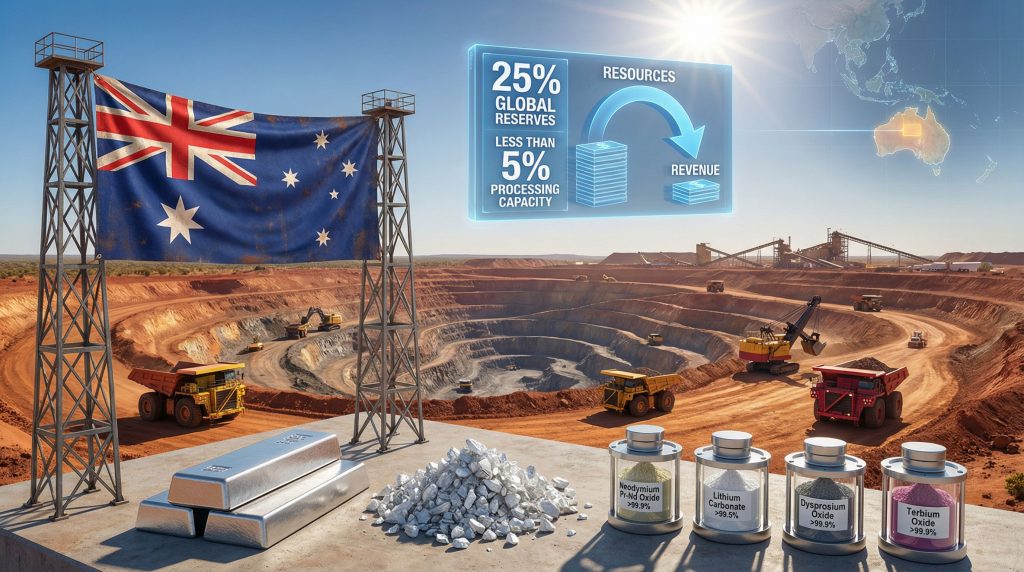
Australia's position in the global rare earth industry presents a compelling paradox of resource abundance coupled with strategic underutilisation. Despite controlling substantial mineral reserves that could power decades of technological advancement, the continent finds itself watching competitors capture the value-added processing opportunities that transform raw materials into economic powerhouses. Furthermore, Australia rare earth industry challenges extend beyond simple market dynamics into the realm of institutional capacity, requiring comprehensive analysis of the structural barriers preventing domestic processing development.
This paradox extends beyond simple market dynamics into the realm of institutional capacity, long-term strategic vision, and the complex interplay between political cycles and industrial development timelines. Understanding why Australia struggles to translate geological advantages into processing leadership reveals broader lessons about modern resource economics and the structural requirements for sustained competitive advantage in the critical minerals energy transition ecosystem.
The Critical Minerals Paradox: Resource Abundance vs Strategic Execution
Australia's position in the global rare earth landscape presents one of the most compelling examples of untapped strategic potential in modern industrial history. With approximately 22-26% of the world's identified rare earth oxide reserves according to the U.S. Geological Survey's 2024 assessments, the nation possesses geological endowments that should theoretically position it as a dominant force in critical minerals markets.
Yet this resource wealth translates into minimal processing capacity. While China controls an estimated 85-90% of global rare earth separation and purification operations, Australia's domestic processing infrastructure remains largely undeveloped. The Lynas Rare Earths Kalgoorlie facility represents one of the few exceptions, though full operational capacity has faced extended commissioning timelines and infrastructure coordination challenges.
Australia's Mineral Endowment vs Global Market Position
The statistical comparison between reserve holdings and market position illustrates the magnitude of Australia's strategic challenge. China, holding approximately 26% of global rare earth reserves according to recent USGS data, has systematically developed processing capabilities that far exceed its domestic resource requirements. This processing-to-reserves ratio demonstrates how sustained industrial policy can transform moderate resource endowments into global market dominance.
Australia's challenge extends beyond simple capacity metrics to encompass the entire value chain from extraction through final product manufacturing. The nation excels at large-scale mining operations but lacks the downstream infrastructure necessary to capture premium pricing available in processed rare earth products. This gap becomes particularly problematic given that processed rare earth oxides command prices 300-500% higher than unprocessed concentrates.
The competitive landscape has shifted dramatically since the early 2000s when Australia possessed genuine first-mover advantages in rare earth development. Jake Klein, founder of Evolution Mining and former Lynas board member, emphasised during a December 2024 address to the Melbourne Mining Club that institutional failures rather than geological constraints prevented Australia from capitalising on these advantages.
The Infrastructure Investment Gap Analysis
Infrastructure reliability represents a fundamental constraint on Australia's rare earth processing ambitions. Power grid stability, transportation networks, and processing facility availability create cascading limitations that affect project economics and investor confidence. Consequently, these infrastructure deficits compound over time, creating self-reinforcing cycles where insufficient capacity prevents project development.
Critical Infrastructure Assessment by Region:
| State | Power Infrastructure Status | Processing Facilities | Workforce Development |
|---|---|---|---|
| Western Australia | Improved grid stability post-2022 reforms | Limited operational capacity | 3,500+ specialised positions needed |
| South Australia | Variable reliability with 2024 improvements | Minimal processing infrastructure | 1,200+ technical roles required |
| Queensland | Enhanced grid performance | No large-scale REE facilities | 2,800+ skilled positions gap |
These infrastructure deficits compound over time, creating self-reinforcing cycles where insufficient capacity prevents project development, which in turn reduces incentives for infrastructure investment. Klein specifically referenced power failures at processing facilities as emblematic of persistent infrastructure inadequacy despite years of project planning and capital allocation.
The infrastructure gap extends beyond immediate operational requirements to encompass long-term strategic capacity. Modern rare earth processing facilities require sustained power availability, specialised waste management systems for radioactive byproducts, and transportation networks capable of handling both raw materials and finished products. Australia's current infrastructure development timelines often extend 5-7 years for major projects, creating additional barriers to rapid capacity deployment.
When big ASX news breaks, our subscribers know first
What Systemic Barriers Prevent Australia from Capturing Value-Add Processing?
The structural impediments preventing Australia from developing domestic rare earth processing capabilities operate across multiple institutional layers, from regulatory frameworks to capital market dynamics. These barriers create compounding effects that extend project timelines, increase costs, and ultimately drive investment toward more accommodating jurisdictions, highlighting critical aspects of Australia rare earth industry challenges.
Regulatory Framework Complexity and Timeline Challenges
Australia's multi-jurisdictional approval processes reflect the federal system's division of responsibilities between Commonwealth and state governments, creating coordination challenges that extend project development timelines significantly. Environmental impact assessments for rare earth processing facilities must address both conventional mining impacts and the specialised requirements for managing radioactive byproducts including thorium and uranium.
The regulatory framework involves multiple agencies operating under different statutory authorities:
• Federal oversight: Australian Radiation Protection and Nuclear Safety Agency (ARPANSA) for radioactive materials management
• State mining authorities: Individual state departments governing extraction permits and processing facility approvals
• Environmental agencies: Commonwealth and state environmental departments coordinating impact assessments
• Indigenous consultation: Native Title Act 1993 requirements for community engagement and benefit-sharing agreements
Each regulatory pathway operates on different timelines with varying technical requirements. Indigenous Land Use Agreements typically require 6-12 months minimum negotiation periods, while environmental impact assessments for radioactive waste management can extend 18-24 months depending on project complexity and community engagement requirements.
Klein's critique of Australia's three-year electoral cycle highlights how political timelines misalign with industrial development requirements. Rare earth processing facilities require 10-15 year development horizons from initial planning through full operational capacity, spanning multiple electoral cycles and creating policy discontinuity risks that deter long-term investment.
Capital Market Limitations for Long-Term Industrial Development
Australia's capital markets demonstrate structural preferences for shorter-term returns that conflict with rare earth processing investment requirements. The sector demands sustained capital allocation over extended development periods, with significant upfront infrastructure costs before revenue generation begins. However, this critical minerals strategy requires patient capital that Australian markets struggle to provide consistently.
Risk premium analysis suggests Australian rare earth projects face financing costs 15-20% higher than comparable projects in Southeast Asian jurisdictions. This premium reflects several factors:
• Regulatory complexity: Extended approval timelines increase carrying costs and project risk assessments
• Infrastructure uncertainty: Limited processing infrastructure precedents create technology deployment risks
• Political discontinuity: Electoral cycle changes can affect project support and regulatory stability
• Skills availability: Limited domestic expertise in rare earth processing increases operational risk premiums
The contrast with Malaysia's approach illustrates how coordinated policy frameworks can overcome capital market limitations. Malaysia's 10-year tax holiday for Lynas operations, combined with direct infrastructure provision including natural gas supply and port facilities, created investment conditions that Australian markets could not match through private sector mechanisms alone.
Klein noted that in the early 2000s, despite Lynas founder Nic Curtis recognising rare earths as strategically significant, Australia's capital markets failed to provide adequate support for domestic processing development. This forced offshore processing facility location decisions that continue to affect Australia's strategic position decades later.
"The fundamental challenge lies not in geological resources but in institutional capacity for sustained industrial policy implementation across multiple political cycles."
How Do Geopolitical Dependencies Shape Australia's Strategic Vulnerabilities?
Australia's rare earth industry challenges extend far beyond domestic policy considerations into complex geopolitical dynamics that shape global supply chain security and strategic resource access. The concentration of processing capacity in China creates dependencies that affect pricing, supply reliability, and technology transfer opportunities across the entire rare earth ecosystem. Additionally, these geopolitical considerations significantly impact Australia's resource exports challenges in the current global landscape.
China's Processing Monopoly and Market Control Mechanisms
China's dominance in rare earth processing represents one of the most concentrated industrial capabilities in modern global trade. According to U.S. Geological Survey data, China controls approximately 85-90% of global rare earth separation and purification capacity while holding roughly 26% of identified global reserves. This asymmetry between resource endowment and processing control demonstrates the strategic value of sustained industrial policy implementation.
China's market control operates through several mechanisms:
• Processing capacity concentration: Integrated facilities spanning extraction through final product manufacturing
• Technology integration: Accumulated intellectual property in separation and purification techniques developed over 30+ years
• Supply chain coordination: State-directed allocation of processing capacity and export timing
• Strategic reserve management: Government stockpiling policies that influence global price dynamics
The historical precedent of China's export quota system from 2010-2015 illustrates how processing monopolies can affect global markets. During this period, export restrictions reduced global rare earth availability and drove prices significantly higher, demonstrating the strategic leverage that processing capacity concentration provides.
China's 2020 strategic reserve accumulation policies further concentrated supply control, with state-directed purchasing affecting global pricing and availability. These policies operate independently of market demand fluctuations, creating additional uncertainty for countries dependent on Chinese processing capacity.
Alternative Partnership Models and Diversification Strategies
Recognition of supply chain concentration risks has driven multiple initiatives to develop alternative processing capabilities and strategic partnerships. For instance, the U.S.-Australia Critical Minerals Partnership represents one approach to reducing dependence on Chinese processing capacity through coordinated investment and technology sharing.
Key Partnership Initiatives:
• U.S.-Australia Framework: $2.4 billion investment commitment for critical minerals development and processing capacity
• Japan-Australia Cooperation: Technology partnerships focused on rare earth processing diversification
• European Union Alignment: Critical Raw Materials Alliance participation supporting supply chain resilience
• Regional Processing Hubs: Collaborative development of Southeast Asian processing alternatives
However, the scale of investment required to meaningfully reduce Chinese processing dependence far exceeds current partnership commitments. Industry estimates suggest $15-20 billion in coordinated investment would be necessary to establish alternative processing capacity equivalent to 25-30% of Chinese capabilities.
Malaysia's success in attracting Lynas processing operations provides a model for how coordinated government support can develop alternative processing hubs. The combination of tax incentives, infrastructure provision, and regulatory streamlining created investment conditions that attracted processing capacity away from traditional locations, supporting the development of a raw materials facility outside China's direct control.
Klein's assessment that many partnership announcements represent "good political soundbites" rather than comprehensive industrial development plans reflects scepticism about whether current initiatives match the scale of strategic challenge. Building alternative rare earth processing capacity requires sustained commitment and technical capability development that extends beyond initial investment announcements.
Which Technical Challenges Create the Highest Barriers to Entry?
The technical complexity of rare earth processing creates substantial barriers to entry that extend far beyond conventional mining operations. These challenges span specialised metallurgy, environmental management, quality control systems, and workforce development requirements that few countries have successfully integrated into operational facilities.
Processing Technology Complexity and IP Constraints
Rare earth processing involves sophisticated chemical separation techniques that require precise control of multiple variables throughout the extraction and purification process. The technical challenges include:
Separation Technology Requirements:
• Solvent extraction: Multi-stage chemical separation using specialised organic compounds
• Ion exchange processes: Selective separation of individual rare earth elements based on ionic properties
• Precipitation control: Precise chemical precipitation techniques for different rare earth compounds
• Purification systems: Advanced purification methods achieving 99.9%+ purity for high-tech applications
The intellectual property associated with these processes has accumulated primarily in Chinese facilities over decades of operational experience. This creates technology transfer restrictions that limit access to proven processing techniques and quality control systems, contributing to broader mining industry evolution patterns worldwide.
Environmental management of radioactive byproducts presents additional technical complexity. Rare earth processing generates thorium and uranium waste streams requiring:
• Radioactive waste licencing: Regulatory compliance for long-term storage and disposal
• Containment systems: Engineering solutions for radioactive material isolation
• Monitoring protocols: Continuous environmental monitoring and reporting systems
• Emergency response: Specialised procedures for radioactive material incidents
Workforce Development and Knowledge Transfer Gaps
Australia faces significant skills shortages across all levels of rare earth processing operations. The specialised nature of the technology requires workforce capabilities that extend beyond conventional mining and metallurgy into advanced chemical engineering and radiological safety.
Critical Skills Requirements by Processing Stage:
| Processing Stage | Technical Expertise | Training Timeline | Current Availability |
|---|---|---|---|
| Extraction Operations | Mining engineers with REE specialisation | 4-6 years development | Limited domestic capacity |
| Chemical Separation | Chemical engineers, process control specialists | 6-8 years expertise building | Significant shortage |
| Purification Systems | Metallurgists, quality control technicians | 5-7 years competency | Minimal existing expertise |
| Environmental Management | Radiological safety, waste management | 3-5 years certification | Regulatory expertise gap |
The workforce development challenge extends beyond individual technical roles to encompass integrated team capabilities. Successful rare earth processing requires coordination between multiple specialisations operating within tight quality and safety parameters.
University research capacity in rare earth metallurgy remains limited across Australian institutions. Unlike countries with established processing industries, Australia lacks the academic infrastructure necessary to train specialists and conduct applied research in rare earth processing technologies.
International talent acquisition faces additional constraints from security clearance requirements for strategic materials and competition with established processing centres offering more comprehensive career development opportunities.
Klein's observation that "all the core intellectual property sits offshore" reflects how the combination of technology transfer restrictions and limited domestic expertise development has created compounding barriers to processing capability development.
What Economic Models Could Unlock Australia's Rare Earth Potential?
Developing economically viable rare earth processing capacity in Australia requires careful analysis of investment models, government support mechanisms, and long-term returns across different strategic approaches. The economic framework must address both immediate project viability and sustained competitive advantage in global markets. Consequently, understanding these economic models becomes essential for addressing Australia rare earth industry challenges effectively.
Integrated Supply Chain Development Scenarios
Australia faces fundamental decisions about how to structure domestic rare earth development, with different approaches offering varying risk-return profiles and strategic outcomes. The primary models under consideration include:
Export-Focused Strategy:
• Maintain current approach emphasising raw material exports
• Limited domestic processing investment requirements
• Continued dependency on offshore processing capacity
• Lower capital requirements but minimal value capture
Partial Integration Model:
• Develop intermediate processing capabilities for rare earth concentrates
• Target specific high-value applications requiring specialised processing
• Selective government co-investment in strategic processing facilities
• Moderate capital requirements with targeted value capture
Full Integration Strategy:
• Complete domestic supply chain from extraction through final products
• Comprehensive processing capability across all rare earth elements
• Maximum government support and strategic coordination
• Highest capital requirements but maximum strategic autonomy
Economic modelling suggests that full integration would require $15-20 billion in coordinated investment over 10-15 years. However, the returns on this investment depend heavily on sustained government policy support and successful competition with established processing centres. Moreover, Australia's rare earth miners are working to challenge China's dominance through innovative approaches and strategic partnerships.
Innovation Hub Development and R&D Investment Strategies
Creating sustainable competitive advantages in rare earth processing requires more than facility construction; it demands ongoing innovation capabilities that can adapt to changing technology requirements and market demands.
Research and Development Priority Areas:
• Clean processing technology: Reduced environmental impact separation techniques
• Automation systems: Advanced process control reducing labour requirements
• Recycling technology: Urban mining and rare earth recovery from electronic waste
• Application development: New uses for rare earth elements in emerging technologies
University-industry partnership models offer pathways for developing domestic expertise while sharing development costs and risks. Successful examples from other countries demonstrate how sustained research funding can create technological capabilities that support long-term competitive advantage.
The innovation hub approach would concentrate resources in specific geographic areas with existing infrastructure and research capabilities. Western Australia, South Australia, and Queensland each offer different advantages for hub development based on existing mining clusters and university research capacity.
Tax incentive frameworks similar to those offered by Malaysia and Vietnam could accelerate private sector investment in research and development. These frameworks require careful design to ensure genuine capability development rather than simple cost reduction for established operations.
How Can Australia Navigate Environmental and Social Licence Challenges?
Environmental management and community acceptance represent critical success factors for Australia's rare earth industry development. The sector's unique challenges around radioactive waste management and long-term environmental stewardship require specialised approaches that build sustained community support.
Radioactive Waste Management and Community Acceptance
Rare earth processing generates thorium and uranium byproducts that require long-term management strategies extending decades beyond facility operational life. This creates environmental stewardship responsibilities that few other mining sectors face, requiring specialised technical solutions and community engagement approaches.
Best Practice Framework Elements:
• Transparent monitoring: Real-time environmental data sharing with communities and regulators
• Independent oversight: Third-party monitoring and reporting systems
• Long-term funding: Dedicated financial provisions for post-closure waste management
• Technology demonstration: Proven waste treatment and disposal technologies
• Community benefits: Tangible local economic development and employment opportunities
The Lynas Corporation experience in Malaysia provides important lessons for domestic development. Community concerns about radioactive waste management led to extended regulatory processes and ongoing monitoring requirements that Australian projects must anticipate and address proactively. Furthermore, CSIRO's critical minerals research demonstrates potential pathways for overcoming these technical challenges.
Community consultation models that build social licence require early engagement, sustained communication, and meaningful benefit-sharing arrangements. Indigenous communities hold significant interests in many areas with rare earth potential, making Indigenous engagement protocols central to project success.
Sustainable Processing Technologies and Carbon Footprint Reduction
Environmental performance increasingly affects market access and investor interest, making clean processing technology development a competitive advantage rather than simply a regulatory requirement.
Clean Technology Integration Opportunities:
• Renewable energy: Solar and wind power for processing facilities
• Water recycling: Closed-loop water systems minimising environmental impact
• Waste minimisation: Advanced processing techniques reducing byproduct generation
• Carbon capture: Integration with carbon reduction technologies
The processing facilities' energy intensity makes renewable energy integration economically attractive in regions with high-quality solar and wind resources. Australia's renewable energy potential could provide cost advantages for energy-intensive rare earth processing operations.
Circular economy principles offer additional opportunities for sustainable processing development. Recovery and recycling of rare earth elements from electronic waste and industrial byproducts can supplement primary processing operations while reducing environmental impact.
International sustainability standards increasingly influence rare earth market access, particularly for electric vehicle and renewable energy applications where environmental credentials affect product marketability.
The next major ASX story will hit our subscribers first
What Strategic Reforms Could Transform Australia's Competitive Position?
Transforming Australia's rare earth industry challenges requires comprehensive policy reforms that address regulatory processes, investment frameworks, and long-term strategic coordination. The scale of change needed extends beyond incremental improvements to encompass fundamental restructuring of how Australia approaches strategic mineral development.
Policy Framework Modernisation Requirements
Current regulatory frameworks developed for conventional mining operations require substantial adaptation for rare earth processing facilities. The unique technical and environmental requirements of the sector demand specialised regulatory pathways that balance thorough oversight with development timeline efficiency.
Priority Reform Areas:
• Streamlined approvals: Integrated assessment processes reducing multi-jurisdictional delays
• Technical expertise: Specialised regulatory capability for rare earth processing oversight
• Fast-track provisions: Expedited processes for strategic mineral projects meeting defined criteria
• Regulatory certainty: Clear timelines and requirements providing investment predictability
Strategic investment facilitation requires coordination between Commonwealth and state governments to provide coherent policy support across electoral cycles. The institutional mechanisms for sustained strategic coordination remain underdeveloped compared to countries with successful rare earth processing industries.
Skills migration pathways for specialised technical roles could accelerate capability development while domestic training programmes develop local expertise. This requires immigration policy coordination with industry development priorities and recognition of rare earth processing as strategically significant.
Long-Term Vision Implementation and Multi-Decade Planning
Klein's emphasis on "multi-decade thinking" reflects recognition that successful rare earth industry development requires planning horizons that extend far beyond conventional political and business cycles. This creates institutional design challenges for sustaining policy support and investment commitment across changing governments and market conditions.
Implementation Timeline Framework:
Phase 1 (2025-2030): Foundation Development
• Infrastructure investment: $5-8 billion in power, transport, and processing facilities
• Skills development: University programme expansion and international expertise recruitment
• Regulatory reform: Streamlined approval processes and specialised oversight capability
Phase 2 (2030-2035): Capacity Scale-Up
• Processing facility expansion: $8-12 billion in integrated separation and purification capacity
• Technology development: Domestic innovation capability and intellectual property accumulation
• Market integration: Established customer relationships and supply chain partnerships
Phase 3 (2035-2040): Strategic Integration
• Advanced manufacturing: $5-10 billion in rare earth product manufacturing facilities
• Global competitiveness: Cost and technology leadership in specific rare earth applications
• Strategic autonomy: Reduced dependence on foreign processing capacity
Cross-party political consensus building mechanisms could provide policy continuity across electoral cycles. This might include bipartisan strategic committees, legislative frameworks requiring multi-party approval for policy changes, and independent oversight bodies with extended terms.
Industry-government partnership models for sustained investment require risk-sharing arrangements that align public and private sector interests over extended development periods. International examples demonstrate various approaches to coordinating strategic mineral development across public and private sectors.
Transforming Resource Advantage into Strategic Capability
Australia's rare earth industry challenges reflect broader questions about how resource-rich nations can capture value from their geological endowments in an increasingly complex global economy. The technical, economic, and political barriers preventing Australia from developing domestic processing capabilities illustrate the gap between resource ownership and strategic advantage.
Critical Success Factors for Industry Development
Successfully transforming Australia's rare earth potential requires coordination across multiple dimensions of policy and industry development. The interconnected nature of the challenges means that partial solutions are unlikely to achieve meaningful results without comprehensive strategic coordination.
Essential Integration Requirements:
• Policy alignment: Coordinated Commonwealth and state government support spanning electoral cycles
• Infrastructure investment: Sustained commitment to power, transport, and processing facility development
• Capability development: University research capacity and specialised workforce training programmes
• International partnerships: Strategic alliances providing technology access and market development support
• Environmental management: Proven solutions for radioactive waste management building community acceptance
The success factors require simultaneous progress rather than sequential development. Infrastructure without workforce capability, or policy support without technical expertise, will not generate the integrated capabilities necessary for global competitiveness.
Long-term commitment beyond electoral cycles emerges as perhaps the most critical requirement. Klein's observation that "China's multi-decade strategy has yielded global dominance" while Australia operates on three-year political cycles identifies a fundamental structural challenge that must be addressed through institutional design rather than political promises.
Timeline and Investment Requirements for Transformation
The investment requirements for meaningful rare earth processing capability development in Australia exceed the scale of typical mining projects and approach the magnitude of major infrastructure programmes. This creates financing challenges that require innovative approaches to risk-sharing between public and private sectors.
Investment Scale Analysis:
• Total requirement: $18-30 billion over 15-20 years for comprehensive processing capability
• Government co-investment: $8-12 billion in infrastructure and strategic facility development
• Private investment: $10-18 billion in processing facilities and technology development
• Research and development: $2-4 billion in university partnerships and innovation capability
The timeline for achieving meaningful results extends well beyond typical project development cycles. International experience suggests 10-15 years minimum for establishing significant processing capability, with full competitive integration requiring 20+ years of sustained development.
However, the strategic benefits of successful development extend far beyond direct economic returns from rare earth processing. Domestic processing capability provides supply chain security, technology development opportunities, and strategic autonomy that become increasingly valuable as global competition for critical minerals intensifies.
Australia's rare earth industry challenges ultimately represent choices about national industrial strategy and long-term competitiveness. The geological advantages provide opportunities, but capturing those opportunities requires institutional capabilities, strategic coordination, and sustained commitment that few countries have successfully implemented.
The experience of watching processing capabilities migrate offshore despite possessing world-class resources offers sobering lessons about the relationship between resource endowment and strategic capability. Whether Australia can reverse these trends and build integrated rare earth processing capabilities will depend on political will, institutional reform, and sustained investment commitment spanning multiple decades.
This analysis is for educational purposes and does not constitute investment advice. Rare earth industry development involves significant technical, economic, and political risks that may affect project outcomes and investment returns. Readers should conduct independent research and consult qualified advisors before making investment decisions related to rare earth companies or projects.
Seeking Opportunities in Australia's Rare Earth Development?
Discovery Alert's proprietary Discovery IQ model delivers real-time notifications on significant ASX mineral discoveries, helping subscribers identify actionable opportunities in Australia's evolving rare earth and critical minerals landscape before the broader market recognises their potential. Explore why major mineral discoveries can generate substantial returns and begin your 30-day free trial today to position yourself ahead of emerging market opportunities.