July 13, 2026
Australia's Critical Minerals Crossroads: Why Coal, Copper and Rare Earths Define the Next Decade
The global mining industry is entering one of its most consequential periods of structural change in modern history. Commodity cycles have always shaped national economies, but what is unfolding across the Australia resources sector coal copper rare earths outlook right now is something qualitatively different: a simultaneous compression of old-economy demand and acceleration of new-economy supply requirements, playing out across the same geological landscape. Understanding how coal, copper and rare earths fit into this transition is not just an academic exercise. For investors, policymakers and industry participants, these three commodities represent three entirely different risk-and-return propositions within what is still commonly described as a single sector.
When big ASX news breaks, our subscribers know first
Australia's Export Identity Is Being Rewritten in Real Time
For most of the past three decades, Australia's resource wealth was essentially a two-pillar story: iron ore feeding China's urbanisation, and coal powering its industrialisation. That model generated enormous national income but also created a structural dependency that is now being tested from multiple directions simultaneously.
The June 2026 Resources and Energy Quarterly, published by the Australian Government's Department of Industry, Science and Resources, provides a useful anchor for understanding the current state of play. Among its headline projections, gold export earnings are forecast to peak at $73 billion in 2026-27 before moderating over the longer term. That figure, while striking, is less important as a gold-specific data point than it is as a signal of broader export earnings volatility across the sector.
The report's overarching finding is that Australia's resources and energy exports remain resilient despite heightened geopolitical uncertainty, but that resilience is increasingly coming from a changing commodity mix rather than from the same commodities that drove the previous supercycle.
Australia's transition from a bulk commodity exporter toward a critical minerals powerhouse is already underway. The pace and completeness of that transition will be determined by policy execution quality, investment conditions, and the speed at which processing infrastructure can be built domestically.
The three-commodity lens of coal, copper and rare earths is instructive precisely because each one represents a different phase of this evolution: coal is the established but declining pillar, copper is the near-term structural growth engine, and rare earths are the long-dated strategic prize where geopolitics and geology intersect in Australia's favour.
Coal: A Managed Decline With Significant Residual Value
Metallurgical vs Thermal: Why the Distinction Matters More Than Ever
Popular discourse around coal tends to treat it as a single commodity with a single trajectory. This framing is analytically unhelpful. Thermal coal, used primarily for electricity generation, faces genuine long-term demand erosion as renewables displace fossil fuel power generation across developed and developing markets alike. However, metallurgical coal, or coking coal, used in the production of steel through blast furnace processes, operates under a fundamentally different demand dynamic. The coal market transformation playing out globally faces a more gradual transition timeline than many commentators suggest.
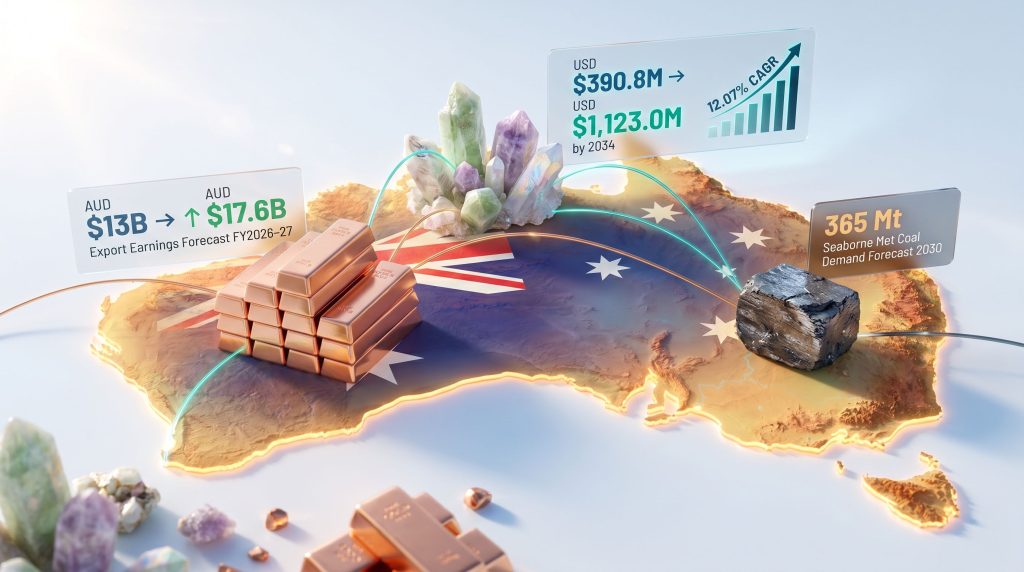
Global seaborne metallurgical coal demand is forecast to reach 365 million tonnes by 2030, representing approximately a 24% increase from 2019 baseline levels. Steel production is not disappearing, and no commercially viable alternative to coking coal in blast furnace steelmaking has yet been deployed at scale. Green steel technologies using hydrogen direct reduction are advancing, but their commercial rollout across major steel-producing nations remains a multi-decade project rather than an imminent disruption.
China's Structural Slowdown and Its Consequences for Australian Exporters
The more immediate headwind for Australian coal exporters is China-specific rather than technology-driven. China's property sector contraction, which has persisted across multiple years, has materially reduced domestic steel consumption and, by extension, demand for imported coking coal. At their peak, coal and iron ore exports collectively represented close to 20% of Australian GDP, a share that is now under sustained structural pressure as Chinese demand softens and its domestic steel industry rationalises capacity.
The project-level data reflects this shift clearly. The number of active coal projects in Australia fell from 47 in 2024 to 40 in 2025, with new development activity confined almost entirely to brownfield expansions of existing operations rather than greenfield mine development. Coal exploration expenditure did rise 2% in 2024, but this anomaly within a multi-year declining capital commitment trend should not be misread as a sector revival signal. Capital is being preserved and optimised within existing assets, not deployed into new capacity.
| Metric | 2024 | 2025 |
|---|---|---|
| Active Coal Projects (Australia) | 47 | 40 |
| Coal Exploration Spend Change | +2% (trend exception) | Declining |
| Seaborne Met Coal Demand Forecast (2030) | — | 365 Mt |
The investment thesis for new coal capacity has fundamentally weakened, but coal is not disappearing from Australia's export ledger in the near term. The sector is in a managed, cash-generative decline phase, not a collapse.
Copper: The Commodity That Powers Everything the Modern Economy Demands
A Structural Demand Case Unlike Any Other Commodity
Copper's strategic importance in the current economic environment is difficult to overstate. Unlike commodities whose demand is driven by a single sector or use case, copper sits at the intersection of virtually every major infrastructure and technology theme of the 2020s. Electricity grid upgrades, data centre construction, renewable energy generation, EV manufacturing supply chains, and advanced industrial robotics all require substantial copper inputs. The simultaneity of these demand drivers is what makes copper's structural case so compelling.
The copper supply crunch is made particularly acute by the combination of declining ore grades at existing mines, long permitting timelines for new projects, and a structural underinvestment in copper exploration that persisted through the low-price environment of the mid-2010s. Mines that take 10 to 15 years from discovery to production simply cannot respond quickly to demand acceleration, which is why price signals at current levels are likely to persist even as economic conditions fluctuate.
Price Records and the Supply Constraint Story
Copper reached a record price of USD $11,870 per tonne in December 2025, a level that reflects the tightening gap between global supply and accelerating demand. Short-term price volatility linked to geopolitical tensions and periodic softness in key industrial markets has occurred around this trend, but it has not altered the medium-to-long-term structural supply deficit dynamic.
One aspect of copper geology that is not widely understood outside the industry is the significance of ore grade decline. As the highest-grade copper deposits globally are progressively depleted, miners are processing larger volumes of rock to extract the same amount of metal. This increases energy consumption, water use, and per-unit production costs, which structurally elevates the price floor needed to incentivise new mine development. Furthermore, it means that the copper price required to bring new supply into the market is rising over time, not falling.
Australia's Production Trajectory: The Numbers That Matter
Australia's copper sector data tells a story of sustained institutional confidence even in a complex regulatory environment:
- Australian copper capital expenditure reached AU$16.1 billion in 2025, reflecting continued commitment from major producers and developers
- Active copper projects grew from 29 in 2024 to 32 in 2025, indicating a healthy pipeline of development activity
- Export volume is forecast to grow from 768,000 tonnes in FY2024-25 to 962,000 tonnes by FY2026-27
- Export earnings are projected to rise from AUD $13 billion to AUD $17.6 billion over the same period, representing approximately a 35% increase
| Indicator | FY2024-25 | FY2026-27 Forecast |
|---|---|---|
| Export Volume | 768 kt | 962 kt |
| Export Earnings | AUD $13 billion | AUD $17.6 billion |
| Capital Expenditure | AUD $16.1 billion | Growing |
| Active Projects | 32 | Expanding pipeline |
What Could Prevent Australia From Fully Capturing This Opportunity?
Australia's copper endowment is significant, but resource wealth and production realisation are not the same thing. Several binding constraints require active management:
- Permitting timelines remain the single largest operational risk. Complicated mining permitting processes delay projects from responding to price signals efficiently, and the opportunity cost of those delays compounds over time.
- Workforce availability, particularly geoscientists, metallurgists, and mine engineers, represents a structural bottleneck that cannot be resolved quickly through training pipelines alone.
- Fiscal and regulatory predictability is a prerequisite for attracting the long-duration capital that copper mine development requires. Investors making decade-long capital commitments require confidence that the rules governing their investment will not change materially mid-project.
Australia's copper opportunity is real and quantifiable. But the gap between resource endowment and production realisation depends heavily on regulatory efficiency and policy execution speed, not just geological endowment.
Rare Earths: Where Geopolitics and Geology Converge
Understanding Why the Global Supply Chain Is Being Restructured
Rare earth elements are not, despite the name, particularly rare in the Earth's crust. What is rare is their occurrence in economically extractable concentrations, and what is rarer still is the processing infrastructure required to separate, refine, and convert them into the oxide and metal forms used in advanced manufacturing. For decades, China developed a dominant position across the entire rare earth value chain, from mining through to magnet manufacturing, creating a dependency that governments in the United States, European Union, Japan, and South Korea are now actively working to reduce.
This is not a market-driven diversification story in the conventional sense. It is a geopolitically engineered demand shift, which makes it structurally more durable than typical commodity cycles driven purely by price signals. The rare earth supply chains being constructed outside China reflect government commitments over multi-year periods, regardless of short-term price movements.
Light vs Heavy Rare Earths: A Critical Distinction for Investors
A nuance that is frequently lost in general coverage of rare earths is the fundamental difference between light and heavy rare earth elements, which have different geological occurrences, different processing requirements, and different end-market applications.
Light rare earths (LREE), including neodymium and praseodymium, account for approximately 85% of global rare earth demand by volume. These elements are the primary inputs for neodymium-iron-boron (NdFeB) permanent magnets used in EV motors, wind turbine generators, and industrial automation systems. Australia holds strong reserves of light rare earths and is well-positioned to serve this dominant demand segment.
Heavy rare earths (HREE), including dysprosium and terbium, are used in smaller volumes but are critical for enhancing the temperature performance of permanent magnets, particularly in high-heat-environment applications such as defence systems and certain industrial motors. Australia's current reserve profile has a less developed heavy rare earth component, which is precisely why projects such as Browns Range in Western Australia are receiving development attention.
Understanding this distinction matters for investors evaluating different Australian rare earth companies, since LREE and HREE projects carry different geological risks, processing requirements, and market access dynamics. In addition, critical minerals in Australia more broadly are attracting increasing policy attention as governments seek to secure domestic supply of strategic materials.
Market Size, Growth Rate, and Production Position
The numbers underpinning Australia's rare earth growth case are among the most compelling in the entire resources sector. According to the IEA's Global Critical Minerals Outlook, demand for rare earth elements is set to accelerate substantially through the transition decade:
| Metric | 2025 | 2034 Projection |
|---|---|---|
| Australian Market Value | USD $390.8 million | USD $1,123.0 million |
| CAGR | — | 12.07% |
| Production Growth (2025) | +35% | — |
| Global Rank (Producer) | 2nd–3rd | Targeting 2nd |
A 35% output surge in 2025 positions Australia to potentially surpass the United States as the world's second-largest rare earth producer behind China. Lynas Rare Earths, the dominant Australian producer, is targeting production of 17,500 tonnes of rare earth oxide (REO) by the end of 2025. The planned Eneabba Refinery, scheduled to begin operations in 2026, will substantially expand domestic processing capability and reduce the longstanding dependency on offshore separation.
That processing bottleneck has been one of the most underappreciated strategic vulnerabilities in the global rare earth supply chain outside of specialist industry circles. Developing domestic refining capacity is therefore not just an industrial policy question — it is a supply chain security imperative that gives Australian rare earth production substantially greater strategic value than raw mining output alone would suggest.
Sector-Wide Risks That Cut Across All Three Commodities
Regulatory Complexity and Financial Risk in a New Phase
The Australian mining sector entered 2026 in what industry participants describe as a more complex operating environment, with regulatory pressure and financial risk identified as the two leading concerns across the industry. Environmental and social governance requirements are extending project timelines and adding cost layers, particularly for new greenfield developments.
Labour Shortages as a Structural, Not Cyclical, Problem
The skills shortage facing Australian mining is not a temporary consequence of a tight labour market. It reflects a structural mismatch between the pace at which new projects are being developed and the pipeline of qualified technical professionals being produced by educational and training systems. Geoscientists, metallurgists, and mine engineers are in chronic short supply relative to industry needs, and this constraint operates as a speed limit on the sector's overall growth rate.
Price Moderation and the Investor Timing Question
While structural demand growth for critical minerals is well-supported over a multi-decade horizon, near-term commodity price performance is subject to meaningful volatility. Increased global supply and moderating demand growth in certain markets could keep price appreciation contained through 2027. Investors need to maintain a clear distinction between structural demand growth, which operates over decades, and near-term price performance, which is subject to geopolitical events, trade policy changes, and macroeconomic cycles.
The next major ASX story will hit our subscribers first
Side-by-Side Sector Comparison
| Dimension | Coal | Copper | Rare Earths |
|---|---|---|---|
| Demand Trajectory | Declining (long-term) | Strong growth | Very strong growth |
| Price Outlook | Moderating | Elevated / record levels | Rising (CAGR 12.07%) |
| New Project Activity | Minimal (brownfield only) | Growing (32 projects) | Expanding rapidly |
| Geopolitical Tailwind | Negative | Moderate | Very strong |
| Key Risk | China demand decline | Permitting delays | Processing bottlenecks |
| Export Earnings Trajectory | Stable to declining | AUD $13B to $17.6B | USD $390M to $1.12B (2034) |
Frequently Asked Questions: Australia Resources Sector Coal Copper Rare Earths Outlook
What is driving copper demand growth in Australia?
Copper demand is being driven by electricity grid upgrades, renewable energy infrastructure, EV manufacturing supply chains, and the rapid expansion of data centres globally. Australia's growing project pipeline and significant geological endowment position it to capture a meaningful share of this structural demand over the coming decade.
Will coal remain important to Australia's economy through 2030?
Metallurgical coal used in steel production will continue generating substantial export revenue for Australia through at least 2030, with global seaborne demand forecast at 365 million tonnes by that year. However, declining Chinese steel demand and reduced new investment signal that coal's proportional share of Australia's export income will gradually contract across the decade.
Why are rare earths considered strategically important for Australia?
Rare earths are essential inputs for permanent magnets used in electric vehicles, wind turbines, defence systems, and advanced electronics. As governments seek to reduce dependence on a single dominant supplier of refined rare earth products, Australia's large light rare earth reserves and expanding processing infrastructure make it one of the most credible alternative sources at commercial scale.
What is the Australian rare earth market projected to be worth by 2034?
The Australian rare earth market is projected to grow from approximately USD $390.8 million in 2025 to USD $1,123.0 million by 2034, representing a compound annual growth rate of 12.07%.
What are the main risks to Australia's resources sector growth?
The primary risks include rising regulatory complexity, project cost escalation, skilled labour shortages, potential near-term commodity price moderation, and geopolitical uncertainty affecting trade flows and foreign investment decisions. Consequently, the net effect of geopolitical tension is likely positive for Australia over a five-to-ten year horizon, provided domestic policy settings remain stable and investment conditions competitive.
Three Commodities, Three Futures, One Strategic Moment
The Australia resources sector coal copper rare earths outlook resolves into a clear hierarchy of opportunity when viewed through a long-term structural lens. Coal remains a significant and cash-generative contributor to national income, but it is no longer the sector's growth engine. Copper represents the most quantifiable near-term earnings upside, with a clear demand catalyst, a rising price environment, and a measurable project pipeline. Rare earths represent the highest-growth, highest-strategic-value opportunity, where Australia's geological endowment intersects with a geopolitically engineered realignment of global supply chains.
What determines whether Australia fully captures its potential across all three is not primarily geological. The binding constraints are policy certainty, permitting efficiency, domestic processing capability, and workforce development. These are all variables that can be actively managed, which means the outcome is not predetermined. The window of opportunity is real, but it is also finite. Competitors in Canada, Greenland, and parts of Africa are developing their own critical mineral propositions, and the countries seeking to diversify their supply chains will not wait indefinitely for Australian projects to navigate their way through regulatory complexity.
Furthermore, the RBA's analysis of the global energy transition underscores that Australia's resource endowment provides the foundation, but it is the quality of the institutional and policy environment built on top of that foundation that will determine how much of the sector's potential is actually realised over the next five to ten years.
This article is intended for informational purposes only and does not constitute financial advice. Commodity price forecasts, production projections, and market size estimates involve inherent uncertainty. Readers should conduct their own research and consult a licensed financial adviser before making any investment decisions.
Want to Capitalise on the Next Major ASX Mineral Discovery Before the Market Moves?
Discovery Alert's proprietary Discovery IQ model delivers real-time alerts on significant ASX mineral discoveries across copper, rare earths, and beyond, instantly transforming complex geological data into actionable investment insights for traders and long-term investors alike. Explore historic examples of exceptional discovery-driven returns or start your 14-day free trial today to position yourself ahead of the broader market.