May 20, 2026
Understanding Australia's Strategic Agricultural Input Security Framework
Global supply chain vulnerabilities have intensified focus on strategic commodity reserves across advanced economies. When critical agricultural inputs face disruption through geopolitical conflicts, shipping bottlenecks, or producer nation instability, food security frameworks become essential infrastructure. Australia's recent implementation of government-backed fertilizer procurement demonstrates how strategic reserve mechanisms can protect domestic agricultural systems from international supply shocks.
The evolution of strategic commodity policies reflects growing recognition that agricultural inputs require the same security considerations traditionally applied to energy reserves. Modern farming systems depend heavily on imported fertilizers, with nitrogen-based products like urea representing critical components of crop nutrition programs. Disruption to these supply chains creates cascading effects through agricultural production, food prices, and rural economic stability.
Export Finance Australia's enhanced powers to underwrite fertilizer transactions represent a sophisticated policy response to contemporary supply chain risks. This framework balances immediate crisis management with longer-term agricultural security objectives, establishing precedents for future commodity market interventions during periods of international instability.
When big ASX news breaks, our subscribers know first
Legislative Framework Enabling Strategic Fertilizer Market Intervention
Australia backs CSBP and Incitec for urea supply deals through legislative mechanisms that classify fertilizers as strategic commodities comparable to fuel reserves. The government formally expanded Export Finance Australia's mandate on 30 March 2026, granting new powers to underwrite international purchases of agricultural inputs under strategic reserve legislation.
This regulatory enhancement enables government financial guarantees for fertilizer importers facing severe price volatility and supply uncertainty. Furthermore, the framework operates through risk-sharing arrangements where Export Finance Australia provides downside protection against rapid price movements, enabling companies to secure forward shipments without exposure to post-purchase market declines.
Eligible Company Criteria and Selection Process
Two major Australian entities received government backing arrangements: CSBP Limited (Western Australian fertilizer manufacturer and distributor) and Incitec Pivot Limited (ASX-listed chemicals and fertilizers corporation). These companies maintain established import networks, domestic distribution channels, and demonstrated capacity to reach farming communities during critical application periods.
The selection criteria emphasise operational capability rather than financial need. In addition, both CSBP and Incitec Pivot possess existing relationships with international suppliers, vessel chartering capacity, and regional storage infrastructure necessary for effective fertilizer distribution across Australia's agricultural regions.
Key Legislative Powers Include:
• Risk underwriting for international commodity purchases
• Financial guarantee mechanisms protecting against price volatility
• Fast-track approval processes for critical agricultural input transactions
• Strategic classification authority for essential commodity imports
Crisis Drivers Behind Government Fertilizer Supply Intervention
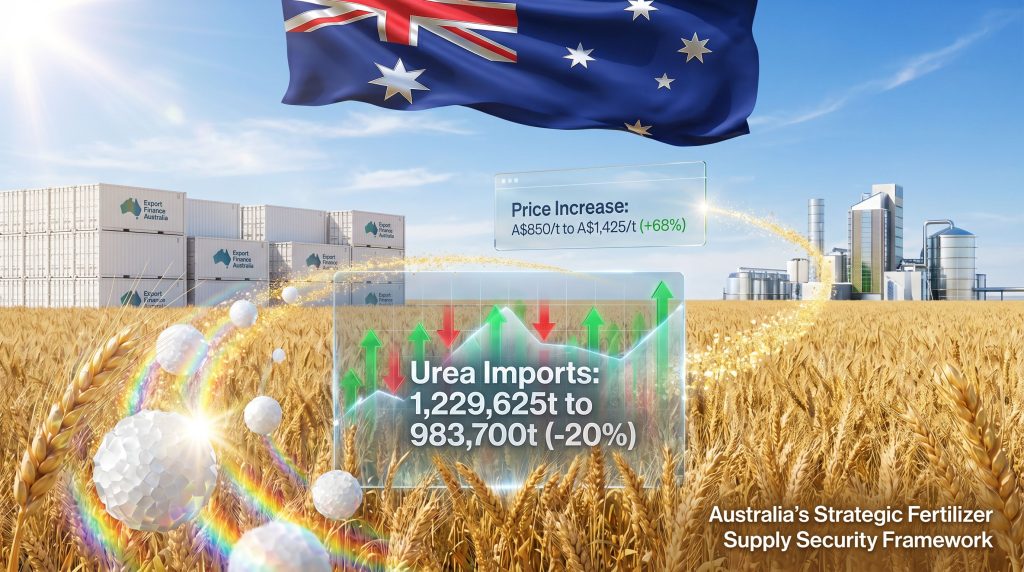
The necessity for Australia backing CSBP and Incitec for urea supply deals stems from severe market disruption caused by the US-Iran conflict and resulting Strait of Hormuz restrictions. Australian urea imports declined dramatically during the critical pre-season period, with January-April 2026 volumes reaching only 983,700 tonnes compared to 1,229,625 tonnes in the equivalent 2025 period, representing a 20% quarterly reduction.
May 2026 import projections demonstrate even more severe supply constraints. Only four vessels carrying a combined 161,300 tonnes were in transit for May arrival as of 22 April 2026, compared to 587,400 tonnes imported during May 2025. This 73% monthly decline occurs precisely during Australia's peak seasonal demand window for winter crop applications.
Price Escalation and Market Response
Granular urea prices at Geelong reached A$1,420-1,430 per tonne by 16 April 2026, representing a 68% increase from pre-conflict baseline levels around A$850 per tonne. This price escalation, combined with supply uncertainty, created significant demand destruction as farmers reduced fertilizer application rates or delayed purchases.
Critical Supply Disruption Timeline:
• 28 February 2026: US-Iran conflict begins, affecting Middle Eastern fertilizer production
• March 2026: Strait of Hormuz restrictions implemented, constraining vessel routing
• 30 March 2026: Australian government expands Export Finance Australia powers
• 22 April 2026: Government backing for CSBP and Incitec announced
The geopolitical supply disruption operates through multiple transmission mechanisms. However, direct production impacts affect ammonia and urea manufacturing facilities in Middle Eastern supplier nations. Vessel routing restrictions through the Strait of Hormuz, which normally handles approximately 20% of global fertilizer trade, create shipping bottlenecks. Furthermore, these trade war impacts affect port access limitations and traditional supplier relationships with Australian importers.
Export Finance Australia's Fertilizer Backing Mechanisms
Export Finance Australia employs sophisticated risk-transfer architectures to support fertilizer importers while maintaining market-based supply chain operations. The mechanism provides financial insurance against rapid price movements, enabling importers to secure shipments without exposure to downside price risk while companies retain operational control over procurement and distribution.
As of the announcement date, Export Finance Australia had not finalised specific deal structures, with details still being determined according to Agriculture Minister Julie Collins. The arrangements operate as government-backed support for private sector importers rather than direct government procurement, preserving market mechanisms while providing price volatility protection.
Transaction Structure and Risk Allocation
The government assumes price volatility risk through guarantee mechanisms while private companies maintain responsibility for supply chain execution, quality control, and farmer distribution. This structure enables rapid response to supply crises without requiring government development of commodity trading capabilities or distribution infrastructure.
Incitec Pivot-Indonesia Arrangement:
• Volume: 250,000 tonnes agricultural-grade urea
• Supplier: PT Pupuk Indonesia (Indonesia's state-owned fertilizer producer)
• Structure: Government price volatility protection with private operational control
CSBP Supply Guarantees:
• Multiple shipment arrangements for Western Australian distribution
• Regional storage and farmer delivery network utilisation
• Seasonal timing coordination for pre-seeding and top-dressing applications
The arrangements specifically target Australia's April-July peak demand period, when winter crop planting and development phases create concentrated fertilizer requirements. Consequently, government support enables importers to secure vessels and negotiate supply contracts despite elevated global prices and shipping constraints.
Comparative Analysis: Strategic Reserve Programs Across Commodities
Australia's fertilizer intervention builds upon established strategic reserve frameworks already operational across multiple commodity sectors. The country maintains similar underwriting arrangements for fuel imports, demonstrating systematic application of supply security principles to critical economic inputs.
Existing Strategic Commodity Coverage
Australia's comprehensive strategic reserve framework extends beyond fertilizers to include petroleum products, with government backing arrangements reportedly covering major fuel importers including BP, Viva Energy, Ampol, and other distribution companies. This multi-sector approach demonstrates coordinated policy development for supply chain resilience.
International Comparative Models:
United States Strategic Framework:
• Strategic Petroleum Reserve adapted for agricultural input security
• Emergency commodity release mechanisms during supply disruptions
• Private-public partnership models for critical input procurement
European Union Agricultural Policy:
• Common Agricultural Policy including input supply security provisions
• Coordinated response mechanisms for member state agricultural crises
• Strategic stockpiling requirements for essential agricultural inputs
Canadian Emergency Protocols:
• Agricultural input procurement protocols for crisis response
• Provincial coordination mechanisms for fertilizer supply security
• Government underwriting capacity for commodity import financing
The Australian model's emphasis on private sector operational control while providing government financial backing represents a hybrid approach balancing market efficiency with supply security objectives. For instance, this structure avoids direct government commodity trading while ensuring adequate supply during crisis periods.
Economic Implications and Market Impact Assessment
Government intervention in fertilizer markets generates multiple economic effects across agricultural input pricing, import confidence, and farmer cost predictability. The 68% price increase from pre-conflict levels to current market rates demonstrates the scale of market distortion requiring stabilisation measures.
Supply Volume Recovery Potential
The 20% quarterly decline and 73% monthly reduction in imports indicate substantial demand destruction occurring in response to elevated pricing. Government price guarantees aim to restore importer confidence and normalise vessel chartering for Australian delivery during critical application periods.
Market Stabilisation Mechanisms:
| Intervention Component | Intended Effect | Measurement Challenge |
|---|---|---|
| Price volatility protection | Reduced daily/weekly price swings | Limited historical comparison data |
| Import guarantee backing | Enhanced forward contracting confidence | Vessel charter rate impacts unclear |
| Seasonal supply security | Stable input availability during peak demand | Application rate data not yet available |
| Farmer cost predictability | Reduced uncertainty for crop planning | Individual farm cost surveys needed |
Fiscal Cost and Risk Assessment
Government exposure through price guarantee mechanisms creates potential fiscal liabilities dependent on global market movements and conflict duration. Administrative costs for Export Finance Australia operations include transaction monitoring, risk assessment, and guarantee settlement processes.
Long-term Economic Considerations:
• Market Distortion Risk: Potential subsidy effects on domestic fertilizer pricing
• Dependency Concerns: Ongoing intervention expectations from agricultural sector
• Fiscal Sustainability: Extended conflict scenarios requiring sustained government support
• Opportunity Cost: Alternative agricultural support program funding implications
The intervention's economic success depends largely on conflict resolution timing and global supply chain normalisation. Extended disruption periods could require expanded government commitment or alternative volatility hedging strategies to maintain agricultural input security.
The next major ASX story will hit our subscribers first
Agricultural Sector and Farmer Organisation Responses
National Farmers Federation President Hamish McIntyre acknowledged the government support while emphasising continued pressure on farming operations. His statement that the arrangement will help get fertiliser to farmers but that farmers and regional businesses are still under pressure indicates partial satisfaction with intervention scope.
The Federation's dual messaging reflects complex agricultural industry perspectives on government market intervention. While appreciating immediate supply security benefits, farm organisations maintain concerns about ongoing cost pressures and call for more comprehensive agricultural input strategies.
Comprehensive Agricultural Planning Requests
The National Farmers Federation specifically called for Australia's national cabinet to develop an agriculture-specific plan addressing both fertiliser and fuel supply challenges. This request indicates industry view that current measures represent necessary but insufficient responses to broader agricultural input security issues.
Industry Position Summary:
• Positive Acknowledgment: Recognition that government deals improve fertiliser access
• Continued Concerns: Emphasis on ongoing cost pressures for farm operations
• Policy Integration Requests: Calls for coordinated fuel, fertiliser, and freight strategies
• Seasonal Urgency: Focus on immediate winter crop application timing requirements
Regional agricultural businesses and individual farm operations face complex decisions regarding fertiliser application rates, timing adjustments, and crop planning modifications in response to elevated input costs despite improved supply security through government backing.
Seasonal Timing Critical Factors in Fertilizer Supply Security
Australia's peak seasonal demand for urea occurs during the April-July period, creating structural vulnerability when global supply disruptions coincide with domestic agricultural timing requirements. Winter crop establishment depends on precise fertiliser application schedules that cannot be significantly delayed without yield impacts.
The timing alignment between conflict-related supply constraints and Australia's critical fertiliser demand window intensifies the strategic importance of government intervention. Pre-seeding applications in April require nitrogen incorporation into soil before planting, while June-July top-dressing applications support crop development during critical growth phases.
Application Window Constraints and Supply Risk Progression
Australian fertiliser suppliers expressed confidence regarding supply availability for April pre-seeding applications but acknowledged uncertainty about June-July top-dressing access. This temporal progression demonstrates how geopolitical shipping constraints create increasing supply pressure as the agricultural season advances.
Seasonal Demand Distribution:
| Period | Application Type | Supply Confidence | Import Volume Risk |
|---|---|---|---|
| April | Pre-seeding nitrogen | Moderate confidence | Government backing active |
| May-June | Early development support | Uncertain availability | Vessel charter constraints |
| July | Top-dressing applications | High uncertainty | Peak shipping bottleneck risk |
Critical Timing Vulnerabilities:
• Vessel Scheduling: Limited container allocation during peak global demand periods
• Storage Capacity: Regional facility limitations during concentrated delivery periods
• Transport Logistics: Rural distribution network capacity during application windows
• Weather Dependencies: Application timing affected by seasonal precipitation patterns
The progression from supply confidence in early-season to acknowledged uncertainty in late-season demonstrates cumulative effects of global shipping constraints on Australian agricultural timing requirements.
Future Policy Development Trajectories and Framework Expansion
Australia's fertiliser intervention establishes precedents for broader strategic commodity policy development and potential framework expansion to additional agricultural inputs. The success of current arrangements may influence government willingness to extend similar backing to other critical farming inputs during supply disruptions.
Potential Strategic Reserve Enhancement
Legislative frameworks enabling Export Finance Australia's expanded powers could accommodate additional commodities beyond fertilisers and fuels. Future policy development might include pesticides, seeds, agricultural machinery, or specialised farming technology during supply chain crises.
Policy Evolution Pathways:
• Geographic Expansion: Bilateral agreements with key supplier nations for enhanced supply security
• Commodity Scope Broadening: Extension to pesticides, herbicides, and specialty agricultural inputs
• Regional Cooperation: Multi-national coordination mechanisms for agricultural input crisis response
• Technology Integration: Digital monitoring systems for supply chain vulnerability assessment
Long-term Agricultural Security Strategy Development
Government intervention in fertiliser markets may catalyse broader agricultural security policy development addressing domestic production capabilities, supply source diversification, and technology investment to reduce import dependency for critical farming inputs.
Strategic Development Areas:
• Domestic Manufacturing: Incentives for local fertiliser production capacity development
• Supply Chain Diversification: Strategic partnerships with multiple supplier regions and countries
• Precision Agriculture: Technology investment reducing overall fertiliser input requirements
• Alternative Input Sources: Research support for organic and sustainable fertiliser alternatives
Future policy frameworks may incorporate lessons learned from current intervention regarding optimal government role, private sector partnership structures, and crisis response timing for maximum agricultural sector benefit. These developments align with broader energy security strategy considerations affecting Australia's economic resilience.
Frequently Asked Questions About Strategic Fertilizer Policy Implementation
How long will government fertiliser backing continue?
The current framework operates under strategic reserve legislation triggered by supply disruption events rather than representing permanent market participation. Government intervention is designed as temporary crisis response, with market-based pricing and supply expected to resume as geopolitical tensions resolve.
What happens to fertiliser prices for individual farmers?
While government backing helps stabilise supply availability, farmers continue facing elevated prices due to global market conditions. Current urea costs remain approximately 68% higher than pre-conflict levels, with price benefits primarily through improved supply security rather than direct cost reduction.
Will this policy apply to other agricultural inputs?
The legislative framework enabling fertiliser backing could potentially extend to other critical agricultural inputs during supply crises. However, current arrangements specifically target fertiliser supply disruption, with future expansion dependent on demonstrated policy success and agricultural sector needs.
How does this affect international trade relationships?
Government backing operates through existing trade relationships and supplier networks rather than replacing international market mechanisms. The policy supports private sector importers working with established suppliers like PT Pupuk Indonesia while providing financial risk mitigation through government support deals.
What measures exist to prevent long-term market dependence?
Strategic reserve legislation includes provisions for crisis response rather than ongoing market intervention. Government backing is explicitly designed to address temporary supply disruptions, with market normalisation expected following global shipping route stabilisation and conflict resolution.
Strategic Agricultural Input Security as Economic Infrastructure
Australia's government-backed fertiliser arrangements demonstrate sophisticated policy integration of agricultural security with broader economic stability objectives. The framework successfully balances immediate farmer supply needs with long-term market functionality, establishing intervention mechanisms that protect critical agricultural inputs without displacing private sector capabilities.
This policy approach recognises fertiliser supply chains as essential economic infrastructure requiring the same strategic consideration traditionally reserved for energy security. By providing financial risk mitigation while maintaining private sector operational control, Australia has developed a model potentially applicable to other critical commodity supply challenges.
The intervention's broader significance extends beyond immediate crisis response to establish precedents for systematic agricultural security policy development. Success in maintaining winter crop fertiliser access during international supply disruption validates strategic reserve approaches for agricultural input protection, potentially informing future policy frameworks for other essential farming inputs.
Moreover, executive intervention measures and resource export challenges demonstrate global trends toward strategic commodity security. Australia backs CSBP and Incitec for urea supply deals represents calculated risk management acknowledging that agricultural supply chain vulnerabilities create national economic risks requiring coordinated policy responses. This framework positions Australia to respond effectively to future supply disruptions while maintaining market-based agricultural input distribution systems essential for efficient farming operations.
Disclaimer: This analysis is based on publicly available information as of April 2026. Agricultural input markets remain volatile due to ongoing geopolitical factors. Farmers and agricultural businesses should consult current market conditions and qualified advisors when making fertiliser purchasing and application decisions.
Could Australia's Strategic Resource Interventions Signal New Investment Opportunities?
Government backing for critical commodity supply chains demonstrates growing state involvement in strategic resource security. Discovery Alert's proprietary Discovery IQ model identifies emerging investment opportunities in Australian resource companies benefiting from government support frameworks and supply chain disruptions. Start your 14-day free trial today to uncover actionable insights from ASX announcements that could position you ahead of market movements in the evolving strategic commodities landscape.