May 16, 2026
Australia's Strategic Input Dependencies Create Agricultural Vulnerability
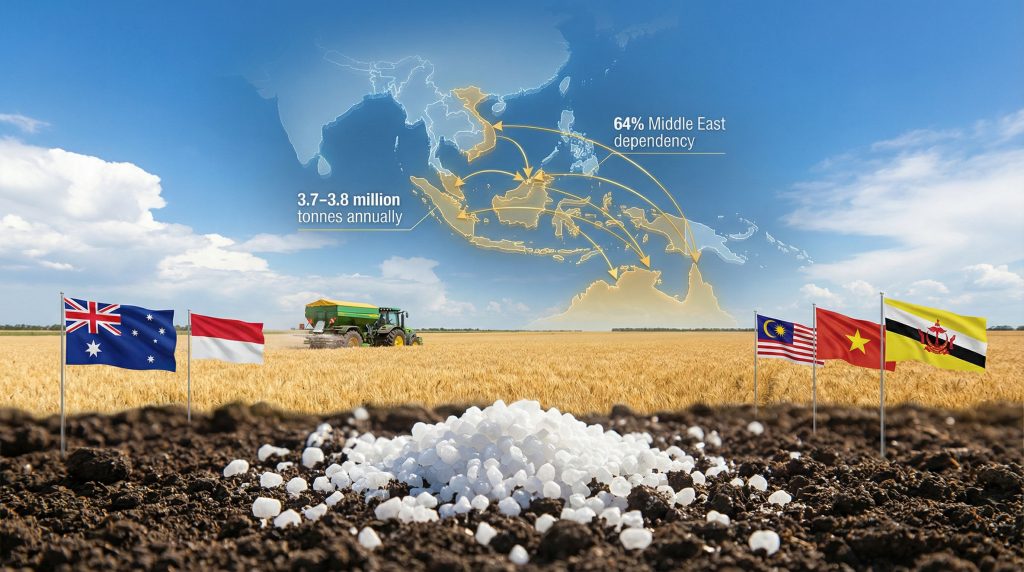
Australia's agricultural productivity depends on fertilizer imports that flow through concentrated geographic channels, creating systemic vulnerability during geopolitical disruptions. The nation imported approximately 3.8 million tonnes of urea annually as of 2025, with Southeast Asia accounting for only 32 percent of total imports while Middle Eastern sources dominated the remaining 68 percent through the Strait of Hormuz.
This dependency structure means that approximately 60 percent of Australia's urea flows through a single maritime chokepoint, according to recent commodity market analysis. The geographic concentration extends beyond urea to encompass 20-25 percent of ammonia shipments, 50 percent of sulfur movements, and 19 percent of DAP and MAP phosphate products, creating multi-product vulnerability.
Critical Timing Vulnerabilities:
- Winter crop seeding commences around 25 April annually
- Pre-seeding fertiliser applications occur in March-April
- Top-dressing applications follow in May-June
- Supply disruptions during this window directly impact crop yields
The compressed agricultural calendar means that supply chain disruptions create immediate operational constraints for farming operations. Australian farmers face an eight-day window between diplomatic negotiations for alternative supplies and the onset of winter crop seeding, demonstrating how commodity dependencies translate directly into agricultural planning pressures.
Australia's domestic fertiliser production capacity reached zero following facility closures in recent years, eliminating buffer capacity that might offset import disruptions. This complete import dependence distinguishes Australia from other major agricultural nations that maintain domestic production capability for supply security.
When big ASX news breaks, our subscribers know first
Southeast Asia's Production Surplus Enables Australian Supply Security
Southeast Asia maintains substantial fertiliser production capacity that exceeds regional demand, creating export availability for Australian procurement strategies. Regional production reached 13.5 million tonnes in 2025 while local consumption approximated 8.15 million tonnes, yielding 5.35 million tonnes of potential export capacity.
Regional Production Distribution:
| Producer | Annual Capacity | Export Potential | Key Facilities |
|---|---|---|---|
| Indonesia | 9.4 million tonnes | 3.2 million tonnes | Pupuk Indonesia complexes |
| Malaysia | 2.1 million tonnes | 1.8 million tonnes | Petronas facilities |
| Vietnam | 2.5 million tonnes | 700,000 tonnes | State enterprises |
| Brunei | 850,000 tonnes | 750,000 tonnes | Brunei Fertilizer Industries |
Indonesia represents the region's largest producer but directs substantial output toward domestic market requirements. State-owned Pupuk Indonesia controls the majority of Indonesian production capacity, though export patterns typically involve spot purchases rather than contractual deliveries to Australia.
Vietnam operates as a price-elastic exporter where international price spikes encourage producers to increase export volumes. Vietnamese facilities produce approximately 2.5 million tonnes annually with domestic requirements of 1.8 million tonnes, creating 700,000 tonnes of potential export capacity that responds to price incentives.
Shipping and Logistics Advantages:
- Transit time: 2-3 weeks to Australian east coast ports
- Established infrastructure: Regular cargo schedules to Geelong and Newcastle
- Port compatibility: Existing bulk handling facilities
- Regulatory compliance: Established quarantine and inspection protocols
Malaysia's Petronas and Brunei Fertilizer Industries emerge as particularly strategic suppliers due to their established export focus and geographic proximity. These facilities maintain consistent production schedules and have demonstrated reliability in international market participation, as evidenced by their contribution of 346,000 tonnes to India's recent fertiliser tenders totaling 2.5 million tonnes.
Strait of Hormuz Closure Disrupts Traditional Middle Eastern Supply Routes
The effective closure of the Strait of Hormuz has severed Australia's primary fertiliser import pathway, forcing immediate procurement strategy restructuring. This narrow waterway, approximately 34 miles at its narrowest point, traditionally facilitated 35 percent of global seaborne urea transit, making it the dominant routing choice for fertiliser distribution worldwide.
Furthermore, the closure mechanism involves Iranian military action targeting commercial shipping during the ongoing conflict. While not constituting a complete physical blockade, elevated risk premiums and insurance costs create functional restrictions that limit trade volume flow to economically viable levels.
Strategic Supply Chain Impact:
- Qatar: Primary historical urea supplier via Strait routing
- Saudi Arabia: DAP and MAP phosphate source through waterway
- UAE: Ammonia and nitrogen product exports via Strait
- Iran: Sulphur and speciality fertiliser shipments through channel
Alternative routing around the Cape of Good Hope extends voyage duration from approximately 2 weeks to 4-5 weeks while imposing additional fuel and insurance costs estimated at 40-60 percent above normal shipping rates. This cost multiplication serves as the functional closure mechanism, making traditional Middle Eastern sourcing economically prohibitive for many buyers.
The disruption coincides with heightened political attention to fertiliser markets. However, the tariffs impact on markets reflects elevated concern about supply chain consequences for domestic agricultural productivity during the conflict period.
Fertiliser Price Volatility Reshapes Australian Agricultural Economics
Dramatic price movements have fundamentally altered Australian farming profitability calculations and crop selection strategies. Granular urea prices increased from $484-498/tonne FOB Southeast Asia on 26 February 2026 to $780-850/tonne by 9 April 2026, representing a 61-71 percent increase within a 42-day period.
Australian Market Price Impact:
| Timeframe | FOB Southeast Asia | Delivered Geelong | Price Increase |
|---|---|---|---|
| Pre-disruption (Feb 2026) | $484-498/t | A$830-840/t | Baseline |
| Current (April 2026) | $780-850/t | A$1,000-1,400/t | 19-67% |
The price escalation reflects global rather than localised market dynamics. DAP and MAP prices in New Orleans reached $770/short ton FOB in mid-April 2026, representing the highest levels since September 2022. Indian DAP pricing climbed to $865/tonne CFR, also reaching September 2022 peak levels.
US Nola urea values concluded at $692/short ton FOB in mid-April, up from $405/short ton one year earlier, establishing a 71 percent year-over-year increase. These comparative price movements demonstrate that Australian cost pressures reflect broader global supply tightening rather than Australia-specific market conditions.
Farmer Response Strategies:
- Crop substitution: Shifting from wheat and canola to nitrogen-fixing legumes
- Application reduction: Decreased pre-seeding and top-dressing volumes
- Precision agriculture: Targeted fertiliser placement to minimise waste
- Forward contracting: Price hedging through advance purchase agreements
Multiple suppliers indicate that growers are actively considering crop portfolio changes from standard crops such as wheat and canola to legumes or pulses that require substantially less fertiliser input. This strategic shift represents more than temporary adjustment, signalling potential permanent changes in Australian agricultural land use patterns.
Government Intervention Establishes Diplomatic Procurement Framework
Australian government response involves coordinated diplomatic engagement to establish alternative fertiliser procurement channels and emergency supply protocols. Prime Minister Anthony Albanese's visit to Brunei during 14-17 April 2026 demonstrates high-level political priority assigned to agricultural input security.
The diplomatic mission yielded immediate commitments from regional partners. Brunei confirmed no plans to introduce export restrictions on fertiliser supply to Australia, while Malaysia engaged in discussions regarding production allocation for Australian procurement. These bilateral arrangements represent strategic partnership development beyond traditional spot market purchasing.
Government Policy Initiatives:
- Fertiliser Supply Working Group: Multi-agency coordination mechanism
- Trade facilitation: Streamlined import procedures for alternative sources
- Strategic reserves evaluation: National fertiliser stockpiling assessment
- Industry coordination: Partnership with Fertiliser Australia and National Farmers Federation
Foreign Minister Penny Wong's statements on 13 April emphasised continuing engagement with regional countries to support the flow of essential goods including fertiliser. This represents formal policy recognition of fertiliser as strategic agricultural infrastructure requiring diplomatic attention.
The joint statement between Australia and Brunei's Sultan Hassanal Bolkiah on 15 April specifically addressed maintaining fertiliser flow, indicating that bilateral agricultural trade agreements now include explicit fertiliser security provisions.
However, multiple suppliers consulted by commodity analysts report that formal details of government support mechanisms remain underdeveloped despite diplomatic engagement, suggesting policy implementation lags behind political commitments.
Regional Partnership Development Replaces Opportunistic Global Sourcing
Australia's fertiliser procurement strategy requires fundamental restructuring toward sustained regional relationships rather than spot market optimisation. This transformation involves building strategic partnerships with Southeast Asian producers while developing comprehensive supply chain infrastructure to support reliable delivery mechanisms.
Traditional Australian fertiliser procurement operated through opportunistic global sourcing, prioritising cost optimisation over supply security. Shipments from Indonesia and Vietnam historically involved spot purchases rather than consistent cargo flows or contractual deliveries, creating vulnerability during supply disruptions.
Emerging Partnership Structure:
- Multi-year agreements: Replacing spot market transactions with contractual commitments
- Volume guarantees: Securing minimum annual allocation arrangements
- Price stabilisation: Formula-based pricing mechanisms reducing volatility exposure
- Quality specifications: Customised product requirements for Australian soil conditions
India's recent fertiliser procurement activities provide evidence of intensifying global competition for available Southeast Asian production. India's tender for 2.5 million tonnes of urea issued on 4 April 2026 created simultaneous sourcing pressure that elevated prices across all markets. Southeast Asian producers contributed 346,000 tonnes to India's procurement, demonstrating active participation in competitive global markets.
Infrastructure Investment Requirements:
- Port capacity expansion: Enhanced bulk handling facilities at regional distribution centres
- Storage infrastructure: Strategic inventory management capabilities
- Transportation networks: Improved rail and road connections to farming regions
- Quality testing: Advanced laboratory facilities for product verification
The partnership model extends beyond simple procurement relationships to encompass integrated supply chain development. This approach recognises that fertiliser security requires infrastructure investment and operational coordination that transcends individual transaction optimisation.
The next major ASX story will hit our subscribers first
Alternative Global Sources Supplement Southeast Asian Core Supply
Beyond Southeast Asia, Australia explores emerging fertiliser sources to create comprehensive supply security while avoiding single-region dependency. These alternative sources require careful evaluation of production capacity, shipping logistics, regulatory compliance, and political stability considerations.
African Market Opportunities:
- Egypt: NCIC production facilities offering multiple fertiliser types
- Nigeria: Dangote Fertiliser complex potential for urea supply
- Morocco: OCP Group phosphate products through established trade routes
- South Africa: Sasol nitrogen derivatives and chemical integration
Egyptian producer NCIC has demonstrated active international marketing through recent tenders offering 20,000 tonnes of DAP, 10,000 tonnes of TSP, 15,000 tonnes of SSP, and 10,000 tonnes of urea for April loading. These volumes indicate Egyptian willingness to participate in global export markets despite domestic demand requirements.
Evaluation Criteria for Alternative Sources:
- Biosecurity compliance: Australian Quarantine and Inspection Service standards
- Shipping economics: Longer transit routes increase delivered costs
- Production consistency: Variable quality standards across different facilities
- Political stability: Supply continuity risks in emerging market jurisdictions
African sources require significantly longer shipping routes compared to Southeast Asian suppliers, with transit times extending to 4-6 weeks and proportionally higher transportation costs. However, these sources provide important diversification benefits and potential cost advantages during periods when Asian markets experience premium pricing.
The evaluation process must balance supply security objectives against economic efficiency, recognising that diversified sourcing strategies typically involve cost premiums compared to single-source optimisation approaches.
Agricultural Adaptation Strategies Address Input Cost Restructuring
Australian farmers implement both immediate tactical adjustments and long-term strategic adaptations to manage altered fertiliser cost structures. These changes affect fundamental aspects of farm management including crop selection, application timing, nutrient management practices, and financial planning approaches.
Immediate Tactical Responses:
- Legume integration: Expanding nitrogen-fixing crops to reduce synthetic fertiliser dependency
- Rotation optimisation: Soil fertility management through strategic crop sequencing
- Variety selection: Adopting nutrient-efficient cultivars requiring lower input volumes
- Precision technology: GPS-guided variable rate application systems
The shift toward legumes and pulses represents more than temporary cost management, potentially creating permanent changes in Australian agricultural land use patterns. Crops such as lentils, chickpeas, and field peas require substantially lower fertiliser inputs while contributing nitrogen fixation benefits to subsequent crops in rotation sequences.
Financial Risk Management Strategies:
- Input cost hedging: Forward purchasing agreements to lock pricing
- Crop insurance enhancement: Coverage for fertiliser price volatility impacts
- Contract farming: Guaranteed pricing arrangements with processors
- Equipment financing: Leasing precision application technologies
Precision agriculture adoption accelerates as farmers seek to optimise fertiliser efficiency. Variable rate application technologies enable targeted nutrient placement based on soil testing and crop requirements, potentially reducing total fertiliser volumes while maintaining yield objectives.
Long-Term Strategic Adaptations:
- Soil health investment: Building organic matter and biological fertility
- Alternative inputs: Organic and biological fertiliser integration
- Crop diversification: Reduced dependence on high-input commodity crops
- Technology adoption: Satellite monitoring and data-driven nutrient management
These adaptation strategies collectively represent fundamental changes in Australian agricultural practices, moving away from intensive input utilisation toward more sustainable and resilient farming systems. The fertiliser supply disruption serves as a catalyst for agricultural transformation that extends beyond immediate cost management concerns.
Investment Opportunities Emerge from Supply Chain Transformation
The fertiliser supply restructuring creates substantial investment opportunities across agricultural infrastructure, technology development, and alternative production methods. These opportunities support both immediate supply security objectives and long-term agricultural sustainability goals.
Infrastructure Investment Themes:
- Port capacity expansion: Enhanced bulk handling facilities at Geelong, Newcastle, and Brisbane
- Regional storage networks: Strategic fertiliser inventory management systems
- Transportation infrastructure: Improved rail and road connections to farming regions
- Digital logistics: Supply chain visibility and tracking technologies
Port infrastructure investment becomes particularly critical as Australia diversifies import sources requiring enhanced handling capacity for multiple product types and origins. Current infrastructure designed for traditional Middle Eastern suppliers may require modification to accommodate Southeast Asian shipping patterns and cargo specifications.
Agricultural Technology Development:
- Precision application systems: GPS-guided variable rate fertiliser placement
- Soil monitoring networks: Real-time nutrient status assessment capabilities
- Alternative input production: Organic and biological fertiliser manufacturing
- Crop optimisation platforms: Data analytics for nutrient management decisions
The precision agriculture sector benefits from accelerated adoption as farmers seek to maximise fertiliser efficiency during periods of elevated costs. Investment in soil testing, variable rate application equipment, and data analytics platforms provides immediate productivity benefits while supporting long-term sustainability objectives.
Production Diversification Opportunities:
- Domestic fertiliser production: Potential for Australian manufacturing capacity
- Organic input manufacturing: Biological and sustainable fertiliser alternatives
- Logistics optimisation: Integrated supply chain management services
- Financial services: Fertiliser price hedging and risk management products
The investment landscape extends beyond immediate supply chain solutions to encompass fundamental changes in Australian agricultural input strategies, creating opportunities for both domestic and international capital deployment across the agricultural value chain.
What does the future hold for Australian fertiliser security?
Australia's fertiliser supply transformation represents a permanent shift toward regional partnership development and diversified agricultural input procurement. The current crisis catalyses strategic planning that prioritises supply security alongside economic optimisation, establishing frameworks for sustained agricultural input resilience.
Southeast Asia emerges as Australia's primary partnership region due to geographic proximity, production surplus, and established trade relationships. Success requires coordinated government diplomacy, strategic infrastructure investment, and adaptive farming practices that collectively build robust agricultural supply networks capable of supporting Australia's food production objectives during periods of global supply chain disruption.
The transformation extends beyond immediate supply substitution to encompass fundamental changes in agricultural practice, technology adoption, and international partnership development. As Australia turns to southeast Asia for urea supply, the nation simultaneously develops comprehensive agricultural resilience strategies that reduce future vulnerability to single-source dependencies whilst maintaining productive agricultural capacity essential for domestic food security and export competitiveness.
Looking to Capitalise on Australia's Agricultural Supply Chain Transformation?
Discovery Alert's proprietary Discovery IQ model delivers real-time alerts on significant ASX mineral discoveries, including fertiliser-related opportunities emerging from Australia's supply chain restructuring. Explore Discovery Alert's dedicated discoveries page to understand how major mineral discoveries have generated substantial returns, then begin your 14-day free trial today to position yourself ahead of the market.