July 9, 2026

The Long Road From Treaty to Trade: Understanding Australia's Uranium Export Relationship With India
Few energy trade relationships illustrate the gap between diplomatic ambition and commercial reality quite as sharply as the one between Australia and India in the nuclear fuel sector. While politicians have been shaking hands over uranium cooperation agreements since 2014, actual export volumes have remained negligible. The finalisation of administrative arrangements in July 2026 marks a genuinely significant procedural milestone, but it is worth examining precisely what has changed, what has not, and what the realistic pathway to meaningful Australia uranium exports to India actually looks like.
When big ASX news breaks, our subscribers know first
A Framework Built Over More Than a Decade
The foundations of Australia's uranium export relationship with India were laid not in Canberra but in Vienna, when India signed a safeguards agreement with the International Atomic Energy Agency in 2008. Before that agreement, India had been effectively locked out of global nuclear commerce for decades, largely because it had never joined the Nuclear Non-Proliferation Treaty. The 45-member Nuclear Suppliers Group then took the consequential step of granting India a special exemption from rules that would otherwise prohibit nuclear trade with non-NPT signatories. That decision fundamentally rewired the architecture of international uranium commerce.
Australia moved relatively quickly in response. A bilateral uranium supply agreement was signed with India in 2014 and formally entered into force in November 2015. However, the timeline from that point to actual trade activation spans a further decade, revealing how many layers of procedural, regulatory, and political complexity sit beneath even a formally ratified nuclear cooperation agreement. Australia's uranium export policy provides further context on the strict conditions governing all such agreements.
The Conditions That Slowed Commercial Activation
Australia's Joint Standing Committee on Treaties did not simply wave through the 2014 agreement. It attached substantive conditions that needed to be satisfied before uranium sales could begin. These conditions addressed three specific areas:
- India's nuclear regulatory regime required independent review and assessment
- Routine inspection protocols for nuclear facilities needed to be formally established
- Reactor decommissioning plans required documentation and formalisation
A dedicated bill on Civil Nuclear Transfers to India subsequently passed both houses of the Australian parliament in November 2016. Yet even after parliamentary authorisation, the only movement was a small test shipment in 2017. No significant commercial flows followed. The administrative arrangement finalised in July 2026 is specifically designed to close this operational gap, providing the procedural mechanism that converts treaty obligations into actual trade transactions.
India's Nuclear Ambitions and the Structural Import Dependency
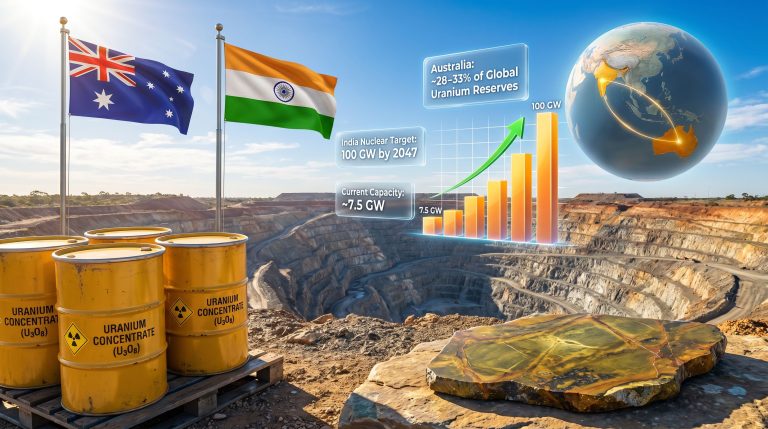
To understand why Australia uranium exports to India carry long-term strategic weight, it is necessary to appreciate the scale of what India is attempting in its nuclear sector. The country currently operates 24 reactors with a combined net generating capacity of approximately 6.2 gigawatts. Its stated target is 100 GW of nuclear generating capacity by 2047. That trajectory implies roughly a sixteen-fold expansion over roughly two decades.
| Metric | Current Status | 2047 Target |
|---|---|---|
| Operating reactors | 24 | 100+ projected |
| Net nuclear generating capacity | ~6.2 GW | 100 GW |
| IAEA safeguards-eligible capacity | Less than 2 GW | Expanding with new builds |
| Primary uranium sources | Kazakhstan, Canada, Russia, France, Uzbekistan | Diversifying |
India's domestic uranium reserves are structurally inadequate to support this ambition. Unlike Canada or Kazakhstan, India does not possess large, economically viable uranium deposits relative to its demand trajectory. This is not a short-term supply gap that domestic production can eventually close. It is a permanent structural feature of India's nuclear programme, meaning the country will remain a major uranium importer for the foreseeable future. Furthermore, understanding the uranium supply-demand outlook helps contextualise just how significant India's long-term requirements will be for global markets.
The IAEA Safeguards Bottleneck
One nuance that frequently escapes coverage of this topic is that Australian uranium cannot simply flow to any Indian reactor. Under the terms of the bilateral agreement and Australia's own export control framework, Australian uranium is only permitted to supply reactors that fall under IAEA safeguards. As of mid-2026, fewer than 2 GW of India's total nuclear capacity qualifies under this requirement.
This is the binding constraint on near-term export volumes. Even with the administrative arrangements now in place, the pace at which India commissions new safeguards-compliant reactors will determine how quickly trade volumes can grow. India operates a unique three-stage nuclear programme designed around its substantial thorium reserves, which creates a complex fleet with varying fuel cycle requirements. The reactors most relevant to Australian uranium imports are pressurised heavy water reactors and light water reactors operating under IAEA oversight.
The practical implication is that projections of 2,500 tonnes of Australian uranium flowing annually to India by 2030, with an estimated export value of approximately AU$300 million per year, are contingent on India's reactor build programme proceeding on an accelerated schedule. These figures represent potential, not current trajectory.
Where Australia Fits in the Global Uranium Hierarchy
Australia is the world's fourth-largest uranium producer, sitting behind Kazakhstan, Canada, and Namibia in the global production rankings. Its 2024 production totalled approximately 4,600 tonnes of uranium, all of which was exported under strict civilian-use controls. Australia is a full NPT signatory and requires every uranium-purchasing nation to maintain rigorous bilateral safeguards as a precondition of any sale. In addition, the global uranium reserves picture reinforces Australia's long-term position as a major supplier capable of meeting sustained demand.
This export-only posture, combined with its strong non-proliferation credentials, makes Australia's uranium commercially distinctive. Buyers are not merely purchasing a commodity; they are purchasing supply security backed by one of the world's most stable and transparent resource governance frameworks.
The Competitive Landscape Australia Is Entering
Entering the Indian uranium market in mid-2026 means competing, or more precisely coexisting, with a group of well-established suppliers. Canada's Cameco signed a landmark long-term supply agreement with India's Department of Atomic Energy in March 2026. The terms of that deal illustrate the commercial scale that is available:
| Contract Parameter | Detail |
|---|---|
| Supplier | Cameco (Canada) |
| Buyer | India's Department of Atomic Energy |
| Volume | Nearly 22 million pounds of U₃O₈ |
| Delivery period | 2027 to 2035 |
| Estimated contract value | CAD 2.6 billion (approx. USD 1.9 billion) |
| Pricing structure | Market-related price terms |
Cameco had previously supplied India under a five-year contract beginning in 2015, giving it a significant first-mover advantage and an established operational relationship with India's nuclear establishment. Kazakhstan remains India's primary supplier through long-term contracts with Kazatomprom. Russia and France also supply uranium and nuclear technology under their own bilateral frameworks. Consequently, the ongoing Russian uranium import ban in the United States is already reshaping global supply flows, which may indirectly benefit Australia's positioning.
Australia is not entering this market to displace existing suppliers. India's nuclear ambitions are large enough to accommodate a diversified supplier base, and buyers of strategic commodities typically prefer diversification over concentration. Australia's value proposition rests on several distinct attributes:
- Rule-of-law governance and contract enforceability
- Geopolitical alignment and shared democratic institutions reinforced by the Quad framework
- Long-term treaty stability compared with suppliers whose geopolitical positioning carries greater risk
- Geographic proximity relative to Atlantic Basin producers, which carries logistical relevance for long-term supply chains
The Technical and Regulatory Complexity Beneath the Headlines
Uranium is not a commodity that moves through supply chains like iron ore or coal. Each shipment requires meticulous chain-of-custody documentation from mine gate to reactor loading. Under Australia's export control framework, end-use verification is mandatory for every transaction, meaning each tonne of Australian uranium must be traceable through the entire fuel cycle.
This compliance architecture creates real operational overhead for both exporter and importer. India's nuclear regulatory environment, while improving, is still developing relative to the institutional depth of established nuclear states. The administrative arrangement finalised in July 2026 specifically addresses these procedural dimensions, creating the operational layer that converts legal permission into executable trade.
Understanding the Uranium Fuel Cycle Relevant to India's Fleet
India's reactor fleet presents a technically interesting case for uranium exporters. Pressurised heavy water reactors, which form the backbone of India's existing nuclear capacity, use natural uranium fuel rather than enriched uranium. This means Australian uranium concentrate could theoretically flow directly into PHWRs without requiring enrichment services, reducing the number of intermediate steps in the supply chain.
However, India's newer light water reactors under construction require low-enriched uranium, which means enrichment services would need to be contracted separately. This creates an additional layer of supply chain complexity that Australian uranium exporters will need to navigate as India's fleet mix evolves over the coming decades.
Resource Diplomacy and the Indo-Pacific Strategic Context
Australian Prime Minister Anthony Albanese characterised the country's natural resources as vital for other nations' energy security and stability, articulating a vision of Australia as a reliable, trusted supplier in global energy markets. This framing is deliberate and consistent with a broader strategic positioning of Australian resources, including critical minerals demand such as lithium, cobalt, and rare earths, as instruments of Indo-Pacific diplomacy.
The uranium relationship with India sits within this larger context. India's energy security challenge is structural: rapid economic growth is driving electricity demand upward at the same time that international climate commitments are pushing against fossil fuel expansion. Nuclear power offers India a path toward large-scale zero-carbon baseload electricity that neither solar nor wind can currently match at the required scale. Australian uranium exports therefore carry a dual narrative: commercial resource trade and clean energy partnership.
Prime Minister Modi's framing of the July 2026 arrangement as advancing India's clean energy objectives reflects this understanding. The 100 GW nuclear target by 2047 is not purely an energy policy goal; it is also central to India's long-term decarbonisation strategy. Understanding the broader uranium market dynamics helps frame just how strategically significant this bilateral relationship may become over the next two decades.
The next major ASX story will hit our subscribers first
Frequently Asked Questions
Has Australia Actually Exported Uranium to India in Commercial Quantities?
As of mid-2026, the answer is effectively no. A small test shipment was dispatched in 2017, but no meaningful commercial volumes have followed despite the 2015 agreement being in force for over a decade. The July 2026 administrative arrangement is the mechanism intended to activate genuine commercial trade. For broader context, Australia's uranium production data illustrates the scale of resources available for export as trade agreements mature.
What Volume of Australian Uranium Could India Eventually Absorb?
Industry projections have pointed to a potential annual export volume of up to 2,500 tonnes, with an indicative value of approximately AU$300 million per year. Realising this would require India to significantly expand its IAEA safeguards-compliant reactor fleet, a process measured in decades rather than years. Given that Australia's total uranium production in 2024 was approximately 4,600 tonnes, the Indian market alone could represent more than half of current national output if projections are eventually realised.
Why Is India Allowed to Import Uranium Despite Not Signing the NPT?
India has maintained a strong non-proliferation record despite remaining outside the NPT framework. The 2008 IAEA safeguards agreement and the subsequent NSG exemption created a legal pathway for international nuclear trade with India that does not require NPT membership. Australia satisfies its own non-proliferation obligations through the bilateral safeguards treaty, which restricts all exported uranium to civilian peaceful uses under IAEA oversight.
Key Takeaways for Understanding Australia Uranium Exports to India
The July 2026 administrative arrangement is genuinely significant, but it should be understood precisely for what it is: the closure of a procedural gap rather than the opening of an immediately large commercial relationship.
- Over a decade of diplomatic work now has an operational activation mechanism in place
- Commercial export volumes remain near zero and will grow only as India expands safeguards-compliant capacity
- Cameco's CAD 2.6 billion contract with India's Department of Atomic Energy sets a high-value benchmark for what is commercially achievable
- Australia's competitive positioning is built on geopolitical reliability, not price competition
- The binding constraint on volume growth is the pace of India's IAEA-compliant reactor commissioning programme
- The 100 GW nuclear target by 2047 creates one of the largest long-term uranium demand opportunities in the global market
This article contains forward-looking projections related to uranium export volumes, contract values, and India's nuclear capacity targets. These figures are based on publicly available industry estimates and government announcements. Actual outcomes will depend on regulatory developments, India's reactor build programme, market pricing conditions, and bilateral trade dynamics. Nothing in this article constitutes financial or investment advice.
Want To Capitalise on the Next Major Uranium Discovery Before the Market Catches On?
Discovery Alert's proprietary Discovery IQ model scans ASX announcements in real time, instantly identifying significant mineral discoveries — including uranium — and turning complex data into actionable insights for traders and investors at every level. Explore historic discoveries and the returns they generated, then begin a 14-day free trial at Discovery Alert to position yourself ahead of the market.