July 9, 2026
The Raw Material Trap: Why Africa's Uranium Giants Capture So Little of the Value They Create
Across the global nuclear fuel cycle, a quiet but profound economic injustice has persisted for decades. Nations that extract uranium from the earth frequently receive the smallest share of the value that uranium ultimately generates. The countries operating enrichment facilities, conversion plants, and fuel fabrication infrastructure capture revenues that dwarf those earned at the mine gate. For Namibia, one of the world's most significant uranium producers, this imbalance has defined its economic relationship with the nuclear sector since commercial mining began. That dynamic is now being directly challenged through Namibia domestic uranium processing talks with CGN, marking a potential inflection point in how Africa's resource-rich nations position themselves within high-value industrial supply chains.
When big ASX news breaks, our subscribers know first
Understanding Namibia's Position in the Global Uranium Market
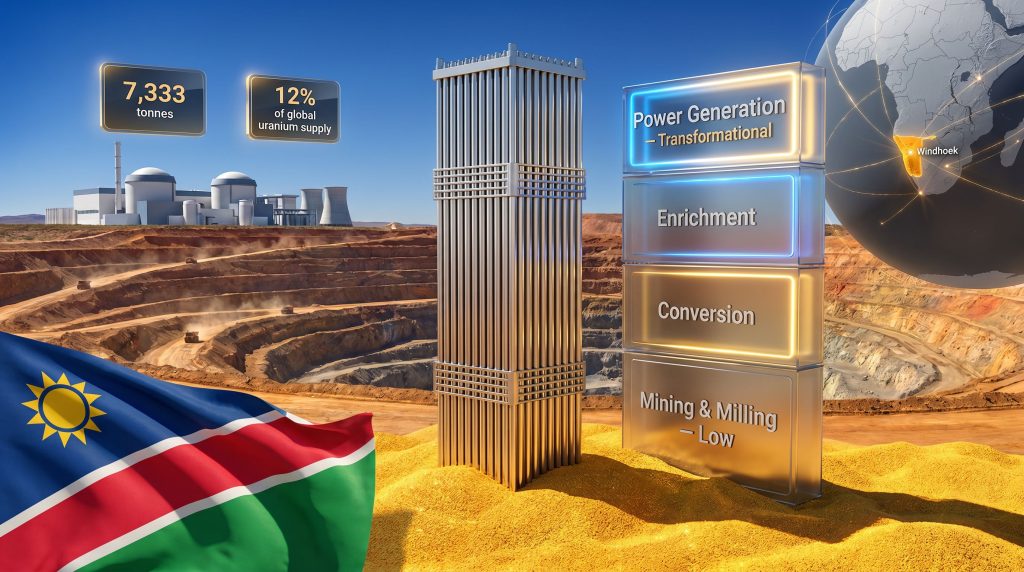
Namibia's uranium credentials are formidable on paper. The country ranks as the world's third-largest uranium producer, responsible for approximately 12% of global uranium supply, according to the World Nuclear Association. In 2024 alone, output reached 7,333 tonnes, concentrated across three producing operations: Rössing, Husab, and Langer Heinrich.
What makes this production profile particularly striking is the ownership structure sitting behind it. Both Rössing and Husab are majority-owned by Chinese interests, with China General Nuclear Power Corporation (CGN) holding a controlling stake in Husab through its subsidiary Swakop Uranium. Langer Heinrich, operated by Paladin Energy, resumed production in 2024 following a period of care and maintenance. Taken together, these three mines represent a significant concentration of global uranium supply within a small southern African nation that currently retains almost none of the downstream economic value.
According to United Nations international trade data cited by Energy Intelligence, virtually all of Namibia's uranium output in 2024 was exported to China in raw form. The country functions, in economic terms, as a supplier of primary feedstock to a foreign industrial ecosystem, with the conversion, enrichment, and fuel fabrication stages occurring entirely outside its borders. Furthermore, the uranium supply challenges facing the global market make this structural imbalance even more pressing to resolve.
The gap between mining-stage revenues and fuel-fabrication-stage revenues within the nuclear fuel cycle is not marginal. Countries that process uranium through to fuel assembly earn multiples of the per-tonne revenue captured at the yellowcake stage.
The Nuclear Fuel Cycle: Where Value Actually Accumulates
To understand why Namibia's strategic pivot matters, it helps to map where economic value is actually generated across the nuclear fuel cycle. The progression from mined ore to usable reactor fuel involves several technically distinct and increasingly lucrative stages:
| Fuel Cycle Stage | Description | Relative Value Captured |
|---|---|---|
| Mining and Milling | Ore extracted and processed to produce yellowcake (U₃O₈) | Low |
| Conversion | Yellowcake converted to uranium hexafluoride (UF₆) for enrichment | Moderate |
| Enrichment | Uranium-235 concentration increased to required fissile levels | High |
| Fuel Fabrication | Enriched uranium formed into pellets and assembled into fuel rods | Very High |
| Power Generation | Reactor uses fuel assemblies to produce electricity | Transformational |
Namibia currently operates exclusively at the first stage. The government's stated strategic objective is to advance domestically through at least the conversion stage, with longer-term ambitions extending into power generation. Even partial movement up this value chain would substantially increase the economic return per tonne of uranium produced, generating greater export revenues, higher tax receipts, and more sophisticated employment.
A critical but underappreciated technical point: the conversion stage, where yellowcake becomes uranium hexafluoride, requires specialised chemical processing infrastructure but is less capital-intensive than enrichment. For a nation beginning its domestic processing journey, conversion represents a more accessible entry point than attempting to build enrichment capacity, which carries both enormous cost and significant geopolitical sensitivity under international non-proliferation frameworks.
CGN's Role: From Mine Owner to Potential Nuclear Partner
The visit by President Netumbo Nandi-Ndaitwah to CGN's headquarters in Shenzhen's Guangdong Province was not a ceremonial formality embedded within a broader diplomatic schedule. It represented the most concrete public signal yet that Windhoek is prepared to convert years of rhetorical commitment to value addition into structured negotiations with a partner capable of actually delivering industrial transformation.
CGN occupies a unique dual position in Namibia's uranium sector. As the majority owner of Husab, it is simultaneously one of the country's most important commercial partners and its largest uranium customer. This structural relationship creates both opportunity and complexity in the context of Namibia domestic uranium processing talks with CGN.
On the opportunity side, CGN's operational familiarity with Namibian geology, labour markets, and regulatory conditions removes barriers that would face a new market entrant. The company understands the resource base intimately. On the complexity side, a partner that profits from purchasing raw uranium at the lowest value tier of the supply chain has structurally mixed incentives when it comes to supporting its supplier's ambitions to capture more of that value domestically.
CGN's global nuclear construction footprint is relevant context here. According to International Energy Agency data, the corporation was overseeing construction of approximately half of the 63 nuclear reactors being built worldwide at the close of 2024. This depth of project delivery experience is unmatched among potential partners for a first-of-kind nuclear facility in sub-Saharan Africa, and it explains why Namibia has identified CGN as the lead candidate for its nuclear power plant ambitions despite the geopolitical tensions surrounding Chinese nuclear involvement in Africa.
Namibia's Parallel Diplomatic Track: Engaging the West
What distinguishes Namibia's strategic approach from that of other African uranium producers is the deliberate cultivation of multiple competing partnerships rather than exclusive alignment with a single geopolitical patron. The country has constructed a timeline of engagements that spans both Chinese and Western interests:
| Event | Date | Significance |
|---|---|---|
| Former President Mbumba meets Chinese FM Wang Yi | January 2025 | Uranium value addition raised formally at ministerial level |
| NIDA signs MOU with NANO Nuclear Energy (USA) | June 2025 | Western technology partnership for domestic processing established |
| US Department of Energy signals strategic interest | April 2026 | Washington formally confirms intent to engage Namibia's uranium sector |
| President Nandi-Ndaitwah tours CGN, Shenzhen | July 2026 | Nuclear plant discussions formally initiated at head-of-state level |
The Namibia Industrial Development Agency's memorandum of understanding with US-based NANO Nuclear Energy, signed in June 2025, is particularly noteworthy because it specifically addresses small modular reactor technology. This is an area where American firms are competing aggressively with Chinese counterparts for influence in emerging nuclear markets.
The US Department of Energy's April 2026 confirmation of interest in Namibia's uranium sector reflects a broader Washington strategic objective of reducing Chinese dominance over African critical minerals demand and supply chains. Namibia, producing roughly one-eighth of global uranium supply, represents a high-value target in that competition.
Namibia's deliberate multi-partner strategy mirrors a broader pattern observable across African resource-rich nations: leveraging great-power competition to extract more favourable terms from all parties rather than accepting a single patron's conditions.
Why Small Modular Reactors May Suit Namibia's Needs
Namibia's electricity demand profile is modest relative to the output of conventional large-scale nuclear reactors. A gigawatt-class reactor would likely overshoot Namibia's current grid absorption capacity and require decades of demand growth to justify the capital commitment. This is where small modular reactor (SMR) technology enters the strategic calculus in a meaningful way.
SMRs are compact nuclear power units typically rated below 300 megawatts of electrical output, compared to the 1,000 megawatts or more common in conventional reactor designs. Their relevance to Namibia's situation stems from several distinct characteristics:
- Lower upfront capital requirements make the financing burden more manageable for a developing economy
- Faster construction timelines compress the period between investment commitment and first electricity generation
- Modular scalability allows Namibia to add generating capacity incrementally as domestic demand grows
- Factory fabrication of key components can reduce on-site construction risks and cost overruns
- Suitability for remote grid integration addresses the challenges of Namibia's dispersed population and infrastructure
The NANO Nuclear Energy MOU specifically explores SMR applications, indicating that Namibia is simultaneously evaluating both large-scale conventional reactor options through CGN and compact modular alternatives through American partners. This technology-agnostic approach reflects sophisticated negotiating strategy rather than indecision.
The next major ASX story will hit our subscribers first
Structural Energy Vulnerability Driving the Nuclear Agenda
Namibia's interest in nuclear power is not purely aspirational. The country faces a structural electricity deficit that constrains industrial growth and raises operating costs across the economy. Heavy dependence on electricity imports, predominantly from South Africa, creates a vulnerability that worsens whenever South Africa's own generation capacity comes under pressure.
The government's 6th National Development Plan (NDP6) targets a minimum of N$20 billion in nuclear energy investment as a component of a broader industrialisation agenda. This policy commitment provides the fiscal and planning framework within which partnership discussions are taking place, though it is important to note that NDP6 represents a planning target rather than confirmed funding or project approval.
Domestic nuclear power generation would serve dual strategic purposes: reducing electricity import expenditure, thereby retaining more capital within the domestic economy, and providing a stable baseload generation source capable of supporting the energy-intensive processing facilities required for domestic uranium conversion and fabrication.
Lessons from Other Uranium-Producing Nations
Namibia is not navigating this challenge in isolation, and furthermore, the experiences of other uranium-producing countries offer instructive parallels:
- Kazakhstan uranium dominance as the world's largest producer has seen the country progressively build domestic conversion capacity and pursue structured joint ventures with both Russian and Chinese partners to move up the fuel cycle value chain. Its approach has been incremental rather than transformational, beginning with processing infrastructure before attempting enrichment.
- Canada maintains both world-class uranium production and advanced fuel fabrication capabilities within its borders, demonstrating that the full domestic value chain is achievable, though Canada's path benefited from decades of nuclear programme development and proximity to US market infrastructure.
- Niger, historically one of Africa's largest uranium producers, remained locked at the raw extraction stage throughout its most productive decades, with the majority of value captured by French interests operating the mines. This model represents precisely the outcome Namibia has publicly committed to avoiding.
The Kazakhstani model is arguably the most relevant reference point for Namibia given the comparable context of a large-volume uranium producer seeking to transition from raw exporter to processed goods supplier without the advanced industrial base that characterises Canadian or French nuclear infrastructure.
Geopolitical Risks Embedded in the CGN Relationship
The structural dependency created by CGN's majority ownership of Husab introduces negotiating complexities that Namibia's leadership will need to manage carefully. A partner with commercial interests in purchasing uranium at the lowest-cost stage of the supply chain has inherently mixed incentives regarding the supplier nation's industrialisation ambitions. In addition, broader uranium market dynamics at the global level further complicate these negotiations.
Does the Russian Uranium Import Ban Create an Opportunity?
An additional complication involves the US government's prior designation of CGN on export restriction lists related to national security considerations. This status could create technical barriers to any nuclear technology transfer arrangements involving Western-origin components or intellectual property. The Russian uranium import ban has also reshaped global supply dynamics, potentially strengthening Namibia's negotiating position as Western buyers seek alternative sources.
Namibia's multi-partner approach partially hedges this risk by maintaining active engagement with US and other Western counterparts, but the operational reality is that CGN's existing ownership stakes in Namibian uranium infrastructure give it structural leverage that diplomacy alone cannot entirely offset.
What Success Would Mean for the Broader Region
The implications of Namibia successfully advancing into domestic uranium processing and nuclear power generation extend well beyond its own borders. Sub-Saharan Africa has no operating nuclear power plants outside South Africa's Koeberg facility, which has been generating electricity since the 1980s. A first-of-kind nuclear facility in Namibia would establish a new regional reference point and potentially catalyse similar ambitions among other uranium-producing African nations.
The workforce development requirements of a domestic nuclear industry are themselves transformative. Nuclear engineering, radiation safety management, plant operations, and regulatory compliance represent high-skill, high-wage employment categories that differ fundamentally from the labour profiles of open-pit uranium mining. Technology transfer commitments from any partnership arrangement would need to include structured skills development pathways capable of building this capacity domestically over time.
Consequently, the compounding effect of higher-value uranium exports, reduced electricity import costs, and expanded industrial activity could meaningfully shift Namibia's revenue base, providing greater fiscal headroom for public investment under NDP6 and successive planning frameworks. Namibia domestic uranium processing talks with CGN therefore carry significance that extends far beyond a single bilateral negotiation — they represent a test case for whether resource-rich African nations can successfully reposition themselves within global industrial value chains on terms that genuinely serve their long-term development objectives.
This article is intended for informational purposes only and does not constitute financial or investment advice. Statements regarding planned investments, construction timelines, and policy targets reflect publicly available information and government planning documents. Forward-looking elements involve uncertainty and should not be relied upon as confirmed outcomes.
Want to Track the Next Major Mineral Discovery Before the Market Does?
Discovery Alert's proprietary Discovery IQ model delivers real-time alerts on significant ASX mineral discoveries, transforming complex resource data into actionable investment insights for both new and experienced investors — explore historic discoveries and their returns to understand the opportunity, then begin your 14-day free trial to position yourself ahead of the broader market.