
July 9, 2026
When Underground Grades Defy Expectations: The Science Behind Uranium Assay Variances
The economics of underground uranium mining rest on a deceptively fragile foundation: the assumption that what instruments measure in the field closely mirrors what laboratory analysis later confirms. For most deposits, this assumption holds within a reasonably predictable margin. However, periodically, the gap between probe-indicated estimates and post-processing chemical assays widens dramatically, and when it does, the consequences ripple through revenue projections, resource valuations, and long-term development planning in ways that the market rarely fully prices in advance.
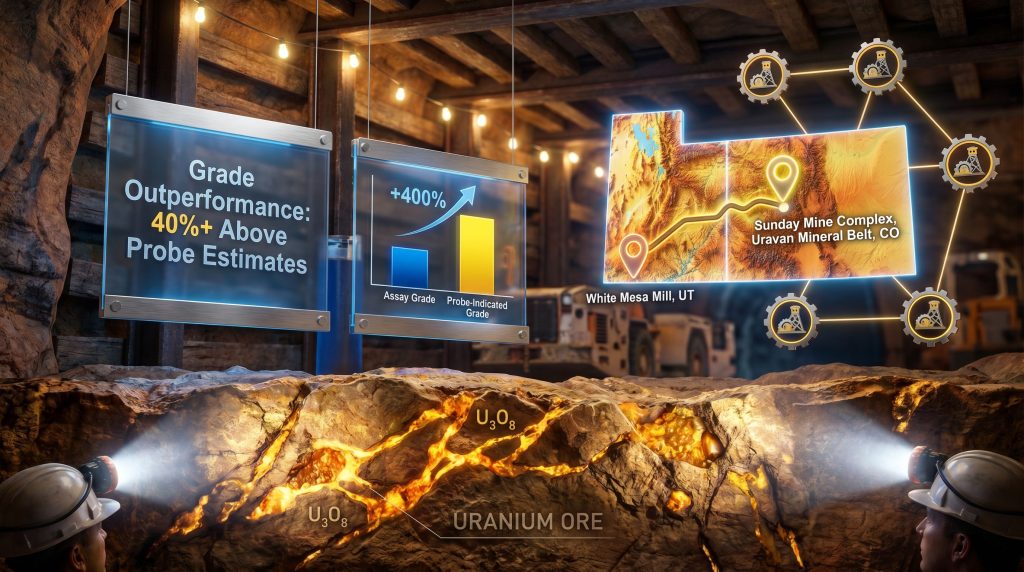
This is precisely the dynamic now unfolding at the Sunday Mine Complex in Colorado, where Western Uranium higher-than-expected uranium grades have emerged from chemical assay results conducted by Energy Fuels at the White Mesa Mill in Utah. The confirmed grade outperformance, coming in at more than 40% above field probe estimates at the point of ore delivery, represents one of the more significant positive variance events recorded at a conventional U.S. uranium operation in recent years. Understanding why this happened, what it means technically, and how it might reshape the broader resource narrative at Sunday Mine requires unpacking several layers of geological, analytical, and economic context.
When big ASX news breaks, our subscribers know first
What Probe-Based Grade Estimation Actually Measures and Why It Misses
The Physics of Downhole Gamma Logging in Uranium Mining
Probe-based grade estimation in uranium mining typically relies on downhole gamma-ray logging, a geophysical technique that measures the natural radioactive decay signature emitted by uranium-bearing minerals. The instrument records gamma radiation intensity along the borehole or stope face, and that signal is converted into an estimated uranium grade using calibration curves developed for the specific geological setting.
The critical limitation of this method is that it measures radioactive equilibrium, not actual uranium content. Uranium and its decay products must be in secular equilibrium for the gamma signal to accurately represent uranium grade. In geological settings where uranium has migrated, been leached, or where the ore body has experienced fluid movement, the decay products and the uranium itself may be spatially decoupled. This produces a condition known as disequilibrium, where the gamma signal either overstates or understates the true uranium concentration.
In the Colorado Plateau and Uravan Mineral Belt specifically, sandstone-hosted uranium-vanadium deposits are known for complex diagenetic histories involving multiple phases of fluid migration. This geological complexity increases the probability that probe readings and chemical assays diverge. Furthermore, a positive disequilibrium — where actual uranium content exceeds what the gamma log suggests — is the more favourable outcome and is precisely what the Sunday Mine Complex results appear to indicate.
- Gamma logging measures radiation from decay products, not uranium directly
- Secular equilibrium must be established for accurate grade estimation
- Fluid migration and leaching events disrupt equilibrium in sandstone-hosted deposits
- Positive disequilibrium means chemical assays will return higher grades than probes suggest
- The Uravan Mineral Belt's geological history makes disequilibrium a known, if underappreciated, variable
The Sunday Mine Complex: Five Mines, One Strategic Footprint
Geology, Structure, and the Uravan Mineral Belt Context
The Sunday Mine Complex operates across five interconnected underground mines within the Uravan Mineral Belt, a geological corridor spanning parts of southwestern Colorado and southeastern Utah that has been central to U.S. uranium and vanadium production since the early twentieth century. The belt's deposits are predominantly hosted in salt wash member sandstones of the Morrison Formation, a Jurassic-age fluvial sequence that serves as the principal uranium-vanadium host rock across the Colorado Plateau.
What makes the Uravan Mineral Belt geologically distinctive is the co-occurrence of uranium and vanadium in carnotite-type mineralisation. This dual-commodity characteristic is not simply a revenue bonus but reflects a specific geochemical environment where vanadium concentrations are high enough to precipitate alongside uranium during ore formation. For Western Uranium & Vanadium Corporation, this means the Sunday Mine Complex is simultaneously a uranium and vanadium producer, creating a dual revenue stream that provides economic resilience when either commodity experiences price softness.
The complex is currently advancing through an active production ramp-up phase, with ore deliveries proceeding under an Ore Purchase Agreement with Energy Fuels. The baseline resource estimates underpinning project economics were codified in a 2015 Technical Report, compiled from historical drilling data accumulated during prior production cycles spanning decades of intermittent activity in the belt. Understanding uranium supply-demand volatility adds further context to why this active ramp-up phase carries strategic weight.
Industry Context: The Uravan Mineral Belt produced significant quantities of uranium during the Cold War-era procurement programmes of the 1950s and 1960s. Many of the mines in the belt were subsequently placed on care and maintenance as uranium prices collapsed in the 1980s. This long operational hiatus means that modern analytical techniques have not been systematically applied across the full extent of mineralisation, creating the possibility that historical resource estimates systematically understate actual grades.
Breaking Down the 40%+ Grade Outperformance at White Mesa Mill
How the Ore Purchase Agreement Structure Creates Direct Financial Exposure to Assay Outcomes
Under the Ore Purchase Agreement structure governing the Sunday Mine delivery programme, payment to Western Uranium is calculated based on confirmed post-processing assay grades rather than probe estimates made at the point of delivery. This creates a direct and unambiguous financial link between laboratory results and revenue received.
| Measurement Stage | Method | Precision Level | Financial Role |
|---|---|---|---|
| At Mine Face | Gamma probe logging | Approximate field estimate | Initial delivery documentation |
| At Mill Delivery | Probe re-measurement | Confirmatory field estimate | Provisional basis for scheduling |
| Post-Processing Assay | Chemical dissolution and analysis | Laboratory precision | Final payment calculation |
The 40%+ positive variance recorded in the current delivery programme means the final payment received by Western Uranium was materially larger than projections based on probe data would have suggested. For investors modelling the company's near-term cash generation, this distinction is consequential because project-level financial models built on probe-grade assumptions will systematically understate revenue if positive disequilibrium is a persistent feature of the ore body. Consequently, understanding uranium market dynamics becomes increasingly important when assessing how such grade variances translate into investment value.
Three Geological Scenarios That Could Explain the Variance
-
Localised Enrichment Zone: The stopes mined during this delivery programme may have intersected a discrete zone of higher-grade uranium concentration not fully captured by historical drilling spacing. This would limit the broader resource implications to a defined area.
-
Disequilibrium Across a Defined Structural Domain: If the mineralisation within a particular structural zone of the Sunday Mine Complex has experienced uranium enrichment relative to its decay product suite, positive disequilibrium could affect a meaningful proportion of unmined areas while being absent in others.
-
Systematic Underestimation Across the Complex: If positive disequilibrium is a consistent geological characteristic of the broader Morrison Formation host rock at Sunday Mine, the 2015 Technical Report's resource estimates could materially understate the true uranium inventory across the entire complex. This is the most consequential but least certain interpretation.
Critical Caveat: A single delivery programme's assay results cannot statistically validate a resource-wide grade upgrade. Formal resource revisions require systematic sampling, updated geological modelling, and a revised technical report prepared under applicable reporting standards such as NI 43-101. The current result is an important operational data point but should not be treated as confirmation of a broader resource upgrade without supporting evidence.
White Mesa Mill: The Only Game in Town for Conventional U.S. Uranium Processing
Why Processing Infrastructure Concentration Shapes Junior Producer Strategy
Energy Fuels' White Mesa Mill in southern Utah holds a distinction that fundamentally shapes the economics of every conventional uranium miner operating on the Colorado Plateau: it is the only fully licensed and operational conventional uranium processing mill in the United States. This creates a structural dependency for junior producers who lack proprietary milling infrastructure, requiring them to enter toll-processing or ore purchase arrangements to convert mined ore into saleable uranium oxide.
The concentration of processing capacity at a single facility creates both opportunity and vulnerability for companies like Western Uranium. On the positive side, access to a licensed, operating mill eliminates the enormous capital burden and regulatory timeline associated with building proprietary processing infrastructure. On the risk side, any disruption to White Mesa Mill operations, or changes in its commercial terms, directly affects every junior producer dependent on the facility.
This dynamic provides important context for understanding why Western Uranium has identified the Mustang mineral processing plant site as a long-term strategic objective. Developing proprietary processing capacity would fundamentally alter the company's position within the value chain, reducing toll-processing costs, enabling direct control over recovery rates, and capturing margin that currently flows to the mill operator. The positive grade results from the Sunday Mine delivery programme strengthen the economic case for Mustang by demonstrating that the ore body contains more recoverable uranium than previously measured, potentially justifying the capital investment required for independent processing capability.
How U.S. Conventional Uranium Grade Compares to Global Benchmarks
Grade Context for Colorado Plateau Operations
| Grade Category | Uranium Content (U₃O₈) | Representative Operations |
|---|---|---|
| Very High Grade | Above 1% U₃O₈ | Cigar Lake, McArthur River (Athabasca Basin, Canada) |
| High Grade | 0.1% to 1% U₃O₈ | Selected Athabasca Basin ISR and underground mines |
| Conventional Grade | 0.05% to 0.1% U₃O₈ | Colorado Plateau underground operations |
| Low Grade | Below 0.05% U₃O₈ | Many in-situ recovery operations, some heap leach |
Colorado Plateau conventional underground mines, including those in the Uravan Mineral Belt, typically operate within the conventional grade range. This matters because at these grade levels, mining margins are inherently thin, making any sustained positive variance in confirmed grades disproportionately meaningful to project economics. A 40% grade uplift at conventional grades does not simply improve margins incrementally; it can shift a marginal project firmly into profitable territory or transform a financially viable project into a highly attractive one.
The United States imports the substantial majority of its uranium requirements, with domestic conventional mining representing a small fraction of total national consumption. This supply gap, combined with the operational status of the Sunday Mine Complex and shifting uranium price trends, positions assets demonstrating genuine grade quality in a favourable light within the broader market context.
The next major ASX story will hit our subscribers first
What Investors and Industry Observers Should Track Going Forward
Key Metrics and Milestones Worth Monitoring
The grade outperformance result opens several investigative and development pathways that will determine whether the Sunday Mine Complex's resource narrative undergoes a material revision or whether the current result is best understood as a localised positive event. For those new to assessing such opportunities, interpreting drill results and drill results interpretation are essential skills when evaluating what these assay variances may ultimately mean for resource models.
- Confirmatory drilling results: Any announcement of systematic sampling or infill drilling programmes targeting grade verification across unexplored areas of the Sunday Mine Complex
- Updated technical reporting: A new NI 43-101 compliant technical report incorporating post-2015 operational data and assay results would be the definitive test of whether the 2015 resource estimate requires revision
- Sustained assay outperformance across future delivery batches: If subsequent ore delivery programmes to White Mesa Mill continue to demonstrate positive variance between probe estimates and chemical assays, the geological case for systematic disequilibrium strengthens considerably
- Mustang mineral processing plant development milestones: Progress announcements on site evaluation, permitting studies, or prefeasibility work at Mustang would signal that proprietary processing ambitions are advancing toward execution
- Vanadium production metrics: Sunday Mine's co-production of vanadium provides a secondary revenue stream whose performance should be tracked alongside uranium output as an indicator of overall asset productivity
Summary Data Reference
| Metric | Detail |
|---|---|
| Grade Outperformance | More than 40% above probe-indicated estimates |
| Processing Destination | Energy Fuels' White Mesa Mill, Utah |
| Mine Location | Sunday Mine Complex, Uravan Mineral Belt, Colorado |
| Mine Structure | Five interconnected underground mines |
| Baseline Resource Reference | 2015 NI 43-101 Technical Report |
| Processing Agreement Structure | Ore Purchase Agreement (payment on confirmed assay) |
| Long-Term Processing Objective | Mustang Mineral Processing Plant site |
| Current Operational Status | Active production ramp-up phase |
| Geological Host | Morrison Formation sandstone, salt wash member |
The broader significance of Western Uranium higher-than-expected uranium grades at the Sunday Mine Complex extends beyond a single delivery programme's favourable result. It raises substantive questions about whether a decade-old technical report, built on historical drilling data from an era before modern analytical techniques were systematically applied, accurately captures the true uranium inventory of one of Colorado's most historically productive mining jurisdictions. Answering that question definitively will require systematic investigation, but the early evidence from the White Mesa Mill assays provides a compelling reason to pursue it.
Disclaimer: This article is for informational purposes only and does not constitute financial advice or a recommendation to buy or sell any securities. Forward-looking statements, resource projections, and scenario analyses involve inherent uncertainty. Readers should conduct their own due diligence and consult a qualified financial adviser before making investment decisions. Resource upgrade scenarios discussed herein are speculative and would require formal technical validation before being relied upon.
Want to Capitalise on Significant Mineral Discoveries Before the Broader Market?
Discovery Alert's proprietary Discovery IQ model delivers real-time alerts on significant ASX mineral discoveries — transforming complex geological and assay data into actionable investment insights for both short-term traders and long-term investors. Explore how historic discoveries have generated substantial returns on Discovery Alert's dedicated discoveries page, and begin your 14-day free trial today to position yourself ahead of the market.