June 18, 2026
The Geopolitical Calculus Reshaping Global Critical Mineral Investment
When a single nation controls the majority of the world's production of a material that every modern economy depends upon, the rest of the world eventually responds. That dynamic has defined the rare earth element market for decades, with China's dominance over both mining and processing creating a structural vulnerability that Western supply chains have been slow to address. The acceleration of that response — a trend evident across the geopolitical mining landscape — is redirecting significant private capital toward jurisdictions that can credibly offer scale, geology, and political workability. Brazil is emerging as one of the most compelling answers to that question, and the Australian billionaire steps up bet on Brazilian critical minerals narrative is one worth examining closely.
When big ASX news breaks, our subscribers know first
Brazil's Critical Minerals Landscape: Why Global Capital Is Paying Attention
A Resource Endowment That Rivals Any Nation on Earth
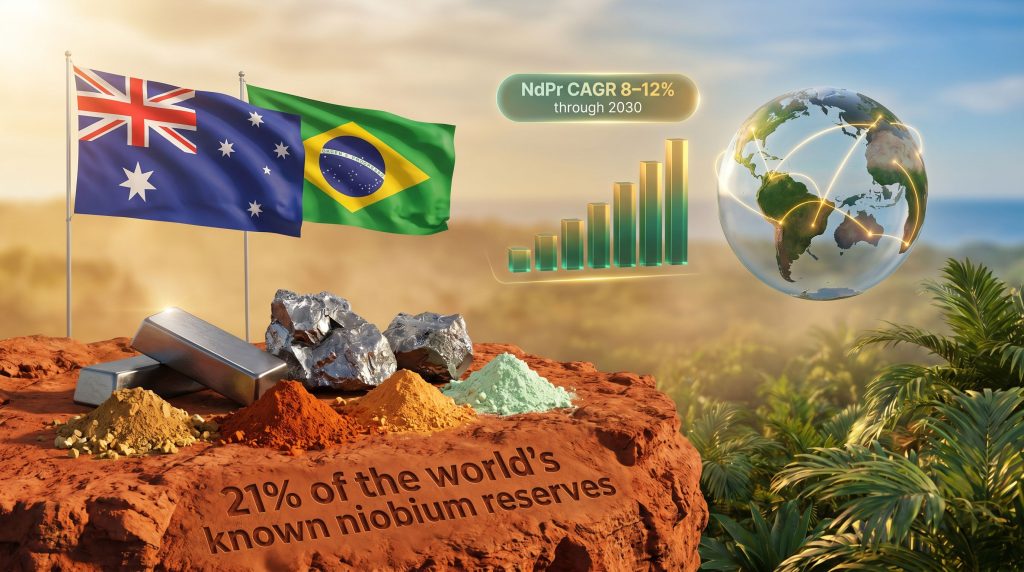
Brazil's geological inheritance is extraordinary by any measure. The country holds an estimated 21% of the world's known niobium reserves, the largest concentration of this element found anywhere on the planet. Alongside that, Brazil ranks among the top five nations globally for rare earth oxide reserves, with meaningful concentrations of lithium, titanium minerals, and nickel distributed across several under-explored geological provinces.
The key provinces of Minas Gerais, Goiás, and the Amazon basin have been mapped at a high level, but detailed resource characterisation across large portions of these regions remains immature relative to the scale of what is likely present. This exploration gap is itself an investment thesis: early-mover capital entering now can accumulate resource positions before full geological delineation drives valuations upward.
What makes Brazil's rare earth deposits particularly interesting from a technical standpoint is their hosting geology. A significant portion of Brazil's REE inventory occurs in ionic clay and carbonatite-hosted systems. Ionic clay deposits, in particular, carry a metallurgical advantage that is not widely appreciated outside specialist circles: the rare earth elements in these systems are adsorbed onto clay mineral surfaces rather than locked within hard crystalline mineral lattices.
This means they can often be leached at ambient temperature using relatively simple reagent systems, bypassing the energy-intensive cracking and roasting steps that add cost and complexity to hard-rock REE processing. The result is a potentially lower operating cost structure per unit of rare earth oxide produced.
Brazil's REE profile is also notably skewed toward the elements commanding the highest prices in current markets. Deposits across Goiás and Minas Gerais are rich in neodymium and praseodymium, collectively known as NdPr, which are the magnet metals at the core of permanent magnet motors used in electric vehicles and wind turbine generators. Demand for NdPr is forecast to grow at a compound annual growth rate of approximately 8 to 12 percent through 2030, driven by accelerating EV adoption and the rapid scaling of offshore wind capacity globally.
Despite holding world-class reserves, Brazil contributes a fraction of global REE production compared to China's 60 to 70 percent market share. That gap between reserve endowment and production output is precisely what makes the country a target for patient, long-horizon capital.
The Supply Chain Diversification Imperative
The pressure on Western manufacturers and governments to reduce exposure to Chinese-controlled critical mineral supply chains has intensified markedly. Furthermore, China's rare earth export restrictions between 2023 and 2025 have compounded this urgency considerably. Downstream policy frameworks in the United States and Europe, including the Inflation Reduction Act and the EU Critical Raw Materials Act, have embedded incentive structures that reward sourcing from non-Chinese supply chains. This creates a commercial pull, not just a political push, for Brazilian project development.
"Brazil is not simply a resource story. It is a geopolitical rebalancing story, with nations and private capital converging on Latin America's largest economy to build supply chain alternatives that reduce leverage held by a single dominant producer."
Brazil occupies a distinctive position in this landscape: resource-rich, geologically diverse, and increasingly aligned with Western supply chain priorities, while retaining its historically non-aligned foreign policy posture. That combination makes it acceptable to a wide range of consuming nations without the geopolitical complications that accompany fully Western-aligned mineral suppliers. In addition, rare earth supply chains globally are under increasing scrutiny, making Brazil's position even more strategically valuable.
Who Is Driving Australian Capital Into Brazil's Mining Sector?
Gina Rinehart and the Logic of High-Conviction Resource Positioning
Gina Rinehart, executive chairman of Hancock Prospecting and Australia's wealthiest individual, has established herself as one of the most prominent foreign investors backing Brazilian critical mineral development. Her involvement with Brazilian Rare Earths, a Brazil-based REE developer pursuing an ASX listing, carries significance beyond the capital itself. Rinehart's investment philosophy has historically centred on large-scale, long-duration resource positions in jurisdictions with structural supply advantages.
The decision to step up exposure to Brazil signals that the country now satisfies that criteria in her assessment. This matters to other investors because anchor capital from a recognised resource billionaire performs a specific function in early-stage project financing. It compresses perceived sovereign and execution risk, reduces the cost of attracting subsequent institutional co-investors, and provides a credibility signal that ASX retail markets respond to.
When an investor with Rinehart's track record in bulk commodity development commits capital to a project in a complex jurisdiction, the implicit message is that the due diligence has been done and the risk-reward is considered favourable.
The Broader Australian Investment Wave
The movement of Australian capital into Brazil's critical minerals sector is not a single-actor phenomenon. A cohort of ASX-listed and Australian-backed developers has established material positions across Brazil's key geological provinces:
| Company | Project | Commodity Focus | Location |
|---|---|---|---|
| Brazilian Rare Earths | Pela Ema (Serra Verde) | Rare Earth Elements | Goiás |
| Viridis Mining | Colossus Project | Rare Earth Elements | Minas Gerais |
| Meteoric Resources | Caldeira Project | Rare Earth Elements | Minas Gerais |
| Hancock Prospecting (Rinehart) | Brazilian Rare Earths stake | REE / Critical Minerals | Brazil-wide |
What differentiates Australian mining capital from other foreign entrants is a combination of operational capability and capital market access. Australian investors and operators have deep experience in large-scale open-pit and bulk-tonnage extraction, directly applicable to Brazil's shallow, laterite-hosted REE deposits. The ASX also provides an institutional and retail investor base with genuine appetite for resource-stage risk, enabling earlier-stage funding than most other exchanges would support.
Niobium: The Strategic Mineral Most Investors Overlook
Why Near-Monopoly Supply Concentration Is Both an Asset and a Warning
While rare earths attract the majority of investor attention, Brazil's position in global niobium supply deserves careful examination. CBMM (Companhia Brasileira de Metalurgia e Mineração) extracts an estimated 85 percent of the world's niobium production from the Araxá deposit in Minas Gerais alone. Brazil as a whole accounts for roughly 90 percent of global supply.
Niobium's primary application is as a microalloying additive in high-strength low-alloy (HSLA) steel, where additions of as little as 0.02 to 0.05 percent by weight can reduce overall steel usage by up to 30 percent while improving strength, toughness, and weldability. This makes it essential to lightweight vehicle manufacturing, large-diameter pipeline construction, and structural steelwork in high-rise buildings. The efficiency gains it enables are so significant that automotive manufacturers treat it as effectively irreplaceable in their material specifications.
What is less widely understood outside specialist materials science circles is niobium's emerging role in next-generation battery technologies. Niobium-based oxide anode materials are being actively developed as alternatives to conventional graphite anodes in lithium-ion cells, offering substantially faster charge rates and improved safety characteristics. Several major battery manufacturers and research institutions in Japan, South Korea, and Europe are advancing this work.
If niobium anodes achieve commercial-scale adoption, the demand profile for the metal expands dramatically beyond its traditional steel market. The concentration of global supply in a single country, and largely within a single deposit, represents both a commercial opportunity for Brazil and a supply security concern for consuming industries.
Investment Structure and the Path to Project Financing
How Australian Capital Flows Into Brazilian Assets
The preferred entry mechanism for Australian investors targeting Brazilian critical minerals has been direct equity participation in project-stage companies, often structured ahead of or concurrent with ASX listing events. Brazilian Rare Earths' planned ASX listing exemplifies a dual-jurisdiction capital formation strategy: operating assets and geological resources in Brazil, while accessing Australian capital markets for development funding.
This structure creates a specific value creation pathway:
- Pre-IPO positioning by anchor investors at discounted entry valuations.
- ASX listing providing price discovery and liquidity for early capital.
- Resource definition drilling upgrading resource classifications and expanding the JORC-compliant resource base.
- Feasibility studies converting geological potential into bankable financial projections.
- Offtake agreements with Tier 1 industrial consumers validating market access and project economics.
- Project financing from institutional lenders and strategic industrial partners.
Developing a mid-scale rare earth processing facility in Brazil typically requires US$200 to US$600 million in capital expenditure from feasibility through to first production. This range varies significantly depending on processing complexity, infrastructure access, and whether the project can leverage existing grid connections and transport corridors.
M&A Dynamics and Strategic Consolidation
The Brazilian critical minerals sector is entering a consolidation phase. Well-capitalised acquirers are targeting exploration-stage assets that have demonstrated resource scale but lack the balance sheet to progress through feasibility and permitting. Cross-border M&A in this sector navigates a specific regulatory architecture, including the Agência Nacional de Mineração (ANM) for mining rights, IBAMA for environmental licensing, and CADE for competition review of significant transactions.
Understanding this regulatory stack is a genuine competitive advantage. Projects near sensitive Cerrado biome or Amazon-adjacent ecosystems face the most complex environmental pathways, while those in already-disturbed agricultural or industrial zones can move materially faster through IBAMA processes. Investors who have done the jurisdictional work to identify which assets sit in which regulatory category are better positioned to assess realistic development timelines.
Brazil vs. Other Critical Mineral Jurisdictions
A Comparative Framework for Capital Allocation Decisions
| Jurisdiction | Key Critical Minerals | Geopolitical Alignment | Regulatory Complexity | Infrastructure Maturity | Chinese Supply Chain Exposure |
|---|---|---|---|---|---|
| Brazil | REE, Niobium, Lithium, Nickel | Non-aligned / Western-leaning | High | Moderate | Low |
| Australia | Lithium, REE, Nickel, Cobalt | Strong Western alignment | Moderate | High | Moderate |
| Democratic Republic of Congo | Cobalt, Copper | Variable | Very High | Low | High |
| Canada | Lithium, REE, Nickel | Strong Western alignment | Moderate | High | Low |
| China | REE, Lithium, Tungsten | State-controlled | Low (domestic) | Very High | Dominant |
Brazil's comparative position reveals an important nuance: the regulatory complexity that deters undercapitalised entrants is the same feature that protects the competitive position of those who successfully navigate it. Permitting timelines of 3 to 7 years from exploration licence to production approval are long by global standards, but they create structural barriers to entry that reward early movers. Consequently, the critical minerals demand surge globally is compressing the available window for advantageous early positioning.
The next major ASX story will hit our subscribers first
Risk Factors Every Investor Must Understand
What Can Go Wrong and How to Think About It
No assessment of the Brazilian critical minerals opportunity is complete without honest engagement with the downside scenarios:
- Currency risk: The Brazilian Real has historically been volatile against both the USD and AUD. Since project operating costs are largely BRL-denominated while revenues are USD-priced, exchange rate movements can materially affect project economics without any change in physical commodity prices.
- Environmental licensing: IBAMA's review processes are rigorous and can be extended by legal challenges from community or environmental groups. Projects that underinvest in community engagement and environmental baseline studies face the highest risk of extended delays.
- Infrastructure gaps: Many of Brazil's most prospective mineral provinces are located in areas with limited rail, port, and grid access. The capital cost of self-funding infrastructure, or the timeline cost of waiting for public investment, must be factored into project economics from the outset.
- Political transition risk: Changes in federal or state government can shift royalty frameworks, environmental enforcement priorities, and the practical pace of administrative approvals, even when underlying legislation remains stable.
- Chinese SOE competition: While regulatory scrutiny of Chinese state-owned enterprise participation in Brazilian strategic mineral assets has increased under recent policy settings, Chinese capital remains active in the Brazilian mining sector and can offer financing terms that private Western investors cannot match.
Disclaimer: The analysis above reflects publicly available information and industry assessments. It does not constitute financial advice. All investment decisions involving resource-stage companies carry material risk, including the possibility of total capital loss. Readers should seek independent financial advice before making investment decisions.
The Supply Chain Endgame: What Production Actually Means for Global Markets
From Exploration Asset to Geopolitical Infrastructure
If the Brazilian REE projects currently in advanced exploration or feasibility stages reach commercial production through the late 2020s and early 2030s, their collective contribution could reach 5 to 15 percent of ex-China NdPr supply. That figure sounds modest, but its significance is disproportionate: in a market where the marginal supplier sets pricing leverage, an incremental 10 percent of supply from a non-Chinese source substantially changes the negotiating dynamics between Chinese producers and Western consumers.
The more transformative scenario — and the one that the Brazilian federal government's critical minerals industrialisation agenda is oriented toward — involves building downstream processing capability within Brazil. Rather than exporting raw ore or concentrate, the ambition is to produce magnet-grade REE oxides and eventually alloys within Brazilian borders. If achieved, this shifts Brazil from a raw material exporter to a participant in the higher-margin stages of the critical minerals value chain, and provides EV manufacturers and wind turbine producers with an offtake source that is further separated from Chinese processing dominance.
Offtake agreements with Tier 1 automotive OEMs, magnet manufacturers, or government-backed strategic reserves remain the critical validation mechanism that converts geological potential into bankable project economics. Australian-backed Brazilian developers are actively engaging Japanese, Korean, European, and North American industrial consumers for precisely this reason. Moreover, critical minerals and energy security considerations are elevating the strategic importance of these offtake arrangements well beyond simple commercial transactions.
Near-Term Catalysts and the Long-Term Structural Case
What to Watch Between 2025 and 2027
Several near-term developments will materially inform how this investment theme evolves:
- ASX listing milestones for Brazilian Rare Earths will test market appetite for Brazilian critical mineral equity at current valuations.
- Brazilian federal mining code reform progress could accelerate or complicate permitting timelines across the sector.
- U.S.-China trade tension escalation or resolution around critical mineral export controls will directly influence the urgency with which Western manufacturers seek alternative supply.
- Offtake agreement announcements from Tier 1 industrial consumers will serve as the most credible validation of project economics.
- NdPr price movements driven by EV adoption curves will affect the financial attractiveness of development capital deployment.
The long-term structural case rests on the convergence of EV adoption, defence procurement mandates, and clean energy infrastructure buildout creating a multi-decade demand floor for the critical minerals in which Brazil specialises. As reported by the AFR, the current wave of investment from figures such as Rinehart underscores the seriousness with which Australia's top resource capital is treating this structural shift. The Australian billionaire steps up bet on Brazilian critical minerals is best understood not as speculative positioning on a short-term commodity cycle, but as early-stage infrastructure construction for a supply chain architecture that the global economy will depend upon for decades to come. The investors moving now are placing long-duration bets on a structural transformation, and the geological, geopolitical, and commercial fundamentals supporting that bet are, on balance, compelling.
Want to Identify the Next Major Critical Mineral Discovery Before the Broader Market?
Discovery Alert's proprietary Discovery IQ model scans ASX announcements in real time, instantly alerting subscribers to significant mineral discoveries across rare earths, niobium, and other critical commodities — turning complex geological data into actionable investment insights. Explore how major mineral discoveries have historically generated exceptional returns on Discovery Alert's discoveries page, and begin your 14-day free trial today to position yourself ahead of the market.