
August 23, 2026
The Hidden Resource Stream Powering America's Critical Minerals Future
The global race to secure critical minerals rarely focuses on what already exists inside the billions of electronic devices reaching end-of-life every year. Primary mining dominates the conversation, with new deposits, drilling programmes, and extraction timelines attracting the bulk of investor and policy attention. Yet a parallel supply stream — one embedded in enterprise server rooms, decommissioned manufacturing lines, and obsolete consumer electronics — quietly holds some of the most concentrated deposits of rare earth elements and strategic materials available to Western economies. The challenge has never been whether these materials exist in sufficient volumes, and understanding Paladin Envirotech e-waste recycling sites reveals how this challenge is being addressed at scale across America's domestic supply chain.
When big ASX news breaks, our subscribers know first
Why the Last Mile of Electronics Retirement Has Always Failed Critical Minerals Recovery
The concept of urban mining — recovering metals and rare earth elements from manufactured goods rather than extracting them from the earth — has existed as an industry aspiration for decades. In practice, the recovery rates for the most strategically valuable materials have remained disappointingly low. Understanding why requires tracing the lifecycle of end-of-life electronics past the point where most analysis stops.
When an organisation retires a batch of servers, laptops, or industrial control systems, the immediate priorities are data security and compliance. The physical fate of the material is often secondary, delegated to whichever logistics provider offers the most convenient collection arrangement. For large enterprises with high volumes, dedicated IT asset disposition (ITAD) providers offer structured programmes with documented chain-of-custody processes. For smaller and mid-sized organisations, however, the options narrow considerably.
This is where the last-mile problem becomes a critical minerals problem. Devices that cannot meet the volume thresholds or logistics requirements of enterprise-focused providers tend to follow one of two paths:
- They accumulate in storage, delaying recovery and degrading the condition of reusable components
- They enter low-grade mechanical shredding streams that recover bulk metals like steel, aluminium, and copper while losing rare earth elements entirely
Neither pathway captures the neodymium in hard drive magnets, the dysprosium in precision motors, or the indium and gallium embedded across circuit boards and display assemblies. These materials — critical to defence electronics, wind turbine generators, and electric vehicle drivetrains — are effectively written off at the collection stage rather than the processing stage. Furthermore, growing critical minerals demand for clean energy and defence applications makes this loss increasingly costly at a national level.
The failure of conventional recycling to recover rare earth elements is not primarily a technology problem. It is an infrastructure distribution problem. Materials cannot be processed if they never reach the right facility.
What Paladin Envirotech Actually Does and Why Its Model Is Different
Paladin Envirotech operates across the intersection of secure ITAD services and high-value materials recovery, a combination that distinguishes it from both conventional recyclers and pure-play rare earth processors. Its service scope extends well beyond mechanical processing, encompassing downstream vendor management, certified data destruction (both physical and logical), component testing and repair assessment, dismantling and material sorting, and downstream rare earth element recovery.
The company maintains an international operational presence with facilities in the Netherlands, South Korea, and Ireland, giving it the infrastructure to manage multinational equipment retirement programmes under consistent compliance standards. Its expanding US network brings this same framework to domestic markets that have historically lacked structured, distributed access to high-value electronics recycling services.
The ADR Technology Advantage
The materials recovery dimension of Paladin Envirotech's model is built around a partnership with Critical Minerals Recycling, which holds the patent on Advanced Dissolution Recycling (ADR) technology. This process represents a fundamental departure from how most e-waste is handled at the processing stage.
Conventional mechanical shredding reduces electronics to mixed material fractions. Bulk metals are separated and recovered at reasonable rates, but rare earth elements — which are present in relatively small concentrations and tightly integrated into components — are lost to mixed streams that cannot economically justify rare earth separation. Consequently, materials worth considerably more per kilogram than the bulk metals being recovered are effectively discarded.
ADR technology approaches the problem differently by using selective chemical dissolution to target specific rare earth elements and strategic materials, achieving recovery yields that mechanical processing cannot replicate. The key characteristics that differentiate this approach include:
- Material specificity: The process targets individual rare earth elements rather than recovering a mixed concentrate
- Scalability: The technology can be deployed across distributed processing sites rather than requiring centralised megafacilities
- Environmental profile: Chemical dissolution of targeted materials from existing waste streams carries a substantially lower environmental footprint than primary mining operations
- Supply chain controllability: Recovered materials enter domestic manufacturing supply chains directly, bypassing the foreign processing dependencies that affect conventionally mined rare earths
A Complete Map of Paladin Envirotech's US E-Waste Recycling Sites
The expansion of Paladin Envirotech's US network through mid-2026 has created a distributed collection and processing infrastructure spanning seven locations across the country. The Paladin Envirotech e-waste recycling sites collectively address geographic coverage gaps that previously pushed electronics retirement volumes into lower-value processing channels.
| Location | State | Facility Size | Primary Service Region | Status |
|---|---|---|---|---|
| Laurel | Maryland | Core hub | DC / Baltimore corridor | Operational (opened February 2026) |
| Columbus | Ohio | ~40,000 sq ft | Midwest processing centre | Operational |
| Dallas (Wylie) | Texas | ~15,000 sq ft | South-Central US | Operational |
| Lacey (Olympia) | Washington | ~15,000 sq ft | Pacific Northwest | Operational |
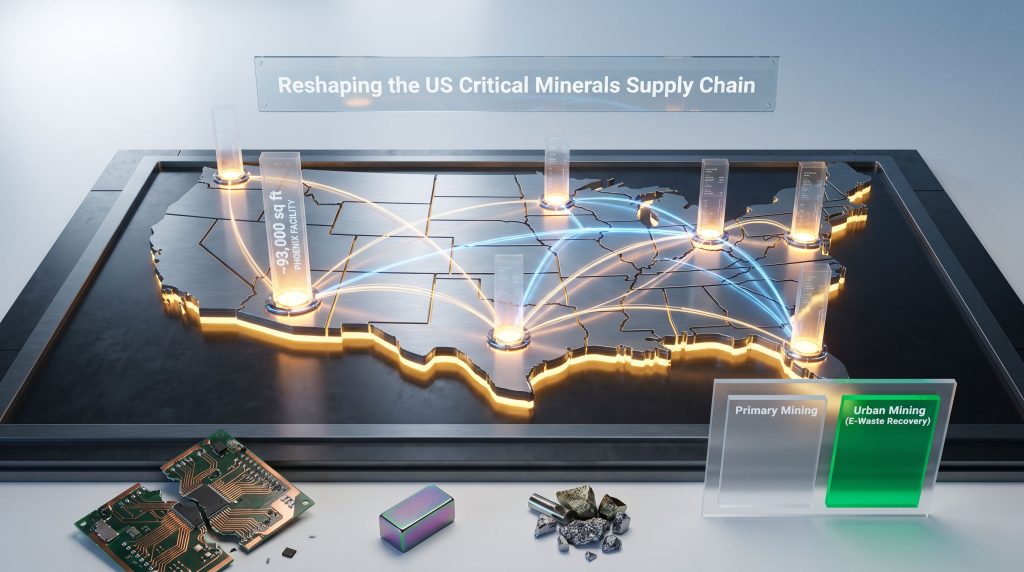
| Phoenix | Arizona | ~93,000 sq ft | Southwest (AZ, NV, Southern CA, NM) | Operational (announced June 2026) |
| Tampa | Florida | TBC | Southeast US | Network listed |
| St. Cloud | Minnesota | TBC | Upper Midwest | Network listed |
The Phoenix acquisition is particularly significant in terms of scale. At approximately 93,000 square feet, it is the largest of the newly announced US facilities and was acquired as an existing shredding and mechanical processing operation, providing immediate processing capacity from day one. Combined with all existing sites, Paladin Envirotech's total global operational footprint is now approaching 600,000 square feet.
Regional Coverage Analysis
Each site addresses a distinct geographic market with its own electronics retirement volume profile:
Mid-Atlantic (Laurel, Maryland): The first Paladin Recycle Local satellite to launch, serving the Washington DC and Baltimore corridor, which generates substantial e-waste volumes from federal contractors, technology firms, and defence sector organisations.
Midwest (Columbus, Ohio): At 40,000 square feet, Columbus functions as a core processing centre for the broader Midwest region, handling volumes beyond what a standard satellite intake facility would manage.
South-Central (Dallas/Wylie, Texas): Positioned to capture high-volume commercial and industrial electronics retirement across Texas and adjacent states, a market that had previously lacked structured local collection options.
Pacific Northwest (Lacey, Washington): Serves the technology-intensive Olympia and Seattle corridor, where the density of technology sector employers generates consistent enterprise-grade e-waste volumes.
Southwest (Phoenix, Arizona): Represents the company's entry into a previously uncovered region, with a service territory covering Arizona, Nevada, Southern California, and New Mexico.
How the Hub-and-Satellite Architecture Solves a Structural Problem
The operational logic behind the Paladin Recycle Local network addresses a specific market failure: the mismatch between where e-waste is generated and where processing infrastructure has historically been concentrated. In addition, the US critical minerals landscape has made domestic recovery infrastructure far more strategically urgent than it was even five years ago.
The Six-Stage Processing Workflow
Each site across the network operates under a standardised processing sequence:
- Secure intake and chain-of-custody documentation at the regional facility, establishing legal and compliance records from the moment material arrives
- Physical and logical data sanitisation, including certified data destruction that meets regulatory requirements for sensitive information held on retiring equipment
- Dismantling, sorting, and categorisation of end-of-life electronics by material type and recovery pathway
- Testing and repair assessment to identify components suitable for reuse or resale, maximising the value recovered from each batch
- Materials recovery and downstream processing, including rare earth element extraction via the ADR technology pathway for qualifying material streams
- Reporting and compliance documentation returned to the originating organisation, supporting their own environmental and data security obligations
Why Distributed Infrastructure Outperforms Centralised Models
A single large processing facility, however technically advanced, creates a structural barrier to collection. Transport costs scale with distance and become prohibitive for smaller volumes. Collection scheduling becomes less responsive as route distances increase. These friction points push small and mid-sized organisations toward whichever option is most convenient rather than most value-preserving.
The hub-and-satellite model reduces these friction points systematically. Smaller satellite intake points positioned close to where electronics are retired lower the logistics cost per unit. Faster collection turnarounds reduce the incentive to stockpile material or route it to lower-quality alternatives. Standardised operating controls applied uniformly across all nodes ensure that compliance standards do not vary with facility size.
The Critical Minerals Security Argument for Urban Mining
The strategic case for investing in domestic e-waste processing infrastructure extends well beyond operational efficiency. It connects directly to some of the most consequential supply chain vulnerabilities facing Western manufacturing and defence sectors. Indeed, disruptions to rare earth supply chains have repeatedly demonstrated how exposed downstream manufacturers can become when sourcing is concentrated in a small number of foreign jurisdictions.
What Is Actually Inside End-of-Life Electronics
The concentration of critical materials in electronics waste streams is frequently underestimated. Key rare earth elements and strategic materials present in enterprise-grade electronics include:
- Neodymium and dysprosium: Found in the permanent magnets used in hard drive actuator arms, precision motors, and speakers. These are the same rare earth elements required for the magnets in EV drivetrains and wind turbine generators.
- Praseodymium: A component of NdFeB (neodymium-iron-boron) permanent magnets, which represent the highest-performance magnet class used across defence and clean energy applications.
- Indium and gallium: Present in display panels, semiconductors, and thin-film components. Both are classified as critical minerals by multiple governments due to supply concentration risks.
- Tantalum and cobalt: Embedded in capacitors and battery systems respectively, with cobalt supply chains carrying particularly high geopolitical risk exposure.
Primary Mining vs. Urban Mining: A Strategic Comparison
| Dimension | Primary Mining | Urban Mining via E-Waste Recovery |
|---|---|---|
| Lead time to production | Years to decades | Months to scale existing infrastructure |
| Environmental footprint | High (land disturbance, tailings) | Substantially lower |
| Geographic concentration risk | High (resource-specific regions) | Distributed (follows electronics retirement) |
| Supply chain controllability | Subject to geopolitical factors | Domestically controlled |
| Material grade consistency | Variable by deposit | Consistent from standardised electronics |
| Capital intensity | Extremely high | Moderate, leverages existing waste streams |
Urban mining does not replace primary extraction for meeting total rare earth demand. It functions as a complementary domestic supply stream that reduces the volume of imports required and insulates manufacturing supply chains from single-source foreign supply disruptions.
Furthermore, the battery recycling process employed in advanced e-waste facilities illustrates how the same dissolution and separation principles can be applied across multiple material categories beyond rare earth magnets alone.
The next major ASX story will hit our subscribers first
Frequently Asked Questions: Paladin Envirotech E-Waste Recycling Sites
What is the Paladin Recycle Local programme?
Paladin Recycle Local is a network of regional collection and processing satellites operated under the Paladin Envirotech umbrella, designed to provide secure ITAD and electronics recycling services at a local level. The programme specifically targets the last-mile collection gap that causes strategically valuable materials to be directed toward low-value or offshore processing streams.
How many US e-waste recycling sites does Paladin Envirotech operate?
As of mid-2026, the network spans at least seven US locations including Laurel (Maryland), Columbus (Ohio), Dallas/Wylie (Texas), Lacey/Olympia (Washington), Phoenix (Arizona), Tampa (Florida), and St. Cloud (Minnesota), with some sites operational and others in the process of opening.
What rare earth elements does Paladin Envirotech recover?
Through its ADR technology partnership, the company targets rare earth elements including neodymium, dysprosium, and praseodymium from permanent magnets, along with strategic materials such as indium, gallium, cobalt, and tantalum from other electronic components.
Who can use these facilities?
The network is specifically designed to serve organisations of all sizes, with a particular emphasis on small and mid-sized businesses that have been excluded from structured ITAD services due to volume thresholds and logistics constraints imposed by enterprise-focused providers. Organisations seeking further detail on service scope can visit Paladin directly to explore their full range of programmes.
The Expansion Trajectory and What Comes Next
The hub-and-satellite architecture Paladin Envirotech has deployed is inherently scalable. New satellite nodes can be added to extend geographic coverage without requiring changes to the underlying compliance framework, reporting systems, or chain-of-custody protocols. This architectural flexibility means that coverage gaps — currently visible in parts of the Southeast, Mountain West, and upper Midwest — represent logical next targets for network expansion.
The broader competitive dynamics of the domestic e-waste recovery sector are also shifting. Growing awareness of critical mineral supply chain vulnerabilities, combined with increasing regulatory pressure around responsible electronics disposal, is creating structural demand for services that combine compliance rigour with high-value materials recovery.
Organisations that have built distributed, technology-differentiated, compliance-grade networks are well positioned as this market matures. The combination of data security certification, documented chain-of-custody, and rare earth recovery capability is not easily replicated by either conventional recyclers or pure-play commodity processors. Paladin Envirotech e-waste recycling sites represent precisely this kind of integrated, strategic infrastructure — purpose-built for the critical minerals challenge Western economies now face.
Disclaimer: This article is intended for informational purposes only and does not constitute financial or investment advice. Statements regarding future expansion plans, technology performance, and market positioning reflect publicly available information and should not be taken as guarantees of future outcomes. Investors and stakeholders should conduct independent due diligence before making any decisions based on the information contained herein.
Want to Track the Next Major Mineral Discovery Before the Market Does?
Discovery Alert's proprietary Discovery IQ model delivers real-time alerts on significant ASX mineral discoveries — turning complex data across more than 30 commodities into clear, actionable insights for investors at every level. Explore historic discoveries and their extraordinary returns to understand the scale of opportunity, then begin your 14-day free trial to position yourself ahead of the market.