May 13, 2026
Why Exploration Funding Is the Fault Line Running Through Australian Resources Policy
The economics of mineral discovery operate on timelines that most fiscal cycles simply cannot accommodate. From first drill hole to first production, a greenfields mining project can take anywhere from ten to twenty-five years to reach commercial output. This geological reality means that the policy decisions made in any single budget cycle carry consequences that extend across multiple governments, commodity price cycles, and global energy transitions. When fiscal settings either encourage or discourage early-stage exploration, the downstream effects on supply chains, export revenues, and sovereign competitiveness are not felt immediately but instead accumulate quietly across decades.
This temporal disconnect between policy action and resource sector consequence makes the Australian budget mining industry reaction to the 2026-27 Federal Budget particularly instructive. The Albanese government has committed significant capital to downstream processing and green metals innovation, yet simultaneously removed one of the few financial instruments specifically designed to support the earliest and riskiest phase of the mineral discovery cycle. Understanding why this contradiction exists, and what it means for Australia's long-term resource sector trajectory, requires looking beyond headline dollar figures to the structural mechanics of how mining projects actually get built.
When big ASX news breaks, our subscribers know first
What the 2026-27 Federal Budget Actually Delivered for Mining
Tax Stability as a Foundation for Sovereign Risk Management
Among the various fiscal signals a government can send to capital markets, the decision not to change something often carries as much weight as the decision to introduce something new. The Albanese government's choice to leave existing mining tax settings unchanged in the 2026-27 budget was widely interpreted by peak industry bodies as a meaningful signal of stability. For international mining investors evaluating where to deploy long-term capital, sovereign risk considerations rank alongside geological prospectivity and infrastructure access as primary decision criteria.
Maintaining an unchanged tax regime reduces one dimension of sovereign risk, even if other structural competitiveness concerns remain unresolved. The Minerals Council of Australia acknowledged this, noting that preserving the existing fiscal framework provides a degree of certainty that supports ongoing investment planning across the sector. Furthermore, the Minerals Council's own analysis reinforces the view that tax stability underpins national economic resilience over the long term.
Critical Minerals Investment at Scale
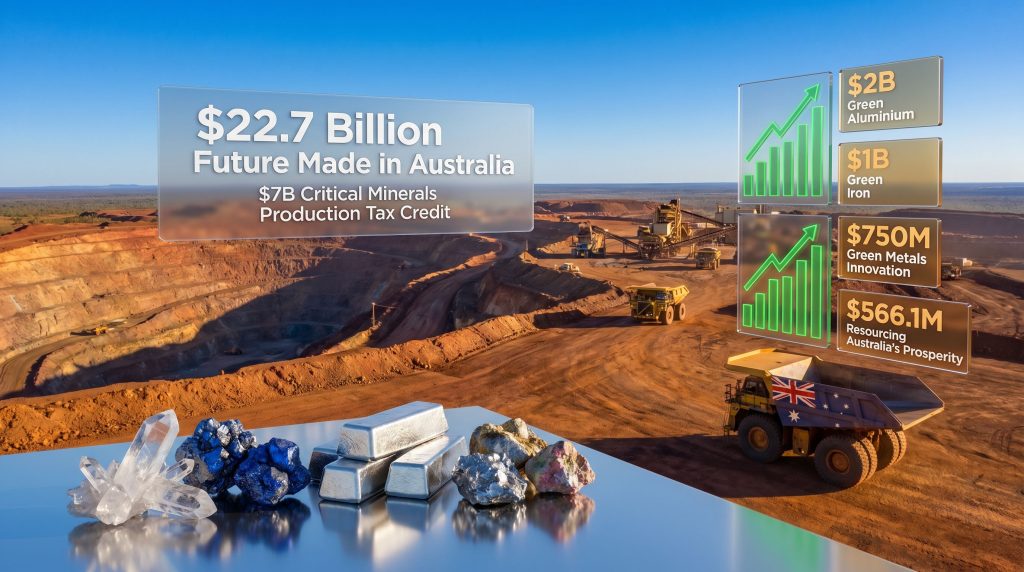
The centrepiece of the budget's resources-related spending is an interconnected suite of critical minerals support measures operating under the broader $22.7 billion Future Made in Australia initiative. The specific allocations relevant to the mining and processing sector include:
| Budget Measure | Allocation | Timeframe | Primary Focus |
|---|---|---|---|
| Critical Minerals Production Tax Credit | $7 billion | 10 years | All 31 critical minerals |
| Green Aluminium Production Credit | $2 billion | From 2028 | Aluminium smelters |
| Green Iron Investment Fund | $1 billion | Forward estimates | Iron ore and green steel |
| Green Metals Innovation Fund | $750 million | Forward estimates | R&D and metallurgical tech |
| Resourcing Australia's Prosperity | $566.1 million | Forward estimates | Geoscience and exploration data |
The production tax credit mechanism is particularly significant from a structural policy perspective. Unlike grant-based funding, a production tax credit creates an ongoing, volume-linked financial incentive that scales with actual output rather than projected output. For processing operations working through the cost challenges of scaling new technologies, this design reduces the financial risk of production ramp-up phases. The credit covers all 31 minerals on Australia's official critical minerals priority list, including lithium, cobalt, nickel, manganese, and rare earth elements.
The cumulative value of critical minerals-specific budget measures across the forward estimates exceeds $31 billion, representing a material commitment to positioning Australia within global battery supply chains and green steel value chains.
The $566.1 million allocated through Resourcing Australia's Prosperity deserves particular attention. Geoscience investment has a well-documented multiplier effect on exploration activity. Improved geological data, particularly for underexplored regions and deeper crustal targets, reduces the technical risk that exploration companies must price into their programs. Public investment in precompetitive geoscience data effectively lowers the barrier to entry for private exploration capital, making it one of the highest-return forms of mining sector support available to government. In addition, this investment directly supports critical minerals demand pressures that are only intensifying as the global energy transition accelerates.
Where the Budget Falls Short
The Junior Minerals Exploration Incentive Removal
The most contentious decision in the 2026-27 budget, as far as the exploration community is concerned, is the elimination of the Junior Minerals Exploration Incentive (JMEI). To understand why this matters, it helps to understand what the Junior Minerals Exploration Incentive actually did.
The JMEI functioned as a flow-through tax incentive mechanism that allowed junior exploration companies to transfer unused tax deductions from their exploration expenditure to retail investors through the issuance of exploration credits. Because junior explorers are typically pre-revenue and therefore cannot use exploration deductions themselves, the JMEI effectively unlocked a class of investor capital that would otherwise not be deployed into greenfields discovery programs.
The instrument was structurally similar in concept to Canada's Flow-Through Share scheme, which has been operating continuously since the 1950s and is widely credited with sustaining Canada's position as a global leader in mining exploration investment. Canada's FTS scheme allows resource companies to renounce qualifying exploration expenditures to investors, who can then deduct these amounts against their own taxable income. The result is a capital formation mechanism specifically calibrated for high-risk, pre-revenue discovery activity. The full range of JMEI benefits made it a uniquely valuable instrument for unlocking retail capital at the exploration stage.
The Association of Mining and Exploration Companies (AMEC) described the JMEI's removal as a significant setback for investor confidence in greenfields exploration, particularly given the government's stated ambitions to build domestic critical minerals supply chains. The logical tension here is not subtle: you cannot build a processing industry around minerals that have not yet been discovered, and the discovery pipeline depends on junior explorer activity, which in turn depends on access to exploration-stage capital.
The Structural Disconnect in Supply Chain Logic
Australia's resources sector contributes approximately 14% of GDP and accounts for more than 70% of total export earnings, figures that underscore the sector's outsized importance to national economic performance. Yet the budget's allocation decisions reveal a preference for supporting the later, more capital-visible stages of the mineral value chain over the earlier, less visible but foundational exploration stage.
This reflects a broader pattern in industrial policy globally: downstream processing facilities are tangible, job-creating, and politically legible in ways that exploration drilling programs simply are not. A processing plant employs hundreds of workers in a specific location; a geochemical sampling program in a remote tenement employs a handful of geologists and generates no immediate economic activity visible to communities or media cycles.
The risk is that Australia builds globally competitive processing capacity while the domestic discovery base that should feed it gradually narrows. Without continuous greenfields discovery generating new deposits, the long-term input supply for Australian processors becomes increasingly reliant on imported or third-country-sourced material, which undermines the strategic rationale for domestic processing investment in the first place.
Competitiveness Erosion Beyond Tax Settings
Industry bodies including the Minerals Council of Australia and the Chamber of Minerals and Energy in Western Australia have consistently raised concerns about structural competitiveness factors that sit outside the direct tax framework:
- Industrial relations complexity: Labour cost inflation and workplace relations frameworks that increase project delivery costs relative to comparable international jurisdictions
- Energy pricing: Energy-intensive processing operations face cost disadvantages in an environment of elevated electricity prices, partly offsetting the benefit of processing-focused tax incentives
- Permitting and approvals timelines: Regulatory processes for new project approvals remain among the lengthiest in comparable mining jurisdictions, deterring early-stage capital commitment. Consequently, mining permits reform efforts in other jurisdictions further highlight how competitive approvals processes can be used to attract global exploration capital
- Inter-departmental coordination: Multiple agencies with overlapping oversight create administrative friction that adds cost and delay without corresponding environmental or community benefit
Treasury's own forecasts point to subdued mining investment growth in the near-to-medium term, a projection that suggests the budget's incentive architecture, while meaningful, is not yet sufficient to overcome these structural headwinds.
How Peak Industry Bodies Read the Budget
The spectrum of responses from Australia's major mining industry organisations reveals both shared priorities and genuine fault lines in how the sector evaluates the government's overall approach.
| Organisation | Overall Assessment | Primary Concern |
|---|---|---|
| Minerals Council of Australia (MCA) | Cautiously supportive | Fiscal dependency on mining revenue without proportional structural reinvestment |
| Association of Mining and Exploration Companies (AMEC) | Mixed: supportive of processing measures, concerned about exploration | JMEI removal undermines discovery pipeline |
| Chamber of Minerals and Energy WA (CME) | Generally positive | Stronger inter-departmental approval coordination needed |
| Queensland Resources Council (QRC) | Welcoming but incomplete | Broader commodity class support and private investment incentives required |
The MCA's critique of fiscal dependency is particularly worth examining. Australia's federal and state governments collectively extract significant royalty and tax revenue from the mining sector across the commodity cycle. The MCA's position is that consistently drawing record revenues from the sector while leaving structural competitiveness challenges unaddressed creates a long-term sustainability problem: the revenue base depends on a competitive industry, and the industry's competitiveness is eroding in ways that the budget does not fully address. For further context on how industry bodies have responded, mining industry commentary provides a detailed breakdown of the range of sector reactions.
Comparing Australia's Approach to International Exploration Incentive Frameworks
Australia's removal of the JMEI stands in notable contrast to the policy direction of its key competitors for global exploration investment capital.
Canada's Flow-Through Share scheme remains the global benchmark for junior exploration incentives. The scheme has operated for over six decades and has been credited with generating exploration expenditure multiples several times greater than the direct revenue cost to government. Academic analysis of the FTS mechanism consistently finds that the tax foregone is more than offset by the economic activity, employment, and royalty revenues generated by the discoveries it enables.
The United States' Inflation Reduction Act, while primarily focused on clean energy manufacturing, includes provisions for domestic critical mineral processing and supply chain development that complement rather than replace upstream exploration support. The IRA's design reflects an understanding that processing capacity without domestic mineral supply is strategically incomplete.
The European Union's Critical Raw Materials Act similarly recognises the distinction between processing capacity and raw material supply security, setting benchmarks for domestic extraction as well as processing within member state economies.
Australia's downstream processing incentives are internationally competitive. Its upstream exploration support framework now lags behind peer nations, creating a risk that future critical mineral supply chains are built on a progressively narrowing domestic discovery base.
What the Budget Means for Sector-Specific Investment Outlook
Commodities Positioned to Benefit
The budget's incentive architecture creates a clearly differentiated outlook across commodity classes:
- Lithium and battery minerals: Direct beneficiaries of both the production tax credit and the broader Future Made in Australia processing framework. Australia's existing position as the world's largest lithium producer means there is a significant installed base of operations that can access production-linked credits.
- Aluminium: The Green Aluminium Production Credit from 2028 provides meaningful long-term cost relief for smelters navigating energy transition pressures. Australian aluminium smelting faces structural energy cost challenges that this credit partially addresses.
- Green iron and steel: The Green Iron Investment Fund positions Australia to participate in the emerging green steel value chain, capitalising on existing iron ore extraction capacity and proximity to Asian steel markets.
- Geoscience and data infrastructure: Investment through Resourcing Australia's Prosperity will improve national geological knowledge particularly for underexplored regions, providing a long-term foundation for future exploration cycles.
Commodities Facing Ongoing Headwinds
- Junior and mid-tier explorers: The JMEI removal directly reduces access to flow-through capital structures, with no announced replacement mechanism. However, the broader question of junior explorers funding remains a pressing policy concern given the sector's role in generating future mineral supply.
- Nickel: Global oversupply driven by Indonesian laterite production has suppressed prices significantly. The budget contains no commodity-specific relief mechanism for nickel producers or explorers.
- Thermal coal: Absent from major support measures, reflecting the energy transition's ongoing displacement of coal from federal industrial policy frameworks.
The next major ASX story will hit our subscribers first
Frequently Asked Questions: Australian Budget and Mining
Did the 2026-27 budget change how mining is taxed in Australia?
No. The Albanese government maintained existing mining tax settings without modification, a decision interpreted by industry as a positive signal for investment certainty and sovereign risk reduction.
What is the production tax credit and how does it work?
The $7 billion critical minerals production tax credit operates over ten years and provides a volume-linked tax offset for producers of any of the 31 minerals on Australia's official critical minerals list. Unlike upfront grants, the credit scales with actual production, creating ongoing financial support through operational ramp-up phases.
Why is the JMEI removal considered so significant?
The JMEI enabled junior exploration companies to transfer unused exploration tax deductions to investors through exploration credits, effectively unlocking retail and institutional capital for high-risk greenfields programs. Its removal eliminates one of the few capital formation mechanisms specifically designed for pre-revenue discovery activity, which is the foundational input to Australia's future critical mineral supply chains.
Which minerals are covered by the production tax credit?
The credit covers all 31 minerals on Australia's official critical minerals priority list, including lithium, cobalt, nickel, rare earth elements, manganese, vanadium, and other strategically significant commodities.
What did the Minerals Council of Australia say about the budget?
The MCA expressed cautious support for the critical minerals incentive architecture while warning that structural competitiveness challenges around industrial relations, energy costs, and regulatory efficiency remain insufficiently addressed, and that the government's reliance on mining revenues to fund broader spending creates long-term sustainability risks for the sector.
Reconciling Record Investment With Legitimate Industry Frustration
At first glance, it seems contradictory for an industry to respond with frustration to a budget delivering more than $31 billion in sector-specific support. The resolution of this apparent contradiction lies in understanding that the budget's generosity is concentrated at one point in the mineral value chain while structural deficiencies accumulate at another.
Processing incentives and green metals funds address the challenge of converting known mineral resources into refined products. What they do not address is the prior challenge of finding those resources in the first place. A policy architecture that invests heavily in the factory while progressively undermining the mine is strategically incomplete, regardless of the headline investment figures attached to it.
Industry bodies describing the Australian budget mining industry reaction as broadly positive but incomplete are not being ungrateful. They are identifying a genuine sequencing problem: the most capital-visible and politically legible parts of the mineral value chain are receiving support, while the least visible but most foundational parts are being allowed to weaken.
What a More Structurally Complete Budget Would Include
- Reinstatement or redesign of junior exploration incentives to maintain greenfields discovery pipeline momentum, potentially modelled on the Canadian FTS scheme's long-running success
- Industrial relations reform targeted at reducing project delivery costs and improving labour market flexibility for remote and regional mining operations
- Streamlined environmental and approvals frameworks to shorten project development timelines without reducing environmental standards
- Coordinated inter-departmental policy execution to ensure that budget measures translate into operational outcomes rather than remaining as aspirational commitments
Key Takeaways
The 2026-27 Federal Budget delivers a genuinely significant package of critical minerals support while leaving the exploration sector with a structural gap that risks undermining the long-term supply chains the government is trying to build. The key conclusions for mining sector stakeholders are:
- Tax stability provides investment certainty and reduces one dimension of sovereign risk perception among global capital allocators
- Critical minerals investment at the scale announced demonstrates real government commitment to the energy transition supply chain, particularly in processing and green metals
- JMEI removal is the most consequential structural policy gap in an otherwise supportive budget, with no announced replacement mechanism
- Competitiveness concerns around regulation, energy costs, and industrial relations remain unresolved and are not adequately addressed by the budget's incentive architecture
- Investment outlook remains cautious, with Treasury's own forecasts pointing to weak mining investment growth despite unprecedented incentive commitments
- International comparisons show Australia's exploration support framework now lags behind Canada and other peer jurisdictions at a moment when global competition for critical mineral supply chains is intensifying
The central tension in Australia's 2026-27 resources policy is not between investment and restraint. It is between a well-funded vision for downstream mineral processing and an increasingly underfunded foundation of upstream discovery. Resolving that tension will determine whether Australia's Australian budget mining industry reaction is remembered as the moment policy caught up with ambition, or the moment the foundation began to crack.
Disclaimer: This article contains forward-looking statements and analysis based on publicly available budget documentation and industry commentary. It does not constitute financial or investment advice. Readers should conduct independent research and seek professional advice before making investment decisions. Budget figures and policy details are subject to legislative passage and implementation.
Want to Know Which ASX Explorers Are Making Significant Mineral Discoveries Right Now?
As Australia's exploration funding landscape shifts and the JMEI removal tightens capital access for junior miners, staying ahead of significant ASX mineral discoveries has never been more critical — Discovery Alert's proprietary Discovery IQ model delivers real-time alerts the moment major discoveries are announced, turning complex geological data into actionable investment insights. Explore historic discovery returns on Discovery Alert's dedicated discoveries page to understand what's at stake, then begin a 14-day free trial to position yourself ahead of the broader market.