
June 6, 2026
The Geopolitical Logic of Mineral Diplomacy in a Fractured World
When two nations with strained diplomatic ties choose to sit across the same table, it rarely happens by accident. Shared ideology, mutual defence commitments, and aligned foreign policy positions are the conventional glue of bilateral engagement. But there is a second category of convergence, one increasingly visible in today's resource-constrained world: the pressure of supply chain necessity, where the scramble for critical minerals quietly overrides diplomatic tension and reorders strategic relationships.
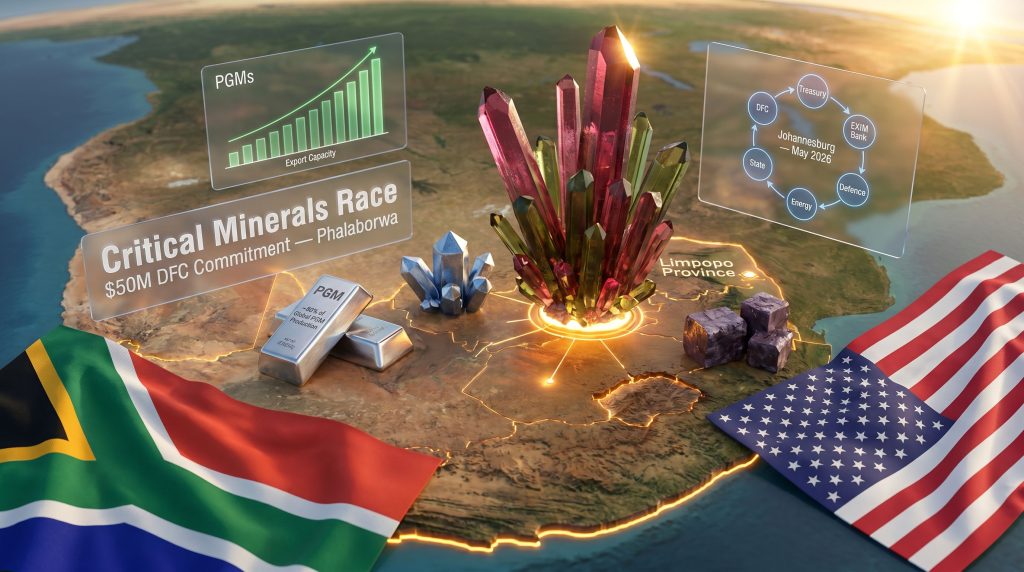
This dynamic sits at the heart of what unfolded in Johannesburg in early May 2026, when approximately 25 officials from the United States and South Africa gathered for a minerals investment forum that participants described as the most significant bilateral meeting between the two countries so far this year. The US and South Africa minerals investment talks, reported by the Financial Times, were not the product of smooth relations. They were the product of something more durable: economic urgency and the shared recognition that China's dominance of global critical minerals demand presents a structural problem that neither country can solve alone.
When big ASX news breaks, our subscribers know first
Why China's Processing Dominance Is the Real Supply Chain Crisis
Most public discussions of critical mineral security focus on where minerals are extracted. The more strategically significant question is where they are processed. China controls an estimated 80 to 90 percent of global rare earth processing capacity, according to assessments from the US Geological Survey and the Department of Energy's Critical Materials Institute. This is not simply a matter of resource abundance. China has systematically invested in the downstream infrastructure required to transform raw ore into refined material suitable for manufacturing applications.
The downstream processing chain for rare earth elements involves a series of technically demanding steps including crushing, flotation concentration, solvent extraction, and precision separation of individual elements. These processes require specialised chemical facilities, significant capital investment, and decades of accumulated technical expertise. Western nations largely ceded this capability during the 1990s and 2000s, when Chinese producers undercut global competitors on price.
The result is a structural vulnerability that extends well beyond rare earth supply chains. China also holds dominant positions across cobalt refining, graphite anode production, and manganese processing, each of which feeds directly into the battery supply chains underpinning the electric vehicle transition. For US policymakers, this concentration represents a category of national security risk that conventional trade policy instruments are poorly equipped to address.
South Africa's Strategic Position in Washington's Diversification Calculus
Against this backdrop, South Africa's mineral endowment takes on dimensions that go beyond its significance as a mining economy. The country's resource base is not merely large; it is strategically differentiated in ways that directly address the gaps in Western supply chains.
| Mineral | South Africa's Global Position | Key Strategic Application |
|---|---|---|
| Platinum Group Metals (PGMs) | Approximately 80% of global production | Hydrogen fuel cells, catalytic converters, defence electronics |
| Chromium | Top-three global producer | Aerospace alloys, stainless steel manufacturing |
| Manganese | Major global exporter | EV battery cathodes, steel production |
| Vanadium | Significant reserve base | Grid-scale vanadium redox flow batteries, energy storage |
| Rare Earth Elements | Emerging producer via Phalaborwa | EV traction motors, wind turbine generators, defence systems |
Critically, South Africa does not only offer raw ore. The country retains substantial pyrometallurgical and hydrometallurgical processing infrastructure, particularly in the PGM and ferrous metals sectors. This represents exactly the kind of Western-accessible refining capacity that the US has identified as a systemic gap in its supply chain resilience strategy.
The combination of reserve abundance and existing processing infrastructure makes South Africa a qualitatively different kind of partner than a nation offering only primary extraction potential. It is this dual capability that gives the current US engagement its strategic weight.
Inside the Johannesburg Forum: What the Composition of Attendees Reveals
The Johannesburg meeting on 7 May 2026 was organised under the auspices of the Centre for Strategic and International Studies (CSIS), a Washington-based think tank with close institutional ties to US foreign policy and defence communities. The forum had first convened in the United States in March 2026, making the Johannesburg session the second iteration of what appears to be a structured bilateral dialogue rather than a one-off diplomatic encounter.
The US delegation's composition is itself analytically instructive. Officials attended from:
- The Department of the Treasury
- The Department of State
- The Department of Commerce
- The Department of Defence
- The Department of Energy
- The US Export-Import Bank
- The Development Finance Corporation (DFC)
- US Ambassador Leo Brent Bozell III
The simultaneous presence of defence, commerce, and energy officials alongside financing institutions is a deliberate architectural choice. It signals a whole-of-government approach in which mineral access is framed not as a trade matter but as a national security and economic competitiveness priority. The South African side brought two deputy ministers, senior government officials, and approximately 20 executives from the mining and banking sectors, indicating a parallel whole-of-economy posture from Pretoria.
What distinguishes this forum from routine investment promotion events is the involvement of the DFC and EXIM Bank alongside the defence establishment. The DFC, established under the Better Utilization of Investments Leading to Development (BUILD) Act, is specifically mandated to deploy financing tools in strategic markets where private capital is insufficient or faces elevated political risk. Its presence signals that Washington is prepared to use concessional financing instruments to de-risk investment in South African mineral projects.
The Fractured Relationship That Makes These Talks Remarkable
The significance of the Johannesburg forum cannot be fully appreciated without understanding how deteriorated the bilateral relationship had become before it took place. Since the return of the Trump administration to office, US-South Africa relations experienced a sequence of high-profile ruptures:
- The administration moved to cut foreign aid to South Africa
- The South African ambassador to Washington was expelled
- Washington announced plans to resettle Afrikaner refugees, a measure Pretoria interpreted as a politically charged interference in domestic affairs
- The United States boycotted South Africa's G20 presidency in November 2025
This is not the backdrop against which bilateral investment frameworks typically emerge. Yet minerals have created what the Financial Times characterised as commercial common ground, a convergence point that operates on a different logic than conventional diplomacy.
The underlying mechanism is worth examining carefully. South Africa's non-aligned foreign policy posture means Pretoria maintains active commercial and diplomatic relationships with both China and Russia, positions that place it at odds with the current US administration's worldview. However, Washington's critical minerals trade strategy requires engagement with resource-rich nations regardless of perfect ideological alignment. The pattern is consistent with other US resource partnerships, including long-standing energy arrangements with Gulf states, where strategic and commercial logic has historically operated somewhat independently of governance concerns.
The Phalaborwa Project: A Technical Case Study in Non-Chinese Rare Earths
Among the projects identified as candidates for early US investment focus, the Phalaborwa Rare Earths Project in Limpopo Province occupies a distinctive position. Owned by Rainbow Rare Earths and backed by TechMet, a US government-linked private investor, the project has already secured a $50 million commitment from the Development Finance Corporation.
What makes Phalaborwa technically unusual is its feedstock source. Rather than extracting rare earth elements through conventional hard rock or ionic clay mining, the project recovers REEs from phosphogypsum waste stockpiles, the accumulated byproduct of decades of historic phosphate processing at the site. This approach carries several consequential advantages:
- Reduced environmental permitting complexity, since extraction occurs from existing industrial waste rather than virgin land disturbance
- Lower capital intensity relative to greenfield hard rock rare earth mines, which typically require extensive crushing and beneficiation infrastructure
- Reduced geological exploration risk, since the resource is already characterised and surface-accessible
- A positive environmental narrative, given that processing phosphogypsum stockpiles can reduce the long-term environmental liability associated with the material
From a mineral composition perspective, phosphogypsum-hosted rare earth deposits tend to be enriched in light rare earth elements including cerium, lanthanum, neodymium, and praseodymium. Neodymium and praseodymium (collectively referred to as NdPr) are the primary inputs for sintered neodymium-iron-boron (NdFeB) permanent magnets, which are the dominant magnet technology used in EV traction motors and wind turbine generators.
Furthermore, the DFC's $50 million commitment also serves a signal function for the broader investment community. DFC financing typically involves political risk insurance and concessional loan structures that lower the effective cost of capital for co-investors. When the DFC anchors a project, it effectively provides a risk certification that can catalyse additional institutional capital from private investors who would otherwise require higher returns to compensate for frontier market exposure.
Logistics Infrastructure: The Hidden Multiplier for South African Mineral Exports
One of the less-publicised dimensions of the Johannesburg discussions was the prospect of US investment in South Africa's logistics and transport infrastructure. This conversation reflects a sophisticated understanding of where the real bottlenecks in South African mineral supply chains actually reside.
South Africa's state-owned rail operator, Transnet, has experienced prolonged operational and financial challenges that have constrained the country's ability to move minerals from mine to port at scale. Richards Bay and Durban, the country's primary mineral export terminals, have faced throughput limitations that affect manganese, chrome, and coal exports. For a US investor considering an upstream mining or processing project, these logistics constraints represent a compounding risk: a producing asset cannot generate returns if it cannot reliably move product to market.
Infrastructure investment in logistics networks is sometimes described in mining finance circles as enabling capital, spending that multiplies the value of upstream investments by removing export bottlenecks rather than adding direct productive capacity. For US institutional capital, targeting infrastructure alongside primary extraction projects is a strategically rational allocation model.
The involvement of the EXIM Bank is relevant here. EXIM financing has historically been deployed to support US equipment and technology exports tied to infrastructure development in emerging markets. A South African rail or port logistics investment financed partly through EXIM instruments would generate demand for US-manufactured rolling stock, port equipment, or engineering services, creating economic linkages that extend beyond the mineral supply chain itself.
The next major ASX story will hit our subscribers first
Washington's Wider Critical Minerals Playbook Across Multiple Continents
The South Africa engagement does not exist in isolation. It is one component of a broader US diplomatic architecture designed to construct alternative mineral supply chains across multiple geographies simultaneously. Comparable frameworks are at varying stages of development across:
- Democratic Republic of Congo — cobalt and coltan, though governance and security challenges complicate investment structures
- Zambia — copper discussions that have encountered friction, with Lusaka resisting conditions tied to health aid arrangements
- India — rare earth and processing capacity partnerships leveraging the Quad security framework
- Ukraine — a minerals framework covering titanium, lithium, and rare earths established in the context of post-conflict reconstruction financing
- Australia — lithium, nickel, and cobalt cooperation through existing defence partnership channels
If the South Africa framework progresses toward a formal bilateral minerals agreement, it could establish CSIS-facilitated dialogue, DFC financing, and EXIM Bank support as the standard institutional architecture for US resource diplomacy across Sub-Saharan Africa more broadly. The geopolitical mining landscape is increasingly shaped by precisely this kind of structured, whole-of-government engagement model. The approach being tested in South Africa could consequently be replicated across the continent.
Risk Factors That Could Derail or Delay a Formal Agreement
Both delegations at the Johannesburg forum were explicit that any formal agreement remains at an early stage. Officials indicated that a priority project list was still under development. Several structural barriers remain.
Geopolitical and Diplomatic Risks:
- South Africa's maintenance of commercial and diplomatic relationships with China and Russia could become a point of friction as the US seeks more exclusive supply chain partnerships
- Domestic political sensitivity around foreign ownership of South African mineral assets, particularly given the country's history of resource nationalism debate
- US policy continuity risk: bilateral engagement frameworks can be vulnerable to changes in administration priorities or senior personnel
Operational and Structural Challenges:
- Transnet's ongoing rail network difficulties continue to undermine investor confidence in South Africa's logistics reliability
- Load-shedding and energy supply instability, though materially improved from peak crisis levels, continues to affect mining sector productivity and operational cost structures
- Environmental and water licensing timelines for new or expanded mining projects can extend project development schedules significantly
Competitive Dynamics:
China maintains deep commercial relationships across South Africa's mining sector, including investments in processing facilities and long-term offtake arrangements with major producers. Beijing's response to a formalised US-SA minerals framework could include competitive counter-offers designed to retain South African mineral exports within Chinese supply chains. Furthermore, the European raw materials strategy adds another layer of competitive complexity, as European institutions similarly pursue African mineral partnerships that could overlap with US ambitions.
This article presents analysis of publicly reported developments and does not constitute investment advice. Readers should conduct independent research and seek professional financial guidance before making investment decisions. All statistics and projections referenced should be verified against current primary sources prior to reliance.
What the Investment Community Should Take Away From These Developments
For investors and market participants tracking the US and South Africa minerals investment talks, several analytical conclusions emerge from the structure and composition of the Johannesburg forum:
- The presence of five federal departments plus two government financing institutions in a single bilateral forum is not routine. It reflects institutional commitment of a kind that typically precedes formal policy frameworks rather than one-off exploratory conversations.
- The DFC's existing $50 million commitment to Phalaborwa means US government capital is already deployed in the South African rare earths sector. This is not an abstract future possibility; it is a live investment relationship that the forum was partly designed to expand.
- Infrastructure as a co-investment theme represents an under-appreciated dimension of the engagement. Companies with logistics, rail, or port infrastructure exposure in South Africa may benefit from increased institutional interest in resolving the Transnet bottleneck problem.
- The CSIS-facilitated forum structure signals that this is intended as an ongoing dialogue rather than a single engagement. The March 2026 US meeting followed by the May 2026 Johannesburg session suggests a structured cadence of engagement that is likely to continue.
- South Africa's smelting and processing capacity distinguishes it from most other African mineral jurisdictions. For Western supply chain architects, access to non-Chinese processing infrastructure is arguably more strategically valuable than raw ore access alone.
The trajectory of engagement points toward a structured bilateral minerals framework, but the path from preliminary talks to committed capital involves navigating complex domestic politics, competitive geopolitical pressures, and significant infrastructure challenges. The Johannesburg forum of May 2026 marks the beginning of a process, not its conclusion.
Want to Track the Next Major Mineral Discovery Before the Market Does?
Discovery Alert's proprietary Discovery IQ model scans ASX announcements in real time, instantly identifying significant mineral discoveries across critical commodities — including the rare earths, PGMs, and manganese reshaping global supply chains — and delivering actionable alerts directly to subscribers. Explore how historic discoveries have generated extraordinary returns and begin your 14-day free trial today to position yourself ahead of the market.