
June 17, 2026
Africa's Most Consequential Mining Jurisdiction Is Rewriting Its Playbook
Few structural transformations in global mining are as telling as the one currently unfolding in South Africa. For decades, the country sat atop one of the most extraordinary concentrations of mineral wealth on the planet, yet progressively haemorrhaged investor confidence, exploration capital, and operational credibility. The reasons were never geological. South Africa's ore bodies remained world-class throughout. The failure was institutional, and understanding why that matters is the starting point for understanding why the current South Africa mining partnerships reset carries genuine significance for the continent's resource future.
The mechanics of mining investment are deeply cyclical, but they are also deeply institutional. Capital follows certainty. Certainty requires functioning relationships between governments, operators, financiers, and communities. When those relationships fracture, even the richest mineral endowments sit underdeveloped. South Africa mining decline has seen the slow migration of junior mining capital to competing jurisdictions. The reset now underway is not driven by a single policy change or a commodity price windfall. It is the product of a structural renegotiation between actors who previously operated in mutual antagonism.
When big ASX news breaks, our subscribers know first
The Exploration Crisis That Defines the Stakes
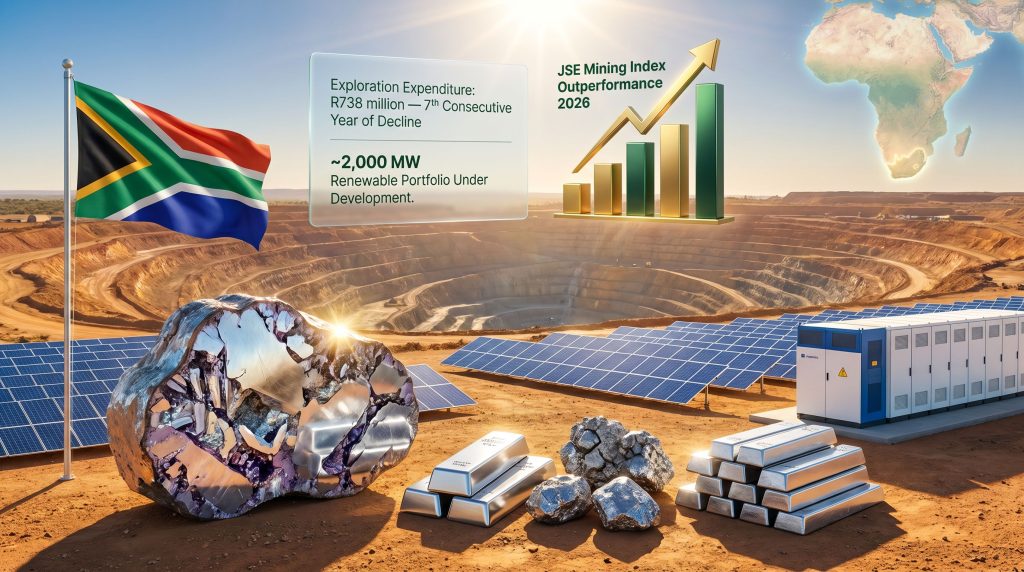
Before examining what the partnership model looks like in practice, it is worth anchoring the discussion in the data that illustrates just how severe the deterioration has been. South Africa's mineral exploration expenditure fell for a seventh consecutive year in 2025, declining 5.3% to R738 million, according to government statistics. More sobering is the long-run trajectory: total prospecting investment has contracted by more than 85% over the past three decades.
This is not a statistic that can be addressed through operational improvements alone. Exploration is the seed crop of mining. Without new discoveries today, production pipelines thin out five to fifteen years from now regardless of how well existing mines perform. The structural lag between exploration investment and production output means the consequences of this 30-year drawdown will compound long after any given reform initiative takes effect.
South African Minister of Mineral and Petroleum Resources Gwede Mantashe has described exploration investment as the lifeblood of a sustainable mining industry, explicitly acknowledging that gains in energy and logistics reform mean little without a parallel recovery in prospecting activity and faster licensing systems.
The drivers of this prolonged decline are well documented and interconnected:
- Permitting processes that consistently lag competing African jurisdictions
- Chronic electricity supply instability making operational economics unpredictable
- Freight rail deterioration increasing logistics costs and reducing export reliability
- Policy uncertainty suppressing long-cycle capital allocation decisions
- Geological data infrastructure gaps reducing the attractiveness of early-stage target generation
The compound effect of these factors has been a progressive reallocation of African exploration budgets toward jurisdictions including Zambia, Namibia, Tanzania, and the Democratic Republic of Congo, all of which have maintained or grown their prospecting investment pipelines over the same period that South Africa's contracted.
Comparison: South Africa vs. Competing African Exploration Destinations
| Metric | South Africa | Sub-Saharan Peer Benchmark |
|---|---|---|
| Annual exploration spend (2025) | R738 million (~USD 40M) | Most peers showing flat or modest growth |
| Consecutive years of decline | 7 years | Competitors maintaining or expanding pipelines |
| 30-year prospecting investment trend | More than 85% contraction | Most peers have sustained or grown investment |
| Permitting speed | Ongoing reform; historically slow | Several peers offer faster processing |
How Government-Industry Relations Broke Down and What Changed
The adversarial dynamic between South Africa's government and its mining industry did not materialise overnight. It accumulated over years of regulatory friction, policy reversals, and operational disputes that gradually eroded the mutual trust necessary for long-term capital commitment.
The crisis point came when the Department of Mineral Resources put forward a proposed moratorium on new mining and prospecting rights, triggering immediate alarm across the industry. The Minerals Council of South Africa, representing major producers across the sector, secured a binding High Court order preventing the suspension from taking effect. What might have deepened the institutional divide instead produced an unexpected outcome: the legal confrontation forced both parties into structured dialogue that had previously been absent.
The withdrawal of the moratorium proposal marked a genuine inflection point. It signalled a shift from a regulatory posture built on unilateral government intervention toward a framework of negotiated outcomes. This distinction matters because it defines what the South Africa mining partnerships reset actually involves: not a policy announcement or a legislative amendment, but a rebuilt institutional architecture through which government and industry co-design solutions rather than contest positions.
The Business for South Africa structure provided the formal coordination mechanism through which organised industry could engage the Ramaphosa administration on operational priorities. The easing of rotational power cuts and measurable improvements in freight rail performance that followed represent the most visible outputs of this coordination process.
Economist Dawie Roodt has observed that investors require more than policy statements; they need demonstrable evidence that government and industry can execute together. South Africa's progress on energy stabilisation and logistics reform has begun providing precisely that evidence, which is reflected in improved market sentiment across the sector.
Furthermore, Motsepe says partnerships boosting South Africa's mining sector, reinforcing the view that structured collaboration between public and private stakeholders is generating outcomes that unilateral action previously failed to achieve.
Energy Transformation as the Partnership Model's Most Advanced Expression
Nowhere has the partnership architecture produced more tangible results than in South Africa's private renewable energy sector. Mining companies confronting chronic grid instability began pursuing energy security through co-investment with independent power producers, and the transaction volumes that followed have reshaped the country's industrial energy landscape in ways that extend well beyond the mining sector itself.
The most significant recent example involves African Rainbow Energy's consolidation of its stake in SOLA Group to 83%, creating one of South Africa's largest independently owned renewable power platforms. The combined portfolio spans approximately 2,000 MW across operational and construction-stage solar and battery storage infrastructure.
SOLA Group chief executive Brian Dames has described the partnership's evolution as representative of how clean energy solutions can scale when mining capital and energy developer expertise align around shared commercial objectives. Patrice Motsepe, who leads African Rainbow Energy, has characterised the transaction as central to building a world-class African energy business capable of delivering affordable power to large industrial consumers across the continent.
The commercial logic driving this transaction is replicable across the sector. In addition, renewable energy in mining has become one of the most strategically significant investment themes driving capital allocation decisions across the continent:
- Mining operations require continuous, predictable power supply that grid-connected electricity cannot guarantee in South Africa's current infrastructure environment
- Long-term power purchase agreements at fixed or capped rates eliminate the tariff volatility that undermines operational cost planning
- Renewable energy investment reduces scope 2 carbon emissions, improving ESG positioning for internationally listed mining groups
- Battery energy storage systems (BESS) integrated with solar installations provide dispatchable power during periods of peak operational demand, addressing the intermittency limitation that solar-only configurations cannot resolve
- Cross-sector wheeling agreements extend the commercial model beyond mining, with the SOLA portfolio supporting industrial consumers including Sasol, Amazon, and Tronox
This last point reveals something underappreciated about mining-led energy investment: when mining companies act as anchor demand for renewable energy infrastructure, they generate capacity that benefits the broader industrial economy. South Africa's mining sector is, in this sense, functioning as an inadvertent catalyst for the country's wider energy transition.
Why Battery Storage Is Non-Negotiable for Mining Applications
Solar generation profiles peak during daylight hours, but mining operations run continuously, often with highest energy demand during shift changes and processing cycles that extend well into evening hours. Battery energy storage systems resolve this mismatch by capturing excess daytime generation and dispatching it during periods when solar output drops. The infrastructure investment creates a secondary benefit by adding distributed storage capacity to South Africa's grid, supporting broader grid modernisation independent of any central utility intervention.
South Africa's Critical Minerals Position and International Partnership Dynamics
South Africa's mineral endowment extends well beyond the gold and platinum group metals that historically defined its global identity. The country holds world-leading reserve positions across several minerals now classified as critical inputs for energy transition technologies. The surge in critical minerals demand globally has consequently elevated South Africa's strategic importance in ways that extend well beyond its traditional commodity profile.
South Africa's Critical Minerals Competitive Position
| Mineral | South Africa's Global Standing | Primary Technology Application |
|---|---|---|
| Platinum Group Metals (PGMs) | Largest global reserves | Hydrogen fuel cells, catalytic converters, industrial catalysts |
| Chrome | Largest global reserves | Stainless steel, battery technology |
| Manganese | Top 3 global producer | Battery cathodes (NMC), steel production |
| Vanadium | Significant producer | Grid-scale vanadium redox flow batteries (VRFB) |
| Gold | Historically dominant; production declining | Financial reserves, electronics, jewellery |
The formalisation of a United Kingdom-South Africa Partnership on Minerals for Future Technologies introduces an additional dimension to the South Africa mining partnerships reset: international bilateral accountability. When foreign governments formalise supply chain partnerships around specific minerals, they create external pressure that reinforces domestic reform timelines. South Africa's recognition that the UK partnership could migrate to competing jurisdictions if domestic regulatory conditions fail to improve is itself a reform accelerant.
The partnership focuses on joint exploration, downstream processing capability development, and supply chain integration, targeting the minerals most critical to electric vehicle manufacturing and renewable energy infrastructure. South Africa's vanadium endowment is particularly noteworthy in this context. Vanadium redox flow batteries represent one of the most promising technologies for grid-scale stationary energy storage, and South Africa holds significant production capacity in a mineral that most global battery discussions systematically underweight relative to lithium and cobalt.
Banks Repositioning as Infrastructure Co-Investors
The role of South African banking institutions in the mining recovery narrative has evolved significantly. Absa Group and Standard Bank Group have each articulated a strategic shift from passive debt provision toward active co-investment in mining-linked infrastructure, a repositioning that reflects both commercial opportunity and national economic necessity.
Jason Quinn, chief executive of Absa Group, has made clear that unlocking large-scale infrastructure investment in South Africa requires genuine partnership between capital providers, industry, and government rather than any single actor operating independently. Standard Bank Group CEO Kenny Fihla has similarly argued that the scale of investment required across South Africa's infrastructure environment makes collaboration between public and private stakeholders not merely beneficial but structurally essential.
The mechanism through which this occurs is blended finance, a structure that combines concessional public capital from Development Finance Institutions with commercial bank debt and private equity to enable projects that would fail standard commercial viability assessments. The Industrial Development Corporation (IDC) plays a critical intermediary role in this architecture, bridging public and private capital in ways that reduce effective project risk for commercial co-investors.
For junior mining companies operating in constrained equity markets, blended finance frameworks represent one of the few viable pathways to project development. Junior exploration investment has become significantly more difficult for early-stage South African mining projects given the exploration spending decline and associated reduction in institutional investor appetite for the jurisdiction. However, blended finance structures are beginning to partially offset this constraint.
The next major ASX story will hit our subscribers first
Structural Barriers That Partnership Models Have Not Yet Resolved
An honest assessment of the South Africa mining partnerships reset requires acknowledging where structural problems persist despite genuine institutional progress.
Logistics infrastructure remains fragile despite reform momentum. Transnet's freight rail network has shown gradual performance improvement, but the system is structurally undercapitalised and vulnerable to cable theft, which imposes costs across both rail and energy infrastructure networks. Mining operations in the Northern Cape and Limpopo provinces are particularly exposed to logistics bottlenecks that increase operating costs and reduce the predictability of export schedules.
Regulatory velocity continues to undermine investor confidence at the project level. The gap between policy intent and administrative execution is most visible in permitting timelines. Investors consistently identify licensing delays as the single most significant regulatory deterrent, and while digitised licensing systems and dedicated mining investment desks are under development, their operational impact has not yet been fully demonstrated.
Social licence dynamics represent what may be the most underestimated risk in the current recovery narrative. Traditional leaders and affected communities are increasingly asserting rights over mining decision-making processes, and projects with strong geological and financial fundamentals have historically been delayed or derailed by community opposition that was not incorporated early enough into project design. The evolution toward community benefit agreements (CBAs) and equity participation models reflects this reality, but implementation quality varies significantly across the sector.
Market Signals and What Investor Sentiment Is Actually Communicating
The Johannesburg Stock Exchange's industrial metals and mining index has significantly outperformed the broader market in 2026. This is not primarily a reflection of current operational conditions; equity markets are forward-looking instruments. The outperformance communicates institutional investor expectations about future operating environments, specifically that energy stabilisation, logistics improvement, and regulatory engagement will translate into improved margins and production reliability for listed mining companies over the medium term.
The critical nuance for interpreting this market signal is that it represents anticipated improvement, not confirmed delivery. Sustained outperformance requires continued institutional execution, particularly on the three areas where delivery remains incomplete: exploration licensing reform, Transnet concessioning progress, and community partnership framework implementation. Furthermore, mining joint ventures are increasingly being structured specifically to manage these residual risks through shared governance rather than single-operator exposure.
Three Trajectory Scenarios for South Africa's Mining Recovery
| Scenario | Required Conditions | Projected Medium-Term Outcome |
|---|---|---|
| Accelerated Recovery | Licensing reform delivered; exploration spend reverses; rail concessions operational | South Africa reclaims top-tier African mining investment destination |
| Managed Stabilisation | Energy and logistics improve; exploration stagnates; community tensions persist | Sector stabilises but misses critical minerals investment cycle |
| Regression Risk | Reform agenda disrupted; commodity correction; logistics deterioration | Capital flight accelerates; exploration deficit becomes irreversible |
The Partnership Architecture in Summary
The South Africa mining partnerships reset is best understood not as a single event or policy decision, but as a multi-dimensional institutional reconstruction that is still incomplete. Its most advanced component is the energy transition, where mining-led private renewable investment has created a functional and expanding model that other sectors are now replicating. Its most visible institutional achievement is the replacement of adversarial government-industry relations with structured coordination mechanisms that have produced measurable operational outcomes.
Its most significant unresolved vulnerability remains the exploration crisis. Seven consecutive years of declining prospecting expenditure represent a structural threat to long-term production capacity that energy partnerships and regulatory engagement cannot address without a parallel recovery in early-stage geological investment. The Junior Mining Exploration Fund, the reopening of the former Comro research facility, and the UK-South Africa critical minerals partnership are all targeted at this gap, but their impact will require years to materialise in exploration activity and decades to translate into production.
The trajectory of the South Africa mining partnerships reset will ultimately be determined by whether institutional trust, once rebuilt in the energy and logistics domains, can be extended to the regulatory environment that governs exploration. Consequently, South Africa's reviving mining sector will depend on whether partnership frameworks can be scaled from their current operational achievements into the deeper structural reforms that long-cycle capital decisions genuinely require. That is the test that no partnership announcement has yet passed.
This article is based on publicly available industry reporting and market analysis, including coverage published by the Investing in African Mining Indaba. It contains forward-looking assessments and scenario analysis that involve inherent uncertainty. Nothing in this article constitutes financial advice or investment recommendations. Readers should conduct independent research before making any investment decisions.
Want to Track the Next Major ASX Mineral Discovery Before the Market Does?
Discovery Alert's proprietary Discovery IQ model delivers real-time alerts on significant ASX mineral discoveries — cutting through the noise of daily announcements across more than 30 commodities to surface actionable opportunities the moment they emerge. Explore historic examples of major mineral discoveries and their market returns, then start your 14-day free trial at Discovery Alert to position yourself ahead of the broader market.