June 15, 2026

When Geopolitics Moves Markets: Understanding the Commodity-Conflict Nexus
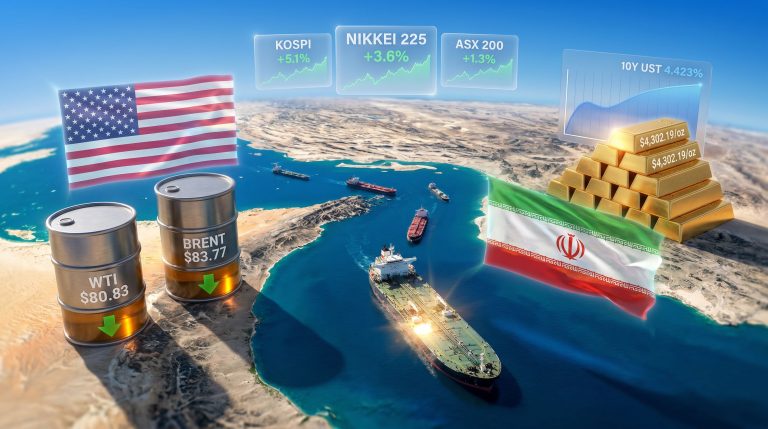
Global commodity markets do not move in isolation. They breathe in rhythm with the world's political architecture, tightening when conflict closes trade corridors and expanding when diplomacy reopens them. Few geographic features illustrate this dynamic more vividly than the Strait of Hormuz, a narrow waterway connecting the Persian Gulf to the Gulf of Oman. Through this roughly 33-kilometre-wide passage flows an estimated 20 to 21% of the world's seaborne oil trade, making it arguably the single most consequential chokepoint in the global energy system.
When US and Iranian officials signalled agreement on a preliminary peace framework in June 2026, including commitments to end hostilities, lift the US blockade on Iran, and restore access through the Strait, equity markets around the world responded with immediate force. Nowhere was this more visible than on the Australian Securities Exchange, where Australian mining shares boosted by US Iran peace deal headlines captured what analysts described as one of the most geopolitically charged single-session moves in recent ASX history.
When big ASX news breaks, our subscribers know first
The Strait of Hormuz: Why One Waterway Moves the World
To understand why a peace framework between Washington and Tehran can shift share prices in Sydney, it helps to understand what the Strait of Hormuz actually represents in structural terms. It is not merely a shipping lane. It is the pressure valve of global energy supply.
Prolonged military tension near the Strait does not simply threaten physical oil flows. It embeds a geopolitical risk premium into crude prices that permeates every energy-linked cost across the global economy, from jet fuel and transport logistics to the diesel that powers open-pit mining operations in Western Australia's Pilbara region and Queensland's coal belts. The global mining landscape is, consequently, deeply sensitive to energy price shifts driven by conflict risk.
When the risk premium inflates, it raises input costs for miners, compresses margins, and reduces the attractiveness of future earnings. When it deflates, the reverse dynamic occurs with remarkable speed.
This is precisely the mechanism that played out on June 15, 2026. The preliminary nature of the framework was sufficient to trigger repricing. Markets do not wait for signed agreements. They price in probabilities, and the probability of reduced energy risk shifted meaningfully in a single session.
ASX 200 Performance on June 15, 2026: A Multi-Sector Snapshot
The S&P/ASX 200 index surged past the 8,900 mark in early trading, climbing 1.5% to 8,928.50 by 00:39 GMT, briefly touching its highest level since April 22, 2026. By midday, the intraday gain had extended to approximately 1.96%, before institutional rebalancing stabilised the session. ASX market performance in recent months has demonstrated just how responsive Australian equities are to global geopolitical shifts.
This move followed an already-strong prior week, during which the benchmark had gained more than 2%, supported by earlier signals of conflict de-escalation and shifting expectations around the Reserve Bank of Australia's monetary policy trajectory.
The variance between early intraday data and later AAP-reported figures, which placed the index at approximately 8,692 with a gain of around 0.4%, reflects the reality of session-open volatility. Institutional repositioning following the first rush of retail and algorithmic buying often brings indexes back from intraday extremes. According to reporting from CommBank, Australian shares broadly advanced on the back of US-Iran optimism, confirming the sentiment-driven nature of the session.
| Metric | Reported Figure |
|---|---|
| ASX 200 Opening Move | +1.5% to 8,928.50 (00:39 GMT) |
| Intraday Peak | +1.96% |
| Prior Week Gain | +2% |
| Highest Level Since | April 22, 2026 |
Sector Winners and Losers
The session was defined by a sharp divergence between two historically correlated sectors: mining and energy.
Gold sub-index: Surged approximately 8%, positioning the sector for its strongest single-session performance in over two months.
Mining sub-index: Advanced 3.7%, reflecting broad-based demand for hard-asset exposure across diversified and specialised producers.
Energy sub-index: Fell 2.5% as markets priced in the eventual return of Iranian crude to global supply chains.
Individual stock movements reinforced this picture:
- Vault Minerals surged +13%, boosted by both the macro environment and a company-specific reaffirmation of its 2026 production guidance
- Evolution Mining soared +9%, reflecting gold's operational leverage dynamics
- Northern Star Resources jumped +5.3%
- BHP (ASX: BHP) gained +3.1%
- Rio Tinto (ASX: RIO) added +1.6%
- Woodside Energy fell 1.6%, compounded by the company's public statement that it was unaware of any proposal involving Exxon Mobil and was not engaged in takeover discussions
Why Lower Oil Prices Are Structurally Positive for Australian Miners
A detail often missed by generalist investors is that falling oil prices are not simply a macro sentiment indicator for mining equities. They have a direct and measurable effect on operating costs at the mine site level. Monitoring crude oil price trends is, therefore, essential for anyone tracking Australian mining sector performance.
Diesel fuel is the lifeblood of open-cut mining operations. Haul trucks, excavators, drilling rigs, and the broader logistics infrastructure connecting remote mine sites to port facilities all run on distillate fuels derived from crude oil. For operations in Western Australia, where haul distances can span hundreds of kilometres through some of the world's most remote terrain, fuel costs routinely represent 15 to 30% of total cash operating costs depending on the commodity and mine configuration.
When oil prices fall sharply, as they did on June 15, 2026 following the Strait of Hormuz peace signals, the direct operational benefit to mining companies flows through three channels:
- Reduced diesel and fuel costs at the site level, improving cash margins per tonne mined
- Lower transport and logistics costs across supply chains connecting mine sites to processing facilities and export terminals
- Improved earnings forecasts that analysts revise upward, attracting institutional capital into the sector
This trifecta is why mining equities frequently outperform broader market moves during oil price declines, particularly when the oil price fall is driven by supply-side improvements rather than demand destruction.
The Gold Price Paradox: Why Peace Lifts Bullion
One of the less intuitive dynamics of the June 15 session was the surge in gold prices alongside a peace deal, an event that, on the surface, should reduce safe-haven demand. Understanding why this happened requires moving beyond the simplistic safe-haven narrative that dominates mainstream financial commentary. The gold safe-haven appeal is real, however it is only one dimension of gold's pricing architecture.
Gold's relationship with geopolitical risk is real but secondary to its relationship with real interest rates and the US dollar. When oil prices fall and inflation expectations moderate, the outlook for real yields shifts, often weakening the greenback. A softer US dollar makes gold, denominated in USD, more accessible to buyers transacting in other currencies, which drives spot prices higher.
This mechanism explains the apparent paradox. The peace framework reduced oil prices, which reduced inflation expectations, which softened US dollar expectations, which lifted gold. The chain of causation is indirect but consistent with historical patterns observed across multiple commodity cycles.
For ASX-listed gold producers, this dynamic is further amplified by a concept known in the sector as operational leverage. Gold miners carry high fixed-cost structures, meaning their earnings are disproportionately sensitive to changes in the gold price. A 5% increase in the spot gold price can translate into a 20 to 40% increase in free cash flow for producers operating near their all-in sustaining cost (AISC) thresholds, depending on their cost profile.
This leverage effect explains why Evolution Mining's +9% session gain and Vault Minerals' +13% surge appear outsized relative to the underlying move in gold prices themselves. Furthermore, understanding the broader gold price drivers helps contextualise why these moves can occur with such velocity.
What Is All-In Sustaining Cost and Why It Matters
AISC is the industry-standard metric for measuring the true cost of gold production. Introduced by the World Gold Council in 2013, it captures not just direct mining costs but also sustaining capital expenditure, corporate-level administration, and site-level exploration. It replaced older cash cost measures that understated the full economic burden of maintaining production.
Investors monitoring gold producer performance should watch the AISC margin, which is the difference between the prevailing gold price and a producer's AISC. When gold prices surge and AISC remains relatively stable, as it tends to do in the short term, margin expansion is rapid and significant, precisely the conditions that existed on June 15, 2026.
The RBA Factor: Domestic Monetary Policy as a Secondary Amplifier
Layered beneath the geopolitical catalyst was a domestic monetary policy variable that added further momentum to the ASX mining rally. The Reserve Bank of Australia's cash rate decision, scheduled for the week of June 15, 2026, was widely anticipated to result in a rate hold following a sequence of weak domestic economic data.
While a hold may appear neutral, its significance in a tightening cycle context is meaningfully positive for capital-intensive sectors like mining.
| RBA Scenario | Impact on Mining Equities |
|---|---|
| Rate hike (unexpected) | Negative: raises discount rate, strengthens AUD, compresses margins |
| Rate hold (expected) | Neutral to mildly positive: confirms peak tightening |
| Rate cut (forward guidance) | Strongly positive: lowers cost of capital, weakens AUD, boosts export revenues |
The combination of a likely rate hold confirming the peak of the tightening cycle, alongside a sharp geopolitical catalyst, created compounding conditions for mining equity appreciation. An Australian dollar that weakens relative to the US dollar also directly benefits miners who report revenues in USD while booking operating costs in AUD, a structural advantage that is frequently underappreciated in mainstream analysis of ASX mining performance. As reported by The Nightly, Aussie shares surged notably on the back of US-Iran peace deal hopes, with the broader sentiment shift amplifying the domestic monetary policy tailwind.
The next major ASX story will hit our subscribers first
Vault Minerals and the Importance of Company-Specific Catalysts
The +13% gain recorded by Vault Minerals deserves particular attention because it illustrates a principle that experienced resource sector investors understand well: in macro-driven rallies, company-specific positive signals act as a confirmation mechanism that amplifies institutional buying beyond what the broader market catalyst would ordinarily produce.
Vault Minerals' reaffirmation that it remained on track to meet its 2026 production guidance arrived at precisely the moment when investors were already repositioning toward gold equities. The guidance update served as a signal of operational discipline and execution competence, qualities that attract incremental buying from fund managers seeking to distinguish between producers that will capture the macro tailwind and those that may be operationally constrained.
This dynamic, where macro catalyst meets company-specific affirmation, is one of the most reliable setups in resource sector investing and one that frequently produces the largest single-session moves within a broader sector rally.
Strategic Outlook: Variables Investors Should Monitor
The June 15 rally represents a moment in time, not a guaranteed trajectory. Several variables will determine whether the gains extend or reverse.
Factors that could sustain the rally:
- Formal confirmation of the US-Iran peace framework beyond the preliminary stage
- A longer-than-expected timeline for Iranian crude to re-enter global supply, which would moderate the oil price decline and stabilise energy sector losses
- Further US dollar weakness reinforcing gold's upward trajectory
- An RBA rate cut or dovish guidance shift amplifying the domestic monetary tailwind
- Improved Chinese economic data strengthening demand outlooks for iron ore and copper
Risk factors that could reverse the gains:
- Iranian authorities rejecting or walking back the preliminary framework
- OPEC+ supply cuts offsetting the return of Iranian crude and limiting oil price declines
- A surprise RBA rate increase driven by revised inflation data
- Deterioration in Chinese property sector demand reducing steel and base metal consumption
- Broader global risk-off sentiment driven by unrelated geopolitical or financial stress events
This article contains forward-looking analysis and scenario projections. These represent analytical frameworks based on available information as of June 15, 2026, and should not be interpreted as financial advice. Commodity markets and equity prices are inherently volatile, and outcomes may differ materially from those described.
Summary: The Overlapping Drivers Behind the June 15 ASX Mining Surge
| Driver | Mechanism | Primary Beneficiary |
|---|---|---|
| US-Iran peace framework | Deflates geopolitical risk premium | Broad ASX, especially miners |
| Oil price decline | Reduces diesel and logistics costs | Base metal and gold producers |
| Gold price surge via USD weakness | Lifts revenues of gold producers | Gold sub-index (+8%) |
| Operational leverage in gold mining | Amplifies gold price gains into earnings | Evolution Mining, Vault Minerals |
| RBA rate hold expectation | Confirms peak tightening, supports valuations | Capital-intensive miners |
| Company-specific guidance reaffirmation | Amplifies macro tailwinds for individual names | Vault Minerals (+13%) |
The June 15 session demonstrated that Australian mining shares boosted by US Iran peace deal dynamics are not simply reactive to a single news event. They reflect the intersection of global energy geopolitics, monetary policy cycles, currency dynamics, commodity price mechanisms, and company-level execution, each reinforcing the other in ways that reward investors who understand the full architecture of how these markets connect.
Want To Capitalise On The Next Major ASX Mining Catalyst?
When geopolitical shifts move Australian mining shares with the speed witnessed on 15 June 2026, being positioned ahead of the market is everything — Discovery Alert's proprietary Discovery IQ model delivers real-time alerts on significant ASX mineral discoveries, turning complex market signals into actionable opportunities the moment they emerge. Explore historic discoveries and their exceptional returns, then start your 14-day free trial at Discovery Alert to ensure you're never on the wrong side of the next major market move.