June 15, 2026
The World's Most Consequential 34 Miles: Understanding the Strait of Hormuz
Geopolitical risk premiums are among the most misunderstood forces in global commodity markets. Unlike supply-demand fundamentals, they are invisible in the underlying data until the moment they disappear. When they unwind, the price moves can be sudden, dramatic, and seemingly disconnected from any single observable event. This is precisely the dynamic playing out across global financial markets following reports of a preliminary US-Iran agreement — a Strait of Hormuz reopening deal — that could formally restore transit through this critical waterway.
To understand why this development carries such extraordinary weight, it is necessary to start not with the deal itself, but with the waterway at its centre.
When big ASX news breaks, our subscribers know first
The Strategic Weight of a Single Waterway
The Strait of Hormuz is a narrow maritime passage separating Iran from Oman at its widest point spanning roughly 34 miles, with navigable shipping lanes covering a fraction of that distance. Despite its modest physical dimensions, it functions as the circulatory system of global energy trade. Estimates from the US Energy Information Administration suggest that roughly 20% of the world's total petroleum liquids consumption transits this single corridor, making it the most consequential energy chokepoint on the planet.
What makes the strait uniquely irreplaceable is the absence of viable alternatives at comparable cost and volume capacity. While overland pipelines such as the East-West Pipeline through Saudi Arabia and the Abu Dhabi Crude Oil Pipeline to Fujairah exist, their combined throughput capacity represents a small fraction of the volumes the strait handles daily. Rerouting significant crude flows around the Cape of Good Hope, for instance, adds weeks to shipping transit times and materially elevates freight costs — consequences that are ultimately passed through to end consumers.
The disruption extends well beyond crude oil. The strait also serves as the primary export corridor for liquefied natural gas from Qatar, one of the world's largest LNG producers. Shifts in global LNG supply maintain a structural relationship with Hormuz transit availability, meaning any restriction on passage ripples directly into power generation costs across Japan, South Korea, and other import-dependent economies. Petrochemical feedstocks, fertiliser inputs, and a range of industrial raw materials share the same transit dependency.
What Is the Strait of Hormuz Reopening Deal?
The Nature of the Agreement: MOU vs. Binding Treaty
Precision in terminology matters enormously when interpreting diplomatic announcements for their market implications. The agreement reached between the United States and Iran is structured as a memorandum of understanding (MOU), not a final peace treaty or binding international accord. This distinction carries real consequences for how investors should assess execution risk.
An MOU represents an expression of intent and a framework for further negotiation. It is non-binding in the legal sense and subject to domestic political ratification processes in both countries. A ceasefire extension has been incorporated alongside a pathway toward the phased resumption of oil and gas shipments through the strait. Critically, Iranian officials confirmed that implementation would not commence until the formal signing of the agreement.
That formal signing is expected to take place in Switzerland. Pakistan, which served as a neutral intermediary throughout the negotiation process, relayed proposals between Washington and Tehran and facilitated the diplomatic architecture that produced the preliminary agreement. Iran's reported preference was to sequence the reopening of the strait ahead of any nuclear programme discussions, reflecting Tehran's acute sensitivity to the economic damage inflicted by months of disrupted energy exports.
Conflicting signals from Iranian officials in early reporting introduced uncertainty about whether domestic approval had been fully secured at the time of announcement — a detail that warrants careful monitoring as the formal signing date approaches.
What the Agreement Covers
| Element | Included in Agreement | Status |
|---|---|---|
| Strait of Hormuz reopening | Yes | Pending formal signing |
| Ceasefire extension | Yes | Active but described as fragile |
| US naval blockade easing | Reported | Details unconfirmed |
| Sanctions relief | Partially linked | Under ongoing negotiation |
| Iran nuclear programme talks | Deferred | Post-signing agenda item |
How Global Financial Markets Responded
Equity Markets: A Broad-Based Risk-On Surge
Market reactions to the announcement were swift and broadly synchronised across time zones, reflecting the systemic nature of the risk that had been embedded in asset prices during the period of disruption.
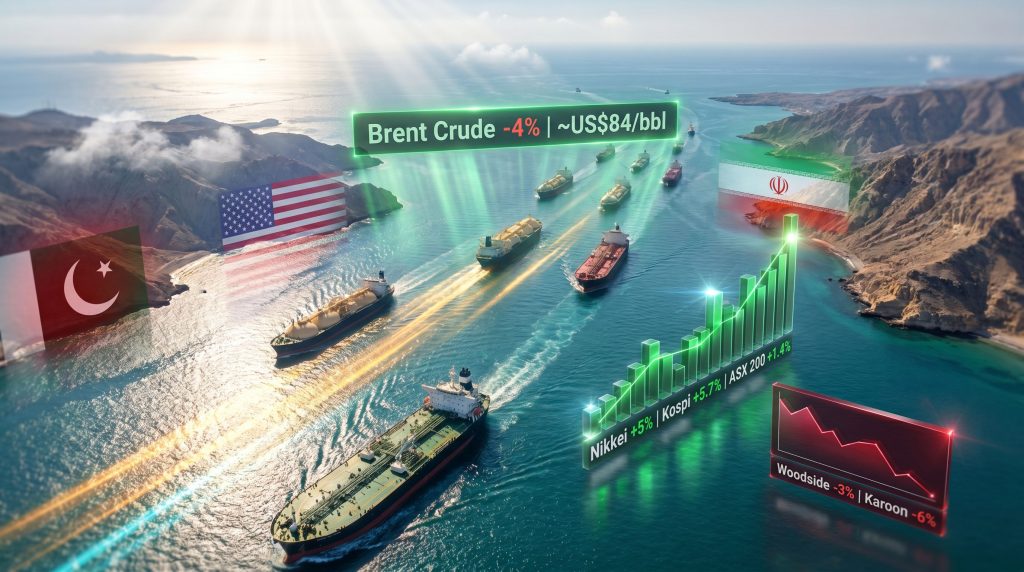
- Japan's Nikkei index gained more than +5% in a single session, driven by Japan's acute sensitivity to energy import costs
- South Korea's Kospi advanced +5.7%, the largest single-day gain reflecting how dramatically lower oil prices benefit export-oriented manufacturing economies with high energy import dependency
- Australia's ASX 200 rose approximately +1.4%, reaching 8,920 points as investor sentiment shifted toward risk assets
- The broader All Ordinaries index climbed +1.39% to 9,131.7, signalling wide sectoral participation in the rally rather than a narrow sector rotation
The scale of the South Korean reaction deserves particular attention. South Korea imports virtually all of its crude oil, and energy costs represent a meaningful input into the country's dominant semiconductor, shipbuilding, and automotive manufacturing sectors. A sustained reduction in energy prices would mechanically improve the earnings outlook across those industries.
Oil Price Collapse: Unwinding the Risk Premium
Brent crude fell more than -4% to approximately US$84 per barrel following the announcement. This move represents not a fundamental deterioration in demand, but the rapid compression of a geopolitical risk premium embedded in energy prices throughout the conflict period. Furthermore, crude oil price trends leading into this event had already reflected months of accumulated uncertainty, making the scale of the unwind all the more pronounced.
Energy markets price probability-weighted futures, not certainties. A credible MOU, even without formal ratification, is sufficient to trigger significant premium unwinding because it shifts the probability distribution of outcomes. Traders do not wait for ink to dry before repositioning.
This dynamic explains why oil price movements during de-escalation events frequently overshoot what underlying supply changes would justify. The risk premium that accumulated during months of uncertainty can dissolve within hours, even when the physical flow of barrels through the strait has not yet changed.
Sector Winners: Who Benefits Most
The clearest sectoral beneficiaries are those with direct fuel cost exposure. Australian aviation stocks led the local market's advance:
- Virgin Australia surged more than +11%, reflecting the outsized sensitivity of low-cost carriers to jet fuel costs
- Qantas gained approximately +5%, with the improvement reflecting both direct fuel cost relief and improved consumer sentiment for discretionary travel spending
- Flight Centre rose roughly +8%, capturing the indirect benefit from a recovering travel demand environment combined with lower operational costs across its airline partners
Beyond aviation, transport logistics operators, consumer discretionary retailers with significant distribution cost exposure, and energy-intensive manufacturers all stand to benefit from a sustained lower oil price environment. For these businesses, fuel is not a discretionary expense but a core input cost, meaning that price normalisation flows directly into margin improvement.
Sector Losers: Energy Producers Under Pressure
The inverse relationship between oil price relief and upstream producer valuations played out precisely as structural analysis would predict:
- Woodside Energy declined approximately -3% as near-term revenue expectations were marked down in line with Brent crude's decline
- Karoon Energy fell more than -6%, reflecting the higher earnings sensitivity that characterises smaller producers with less diversified revenue streams
It is worth noting that this pressure on energy producers is a mechanical response to commodity price movement, not a signal of operational deterioration. A sustainably lower oil price environment can paradoxically support longer-term demand growth by reducing the incentive for demand-side substitution toward alternatives.
Quantifying the Disruption: What the Closure Actually Cost
Supply Shock Mechanics and the Compounding LNG Effect
The economic cost of Hormuz disruption operates through several transmission channels simultaneously. The most direct is crude oil price inflation, which feeds through to transport fuel costs, electricity generation costs in oil-dependent power systems, and petrochemical input prices across manufacturing supply chains.
The LNG dimension is frequently underappreciated in analysis focused primarily on crude. Qatar's LNG export infrastructure is almost entirely oriented toward strait transit, meaning any restriction on passage directly constrains one of the world's largest sources of flexible gas supply. Asian spot LNG prices, which serve as benchmarks for a significant share of gas contracts across Northeast Asia, respond rapidly to changes in Qatari export availability.
Regional Economic Exposure
| Region | Exposure Level | Primary Channel |
|---|---|---|
| Japan | Very High | Near-total crude import dependency; LNG price linkage |
| South Korea | Very High | Crude imports; manufacturing input cost inflation |
| China | High | Crude imports; refining margin compression |
| India | High | Crude imports; Gulf diaspora remittance flows |
| Europe | Moderate | LNG pricing linkage; petrochemical feedstock costs |
| Australia | Indirect | LNG export pricing benchmarks; energy sector earnings |
Australia's exposure, while indirect, is structurally significant. Australia's energy exports are frequently benchmarked against Asian spot prices, creating a revenue linkage between Hormuz transit availability and domestic energy sector earnings. The relationship runs in both directions: disruption supports LNG export revenues, while normalisation compresses them.
Is the Deal Durable? Three Scenarios Investors Should Consider
Scenario 1: Full Implementation (Bull Case for Energy Stability)
- Formal signing in Switzerland proceeds on schedule
- Oil and gas shipments resume through the strait within weeks of signing
- Brent crude stabilises at a lower range as the full geopolitical risk premium unwinds
- Aviation, transport, and consumer discretionary sectors sustain margin improvement through the second half of 2026
- Nuclear talks commence on a defined timeline, progressively reducing long-term uncertainty and tail risk
Scenario 2: Delayed or Partial Implementation (Base Case)
- Signing occurs but technical or political implementation obstacles emerge
- Oil prices partially recover as markets reassess execution credibility
- Energy producers stabilise after the initial sell-off
- Diplomatic momentum continues with reduced market conviction; volatility remains elevated
Scenario 3: Deal Collapse (Bear Case)
- Iranian domestic political opposition or US legislative pushback derails ratification
- The strait remains restricted; Brent crude rebounds sharply above prior conflict-period highs
- Asian equity market gains reverse; risk-off positioning returns across asset classes
- LNG spot prices spike; Australian LNG exporters recover lost ground as the supply premium re-emerges
However, market volatility throughout 2025 demonstrated how rapidly investor sentiment can shift when geopolitical developments surprise to the upside — a pattern that appears to be repeating with this announcement.
Analytical Note: Current market pricing reflects a probability-weighted blend of Scenarios 1 and 2. The magnitude of single-session moves in equities and oil indicates substantial repositioning, but the incomplete nature of the agreement means certainty pricing has not yet been fully reached. The gap between MOU and formal treaty ratification remains the critical execution risk.
The next major ASX story will hit our subscribers first
Long-Term Macro Implications: Central Banks, Supply Chains, and Regional Power Dynamics
Energy Disinflation and Monetary Policy
Lower energy prices reduce headline inflation across every import-dependent economy, and the timing of this potential relief is particularly consequential. Central banks across the Asia-Pacific region have been navigating the tension between persistent services inflation and energy-driven goods price pressures. A sustained reduction in oil prices would ease that tension, potentially accelerating the pace at which rate-cutting cycles can proceed through the second half of 2026.
For the Australian dollar, the interaction is complex. Lower energy prices reduce the earnings outlook for Australia's significant LNG export sector, which can exert modest downward pressure on the AUD through the terms of trade channel. However, improved risk sentiment globally tends to support the AUD as a risk-correlated currency, creating partially offsetting dynamics.
Supply Chain Reconfiguration: Will Rerouting Arrangements Persist?
One underappreciated dimension of prolonged supply disruptions is the degree to which market participants adapt through structural rerouting. Major importers who shifted procurement toward non-Gulf sources, extended overland pipeline utilisation, or built strategic inventory buffers during the disruption period may not immediately reverse those arrangements even after the strait formally reopens.
This behaviour pattern, observed historically following previous Hormuz tension episodes, means that the full demand recovery for strait-routed crude may lag the diplomatic timeline. Traders remain sceptical about the implementation timeline, and shipping tanker rates and freight market signals will provide early evidence of whether physical flows are normalising in line with diplomatic progress.
Pakistan's Emergence as a Regional Broker
Pakistan's role as the primary mediator in this negotiation represents a notable development in South Asian foreign policy positioning. Serving as a credible intermediary between Washington and Tehran requires maintaining functional diplomatic relationships with both parties simultaneously — a balance that few regional actors have managed in recent years. Whether Pakistan can sustain and build on this diplomatic capital will be one of the more consequential geopolitical storylines emerging from this settlement process.
Switzerland's selection as the signing venue continues a long-standing tradition of using neutral European territory for high-stakes diplomatic formalisation, a pattern that itself carries diplomatic signalling value about the seriousness of both parties' commitment to the process.
FAQ: Strait of Hormuz Reopening Deal
What is the Strait of Hormuz and why does it matter for oil prices?
The Strait of Hormuz is a narrow maritime passage between Iran and Oman that functions as the primary export corridor for Persian Gulf crude oil and LNG. Approximately 20% of global petroleum liquids trade transits this single waterway, and no practical alternative routing exists at comparable cost or scale.
Has the Strait of Hormuz deal been formally signed?
As of the announcement on 15 June 2026, the agreement existed as a preliminary memorandum of understanding. A formal signing was expected in Switzerland, with Iranian officials confirming that implementation would not begin until that formal execution occurred.
Who mediated the US-Iran Strait of Hormuz agreement?
Pakistan served as the primary neutral intermediary, relaying proposals between the two parties and facilitating the diplomatic framework that produced the preliminary agreement.
Why did oil prices fall so sharply on the announcement?
Markets immediately began unwinding the geopolitical risk premium that had been embedded in crude prices throughout the period of disruption. Brent crude fell more than -4% to approximately US$84 per barrel as traders repositioned to price in the probability of resumed supply flows.
Which Australian stocks benefit most from a Hormuz reopening?
Aviation operators, travel companies, and transport logistics businesses are the primary near-term beneficiaries through lower fuel input costs. Consumer discretionary and energy-intensive manufacturing sectors also benefit from reduced input cost pressures.
Could the deal still fall apart?
Yes. Material execution risks remain, including the gap between MOU status and formal ratification, conflicting signals from Iranian domestic political factions, and unresolved details around sanctions relief and the deferred nuclear negotiation track.
Key Takeaways for Investors and Economists
- The preliminary US-Iran agreement represents the most significant de-escalation signal in Middle Eastern energy geopolitics in recent years, with market reactions reflecting substantial probability-weighted repositioning
- Brent crude at approximately US$84 post-announcement reflects geopolitical risk premium compression, not a fundamental demand collapse
- Aviation, travel, and transport sectors are positioned as structural beneficiaries; upstream energy producers face near-term earnings headwinds
- The MOU-to-treaty gap and the deferred nuclear negotiation track represent the primary execution risks that could reverse current market pricing
- Central banks in import-dependent economies across Asia-Pacific may find energy disinflation supportive of their rate-setting objectives through the second half of 2026
- Supply chain rerouting decisions made during the disruption period may not reverse immediately, meaning physical flow normalisation could lag the diplomatic timeline
This article is intended for informational purposes only and does not constitute financial or investment advice. Markets discussed involve significant uncertainty, and forward-looking statements involve inherent risk. Readers should consult a qualified financial adviser before making investment decisions.
Want to Stay Ahead of the Next Market-Moving Discovery?
While geopolitical developments like the Strait of Hormuz deal reshape commodity markets overnight, Discovery Alert's proprietary Discovery IQ model ensures subscribers never miss a significant ASX mineral discovery — delivering real-time alerts that transform complex data into actionable opportunities the moment they hit the exchange. Explore historic discoveries and their remarkable returns, then begin your 14-day free trial to position yourself ahead of the market.