May 20, 2026
Understanding Australia's Geoscience Infrastructure Evolution
The global transition toward renewable energy technologies has fundamentally reshaped how nations approach geological resource assessment and strategic planning. Countries worldwide are reassessing their subsurface knowledge to identify critical materials essential for energy storage, transmission infrastructure, and manufacturing supply chains. This technological shift demands unprecedented precision in geological mapping, real-time earth observation capabilities, and integrated data systems that can support both immediate resource development needs and long-term environmental stewardship objectives.
Australia's position within this evolving landscape reflects decades of geological survey expertise, yet the increasing complexity of modern resource challenges requires systematic modernisation of national capabilities. The intersection of climate policy, resource security, and technological advancement has created new imperatives for comprehensive geoscience infrastructure that extends far beyond traditional mineral exploration frameworks.
When big ASX news breaks, our subscribers know first
What Defines Australia's National Geoscience Strategy Framework?
Strategic Architecture of National Resource Assessment
The Geoscience Australia national strategy represents a comprehensive approach to geological data collection, analysis, and dissemination that integrates federal coordination with state-level implementation mechanisms. This framework encompasses five distinct operational domains: resource potential evaluation, precision positioning systems, earth observation infrastructure, comprehensive mapping initiatives, and natural hazard monitoring capabilities.
The strategic approach emphasises data integration across multiple government agencies, establishing standardised protocols for geological information sharing while maintaining quality assurance standards for scientific accuracy. Furthermore, the framework prioritises accessibility of geological data for both government decision-making and private sector resource development activities through 3D geological modelling techniques.
Federal Coordination and State Implementation Protocols
The implementation structure relies on coordinated efforts between federal agencies and state geological surveys, ensuring that national priorities align with regional resource development objectives. This coordination mechanism facilitates data sharing protocols that enhance the overall quality and coverage of geological information across jurisdictional boundaries.
Key operational components include:
- Standardised data collection methodologies across all jurisdictions
- Integrated database systems for seamless information access
- Quality assurance protocols for geological survey data
- Professional certification standards for geoscience practitioners
- Public-private partnership frameworks for research collaboration
The organisational structure recognises that geological formations and mineral deposits do not respect political boundaries, requiring collaborative approaches to resource assessment that leverage expertise and infrastructure across multiple agencies and institutions.
How Does the 2026-2036 Vision Transform National Capabilities?
Comprehensive Resource Assessment Strategy
The decade-long strategic framework prioritises systematic evaluation of Australia's geological potential across multiple resource categories essential for economic development and environmental sustainability. The strategy encompasses critical minerals mapping for renewable energy infrastructure, hydrogen resource potential assessment, carbon storage site identification, and comprehensive evaluation of offshore renewable energy opportunities.
The technical approach utilises advanced satellite imagery through the Landsat Next system, providing high-resolution earth observation capabilities that enable detailed analysis of geological formations and mineral distribution patterns. This satellite technology integration represents a significant advancement in Australia's capacity for real-time environmental monitoring and resource assessment. Additionally, these capabilities support mining industry innovation through enhanced exploration techniques.
Strategic focus areas include:
- Critical minerals identification for battery manufacturing and renewable energy systems
- Hydrogen resource evaluation through geological formation analysis
- Carbon storage assessment for climate change mitigation strategies
- Offshore renewable energy site analysis for wind and solar development
- Groundwater resource mapping for agricultural and industrial applications
Investment Allocation and Expected Outcomes
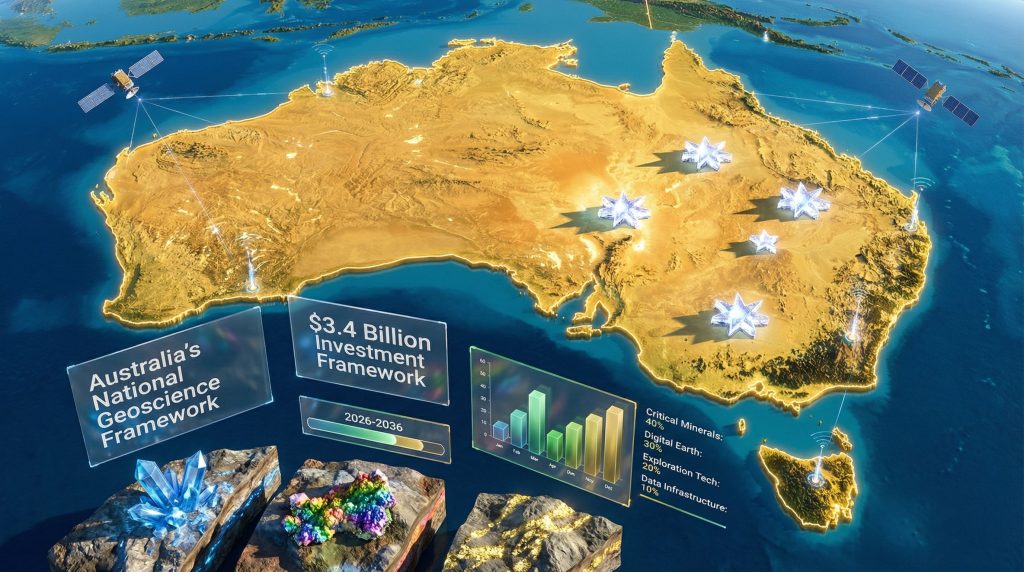
The $3.4 billion Resourcing Australia's Prosperity initiative represents one of the most significant investments in national geoscience capabilities in Australian history. This funding framework spans the entire ten-year strategy period, with allocations designed to maximise both immediate operational improvements and long-term capacity building.
| Priority Area | Investment Focus | Timeline | Expected Impact |
|---|---|---|---|
| Critical Minerals Mapping | Enhanced geological surveys | 2026-2030 | Improved resource discovery rates |
| Earth Observation Systems | Satellite technology integration | 2026-2028 | Real-time environmental monitoring |
| Navigation Infrastructure | Precision positioning capabilities | 2026-2027 | Enhanced survey accuracy |
| Hazard Assessment | Risk monitoring systems | 2026-2036 | Community safety improvements |
| Digital Integration | Database modernisation | 2026-2029 | Streamlined data access |
The investment strategy emphasises measurable outcomes that support both economic development objectives and environmental protection requirements, ensuring that resource development activities align with sustainability commitments and community safety priorities.
What Economic Drivers Support This Strategic Investment?
National Economic Security and Resource Independence
The strategic investment framework addresses multiple economic vulnerabilities that have become increasingly apparent in recent years. Global supply chain disruptions have highlighted the importance of domestic resource security, particularly for materials essential to renewable energy infrastructure and advanced manufacturing capabilities.
The Geoscience Australia national strategy specifically targets resources critical to Australia's net-zero transition commitments, including lithium for battery manufacturing, rare earth elements for wind turbine magnets, and copper for electrical infrastructure. For instance, this focus aligns with broader economic policies designed to strengthen Australia's position in global clean energy supply chains whilst supporting the critical minerals transition.
Return on Investment Analysis
Historical analysis of previous geoscience investments demonstrates significant economic returns through enhanced resource discovery rates and improved risk assessment capabilities. Every dollar invested in geological survey activities has historically generated multiple dollars in economic value through successful mineral exploration projects and improved land use planning decisions.
The current investment framework projects enhanced competitiveness in several key areas:
- Resource discovery efficiency: Improved geological data reduces exploration costs and increases success rates
- Infrastructure planning: Better geological information supports more effective development of transportation and utilities
- Risk mitigation: Enhanced hazard assessment capabilities reduce costs associated with natural disaster impacts
- Export opportunities: Advanced geoscience capabilities create opportunities for consulting and technology services
The strategy recognises that geological knowledge represents fundamental infrastructure that supports multiple economic sectors beyond traditional mining activities, including agriculture, construction, and urban planning.
How Do Regulatory Frameworks Enable Strategic Objectives?
Legislative Foundation and Data Governance
The implementation of national geoscience strategy objectives requires sophisticated regulatory frameworks that balance public access to geological information with intellectual property protection for research innovations. Current legislative structures provide mechanisms for data-driven operations whilst maintaining appropriate security protocols for sensitive geological information.
Environmental assessment procedures have evolved to incorporate enhanced geological data requirements, ensuring that development projects utilise the most current and accurate subsurface information available. These regulatory improvements streamline permitting processes while maintaining rigorous environmental protection standards according to Geoscience Australia's strategy framework.
International Collaboration and Data Exchange
Australia's geoscience strategy includes provisions for expanded international collaboration, particularly with Pacific region nations that share similar geological characteristics and resource development challenges. These partnerships facilitate data exchange agreements that enhance understanding of regional geological systems while providing opportunities for Australian expertise export.
The regulatory framework addresses intellectual property considerations for joint research projects, ensuring that Australian innovations in geoscience technology and methodology can be effectively commercialised while supporting international development objectives.
Key regulatory enablers include:
- Streamlined environmental assessment protocols incorporating enhanced geological data
- Data sharing agreements between federal and state agencies
- International collaboration frameworks for Pacific region partnerships
- Intellectual property protection mechanisms for geoscience innovations
- Professional certification standards ensuring data quality and reliability
What Implementation Challenges Require Strategic Management?
Technical Infrastructure and Workforce Development
The successful deployment of advanced geoscience capabilities requires significant technical infrastructure investments, including high-performance computing systems for data analysis, specialised laboratory facilities for sample processing, and communication networks for real-time data transmission from remote monitoring stations.
Workforce development represents another critical challenge, as the strategy requires geoscientists with expertise in emerging technologies including artificial intelligence applications for geological data analysis, advanced satellite imagery interpretation, and integrated environmental monitoring systems. Universities and professional organisations must expand training programmes to meet these evolving skill requirements.
Inter-Agency Coordination and Budget Management
The complexity of coordinating activities across multiple government agencies creates potential bottlenecks that could delay implementation of key strategic objectives. Effective coordination mechanisms must balance federal oversight with state-level operational flexibility, ensuring that national priorities align with regional development needs.
Budget allocation efficiency becomes critical when managing a decade-long investment program across multiple agencies and operational domains. Consequently, contingency planning must address potential cost overruns, technology deployment delays, and changing political priorities that could affect long-term funding commitments.
Risk mitigation strategies include:
- Phased implementation timelines allowing for adaptive management approaches
- Alternative funding mechanisms to maintain continuity during budget constraints
- Technology redundancy planning to address equipment failures or obsolescence
- Regular performance assessment and strategy refinement protocols
The next major ASX story will hit our subscribers first
How Does This Position Australia in Global Geoscience Leadership?
International Competitive Advantages
Australia's geographical position provides unique advantages for Southern Hemisphere geological research and earth observation activities. This positioning enables valuable data collection capabilities that complement Northern Hemisphere monitoring systems, creating opportunities for international collaboration and technology export.
The comprehensive scope of Australia's geoscience strategy exceeds similar initiatives in many developed countries, positioning Australian expertise as globally competitive in critical areas including mineral exploration technology, environmental monitoring systems, and integrated geological data management. Moreover, this development supports the establishment of a national minerals reserve framework that enhances Australia's strategic position.
Technology Export and Knowledge Transfer Opportunities
Advanced geoscience capabilities developed through this strategic investment create significant opportunities for international consulting services and technology transfer partnerships. Australian companies and research institutions can leverage enhanced domestic capabilities to compete for major international geological survey projects and infrastructure development contracts.
The strategy specifically targets development of exportable expertise in several high-value areas:
- Critical minerals exploration techniques applicable to global renewable energy supply chains
- Integrated environmental monitoring systems for sustainable development projects
- Precision geological mapping technologies for infrastructure planning
- Natural hazard assessment methodologies for disaster risk reduction
Pacific region nations represent particularly promising markets for Australian geoscience expertise, given shared geological characteristics and development challenges that align with Australian technical strengths.
What Measurable Outcomes Define Strategic Success?
Performance Indicators and Assessment Frameworks
The ten-year strategy implementation requires comprehensive monitoring systems that track progress across multiple operational domains while maintaining accountability for public investment outcomes. Performance measurement encompasses both quantitative metrics such as resource discovery rates and data accessibility statistics, and qualitative assessments of capability improvements and international competitiveness.
Primary success metrics include:
- Resource discovery enhancement: Measured through exploration success rates and economic value of new discoveries
- Data accessibility improvements: Tracked through user engagement statistics and data download volumes
- International collaboration expansion: Assessed through partnership agreements and joint project developments
- Community safety enhancement: Evaluated through improved disaster prediction accuracy and response capabilities
- Economic value creation: Calculated through return on investment analysis and export revenue generation
Long-term Impact Assessment and Adaptive Management
The strategy includes provisions for regular review and refinement based on emerging technologies, changing economic conditions, and evolving environmental priorities. This adaptive management approach ensures that investment priorities can be adjusted to maximise effectiveness while maintaining overall strategic coherence.
Annual progress reporting mechanisms provide transparency for public accountability while enabling continuous improvement of operational approaches. Independent review processes incorporate stakeholder feedback from industry, academic, and community perspectives to ensure that strategy implementation meets diverse national objectives.
Frequently Asked Questions About Australia's Geoscience Strategy
How will enhanced geological data benefit mining exploration companies?
The strategy significantly improves the quality and accessibility of geological information available to exploration companies, reducing initial survey costs and increasing the probability of successful resource discoveries. Enhanced data coverage particularly benefits junior mining companies that may lack resources for comprehensive geological surveys across large exploration areas.
Improved geological databases enable more sophisticated exploration targeting, allowing companies to focus their activities on areas with higher potential for economic mineral deposits. This efficiency improvement reduces environmental impact through more precise exploration activities and decreases the time required for feasibility assessments.
What coordination mechanisms exist between federal and state implementation?
The strategy establishes formal coordination protocols between Geoscience Australia and state geological surveys, ensuring that data collection standards and analytical methodologies remain consistent across jurisdictional boundaries. Regular coordination meetings facilitate information sharing and collaborative planning for major survey projects.
Joint funding arrangements enable shared infrastructure development and coordinated field programs that leverage expertise from multiple agencies. These partnerships particularly benefit regional areas where geological formations cross state boundaries, requiring integrated assessment approaches.
How does the strategy support Australia's climate commitments?
Enhanced geological mapping capabilities directly support renewable energy development through improved identification of suitable sites for wind and solar installations, assessment of geological formations appropriate for carbon storage, and comprehensive evaluation of critical minerals required for clean energy infrastructure.
The strategy includes specific provisions for hydrogen resource assessment, evaluating geological formations that could support large-scale hydrogen production and storage facilities. This capability assessment supports Australia's emerging hydrogen export industry and domestic clean energy objectives according to Science Strategy 2028.
Environmental monitoring enhancements enable better assessment of climate change impacts on geological stability, groundwater resources, and natural hazard patterns, supporting adaptive management approaches for infrastructure development and community protection.
Strategic Implications for Australia's Resource Future
Long-term Economic and Environmental Integration
The comprehensive scope of Australia's Geoscience Australia national strategy represents a fundamental shift toward integrated resource planning that balances economic development objectives with environmental protection requirements and community safety priorities. This approach recognises that sustainable resource development requires sophisticated understanding of geological systems and their interactions with environmental and social systems.
The strategy's emphasis on critical minerals mapping for renewable energy infrastructure demonstrates how geological knowledge can support both economic competitiveness and climate policy objectives. This integration provides a framework for future resource development that contributes to rather than conflicts with environmental sustainability goals.
Enhanced disaster risk assessment capabilities protect communities and infrastructure investments while enabling more informed decision-making about development locations and design standards. These improvements particularly benefit regional areas where geological hazards pose significant risks to economic development and community safety.
The ten-year investment horizon provides sufficient time for fundamental capability improvements while maintaining flexibility for adaptive management as technologies evolve and priorities change. This strategic approach positions Australia to maintain global leadership in geoscience applications while supporting domestic economic development and environmental protection objectives.
Disclaimer: This analysis is based on publicly available information regarding Australia's national geoscience strategy and investment initiatives. Investment and policy decisions should be based on comprehensive analysis of current government announcements and official documentation. Projections regarding economic impacts and strategic outcomes represent analytical assessments rather than guaranteed results.
Looking to Position Yourself in Australia's Resource Development Future?
Discovery Alert's proprietary Discovery IQ model identifies significant ASX mineral discoveries instantly, particularly in critical minerals that align with Australia's enhanced geological mapping initiatives. With the nation's $3.4 billion geoscience investment creating unprecedented opportunities in resource discovery, subscribers gain real-time insights into actionable trading opportunities before the broader market recognises their potential.