
May 20, 2026
Understanding Australia's Magnesium Processing Revolution Through Advanced Metallurgy
The global shift toward supply chain resilience has fundamentally altered how nations approach strategic resource processing. Traditional models that relied heavily on offshore refining for critical materials are increasingly viewed as vulnerabilities rather than cost efficiencies. This transformation becomes particularly evident when examining recent developments in Australia's magnesium processing capabilities, where results confirm metal pathway ahead for latrobe magnesium through advanced hydrometallurgical techniques are demonstrating the viability of domestic value-addition at industrial scale.
The successful production of high-grade magnesium oxide through innovative processing routes represents more than a technical achievement. It signals a potential paradigm shift in how Australia approaches its role within global critical minerals supply chains, moving from raw material exporter to sophisticated processor of strategic materials.
When big ASX news breaks, our subscribers know first
What Does High-Grade Magnesium Oxide Production Mean for Australia's Resource Sovereignty?
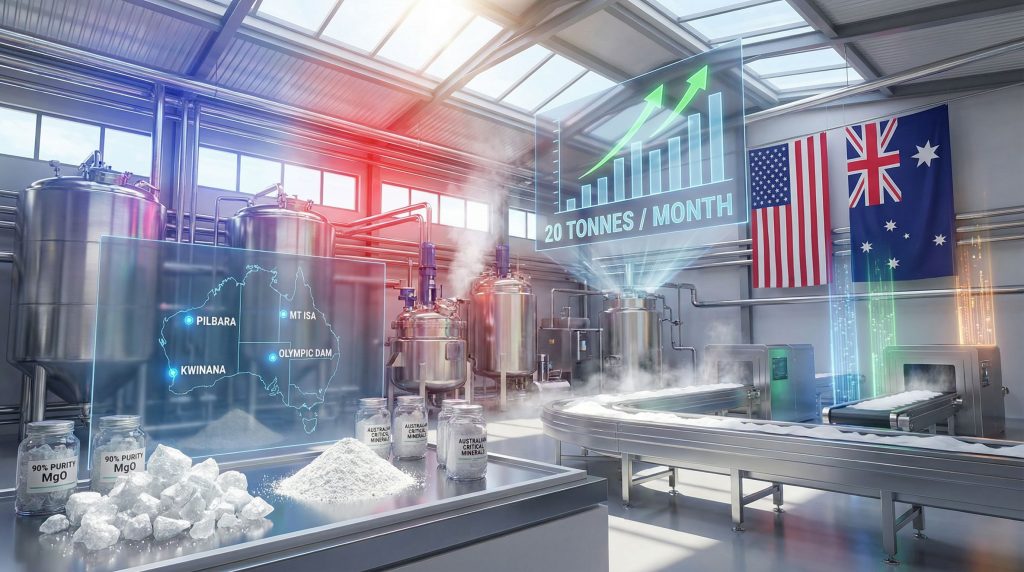
Australia's critical minerals sector has reached a crucial validation point through the demonstration of domestic magnesium processing capabilities. Recent results confirm metal pathway ahead for latrobe magnesium as approximately 20 tonnes of high-grade magnesium oxide has been successfully produced over a continuous 14-day operational cycle, achieving remarkable purity specifications that validate commercial viability.
Technical Specifications Confirm Commercial Viability
The technical achievements demonstrate sophisticated metallurgical control with specific compositional results. Furthermore, these specifications represent a significant milestone in Australia's critical minerals energy transition efforts:
- Magnesium compound concentration: ~90% purity achieved through X-ray diffraction analysis
- Calcium oxide content: 5% (providing beneficial downstream processing advantages)
- Calcium chloride presence: 5.5% (removable through process optimisation)
- Production capacity: Continuous operations producing approximately 10 tonnes per week
These specifications indicate that the hydrometallurgical process has achieved industrial-grade performance standards. The presence of calcium oxide, rather than being considered an impurity, actually provides operational benefits by reducing consumable costs during subsequent metal reduction stages.
CSIRO testing has validated that magnesium compounds at approximately 94% purity maintain optimal metal recovery efficiency and product quality, confirming the technical pathway for metal production.
Process Optimisation Pathways
The demonstrated results indicate significant room for enhancement, with the processing facility capable of achieving concentrations above 95% magnesium compounds through minor adjustments. This optimisation potential suggests the current demonstration represents conservative operational parameters rather than maximum capability.
The modular design of the processing infrastructure allows for systematic improvements without fundamental process redesign. Consequently, this creates a pathway for continuous enhancement of product specifications as market demands evolve.
Why Are Hydrometallurgical Processing Routes Critical for Australia's Industrial Future?
The validation of patented hydrometallurgical extraction processes represents a fundamental departure from traditional pyrometallurgical approaches that have dominated magnesium production globally. Unlike energy-intensive smelting operations, hydrometallurgical pathways offer scalable solutions particularly suited to Australia's industrial landscape.
Energy Efficiency and Operational Advantages
| Process Characteristic | Hydrometallurgical Approach | Traditional Pyrometallurgy |
|---|---|---|
| Energy requirements | Lower baseline consumption | High thermal energy demand |
| Operational flexibility | Modular scaling capability | Fixed infrastructure requirements |
| Environmental impact | Aqueous processing control | Emissions-intensive operations |
| Product quality control | Continuous monitoring capability | Batch-dependent variations |
The hydrometallurgical route demonstrated at the Latrobe Valley facility operates through aqueous chemical extraction, distinguishing it fundamentally from high-temperature smelting methods. This approach enables more precise control over product specifications while maintaining operational flexibility.
Scalability Factors for Mid-Tier Operations
The successful demonstration over a two-week continuous operational period validates the process stability required for commercial deployment. The modular processing design allows for capacity adjustments based on market demand, creating operational agility uncommon in traditional large-scale pyrometallurgical operations.
This scalability becomes particularly relevant for Australia's resource sector. In addition, mid-tier operations often provide optimal economic returns while maintaining manageable operational complexity.
How Does This Development Impact Australia's Critical Minerals Supply Chain Position?
The transition from oxide production to planned metal manufacturing creates strategic implications extending far beyond individual project success. Results confirm metal pathway ahead for latrobe magnesium could fundamentally alter Australia's positioning within global critical minerals strategy frameworks through the establishment of domestic processing capabilities for strategically important materials.
Supply Chain Security Transformation
| Strategic Factor | Current Position | Post-Metal Production |
|---|---|---|
| Processing dependency | Import-reliant infrastructure | Domestic capability development |
| Value-addition potential | Limited to raw materials | Integrated processing chain |
| Export product complexity | Commodity-based offerings | Advanced materials production |
| Strategic autonomy | Vulnerable supply dependencies | Enhanced self-reliance |
The successful demonstration of oxide production validates the technical foundation for subsequent metal production, scheduled for the second half of 2026. This timeline positions Australia to potentially become a significant player in global magnesium metal markets at a time when supply chain security is increasingly prioritised.
International Recognition and Strategic Partnerships
The receipt of a Letter of Interest from the Export-Import Bank of the United States under the US-Australia critical minerals framework indicates international recognition of the strategic importance of this development. This positioning places the operation among a select group of Australian developers considered strategically important to allied critical minerals supply chains.
Such recognition extends beyond commercial validation. However, it suggests integration into bilateral strategic frameworks designed to enhance allied nation supply chain resilience for critical materials.
What Timeline Factors Determine Commercial Success for Australian Magnesium Operations?
The progression from demonstration to commercial production follows a carefully structured timeline that balances technical validation with market positioning requirements. Understanding these temporal factors reveals the strategic importance of execution timing within rapidly evolving global markets.
Development Milestone Framework
Current Phase Completion: Oxide production validation achieved through March 2026 operations
Metal Component Installation: Targeting completion after mid-2026
First Metal Production: Expected during second half of calendar year 2026
Commercial Scale Operations: Timeline dependent on market validation and expansion capital availability
The demonstrated production rate of approximately 520 tonnes annually at current demonstration scale provides a baseline for commercial planning. Furthermore, expansion capabilities through modular design offer significant scaling potential and directly relate to resource energy exports challenges facing Australia.
Critical Path Dependencies
The successful transition to metal production requires coordination of several critical elements:
- Technical Implementation: Installation and commissioning of metal production components
- Market Validation: Confirmation of customer acceptance and pricing parameters
- Financial Structure: Securing expansion capital for commercial scale operations
- Regulatory Compliance: Meeting all requirements for metal production operations
The timing of these elements becomes crucial as global magnesium markets experience increasing demand while facing supply concentration risks from traditional production centres.
How Do International Strategic Partnerships Influence Domestic Critical Minerals Development?
The involvement of international strategic partners, particularly the Export-Import Bank of the United States, demonstrates how bilateral critical minerals frameworks create development momentum for Australian projects beyond purely commercial considerations.
Geopolitical Strategic Value
The Letter of Interest from the US Export-Import Bank positions the operation within established US-Australia critical minerals cooperation frameworks, indicating strategic importance that transcends individual project metrics. This recognition suggests alignment with broader allied objectives for critical minerals supply chain security.
The operation's classification among strategically important Australian developers for allied critical minerals supply chains indicates recognition at policy levels within bilateral cooperation structures.
Development Finance and Technology Access
International development finance interest validates project viability while potentially providing access to advanced processing technologies through strategic partnerships. For instance, this creates opportunities for technology transfer and operational enhancement that might not be available through purely domestic development pathways.
The timing of this international recognition, concurrent with successful oxide production demonstration, suggests sustained interest throughout the development phase rather than opportunistic involvement.
The next major ASX story will hit our subscribers first
What Market Positioning Advantages Does Domestic Magnesium Production Create?
The establishment of domestic magnesium metal production capability creates multiple competitive advantages within regional and global markets. In addition, as supply chain security becomes increasingly prioritised over cost minimisation strategies, these advantages become more pronounced.
Regional Market Dynamics
Logistics Advantages:
- Reduced transportation costs for domestic industrial consumers
- Enhanced supply reliability for downstream manufacturing operations
- Potential for just-in-time delivery arrangements with Australian customers
Supply Security Benefits:
- Reduced dependency on concentrated global production centres
- Direct control over production scheduling and quality specifications
- Strategic positioning for future demand growth in aerospace and automotive sectors
Global Market Integration Opportunities
The strategic partnership framework with allied nations creates preferential access to international markets where supply chain security commands premium pricing. This positioning becomes particularly valuable as global industries reassess supply chain resilience requirements and aligns with broader mining industry innovation trends.
Direct access to allied nation supply chains through established bilateral frameworks potentially provides market access advantages not available to traditional commodity exporters.
How Does Process Chemistry Innovation Impact Long-term Operational Economics?
The technical achievements in hydrometallurgical processing represent broader innovations in resource extraction efficiency that could influence industry-wide operational approaches while creating sustainable competitive advantages.
Economic Optimisation Factors
| Operational Aspect | Innovation Impact | Economic Benefit |
|---|---|---|
| Energy efficiency | Hydrometallurgical routes reduce energy inputs | Lower operational costs |
| Waste management | Integrated processing minimises waste streams | Reduced handling expenses |
| Quality control | Continuous processing enables consistent specifications | Premium pricing capability |
| Operational flexibility | Modular design allows demand-responsive production | Optimised capacity utilisation |
The demonstrated capability to produce magnesium compounds at 90% purity with optimisation potential exceeding 95% indicates sophisticated process control that could translate into premium product positioning within global markets.
Technological Competitive Advantages
The proprietary hydrometallurgical process represents intellectual property that could provide sustained competitive advantages beyond initial production capabilities. Consequently, this technological foundation potentially creates opportunities for licensing or technology export to other jurisdictions facing similar supply chain security challenges.
What Investment Implications Emerge from Successful Demonstration Plant Operations?
The transition from demonstration to commercial operations creates specific investment strategy components that influence project financing strategies and expansion planning. Furthermore, results confirm metal pathway ahead for latrobe magnesium while validating the underlying economic assumptions of the development.
Risk Assessment Framework
Technical Execution Risks: Successfully mitigated through demonstration plant validation
Market Acceptance Risks: Partially addressed through strategic partner interest and allied supply chain recognition
Operational Scaling Risks: Minimised through proven modular design flexibility
Financial Viability Risks: Supported by international finance interest and government strategic frameworks
The successful production campaign provides empirical evidence supporting investment thesis while demonstrating operational readiness for commercial scale deployment.
Capital Deployment Strategies
The modular processing design creates opportunities for phased capital deployment, allowing for graduated scaling based on market validation and demand confirmation. This approach reduces capital risk while maintaining expansion optionality as market conditions evolve.
International development finance interest provides alternative funding sources that may offer more favourable terms than traditional project finance arrangements. However, this is particularly relevant given the strategic classification of the operation.
How Does This Development Influence Australia's Critical Minerals Policy Framework?
The successful demonstration of domestic processing capabilities provides empirical evidence supporting policy initiatives aimed at developing value-added mineral processing within Australia while validating strategic resource development frameworks.
Policy Validation Metrics
Domestic Processing Viability: Technical and economic feasibility confirmed through operational demonstration
Strategic Autonomy Enhancement: Reduced import dependency for critical materials validated through production results
Allied Partnership Integration: Successful alignment with international strategic frameworks demonstrated through bilateral recognition
Innovation Ecosystem Development: Advanced metallurgical capability validated through proprietary process demonstration
The successful results confirm that policy settings supporting domestic processing development can achieve intended outcomes. For instance, this creates strategic benefits extending beyond individual project success.
Framework Development Implications
The demonstrated success potentially influences future policy frameworks for other critical minerals, providing a template for domestic value-addition development that balances commercial viability with strategic objectives.
What Future Scenarios Could Emerge from Successful Magnesium Metal Production?
The establishment of commercial magnesium production creates multiple potential development pathways that could influence broader Australian industrial strategy while positioning the nation as a significant player in global critical minerals markets.
Expansion Scenario Development
Vertical Integration Pathway:
- Partnership development with downstream manufacturing operations
- Advanced alloy development programmes utilising domestic magnesium production
- Technology export opportunities to allied nations facing similar supply chain challenges
Regional Hub Development:
- Expansion of processing capabilities for related critical minerals
- Development of integrated critical minerals processing infrastructure
- Creation of specialised workforce and technological capabilities
Strategic Integration Scenario:
- Contribution to strategic stockpile capabilities for critical materials
- Integration with defence industry supply chain requirements
- Development of next-generation processing technologies for broader application
The modular design of the demonstrated processing capability creates optionality for multiple development pathways. Furthermore, this maintains operational flexibility as market conditions and strategic requirements evolve.
Long-term Strategic Positioning
Successful magnesium metal production could establish Australia as a reliable supplier of critical materials to allied nations while demonstrating the viability of domestic processing for other strategically important minerals. This positioning becomes increasingly valuable as global supply chain security considerations influence procurement decisions across multiple industries.
Disclaimer: This analysis is based on publicly available information and should not be considered investment advice. Readers should conduct their own research and consult with qualified professionals before making investment decisions. Future production timelines, market conditions, and project outcomes involve inherent uncertainties that may differ materially from current expectations.
Looking for Your Next Strategic Mineral Investment?
Discovery Alert's proprietary Discovery IQ model delivers real-time alerts on significant ASX mineral discoveries, empowering subscribers to identify actionable opportunities ahead of the broader market. Begin your 14-day free trial today and secure your market-leading advantage in Australia's evolving critical minerals sector.