
August 7, 2026
Australia's mining sector faces unprecedented challenges as global supply chains experience significant disruption and commodity markets undergo structural shifts. The intersection of corporate governance failures, regulatory enforcement, and strategic asset management has created a complex landscape where traditional business models are being tested. Understanding these dynamics becomes crucial when examining how individual company crises reflect broader systemic vulnerabilities within the resources industry, particularly when considering management red flags that investors must recognise.
Understanding Corporate Insolvency in Australia's Mining Landscape
Corporate insolvency procedures serve as critical mechanisms for managing distressed assets while protecting stakeholder interests. Liberty Bell Bay voluntary administration represents a textbook case of how regulatory intervention can redirect potential liquidation toward asset preservation and restructuring opportunities.
Voluntary administration under Australian corporate law provides a moratorium period where external administrators assess viability options. This differs fundamentally from receivership, where secured creditors primarily drive asset recovery processes. The distinction becomes particularly important in mining operations where specialised infrastructure requires ongoing maintenance to preserve value.
Ernst & Young's appointment as administrator followed ASIC's Supreme Court intervention on March 16, 2026, creating a structured pathway for stakeholder engagement. The administrator's immediate priorities include operational stabilisation and sales process initiation, reflecting the dual mandate of preserving employment while maximising creditor recoveries.
Key procedural elements in mining sector administrations include:
- Asset preservation protocols for specialised equipment and infrastructure
- Workforce retention strategies to maintain operational knowledge
- Environmental compliance continuity during ownership transitions
- Supply chain relationship management to prevent further operational disruption
- Government coordination mechanisms for strategic asset protection
The timeline structure typically involves creditor meetings within 25 business days, followed by either deed of company arrangement negotiations or asset sale processes. For mining operations, technical due diligence periods often extend beyond standard commercial transactions due to specialised infrastructure assessments.
Furthermore, mining administrations frequently involve multiple secured creditor classes, creating complex priority structures. Equipment financiers, working capital lenders, and government support facilities each maintain different security positions, influencing recovery strategies and sale processes.
When big ASX news breaks, our subscribers know first
Anatomy of Financial Collapse in Resource Processing Operations
Liberty Bell Bay's five-year non-compliance period with ASIC financial reporting requirements reveals systematic corporate governance breakdown extending well beyond operational challenges. This extended regulatory failure coincided with the 2021 collapse of Greensill Capital, GFG Alliance's primary financier, creating cascading liquidity constraints across the group's Australian operations.
The cyclone-induced supply disruption in May 2025 represented a triggering event rather than root cause of financial distress. Limited operations status continued for ten months, indicating underlying structural problems prevented normal business recovery following supply chain restoration.
Financial deterioration indicators included:
- Regulatory non-compliance escalation from 2021 through 2026
- Supply chain payment difficulties affecting ore procurement relationships
- Working capital constraints limiting operational flexibility
- Parent company debt restructuring creating subsidiary funding uncertainty
- Government intervention requirements signalling market failure
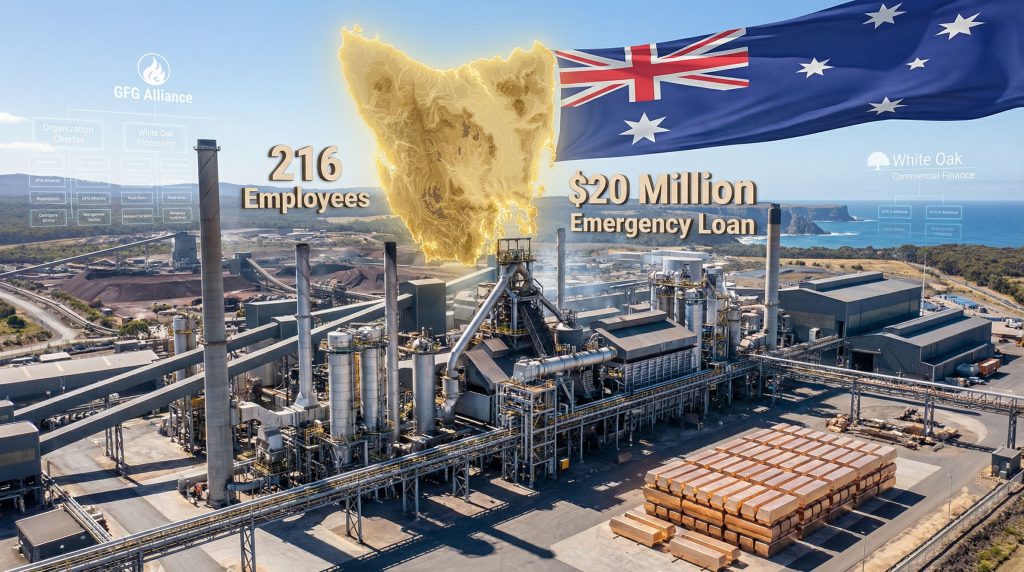
The $20 million Tasmanian government emergency loan facility in August 2025 provided temporary liquidity but failed to address fundamental business model viability. Of this amount, $14.5 million was allocated for ore stockpiling (23,000 tonnes delivered in October 2025), yet remained unused through January 2026 when receivers were appointed to protect this specific asset.
This pattern suggests operational restart capabilities were compromised beyond simple working capital constraints. Technical factors potentially included equipment maintenance backlogs, skilled workforce departures, or customer relationship deterioration during the extended limited operations period.
GFG Alliance's broader Australian asset difficulties created additional complexity. Whyalla Steelworks administration and Tahmoor Colliery liquidation with 238 job losses established a pattern of systematic withdrawal from Australian operations, limiting cross-subsidisation options for Bell Bay's recovery.
However, White Oak Commercial Finance's decision to pursue administration rather than liquidation indicates secured creditor assessment that operational continuity enhances asset recovery prospects compared to distressed sale scenarios.
Strategic Infrastructure at the Heart of National Supply Security
Australia's only manganese alloy smelter creates absolute import dependency if domestic processing capability is lost. This monopoly position extends beyond simple market concentration to encompass specialised technical knowledge, processing infrastructure, and established supply relationships that cannot be rapidly replicated.
Manganese alloys serve essential functions in steel production, particularly for stainless steel manufacturing and specialised alloy applications. Bell Bay's 216 direct employees represent concentrated expertise in smelting technologies, metallurgical processes, and quality control systems specific to manganese processing.
The facility's strategic importance manifests through multiple dimensions:
- Supply chain criticality for Australian steel and manufacturing sectors
- Technical capability preservation requiring specialised workforce retention
- Infrastructure irreplaceability given capital requirements for new smelter development
- Regional economic anchoring in northern Tasmania's industrial base
- Import vulnerability mitigation reducing foreign supply dependencies
International experience demonstrates that smelting facility closures often result in permanent capability loss rather than temporary suspension. Restart costs typically include major equipment refurbishment, skilled workforce recruitment, customer relationship rebuilding, and regulatory compliance restoration.
For Bell Bay specifically, the unused ore stockpile (protected under government receivership) suggests recognition that raw material security alone cannot guarantee operational viability. Processing facilities require continuous operation to maintain optimal efficiency and equipment condition.
The facility's northern Tasmania location provides access to deep-water port facilities and established industrial infrastructure, yet creates geographic isolation from major steel consumption centres. This positioning requires careful logistics coordination and customer relationship management to maintain competitive operations.
Consequently, strategic asset valuation in administration scenarios must balance immediate liquidation value against longer-term replacement costs for domestic processing capability. Government intervention suggests recognition that market-based asset pricing may undervalue strategic importance to national supply security.
Government Intervention Strategies in Critical Asset Administrations
Tasmania's $20 million emergency loan facility represents proactive government intervention to preserve strategic manufacturing capability during corporate distress. This approach differs from reactive worker support programs by attempting to maintain operational continuity rather than managing closure consequences.
The intervention strategy involved multiple coordinated mechanisms:
| Support Mechanism | Amount | Timing | Purpose | Recovery Status |
|---|---|---|---|---|
| Emergency Loan | $20 million | August 2025 | Working capital support | Uncertain |
| Ore Stockpiling | $14.5 million | October 2025 | Restart preparation | Protected via receivership |
| Asset Protection | Receivership costs | January 2026 | Asset preservation | Ongoing |
Federal Industry Minister Tim Ayres' coordination commitment with Tasmanian authorities and administrators reflects recognition that strategic asset preservation requires multi-level government involvement. This approach acknowledges that traditional market-based administration processes may not adequately consider national economic interests.
The ore stockpile protection through separate receivership demonstrates sophisticated asset preservation techniques. By maintaining control over raw materials worth $14.5 million, the Tasmanian government preserves restart optionality for potential acquirers while protecting taxpayer investment.
Government loan subordination relative to secured commercial creditors creates complex recovery dynamics. Fair Entitlements Guarantee scheme activation may provide worker protection while administration processes determine final outcomes, but specific recovery prospects depend on asset sale results and creditor hierarchy arrangements.
In addition, administrative coordination between federal and state governments addresses overlapping jurisdictions for employment support, regional development programs, and strategic industry policy. This coordination becomes particularly important when administration timelines intersect with budget cycles and policy implementation schedules.
The intervention approach contrasts with purely market-based liquidation by attempting to preserve going-concern value rather than accepting distressed asset pricing. Success depends on administrator's ability to identify acquirers who recognise strategic value beyond immediate financial returns.
Stakeholder Analysis in Complex Mining Administrations
Ernst & Young's dual mandate encompasses both traditional creditor protection responsibilities and broader stakeholder coordination requirements given the facility's strategic importance. The administration strategy prioritises operational stabilisation while initiating competitive sale processes.
Workforce considerations involve 216 direct employees whose specialised skills represent significant economic value. Manganese smelting expertise cannot be rapidly replaced, creating strong incentives for acquirer retention of existing personnel. Employee entitlements under Fair Entitlements Guarantee provide baseline protection, yet ongoing employment security depends ultimately on finding viable new ownership.
Creditor recovery prospects vary significantly by security position and claim type:
- Secured creditors (led by White Oak Commercial Finance) hold priority positions over specific assets
- Government loans face uncertain subordination arrangements affecting recovery rates
- Unsecured creditors typically receive minimal distributions in mining administrations
- Employee entitlements benefit from statutory protections and government guarantee schemes
The administrator's commitment to meeting with unions and government representatives reflects acknowledgment that traditional creditor-focused processes require modification when strategic assets are involved. Stakeholder coordination becomes particularly complex when government funding creates hybrid public-private creditor structures.
Potential acquirer profiles likely include vertical integration opportunities for steel producers seeking secure manganese alloy supply, private equity investors attracted to distressed infrastructure assets, and international players seeking Australian market entry points.
Valuation challenges centre on separating distressed sale conditions from fundamental asset worth. Specialised smelting infrastructure requires significant capital investment to replicate, potentially supporting premium valuations for strategic buyers despite current operational difficulties.
Furthermore, community impact extends beyond direct employment to encompass supplier networks, local service providers, and regional economic multiplier effects. Northern Tasmania's industrial base depends partially on Bell Bay's continued operation, creating broader stakeholder interests in successful administration outcomes.
Systematic Challenges Across GFG Alliance Australian Operations
GFG Alliance's systematic retreat from Australian operations extends beyond individual site difficulties to encompass broader strategic repositioning following Greensill Capital's 2021 collapse. This pattern demonstrates how global financial constraints can cascade through geographically dispersed industrial operations.
The portfolio downsizing timeline reveals accelerating difficulties:
| Facility | Location | Status | Employment Impact | Timeline |
|---|---|---|---|---|
| Whyalla Steelworks | South Australia | Administration | Estimated 300+ jobs at risk | Post-2021 |
| Tahmoor Colliery | New South Wales | Liquidation | 238 confirmed job losses | Post-2021 |
| Liberty Bell Bay | Tasmania | Administration | 216 jobs uncertain | March 2026 |
This systematic pattern suggests structural rather than operational challenges across GFG's Australian portfolio. Total confirmed and at-risk employment exceeds 750 positions, representing significant industrial capacity and specialised workforce expertise.
The Greensill Capital relationship provided structured finance solutions specifically designed for industrial operations with complex cash flow profiles. Its collapse created immediate liquidity constraints across GFG operations, yet the five-year timeline suggests attempts at alternative financing arrangements proved inadequate.
Global manganese market dynamics compound company-specific difficulties. Chinese market dominance in both consumption and pricing creates structural challenges for higher-cost Western producers. Australian operations face additional constraints from energy costs, carbon pricing policies, and stringent environmental regulations.
Sanjeev Gupta's industrial empire restructuring reflects broader challenges in maintaining geographically dispersed heavy industry operations under unified ownership. Scale economies from integrated operations must be balanced against local market conditions and regulatory requirements in different jurisdictions.
Investment climate deterioration for energy-intensive processing operations affects acquisition prospects for distressed assets. Potential buyers must evaluate long-term operating economics under evolving carbon pricing regimes and renewable energy transition policies.
Consequently, the systematic nature of GFG's Australian difficulties suggests broader industry consolidation trends rather than isolated management failures. Understanding these dynamics becomes crucial for assessing potential acquirer interest and long-term viability prospects.
The next major ASX story will hit our subscribers first
Investment Perspectives on Distressed Industrial Assets
Specialised smelting infrastructure presents unique investment characteristics combining high barrier-to-entry advantages with significant operational complexity. Potential acquirers must evaluate both immediate restart requirements and longer-term competitive positioning within global manganese markets.
Strategic buyer profiles vary significantly in risk tolerance and value recognition:
- Steel producers seeking vertical integration and supply security
- Private equity investors focused on operational turnaround potential
- International mining companies pursuing Australian market entry
- Infrastructure funds attracted to long-term industrial asset characteristics
- Government entities prioritising strategic capability preservation
Due diligence requirements for smelting operations extend beyond traditional asset assessments to encompass technical condition evaluations, environmental liability quantification, and specialised workforce availability. The unused ore stockpile provides immediate operational capability testing opportunities for serious acquirers.
Restart cost estimations typically include major equipment refurbishment, environmental compliance upgrades, customer relationship rebuilding, and working capital requirements. Industry experience suggests these costs often exceed initial acquisition prices for distressed smelting operations.
Market positioning considerations involve evaluating long-term manganese demand growth against increasing competition from international low-cost producers. Australian operations must justify higher cost structures through service quality, supply reliability, or specialised product capabilities.
Government support transferability remains unclear pending administration outcome. New ownership structures may or may not inherit existing loan arrangements, asset protection mechanisms, or policy support commitments from previous government interventions.
The Bell Bay facility's monopoly position in Australian manganese processing creates both opportunity and responsibility for potential acquirers. Market dominance provides pricing power yet attracts regulatory scrutiny and customer diversification pressures.
Investment timing considerations reflect broader economic cycles affecting commodity demand, infrastructure valuations, and credit market conditions. Current administration circumstances may create acquisition opportunities for well-capitalised buyers willing to accept restart risks, though this contrasts with the experience of other halted iron project situations across the industry.
Future Implications for Australia's Industrial Policy Framework
Critical minerals processing capability preservation emerges as a strategic priority requiring coordination between market-based allocation mechanisms and national security considerations. The Bell Bay case demonstrates how traditional corporate insolvency procedures may inadequately address broader policy objectives, particularly in light of the recent critical minerals order focusing on supply security.
Regulatory framework evolution may incorporate enhanced early warning systems for strategic asset financial distress, potentially including mandatory stress testing, enhanced reporting requirements, or government observer rights during financial difficulties.
Import dependency risks extend beyond immediate supply disruptions to encompass longer-term industrial capability erosion. Once specialised processing facilities close permanently, rebuilding domestic capacity typically requires substantial public and private investment coordination.
Regional development implications affect government intervention calculus beyond pure economic efficiency considerations. Northern Tasmania's industrial base depends on anchor employers like Bell Bay, creating broader community impacts that traditional market mechanisms may not adequately price.
International competitiveness factors require ongoing evaluation as carbon pricing, environmental regulation, and energy costs evolve. Australian processing operations must demonstrate sustainable competitive advantages beyond temporary government support to justify long-term investment.
The GFG Alliance experience provides lessons for managing complex international corporate structures owning strategic domestic assets. Regulatory frameworks may require enhanced transparency, local financial strength requirements, or contingency planning for parent company difficulties.
However, future mining sector investment patterns may shift toward greater government co-investment in strategic processing capabilities, potentially through development banks, sovereign wealth funds, or public-private partnership structures designed to balance commercial viability with national interest considerations.
Policy coordination mechanisms between federal and state governments demonstrated during the Bell Bay intervention may establish precedents for managing future strategic asset crises. Success or failure of current approaches will likely influence framework development for comparable situations within broader industry evolution trends.
Furthermore, these developments occur against a backdrop of increasing global focus on supply chain resilience and strategic mineral processing capabilities. The Liberty Bell Bay voluntary administration case will likely be studied by policymakers seeking to balance market efficiency with national security considerations in future industrial policy frameworks.
Disclaimer: This analysis is based on publicly available information and involves forward-looking assessments of complex corporate and policy situations. Administration outcomes remain uncertain and depend on factors beyond current public knowledge. Investment decisions should incorporate independent professional advice and due diligence appropriate to individual circumstances.
Looking to Capitalise on Australian Mining Sector Opportunities?
While corporate distress creates market uncertainty, significant mineral discoveries continue driving exceptional returns for informed investors. Discovery Alert's proprietary Discovery IQ model delivers real-time alerts on major ASX mineral discoveries, transforming complex geological data into actionable investment insights ahead of market recognition. Explore historic discovery successes and their substantial returns to understand the potential, then begin your 14-day free trial today to position yourself strategically within Australia's evolving mining landscape.