May 19, 2026
When Commodity Cycles Meet Market Psychology: Decoding FMG's Current Position
Few forces in equity markets are as simultaneously powerful and deceptive as commodity price momentum. When a bulk mineral like iron ore surges toward multi-year highs, the instinct among retail and institutional investors alike is to pile into the producers closest to the source. However, the history of resources investing teaches a more complicated lesson: the point of maximum commodity optimism rarely coincides with the most attractive entry point for the underlying equity. Understanding this tension is essential to evaluating whether Fortescue shares buy sell or hold represents the right question — and the right answer — in mid-2026.
When big ASX news breaks, our subscribers know first
The Iron Ore Engine: How FMG's Revenues Actually Work
Fortescue Ltd (ASX: FMG) is one of the world's largest iron ore producers, shipping the majority of its output from the Pilbara region of Western Australia to steel mills predominantly in China. Unlike BHP Group or Rio Tinto, which operate across copper, aluminium, coal, and other commodity streams, Fortescue derives close to 100% of its revenue from iron ore sales. This structural characteristic creates a near-direct transmission mechanism between iron ore spot prices and Fortescue's earnings trajectory.
How Price Movements Drive Earnings
The mechanics work as follows: Fortescue's ore is priced on a wet metric tonne basis, benchmarked against the 62% iron fines index (the most widely traded iron ore grade reference). Because the company ships very large volumes, even a US$5 per tonne movement in the benchmark price can translate into hundreds of millions of dollars in annualised revenue variance. This is why FMG shares behave more like a leveraged derivative on iron ore prices than a typical diversified mining equity.
What is less commonly understood is the grade discount that affects Fortescue's realised prices. The company's Pilbara blend product has historically traded at a discount to the 62% benchmark because of its slightly lower iron content and higher alumina and silica levels. Chinese steel mills apply a price penalty for lower-grade ore due to the additional processing costs and blast furnace inefficiencies it creates. Consequently, Fortescue's actual revenue per tonne typically sits below the headline benchmark figure investors track.
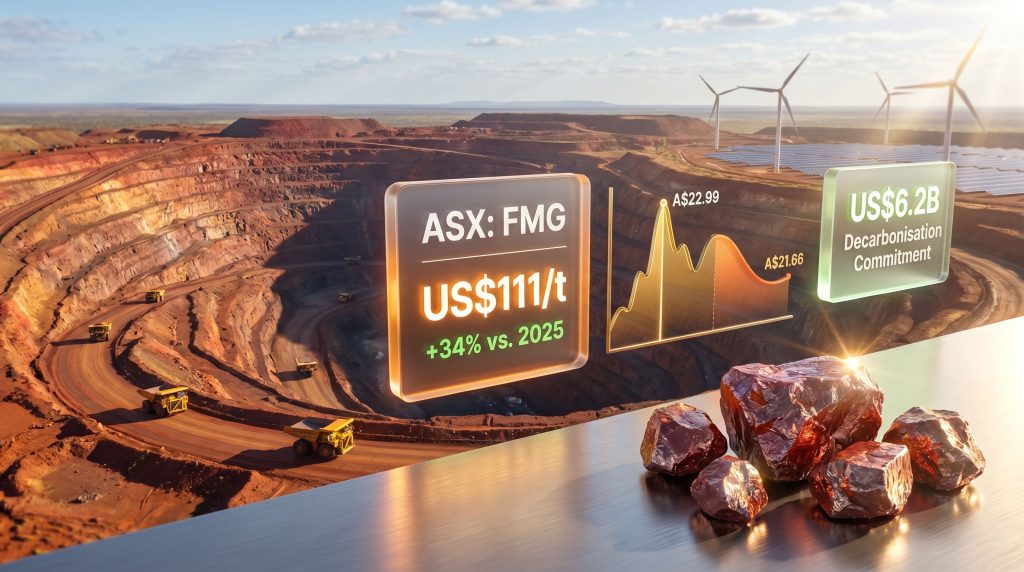
The iron ore demand outlook has recently supported prices above US$111 per tonne, reaching a multi-year high. Prices remain approximately 11% higher year-on-year and 3.2% above one-month-ago levels, providing a meaningful tailwind for Pilbara operators. However, this headline figure overstates the benefit to Fortescue relative to higher-grade producers.
Recent Share Price Action: Rally, Reversal, and What It Signals
Fortescue shares surged approximately 15% in early May 2026, driven by a sector-wide rotation back into ASX mining equities that had been underperforming during a period of geopolitical uncertainty and cost-of-supply concerns. The stock reached a two-year intraday high of A$22.99 before experiencing a sharp 6% pullback over three consecutive trading sessions.
As of mid-May 2026, FMG trades near A$21.66, sitting 2% below its year-to-date starting price but 34% above its level from the same period in 2025. No material company-specific news accompanied the reversal from the two-year high. The most credible explanation is straightforward profit-taking behaviour: investors who accumulated positions during the sector's underperformance phase used the price spike as a disciplined exit opportunity.
This pattern — a rapid surge to a technically significant resistance level followed by a swift reversal without fundamental cause — is a textbook example of what market practitioners call a "sentiment overshoot." It occurs when price advances beyond what fundamental valuation supports, sustained only by momentum and positive sentiment rather than earnings revisions.
The speed of the reversal is instructive. A 6% decline within three sessions following a 15% rally suggests that sellers were positioned and waiting. This is consistent with institutional behaviour around multi-year technical resistance levels, where algorithmic triggers and pre-set exit orders concentrate selling pressure at specific price points.
What Analysts Are Saying: A Sobering Consensus
The analyst community's response to the rally has been notably restrained. Across approximately 17 analysts covering Fortescue, the distribution of ratings tells a cautious story.
| Rating Category | Analyst Count | Implied View |
|---|---|---|
| Strong Buy | 1 | Isolated bullish conviction |
| Hold / Neutral | ~8 | Wait-and-see posture |
| Sell / Strong Sell | ~8 | Active downside risk flagged |
| Consensus | 17 analysts | Hold / Neutral |
The average analyst price target sits at approximately A$18.90, implying roughly 13% downside from mid-May trading levels. Bell Potter has issued a Sell rating with a price target of A$18.15, revised down from a prior target of A$20.30, pointing specifically to second-half cost escalation risks and uncertainty surrounding portfolio restructuring decisions.
At the extreme end of the bear case, at least one analyst has modelled a 12-month scenario targeting A$14.76, a potential 32% decline from recent trading levels. Furthermore, while this represents a tail risk rather than a base case, the fact that such a scenario is being formally modelled by a credentialed analyst warrants acknowledgement.
Featured Snippet Answer: The consensus analyst price target for Fortescue Ltd (ASX: FMG) is approximately A$18.90 as of mid-May 2026, implying around 13% downside from current prices near A$21.66. Of 17 tracked analysts, 8 carry a Sell or Strong Sell rating, 8 hold a neutral stance, and just 1 rates the stock a Strong Buy.
The disconnect between the recent price rally and analyst sentiment is itself informative. It suggests the rally was primarily retail and momentum-driven, without the broad institutional conviction that typically sustains new price highs. When analyst consensus fails to follow price higher, the risk of mean reversion toward target levels increases.
The Bull Case: Three Scenarios That Could Drive a Re-Rating
Despite the cautious consensus, there are credible pathways through which Fortescue shares could outperform analyst expectations. Investors with a long-term orientation and specific conviction on these scenarios may find the risk-reward more compelling than the headline numbers suggest.
1. Sustained Chinese Steel Demand Recovery
The China steel demand outlook remains a pivotal driver of FMG's revenue prospects. Iron ore's 11% year-on-year appreciation reflects a demand backdrop that, while uncertain, has not deteriorated structurally. Any material acceleration in Chinese infrastructure spending or property sector stabilisation would disproportionately benefit high-volume, pure-play producers like Fortescue. China consumes roughly 70% of globally seaborne iron ore, meaning even modest policy-driven demand shifts generate outsised price responses.
2. The Decarbonisation Premium: Undervalued or Misunderstood?
Fortescue has committed US$6.2 billion toward decarbonising its Pilbara operations, including a US$680 million accelerated investment in the 200-megawatt Pilbara Green Energy Project. Management has indicated the programme is expected to deliver material fuel cost savings and operational efficiency gains as the transition matures over a 5 to 10-year horizon.
The green iron transition represents more nuanced strategy than it first appears. Fortescue's mining fleet consumes enormous volumes of diesel fuel, which represents one of the largest variable cost components in its operating structure. Transitioning to green hydrogen-powered or battery-electric equipment would reduce exposure to diesel price volatility, creating a structurally lower and more predictable cost base over time. Markets have not yet fully priced this optionality.
3. Post-Rally Consolidation as an Accumulation Window
At current levels, FMG trades well below its two-year high but 34% above its 12-month low. For investors with a conviction view on iron ore's structural demand trajectory, the consolidation phase following a momentum-driven rally can represent a more disciplined entry point than chasing prices at peak sentiment.
The Bear Case: Why the Majority of Analysts Are Cautious
The weight of analyst opinion currently skews toward caution, and the underlying reasons are worth examining carefully before reaching a Fortescue shares buy sell or hold decision.
Cost Escalation in the Second Half of 2026
Bell Potter's downgrade centres on the risk that operating costs will rise materially in the second half of CY2026, potentially compressing EBITDA margins even if iron ore prices remain supportive. This is a legitimate concern given inflationary pressures across the Western Australian labour market, diesel costs, and maintenance expenditure on ageing equipment fleets.
Iron Bridge Magnetite: The Overhang No One Is Discussing Enough
The Iron Bridge magnetite project represents a less visible but potentially significant source of strategic uncertainty. Unlike hematite ore (which Fortescue's core Pilbara operations produce), magnetite requires considerably more energy-intensive processing to convert raw ore into a marketable product. The economics of magnetite projects are highly sensitive to energy costs and capital expenditure assumptions.
Fortescue's ongoing portfolio optimisation review, which includes scrutiny of Iron Bridge, introduces strategic ambiguity that markets typically discount. Any decision to divest, curtail, or materially restructure the project could trigger writedowns or alter the company's long-term production growth profile in ways that are difficult to model with confidence.
Dividend Sustainability Under Pressure
Fortescue has historically been a generous dividend payer, and income investors represent a meaningful portion of its shareholder base. If second-half cost guidance disappoints and the US$6.2 billion decarbonisation commitment continues drawing on free cash flow, the capacity to sustain elevated dividend payouts could become constrained. For income-focused holders, this risk deserves close monitoring.
Risk Warning: Fortescue's earnings are acutely sensitive to iron ore price movements. A 10% decline in spot prices, without a corresponding AUD/USD depreciation offset, could meaningfully reduce free cash flow generation and dividend capacity. Investors should model this scenario explicitly before sizing their position.
The next major ASX story will hit our subscribers first
Fortescue vs. BHP vs. Rio Tinto: A Comparative Framework
For investors weighing iron ore exposure across the major ASX miners, the following comparison provides a useful orientation. BHP's iron ore strategy has evolved considerably, making direct comparisons with Fortescue's pure-play model increasingly instructive.
| Metric | Fortescue (FMG) | BHP Group (BHP) | Rio Tinto (RIO) |
|---|---|---|---|
| Iron Ore Revenue Dependence | ~100% | ~40-50% | ~55-60% |
| Commodity Diversification | Very Low | High | Medium-High |
| Decarbonisation Investment | US$6.2B committed | Significant, staged | Significant, staged |
| Analyst Consensus (May 2026) | Hold / Sell skew | Mixed / Moderate Buy | Mixed / Moderate Buy |
| Implied Downside (Consensus) | ~13% | More balanced | More balanced |
| Grade Premium / Discount | Grade discount vs benchmark | Mixed, includes premium grades | Includes high-grade Pilbara blend |
Furthermore, Australia's iron ore dominance underpins all three producers, yet Fortescue's near-total iron ore concentration creates the highest leverage to commodity upside but also the greatest earnings volatility during price downturns. BHP and Rio Tinto's copper, aluminium, and other commodity streams provide natural hedges when iron ore prices soften, delivering more stable earnings through commodity cycles.
A Decision Framework: Three Investor Profiles
Rather than applying a single verdict to all investors, the following scenario analysis recognises that the appropriate Fortescue shares buy sell or hold decision depends significantly on individual investor objectives and time horizons.
Profile 1: The Long-Term Conviction Investor
- Holds a structural view on Chinese and Southeast Asian steel demand through the decade
- Treats Fortescue's decarbonisation investment as a genuine, if delayed, competitive moat
- Accepts near-term earnings volatility as the cost of a long-term position
- Suggested posture: Hold existing positions; consider staged accumulation if the share price retreats toward the A$18 to A$19 analyst consensus target range
Profile 2: The Risk-Conscious Income Investor
- Values Fortescue's dividend history but is concerned about payout sustainability if H2 costs rise
- Notes that 8 of 17 analysts currently recommend selling the stock
- Is not comfortable holding a position that the majority of analysts price significantly below current levels
- Suggested posture: Hold but reduce position size if the stock cannot reclaim and sustain above A$22.50; monitor H2 cost guidance as the critical decision trigger
Profile 3: The Momentum or Short-Term Trader
- Entered during the early May rally and has captured material gains
- Recognises the stock reversed sharply from a two-year high with no clear catalyst to resume the uptrend
- Analyst consensus does not support current pricing
- Suggested posture: Consider trimming or exiting; re-evaluate after the next earnings update or a clear iron ore price inflection above US$115 per tonne
Key Catalysts to Monitor Over the Next 6 to 18 Months
Near-Term Triggers (0 to 6 Months)
- Iron ore price direction: A sustained move above US$115 per tonne would likely reignite bullish sentiment, while a decline toward US$90 per tonne would accelerate selling pressure
- H2 CY2026 cost guidance: Any upward revision to operating cost forecasts will validate the bearish analyst thesis and likely pressure the share price
- Iron Bridge portfolio decision: Resolution of the strategic review will remove a key investment thesis overhang
Medium-Term Catalysts (6 to 18 Months)
- Pilbara Green Energy Project milestones: Progress toward the 200MW target and early evidence of fuel cost savings could prompt a re-rating of Fortescue's decarbonisation value component
- Chinese macroeconomic policy: Fiscal measures targeting property sector stabilisation or infrastructure investment would directly support iron ore demand
- Dividend announcements: Fortescue's capacity to maintain or grow its dividend will determine income investor retention and influence institutional positioning
Frequently Asked Questions: Fortescue Shares (ASX: FMG)
Is Fortescue a good buy right now?
Based on May 2026 analyst consensus, FMG is not considered a compelling buy at prices near A$21.66. The majority of analysts carry Hold or Sell ratings, with consensus targets approximately 13% below current trading levels. Investors with a long-term horizon may find better entry points closer to the A$18 to A$19 range.
Why did Fortescue shares fall from their two-year high?
The pullback from A$22.99 appears primarily driven by profit-taking following a rapid 15% rally in early May 2026. No material negative company news triggered the reversal, indicating normal post-rally consolidation rather than a fundamental deterioration in the investment case. For additional context on recent FMG performance trends, the pattern is consistent with broader sector dynamics observed across ASX mining equities.
What is the lowest analyst price target for FMG?
The most bearish 12-month target tracked in May 2026 sits at approximately A$14.76, representing a potential 32% decline from mid-May levels. Bell Potter's revised target of A$18.15 represents a more widely cited downside scenario.
What is the Iron Bridge magnetite project?
Iron Bridge is a magnetite iron ore project that requires significantly more energy-intensive beneficiation processing than standard hematite ore. Its economics are sensitive to energy and capital costs, and it remains under strategic review as part of Fortescue's portfolio optimisation process.
How does FMG compare to BHP and Rio Tinto for iron ore investors?
Fortescue offers the highest pure-play iron ore leverage among the three major ASX miners but carries considerably greater commodity concentration risk. BHP and Rio Tinto provide diversification across copper, aluminium, and other commodities, which tends to deliver more stable earnings across different points in the commodity cycle.
Summary: What the Evidence Supports in May 2026
Pulling the analysis together, the key data points for investors evaluating a Fortescue shares buy sell or hold decision are as follows:
- FMG reached a two-year high of A$22.99 before retreating approximately 6% to around A$21.66 over three trading sessions
- Iron ore above US$111 per tonne provided the initial catalyst, but analyst consensus has not followed the price higher
- 8 of 17 analysts carry a Sell or Strong Sell rating; the consensus price target implies approximately 13% downside
- Bell Potter's revised target of A$18.15 specifically cites H2 cost escalation and Iron Bridge strategic uncertainty
- The US$6.2 billion decarbonisation programme is a credible long-term differentiator but creates near-term cash flow pressure
- The grade discount on Fortescue's Pilbara blend ore means realised revenues per tonne consistently track below the headline 62% benchmark price that most investors monitor
- The most evidence-supported posture for most investor profiles is Hold for existing shareholders and patient accumulation for prospective buyers who identify a more attractive entry level closer to analyst consensus targets
This article contains general financial information only and does not constitute personal financial advice. Investors should consider their own financial circumstances and consult a licensed financial adviser before making investment decisions. Past performance is not indicative of future results. Share prices and analyst targets referenced reflect mid-May 2026 data and are subject to change.
Want To Catch The Next Major ASX Mineral Discovery Before The Market Does?
While Fortescue's iron ore story plays out across commodity cycles and analyst debates, Discovery Alert's proprietary Discovery IQ model scans ASX announcements in real time, instantly identifying significant mineral discoveries across more than 30 commodities and delivering actionable alerts before the broader market reacts — explore the historic returns major discoveries have generated and begin your 14-day free trial to position yourself ahead of the next transformative find.