June 19, 2026
Understanding Australia's Mining Investment Landscape Through BHP's Strategic Position
Australia's resources sector operates within complex global commodity cycles that present both significant opportunities and inherent challenges for long-term investors. The mining industry's cyclical nature means returns rarely follow predictable patterns, yet established operators with diversified portfolios have historically delivered substantial value creation over extended timeframes. This dynamic creates a compelling investment thesis for those willing to embrace volatility in exchange for exposure to fundamental economic trends.
BHP Group represents the archetypal diversified mining operation, with assets spanning multiple continents and commodity exposures that provide natural hedging against regional downturns. The company's operational footprint extends from iron ore operations in Western Australia to copper mining in Chile, creating revenue streams that rarely move in perfect correlation. This geographic and commodity diversification has enabled consistent cash generation across varying market conditions.
When big ASX news breaks, our subscribers know first
BHP's Operational Excellence and Market Leadership Position
Iron Ore Operations and Production Efficiency
BHP's Pilbara iron ore operations maintain some of the world's most competitive cost structures, with production costs significantly below global averages. These assets consistently generate substantial cash flows that fund both shareholder distributions and strategic capital investments. Furthermore, the company's operations directly benefit from current iron ore trends that continue to shape global markets. The company's iron ore division benefits from:
- High-grade ore bodies with decades of remaining reserves
- Integrated rail and port infrastructure reducing transportation costs
- Automated mining systems improving operational efficiency
- Proximity to key Asian markets minimizing shipping expenses
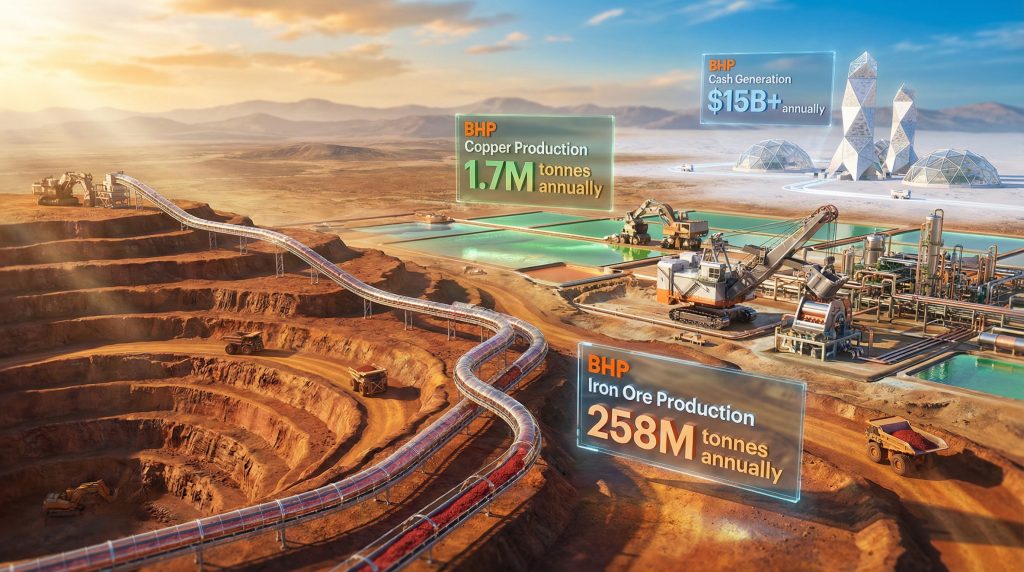
The Pilbara region's geological advantages translate into sustained competitive positioning within global iron ore markets. BHP's operations there produce approximately 258 million tonnes annually, representing roughly 20% of global seaborne iron ore trade.
Copper Assets and Energy Transition Exposure
The company's copper portfolio positions it favourably for accelerating electrification trends across global economies. Copper demand projections indicate significant growth driven by renewable energy infrastructure, electric vehicle adoption, and expanding electrical grid systems. Additionally, the copper investment outlook remains particularly promising for diversified miners. BHP's flagship Escondida mine in Chile produces approximately 1.2 million tonnes of copper annually, making it the world's largest copper mine by production volume.
Escondida's operational characteristics include:
- Reserve life: Multiple decades of proven and probable reserves
- Production costs: Bottom quartile globally due to scale and efficiency
- Expansion potential: Ongoing projects to extend mine life and increase throughput
- Strategic location: Established infrastructure in a mining-friendly jurisdiction
Long-Term Growth Catalysts for Those Looking to Invest in BHP Shares
The Jansen Potash Project Development
BHP's Jansen potash project in Saskatchewan represents the company's largest single capital investment, with total project costs estimated at approximately $7.5 billion. First production is scheduled for mid-2027, with initial capacity of 4.35 million tonnes annually and potential expansion to 8.5 million tonnes.
The project's economics reflect several favourable factors:
| Project Metric | Specification |
|---|---|
| Initial Annual Capacity | 4.35 million tonnes |
| Full Expansion Capacity | 8.5 million tonnes |
| Expected Mine Life | 100+ years |
| Capital Investment | $7.5 billion |
| Expected Production Start | Mid-2027 |
Potash demand drivers include global population growth requiring increased agricultural productivity, soil nutrient depletion in established farming regions, and rising protein consumption in developing economies. These fundamentals suggest sustained long-term demand growth for fertiliser inputs.
Copper Market Dynamics and Future Demand
Global copper consumption is projected to increase substantially over the next decade, driven primarily by energy transition requirements. Electric vehicles require approximately four times more copper than traditional internal combustion vehicles, while renewable energy systems and supporting grid infrastructure consume significant copper quantities.
Key copper demand catalysts include:
- Electric vehicle production scaling globally
- Renewable energy infrastructure deployment
- Grid modernisation and expansion projects
- Industrial electrification initiatives
- 5G telecommunications infrastructure development
Supply-side constraints may amplify price appreciation potential, as few large-scale copper projects are scheduled for development over the next decade. This supply-demand imbalance could create favourable pricing conditions for established producers like BHP.
Financial Performance Analysis and Investment Metrics
Cash Flow Generation and Capital Allocation
BHP's business model generates substantial free cash flow across commodity cycles, enabling consistent shareholder returns and strategic investments. The company targets dividend payout ratios between 50-60% of underlying earnings, providing both income and capital preservation benefits. Moreover, understanding proper investment strategy becomes crucial when evaluating such cyclical investments.
Historical cash flow patterns demonstrate BHP's resilience through various market conditions:
- Strong commodity prices: Excess cash allocated to special dividends and share buybacks
- Moderate pricing: Maintained base dividend with selective growth investments
- Weak markets: Reduced capital expenditure while preserving dividend sustainability
This flexible capital allocation approach has enabled the company to maintain investment-grade credit ratings while funding both growth projects and shareholder distributions.
Total Return Calculations for Long-Term Investors
Australian equity markets have historically delivered total returns averaging approximately 9% annually over extended periods, including dividend reinvestment. For investors considering how to invest in BHP shares, this historical benchmark provides a reasonable framework for long-term return expectations.
Assuming a 9% average annual total return over a 10-year period, a $10,000 initial investment could potentially grow as follows:
- Year 5: Approximately $15,386
- Year 7: Approximately $18,280
- Year 10: Approximately $23,674
These projections assume dividend reinvestment and compound growth, though actual results will vary based on commodity price cycles, operational performance, and broader market conditions.
Risk Assessment for BHP Share Investments
Commodity Price Volatility and Cyclical Exposure
Mining investments inherently carry exposure to commodity price fluctuations driven by global economic growth, supply disruptions, and geopolitical events. BHP's diversified commodity exposure provides some protection against single-commodity downturns, though broad-based commodity cycles can still significantly impact returns.
Key risk factors include:
- Economic slowdowns: Reduced industrial demand affecting multiple commodities
- Currency fluctuations: Revenue translation impacts from USD-denominated sales
- Supply increases: New mine developments potentially oversupplying markets
- Substitution risks: Alternative materials reducing commodity demand
Operational and Regulatory Challenges
Large-scale mining operations face numerous operational risks that can impact production and profitability. BHP's global footprint exposes the company to varying regulatory environments and operational challenges.
"Mining companies must navigate increasingly complex environmental regulations, community relations, and technical challenges while maintaining operational efficiency and safety standards."
Regulatory considerations include carbon pricing mechanisms, environmental compliance requirements, and evolving social licence expectations. These factors may increase operational costs while requiring additional capital investments for compliance.
Competitive Positioning Within Australian Resources Sector
Comparison with Single-Commodity Producers
BHP's diversified approach contrasts with single-commodity focused competitors like Fortescue Metals Group, which concentrates primarily on iron ore production. This diversification provides several advantages:
- Revenue stability: Multiple commodity exposures reduce earnings volatility
- Growth optionality: Various expansion opportunities across different commodities
- Risk mitigation: Geographic and operational diversification reducing single-point failures
- Financial flexibility: Multiple cash flow streams supporting various capital allocation strategies
ESG Integration and Sustainable Mining Practices
Environmental, social, and governance considerations increasingly influence mining company valuations and operational licences. Consequently, companies like BHP are embracing sustainable mining practices across their operations. BHP has established several sustainability commitments:
- Net-zero operational emissions target by 2030
- Scope 3 emissions reduction initiatives
- Water stewardship and biodiversity conservation programmes
- Indigenous partnership frameworks and community development
These initiatives may require significant capital investments but potentially reduce regulatory risks and enhance long-term operational sustainability.
The next major ASX story will hit our subscribers first
Strategic Considerations for Portfolio Integration
Position Sizing and Risk Management
When evaluating how to invest in BHP shares within a diversified portfolio, several factors warrant consideration. Investors can explore how to buy BHP shares through various platforms and brokers available in the Australian market.
Portfolio Allocation Guidelines:
- Individual stock positions typically 3-7% of total portfolio value
- Resources sector allocation generally 10-15% of equity holdings
- Geographic diversification through international commodity exposure
- Cyclical timing considerations through dollar-cost averaging approaches
Tax Optimisation for Australian Investors
Australian residents benefit from several tax advantages when investing in BHP shares:
- Franking credits: Tax credits attached to dividend payments reducing overall tax liability
- Capital gains concessions: 50% discount for assets held longer than 12 months
- Dividend reinvestment plans: Potential for tax-deferred compounding through automatic reinvestment
These tax benefits can significantly enhance after-tax returns for eligible investors, particularly those in higher tax brackets.
Technology Integration and Future Operational Efficiency
Autonomous Systems and Digital Innovation
BHP continues investing in technological solutions to improve operational efficiency and reduce costs. Furthermore, mining technology innovation is reshaping the entire industry landscape:
- Autonomous vehicles: Self-driving trucks and drilling equipment reducing labour costs
- Artificial intelligence: Predictive maintenance and operational optimisation systems
- Digital twins: Virtual modelling for equipment performance and mine planning
- Remote operations: Centralised control systems reducing on-site personnel requirements
These technological investments may provide competitive advantages through improved productivity and reduced operational risks.
Renewable Energy Integration
The company has committed to transitioning mine site power systems toward renewable energy sources, potentially reducing operational costs and environmental impacts. This transition includes:
- Solar and wind power installations at remote mine sites
- Battery storage systems for grid stability
- Energy efficiency improvements across processing facilities
- Partnerships with renewable energy developers for long-term power agreements
Long-Term Market Outlook and Commodity Fundamentals
Infrastructure Development and Emerging Market Growth
Global infrastructure requirements continue supporting long-term commodity demand, particularly in developing economies undergoing urbanisation and industrialisation. Key demand drivers include:
- Urban development: Housing, commercial, and infrastructure construction
- Transportation networks: Railways, highways, and port facilities
- Energy infrastructure: Power generation and transmission systems
- Industrial capacity: Manufacturing facilities and processing plants
These fundamental demand drivers suggest sustained long-term consumption growth for BHP's core commodities.
Energy Transition Requirements
The global shift toward renewable energy systems and electrification creates substantial commodity requirements, particularly for copper and nickel. BHP's exposure to these transition-critical materials positions the company favourably for this multi-decade trend.
Transition metal requirements include:
- Electric vehicles: Copper, lithium, and nickel for batteries and electrical systems
- Wind turbines: Copper and rare earth elements for generators and electrical components
- Solar panels: Silver and copper for electrical connectivity
- Grid infrastructure: Aluminium and copper for transmission and distribution
For additional information about BHP's investor services, visit the official BHP investor portal which provides comprehensive shareholder resources and financial reports.
Investment Disclaimer: This analysis is provided for educational purposes and does not constitute personalised financial advice. Commodity investments carry inherent volatility and risk. Historical performance does not guarantee future results. Investors should conduct their own research and consult qualified financial professionals before making investment decisions. The author may hold positions in discussed securities.
Want to Capitalise on the Next Mining Discovery?
Discovery Alert instantly identifies significant ASX mineral discoveries using its proprietary Discovery IQ model, delivering real-time alerts on actionable opportunities across all major commodities including copper, iron ore, and lithium. Explore how major mineral discoveries have generated substantial returns by visiting Discovery Alert's dedicated discoveries page and begin your 14-day free trial today to position yourself ahead of the market.