
May 22, 2026
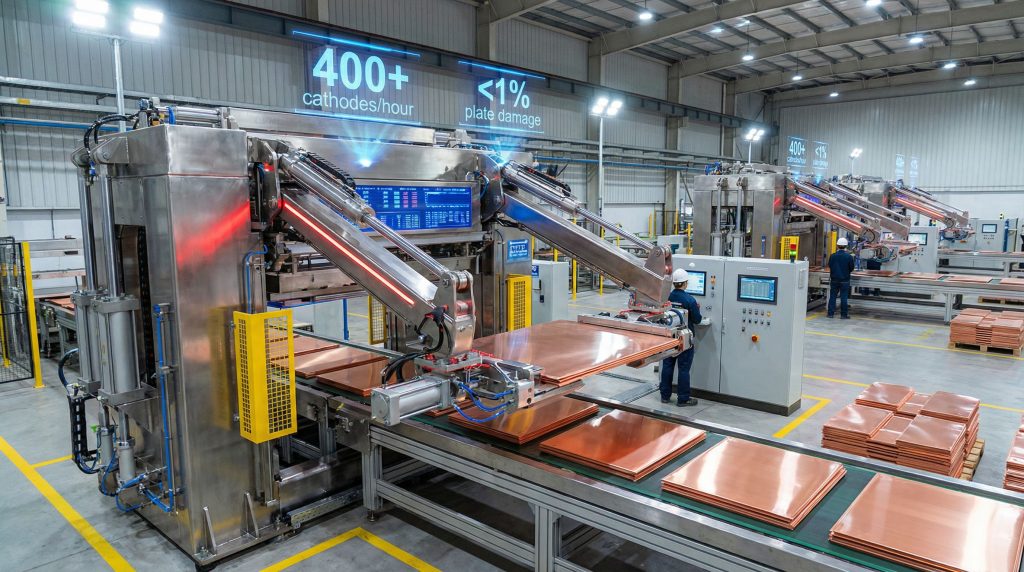
Understanding Modern Electrorefining Challenges Through Automation
The global copper industry faces mounting pressure to increase production efficiency while maintaining worker safety standards in increasingly complex refining operations. Traditional electrorefining processes require intensive manual labour for automated cathode stripping operations, where workers must physically remove refined copper sheets from electrical cathode plates in environments with potential exposure to chemical hazards and mechanical risks. This operational reality has driven major copper producers toward comprehensive automation solutions that address both productivity constraints and occupational safety concerns.
Modern copper refineries process thousands of cathodes daily through electrowinning operations, where electrical current separates pure copper from solution onto cathode plates. The subsequent stripping process represents a critical bottleneck in refining throughput, requiring precise mechanical handling to prevent product damage while maintaining consistent quality standards. Industry analysis indicates that manual cathode stripping operations typically consume significant labour resources while presenting inherent safety risks that automation technologies can effectively mitigate.
When big ASX news breaks, our subscribers know first
Mechanical Systems Driving Cathode Stripping Innovation
Contemporary automated cathode stripping systems integrate sophisticated mechanical components designed for precision handling of delicate copper cathode materials. Hydraulic positioning systems provide controlled movement capabilities for accurate cathode alignment, while pneumatic clamping mechanisms ensure secure holding during the stripping process without causing material deformation or surface damage.
The core stripping mechanism typically employs either wedge-based insertion tools or vibrating blade technologies, each offering distinct advantages for different operational requirements. Wedge-based systems utilise controlled force application to separate copper sheets from cathode plates through gradual insertion, while vibrating tool approaches use high-frequency mechanical motion to reduce adhesion forces between copper deposits and substrate materials.
Integrated Robotic Handling Solutions
Multi-axis robotic systems provide the precision manipulation capabilities necessary for handling delicate copper cathode materials without causing mechanical stress or surface defects. These robotic platforms integrate vision-guided positioning systems that enable real-time quality assessment during the stripping process, identifying potential defects or irregularities that could impact product specifications.
Advanced gripper technologies utilise adaptive pressure control to accommodate variations in copper sheet thickness and material properties. Furthermore, flexible end-effector designs allow single robotic systems to handle multiple product specifications without requiring extensive reconfiguration between production runs. Metso's full deposit robot stripping machine represents a significant advancement in automated handling technology for copper refining applications.
Process Control Architecture Implementation
Modern cathode stripping automation relies on distributed control systems that coordinate mechanical operations with broader refinery process management. Programmable logic controllers manage real-time operational parameters whilst supervisory control and data acquisition systems provide plant-wide integration capabilities.
Predictive maintenance algorithms analyse operational data to identify potential equipment issues before they impact production continuity. In addition, machine learning applications process historical performance data to optimise processing parameters and reduce unplanned maintenance requirements. These AI in mining automation applications represent cutting-edge technological advancement in the sector.
Quantifying Automation Performance Improvements
Industry implementation of automated cathode stripping systems demonstrates significant operational improvements compared to traditional manual processes. Performance analysis indicates that automated systems typically achieve processing rates exceeding 400 cathodes per hour, representing substantial throughput improvements over manual operations that generally process approximately 200 cathodes hourly.
| Performance Metric | Manual Operations | Automated Systems | Improvement Factor |
|---|---|---|---|
| Processing Speed | 200 cathodes/hour | 400+ cathodes/hour | 2x throughput increase |
| Product Damage Rate | 3-5% material loss | <1% material loss | 70-80% reduction |
| Labour Requirements | 4-6 operators/shift | 1-2 operators/shift | 60-75% reduction |
| Safety Risk Exposure | High manual contact | Minimal human contact | 90%+ risk reduction |
Note: Performance metrics represent typical industry ranges and may vary based on specific facility configurations, equipment specifications, and operational parameters.
Quality consistency improvements represent another significant benefit of automation implementation. However, automated systems maintain consistent processing parameters across all production runs, reducing variability in product specifications and minimising rejection rates due to handling damage or processing inconsistencies.
Technology Leaders Shaping Market Development
The automated cathode stripping market encompasses specialised equipment manufacturers developing integrated solutions for electrorefining applications. Leading technology providers focus on modular system designs that accommodate varying facility requirements whilst providing scalable automation capabilities.
Robotic Integration Platforms
Advanced robotic systems incorporate multiple technological components to achieve precise cathode handling operations:
- Multi-axis articulation: Six-degree-of-freedom robotic arms enabling complex positioning movements
- Vision-guided operation: Real-time imaging systems for quality assessment and defect detection
- Adaptive tooling: Flexible end-effectors accommodating various copper sheet dimensions and material properties
- Force feedback control: Pressure-sensitive handling preventing material damage during manipulation
Control System Technologies
Sophisticated control architectures coordinate automated stripping operations with broader refinery process management. These systems integrate seamlessly with data-driven mining operations that optimise overall facility performance:
- Distributed control networks: PLC-based systems managing real-time operational parameters
- Plant-wide integration: SCADA platforms coordinating cathode stripping with upstream electrowinning processes
- Predictive analytics: Machine learning algorithms optimising processing parameters and maintenance scheduling
- Remote monitoring: IoT connectivity enabling off-site operational oversight and diagnostic capabilities
Facility-Specific Implementation Approaches
Major copper producers implement cathode stripping automation through different strategic approaches based on facility-specific requirements and operational constraints. BHP's Olympic Dam refinery represents a significant industry milestone, having completed implementation of a fully automated cathode stripping system that removes workers from potentially hazardous refining operations.
High-Volume Production Facilities
Large-scale copper refineries require automation systems capable of continuous operation with minimal production interruptions. Key implementation considerations include:
- 24/7 operational capability: Robust mechanical systems designed for continuous operation without extended downtime
- Modular scalability: Expandable system architectures accommodating future production increases
- Integration compatibility: Seamless coordination with existing tankhouse infrastructure and material handling systems
- Maintenance accessibility: Design features enabling routine maintenance without extended production shutdowns
Specialised Processing Applications
Automated cathode stripping systems adapt to various electrometallurgical applications beyond copper refining. For instance, these technologies prove valuable across multiple metal processing operations:
- Multi-metal processing: Adaptable systems handling zinc, nickel, and other electrowinning operations
- Corrosion-resistant construction: 316L stainless steel and specialised coating materials for aggressive chemical environments
- Environmental compliance: Enclosed system designs providing fume control and emissions management
- Custom material handling: Specialised tooling for non-standard cathode configurations or unusual material properties
Economic Value Creation Through Automation
Copper refinery automation delivers economic benefits through multiple operational improvements. Labour cost reductions represent the most immediate financial impact, as automated systems typically require 60-75% fewer operators per production shift compared to manual operations.
Direct Cost Reduction Categories
- Labour optimisation: Reduced workforce requirements and elimination of overtime costs during peak production periods
- Maintenance efficiency: Predictive maintenance capabilities reducing unplanned equipment failures and associated production losses
- Quality improvements: Lower product rejection rates through consistent processing parameters and reduced handling damage
- Energy optimisation: Efficient mechanical systems consuming less power than labour-intensive manual operations
Operational Efficiency Enhancement
Beyond direct cost savings, automation provides strategic operational advantages. Furthermore, these improvements align with broader industry innovation trends transforming copper production:
- Throughput maximisation: Increased processing capacity without requiring facility expansion or additional infrastructure investment
- Production consistency: Standardised processing parameters ensuring uniform product quality across all production runs
- Inventory management: Faster cathode plate recycling reducing material handling bottlenecks and storage requirements
- Operational flexibility: Rapid configuration changes accommodating different product specifications or processing requirements
The next major ASX story will hit our subscribers first
Technological Evolution and Future Development
Cathode stripping automation continues evolving through integration of emerging technologies that enhance operational capabilities and expand application possibilities. Artificial intelligence implementation represents a significant development direction, with machine learning algorithms optimising processing parameters based on real-time operational data analysis.
What Emerging Technologies Are Shaping Automation?
- Advanced materials handling: Lightweight composite components enabling faster operational cycles and reduced mechanical stress on equipment
- Modular robotics: Plug-and-play system architectures facilitating rapid deployment and reconfiguration for changing operational requirements
- IoT connectivity: Remote operation capabilities providing off-site monitoring and diagnostic capabilities for distributed facility management
- Adaptive processing: Real-time parameter adjustment accommodating variations in cathode conditions and material properties
Sustainability-Focused Development
Future technology development increasingly emphasises environmental performance and resource efficiency. Consequently, these advances support the broader global copper supply forecast trends toward sustainable production:
- Energy-efficient designs: Power optimisation reducing overall facility energy consumption
- Recyclable materials: Component construction using materials compatible with circular economy principles
- Emissions reduction: Enhanced containment systems minimising environmental impact from refining operations
- Resource recovery: Improved processing efficiency maximising copper recovery from cathode materials
Implementation Challenges and Risk Management
Successful cathode stripping automation implementation requires careful management of technical, financial, and operational challenges. Legacy system integration represents a primary concern for facilities upgrading existing refinery infrastructure, as compatibility issues can impact project timelines and costs.
Technical Implementation Considerations
- Infrastructure compatibility: Ensuring automated systems integrate effectively with existing tankhouse operations and material handling equipment
- Workforce transition: Comprehensive training programmes for operators transitioning from manual to automated system operation
- Maintenance capabilities: Developing specialised technical support capabilities for sophisticated automation equipment
- System reliability: Ensuring automated systems maintain high availability rates to avoid production disruptions
Financial and Strategic Planning
- Capital investment analysis: Comprehensive ROI evaluation considering equipment costs, installation expenses, and operational savings
- Production continuity: Minimising facility downtime during system installation and commissioning phases
- Vendor evaluation: Selecting technology providers with proven track records and long-term support capabilities
- Performance validation: Establishing measurable success criteria for automation system performance
Safety Standards and Regulatory Compliance
Automated cathode stripping systems must comply with comprehensive safety standards governing industrial equipment operation and worker protection. The primary safety benefit of automation involves removing workers from potentially dangerous refining environments where chemical exposure and mechanical hazards present ongoing risks.
Regulatory Framework Compliance
- Occupational safety standards: OSHA workplace safety requirements and international safety protocol compliance
- Electrical safety systems: Comprehensive lockout/tagout procedures and emergency shutdown capabilities protecting maintenance personnel
- Environmental regulations: Emission control systems and waste handling procedures meeting environmental protection requirements
- Process safety management: Systematic hazard identification and risk mitigation protocols for automated system operation
Risk Mitigation Strategies
- Fail-safe system design: Redundant safety systems and automatic shutdown functions preventing equipment damage or safety incidents
- Physical protection barriers: Comprehensive guarding and access control preventing unauthorised interaction with operating equipment
- Remote operation capabilities: Operator stations positioned safely away from active processing areas
- Maintenance safety protocols: Safe access procedures and equipment isolation systems protecting maintenance personnel
GPA Engineering's robotic cathode stripping machine systems demonstrate advanced safety features and integration capabilities for modern refining operations.
Strategic Impact on Global Copper Production
Cathode stripping automation represents a critical component of modern copper production optimisation, enabling refineries to meet growing global demand for refined copper products whilst maintaining competitive operational costs. Industry adoption of these technologies reflects broader trends toward digitalisation and process optimisation across extractive industries.
Supply Chain Optimisation Benefits
- Production efficiency: Enhanced throughput capabilities supporting increased copper demand from renewable energy and electrification applications
- Quality standardisation: Consistent processing parameters ensuring premium copper cathode products meeting international specifications
- Competitive positioning: Technology adoption providing operational advantages in increasingly competitive global copper markets
- Operational resilience: Reduced dependence on manual labour improving operational continuity during workforce disruptions
Environmental Performance Enhancement
Moreover, these environmental benefits align with copper investment trends emphasising sustainable production methods:
- Resource efficiency: Maximised copper recovery through precise processing reducing material waste
- Energy conservation: Optimised power consumption through efficient automated systems
- Emissions control: Enhanced containment systems reducing environmental impact from refining operations
- Waste minimisation: Reduced cathode plate damage decreasing material losses and disposal requirements
Disclaimer: The information presented in this analysis is based on industry sources and general market trends. Specific performance metrics, financial projections, and technological capabilities may vary based on individual facility requirements, equipment specifications, and operational parameters. Readers should consult with qualified engineering professionals and equipment manufacturers for facility-specific implementation guidance.
Ready to Capitalise on Mining Technology Breakthroughs?
Discovery Alert's proprietary Discovery IQ model delivers instant notifications on significant ASX mineral discoveries, including companies developing breakthrough technologies in copper processing and mining automation. Begin your 14-day free trial today to position yourself ahead of the market and gain actionable insights into the mining sector's technological transformation.