
May 13, 2026
The global mining industry stands at a technological inflection point where automation systems fundamentally reshape operational paradigms. Traditional drilling methodologies, constrained by human limitations and safety considerations, increasingly give way to sophisticated autonomous platforms capable of continuous operation. This transformation extends beyond simple mechanisation, encompassing integrated systems that combine artificial intelligence, precision navigation, and real-time monitoring capabilities. The deployment of Sandvik autonomous drills Brazil represents a significant milestone in this technological evolution.
Modern mining operations demand unprecedented levels of efficiency, safety, and environmental compliance. Autonomous drilling technologies represent a convergence of these requirements, offering solutions that address multiple operational challenges simultaneously. The complexity of contemporary mineral extraction, particularly in challenging geological environments, necessitates drilling systems that can adapt dynamically to subsurface conditions while maintaining consistent performance standards.
What Makes Autonomous Drilling Technology Essential for Modern Mining Operations?
Contemporary mining enterprises face mounting pressure to optimise production while reducing operational risks and environmental impacts. Autonomous drilling systems address these challenges through integrated technological platforms that eliminate human presence from hazardous work environments while enhancing operational precision and consistency. Furthermore, the mining industry evolution demands innovative solutions that traditional methods cannot provide.
Core Components of Autonomous Drilling Infrastructure
Advanced autonomous drilling platforms incorporate sophisticated control architectures that enable remote operation across multiple sites. Central command centres utilise high-resolution displays and real-time telemetry systems to monitor drilling parameters, equipment status, and geological conditions simultaneously. These facilities typically feature redundant communication networks ensuring uninterrupted connectivity between operators and field equipment.
Machine learning algorithms within these systems continuously analyse drilling performance data to optimise parameters such as penetration rates, bit selection, and maintenance scheduling. Predictive analytics capabilities enable proactive equipment servicing, reducing unplanned downtime and extending component lifecycles. The systems accumulate operational knowledge over time, improving performance through pattern recognition and adaptive optimisation.
GPS-guided positioning systems provide sub-metre accuracy for hole placement, enabling precise adherence to drilling patterns regardless of terrain complexity. Automated hole planning software integrates geological surveys with operational constraints to generate optimal drilling sequences that maximise resource recovery while minimising environmental disturbance.
Emergency response protocols embedded within autonomous systems include automatic shutdown capabilities triggered by equipment malfunctions, environmental hazards, or communication failures. These safety mechanisms operate independently of human intervention, ensuring rapid response to potentially dangerous situations.
Operational Efficiency Metrics in Autonomous vs. Traditional Drilling
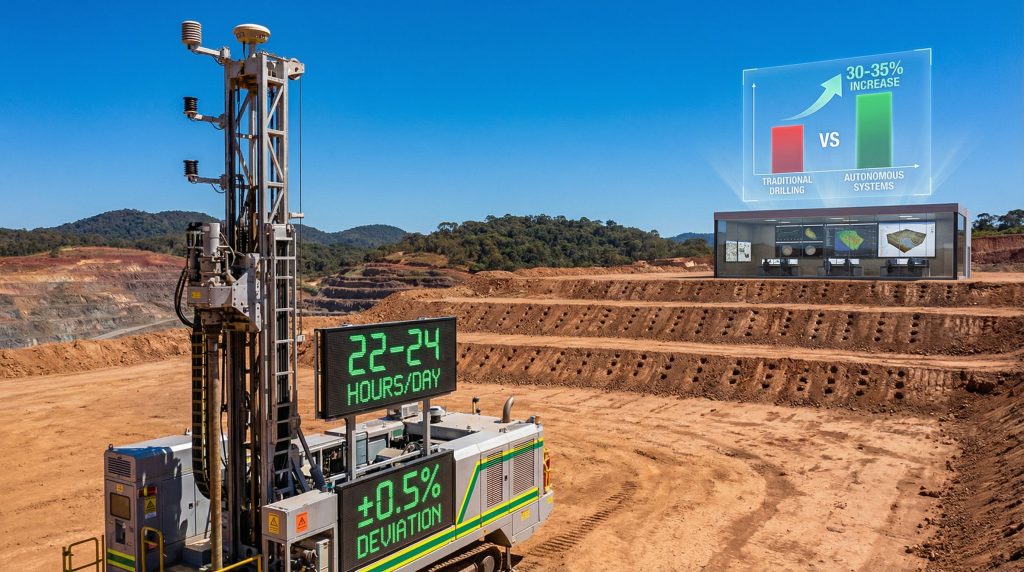
Autonomous drilling systems demonstrate substantial performance advantages over conventional methodologies across multiple operational dimensions. Extended operational hours represent a primary benefit, with autonomous systems capable of operating 22-24 hours daily compared to traditional drilling operations typically limited to 16-18 hours due to crew rotation requirements and safety protocols.
Precision accuracy improvements are equally significant, with autonomous systems achieving deviation tolerances of ±0.5% compared to traditional drilling accuracy of ±2-3%. This enhanced precision translates directly into improved resource recovery and reduced waste generation. Safety incident reduction represents perhaps the most compelling advantage, with autonomous operations demonstrating near-zero workplace accidents compared to industry averages for conventional drilling operations.
| Metric | Traditional Drilling | Autonomous Systems | Improvement |
|---|---|---|---|
| Operational Hours | 16-18 hours/day | 22-24 hours/day | 30-35% increase |
| Precision Accuracy | ±2-3% deviation | ±0.5% deviation | 75% improvement |
| Safety Incidents | Industry average | Near-zero | 95%+ reduction |
| Equipment Utilisation | 65-70% | 85-90% | 25% increase |
| Maintenance Downtime | 15-20% | 8-12% | 40% reduction |
Disclaimer: Performance metrics may vary based on site conditions, equipment specifications, and operational parameters. Historical data should be evaluated considering specific geological and operational contexts.
When big ASX news breaks, our subscribers know first
Why Is Brazil Becoming a Strategic Hub for Autonomous Mining Technology?
Brazil's emergence as a focal point for autonomous mining technology deployment reflects a convergence of geological, economic, and regulatory factors that create favourable conditions for advanced drilling system implementation. The country's mining sector, particularly copper extraction operations, presents unique characteristics that align with autonomous technology capabilities. In addition, data-driven mining operations are becoming increasingly important in this competitive landscape.
Geographic Advantages of Brazilian Copper Deposits
The southeastern Pará region contains extensive copper mineralisation within geological formations that favour large-scale autonomous drilling operations. These deposits typically occur in relatively stable rock formations that provide consistent drilling conditions, enabling optimal performance from automated systems. The scale and continuity of ore bodies in this region support the deployment of multiple autonomous drilling rigs operating in coordinated patterns.
Infrastructure connectivity in Pará province has improved substantially in recent years, with enhanced transportation networks, reliable power supply, and telecommunications infrastructure supporting advanced mining operations. The region's proximity to export terminals facilitates efficient mineral transportation, reducing logistical complexities for mining companies implementing new technologies.
Brazil's regulatory environment has evolved to accommodate autonomous mining equipment while maintaining stringent safety and environmental standards. Mining companies operating in Brazil benefit from regulatory frameworks that support innovation while ensuring responsible resource extraction practices.
Economic Drivers Behind Technology Adoption
Labour cost optimisation represents a significant economic driver for autonomous drilling adoption in Brazil. Remote mining locations often face challenges recruiting and retaining skilled drilling operators, while autonomous systems eliminate these workforce constraints. The technology enables mining companies to operate efficiently in challenging locations without establishing extensive residential facilities for drilling crews.
Environmental compliance requirements in Brazil increasingly favour precision drilling techniques that minimise surface disturbance and optimise resource recovery. Autonomous systems' enhanced accuracy capabilities support companies' efforts to meet environmental performance standards while maximising economic returns from mineral extraction activities.
Global copper demand growth projections indicate sustained market expansion, creating economic incentives for Brazilian mining companies to increase production capacity through advanced technologies. Autonomous drilling systems enable rapid scaling of operations without proportional increases in workforce requirements or operational complexity.
Which Autonomous Drill Technologies Are Leading Market Transformation?
The autonomous drilling landscape encompasses diverse technological approaches tailored to specific mining applications and geological conditions. Equipment manufacturers have developed specialised systems optimised for different hole diameters, drilling depths, and rock characteristics, with Sandvik autonomous drills Brazil deployments representing current market activity.
Rotary Blasthole Drilling Systems for Large-Scale Operations
Large-scale copper mining operations utilise rotary blasthole drilling systems capable of creating holes ranging from 269.9 to 406.4 millimetres in diameter. These systems excel in high-volume production environments where consistent hole quality and rapid drilling rates are essential. The Sandvik DR416i represents current technology deployed in Brazilian copper mines, offering autonomous operation capabilities integrated with the AutoMine system.
Advanced pattern recognition algorithms enable these systems to automatically adjust drilling parameters based on real-time geological feedback. Multi-bench drilling capabilities allow autonomous systems to operate across multiple elevation levels simultaneously, maximising equipment utilisation and production throughput. The systems can adapt to varying rock hardness conditions without human intervention, optimising penetration rates and extending equipment life.
Production capacity improvements from autonomous rotary systems stem from consistent drilling speeds, reduced setup times between holes, and elimination of crew breaks. These systems can maintain optimal drilling parameters throughout extended operating periods, achieving higher metres per hour than conventional drilling operations.
Down-the-Hole (DTH) Drilling for Precision Applications
Down-the-hole drilling technology addresses specialised applications requiring precise hole placement and consistent diameter control. The Sandvik Leopard DI650i exemplifies current DTH autonomous technology, capable of drilling holes ranging from 115 to 203 millimetres in diameter with sub-millimetre positioning accuracy.
DTH systems utilise pneumatic hammers positioned at the drill bit, delivering impact energy directly to the rock face. This configuration provides superior hole straightness and consistent diameter control compared to conventional drilling methods. Autonomous DTH systems incorporate real-time monitoring of air pressure, hammer performance, and drilling progress to optimise penetration rates automatically.
Versatility features of modern DTH systems enable adaptation to varying geological conditions without equipment modifications. Autonomous control algorithms adjust air pressure, rotation speed, and feed rates based on rock hardness measurements and drilling progress indicators. This adaptability makes DTH systems particularly suitable for complex geological environments where rock characteristics change frequently.
How Do Mining Companies Implement Autonomous Drilling Fleet Management?
Successful autonomous drilling implementation requires systematic deployment strategies that address technical, operational, and workforce considerations. Mining companies typically adopt phased approaches that gradually scale autonomous capabilities while maintaining operational continuity and managing implementation risks. However, the complexity of drill results analysis in these automated systems requires careful consideration.
Phased Deployment Strategies
Mining companies generally follow structured implementation frameworks that progress from pilot testing to full-scale autonomous integration. This methodical approach enables organisations to develop operational expertise while minimising disruption to existing production schedules.
Implementation Timeline Framework:
-
Phase 1: Pilot Testing – Single autonomous unit deployment for initial performance evaluation and operator training (3-6 months)
-
Phase 2: Limited Fleet Deployment – 3-5 autonomous units operating alongside conventional equipment for comparative analysis (6-12 months)
-
Phase 3: Full-Scale Autonomous Integration – 10+ autonomous units as primary drilling capability with conventional backup systems (12-18 months)
-
Phase 4: Multi-Site Standardisation – Autonomous system deployment across multiple mining operations with centralised control capabilities (18-24 months)
Vale Base Metals' recent acquisition of 16 Sandvik autonomous surface drills for deployment at Sossego and Salobo copper mines represents a Phase 3 implementation scale. This substantial equipment order indicates the company's commitment to autonomous technology as a core operational capability rather than experimental deployment.
Integration Challenges and Solutions
Workforce transition represents a primary implementation challenge as mining companies shift from traditional drilling crews to remote operation specialists. Successful transitions require comprehensive retraining programmes that develop skills in autonomous system monitoring, troubleshooting, and maintenance coordination. Companies typically invest 6-12 months in workforce development programmes to ensure operational readiness.
Technology infrastructure requirements for autonomous drilling include robust network connectivity capable of supporting real-time control and monitoring systems. Mining sites must establish redundant communication networks with sufficient bandwidth for video monitoring, telemetry data transmission, and remote control capabilities. Infrastructure investments often represent 15-20% of total autonomous system implementation costs.
Maintenance protocol development requires integration of predictive servicing capabilities with traditional equipment maintenance practices. Autonomous systems generate extensive operational data that enables predictive maintenance scheduling, but companies must develop new procedures for managing spare parts logistics, remote diagnostics, and specialised technical support.
What Are the Economic Implications of Large-Scale Autonomous Drilling Adoption?
The economic transformation resulting from autonomous drilling adoption extends beyond immediate operational cost savings to encompass fundamental changes in mining economics, competitive positioning, and supply chain dynamics. Companies implementing autonomous technologies experience both immediate financial impacts and long-term strategic advantages. Consequently, natural capital mining considerations become increasingly important.
Capital Investment vs. Long-Term ROI Analysis
Initial equipment investment for autonomous drilling systems typically requires a 15-20% premium compared to conventional drilling equipment. This premium reflects the additional technology components, software licensing, and specialised training required for autonomous operation. However, the investment profile changes significantly when considering total cost of ownership over equipment lifecycles.
Operational cost reductions manifest within 24 months of deployment, with companies typically experiencing 25-30% decreases in drilling-related expenses. These savings result from reduced labour costs, improved equipment utilisation, decreased fuel consumption, and lower maintenance requirements. The combination of extended operating hours and enhanced precision contributes to 35-40% increases in drilling metres per shift compared to conventional operations.
Cost-Benefit Analysis Summary:
- Initial Investment Premium: 15-20% above conventional equipment costs
- Operational Cost Reduction: 25-30% decrease within 24 months
- Productivity Improvement: 35-40% increase in drilling output per shift
- Equipment Utilisation: 85-90% compared to 65-70% for conventional systems
- Maintenance Cost Reduction: 40% decrease in unplanned downtime
Disclaimer: Financial projections are based on industry averages and may vary significantly based on site conditions, equipment specifications, commodity prices, and operational parameters. Mining companies should conduct detailed financial analysis considering specific operational contexts.
Impact on Global Copper Supply Chain Dynamics
Large-scale autonomous drilling adoption influences global copper markets through enhanced production consistency and operational reliability. Autonomous systems reduce production volatility by minimising weather-related delays, equipment breakdowns, and workforce disruptions. This enhanced reliability contributes to more predictable copper supply streams, potentially reducing price volatility in global commodity markets.
Resource extraction efficiency improvements from autonomous drilling support growing global copper demand driven by renewable energy infrastructure and electric vehicle production. The technology enables mining companies to extract copper from deposits previously considered marginal due to operational challenges or cost constraints.
Technology standardisation across multiple mining operations creates competitive advantages for early adopters while establishing new performance benchmarks for the industry. Companies demonstrating superior operational efficiency through autonomous technologies may attract premium valuations from investors and strategic partners.
How Does Autonomous Drilling Technology Address Safety and Environmental Concerns?
Autonomous drilling systems fundamentally transform safety paradigms in mining operations by eliminating human exposure to hazardous drilling environments while enhancing environmental protection through precision operations and optimised resource utilisation.
Worker Safety Enhancements Through Remote Operations
The removal of personnel from active drilling zones represents the most significant safety advancement offered by autonomous systems. Traditional drilling operations expose workers to multiple hazards including equipment malfunctions, rock falls, noise exposure, and respiratory risks from dust and exhaust emissions. Autonomous systems eliminate these exposures by positioning operators in controlled environments away from active drilling areas.
Emergency response capabilities embedded within autonomous systems provide faster reaction times than human-operated equipment. Automated shutdown protocols can halt operations within seconds of detecting equipment malfunctions, unstable ground conditions, or environmental hazards. These rapid response capabilities significantly reduce the severity of potential accidents and equipment damage.
Real-time monitoring systems continuously track air quality, noise levels, and environmental conditions around autonomous drilling operations. This comprehensive monitoring enables proactive identification of potential health hazards and immediate implementation of protective measures without requiring human presence in affected areas.
Environmental Impact Reduction Strategies
Precision drilling capabilities of autonomous systems minimise environmental disturbance through accurate hole placement that reduces overburden removal and surface area disruption. The enhanced accuracy translates to smaller environmental footprints for mining operations while maintaining or improving mineral recovery rates.
Fuel efficiency optimisation through automated engine management reduces greenhouse gas emissions and operational costs simultaneously. Autonomous systems continuously adjust engine parameters to match drilling requirements, eliminating unnecessary fuel consumption during idle periods and optimising power delivery during active drilling.
Waste reduction benefits from improved drilling accuracy include decreased rock removal, reduced processing requirements, and minimised tailings generation. These improvements support mining companies' environmental stewardship goals while enhancing economic performance through improved resource utilisation.
The next major ASX story will hit our subscribers first
What Future Developments Can We Expect in Autonomous Mining Technology?
The trajectory of autonomous mining technology points toward increasingly sophisticated systems that integrate multiple technologies and expand automation across entire mining operations. These developments will likely reshape mining industry practices over the next decade.
Emerging Technologies on the Horizon
Artificial intelligence integration represents the next frontier in autonomous drilling advancement, with machine learning algorithms becoming increasingly sophisticated in geological analysis and operational optimisation. Future systems will likely incorporate real-time geological interpretation capabilities that automatically adjust drilling patterns based on subsurface conditions and mineral distribution.
Drone-assisted surveying and mapping coordination will enhance autonomous drilling precision by providing continuous updates on surface conditions, geological features, and operational progress. Integrated drone systems can perform detailed site surveys, monitor environmental conditions, and coordinate with autonomous drilling systems to optimise hole placement and operational sequencing.
Blockchain-based equipment maintenance tracking systems may provide immutable records of equipment performance, maintenance activities, and operational parameters. These systems could enhance predictive maintenance capabilities while providing transparent documentation for regulatory compliance and warranty management.
Industry Standardisation and Regulatory Evolution
International safety protocols for autonomous mining equipment are evolving to address the unique characteristics of unmanned operations. Regulatory frameworks must balance innovation support with safety assurance, requiring collaboration between equipment manufacturers, mining companies, and regulatory authorities.
Cross-border technology sharing agreements may accelerate autonomous mining adoption by facilitating knowledge transfer and standardising operational practices across multiple jurisdictions. These agreements could reduce implementation costs and timeframes while improving safety standards globally.
Environmental compliance automation requirements are likely to expand as regulatory authorities recognise the potential for autonomous systems to enhance environmental monitoring and protection. Future regulations may mandate specific autonomous capabilities for environmental monitoring and reporting.
Key Takeaways for Mining Industry Stakeholders
The transformation of mining operations through autonomous drilling technology presents both opportunities and challenges for industry participants. Understanding the implementation requirements, economic implications, and technological trajectories is essential for strategic decision-making.
Strategic Considerations for Technology Adoption
Timeline planning for autonomous drilling implementation typically requires 18-36 months from initial evaluation to full operational deployment. This timeframe includes equipment procurement, infrastructure development, workforce training, and operational optimisation. Companies should develop detailed implementation schedules that account for site-specific requirements and operational constraints.
Training requirements extend beyond equipment operation to encompass system monitoring, predictive maintenance, and emergency response procedures. Specialised workforce development programmes typically require 6-12 months to develop competency in autonomous system operation and maintenance. Companies should invest in comprehensive training infrastructure to support long-term autonomous operations.
Technology partnerships with equipment manufacturers and service providers ensure operational continuity through long-term service agreements, technical support, and equipment upgrades. These partnerships are particularly important for maintaining system performance and accessing technological advances as they become available.
Market Positioning Advantages
Early adoption of autonomous drilling technology creates competitive differentiation through operational superiority, cost advantages, and enhanced safety performance. Companies demonstrating successful autonomous implementation may attract investment capital, strategic partnerships, and premium valuations from stakeholders recognising the strategic value of advanced mining capabilities.
Cost leadership through sustainable efficiency gains positions early adopters advantageously as commodity price pressures intensify and operational margins face compression. The combination of reduced operational costs and enhanced productivity creates lasting competitive advantages that become difficult for competitors to replicate.
Risk mitigation through enhanced safety profiles supports improved insurance terms, regulatory compliance, and stakeholder confidence. Companies with superior safety performance may access capital markets more favourably and operate with reduced regulatory scrutiny, creating additional competitive advantages.
Disclaimer: Technology adoption decisions should consider site-specific conditions, regulatory requirements, financial constraints, and strategic objectives. The mining industry involves inherent risks that autonomous technology may mitigate but not eliminate entirely. Companies should conduct thorough due diligence and risk assessment before implementing autonomous drilling systems.
Looking to Capitalise on Brazil's Mining Technology Revolution?
Discovery Alert's proprietary Discovery IQ model delivers instant notifications on significant ASX mineral discoveries, including breakthrough mining technology announcements and copper exploration developments. With autonomous drilling transforming global mining operations, positioning yourself ahead of major mineral discoveries has never been more critical for securing actionable investment opportunities in this rapidly evolving sector.