May 11, 2026
The Mineral That Modern Civilisation Cannot Function Without
There are commodities that power economies, and then there are commodities that enable entire technological systems to exist. Fluorspar sits firmly in the second category. Without calcium fluoride (CaF₂), there is no hydrofluoric acid. Without hydrofluoric acid, there are no lithium-ion battery electrolytes, no semiconductor etching gases, no aerospace-grade fluoropolymer coatings, and no uranium hexafluoride for nuclear fuel enrichment. The mineral underpins technologies that define the 21st century, yet it rarely receives the analytical attention its strategic position deserves.
It is within this context that the OD6 Metals Big Jim fluorspar lode rediscovery in May 2026 takes on significance extending well beyond a single exploration announcement. To understand why, it is necessary to first understand the industrial architecture that fluorspar supports, the supply vulnerability that makes domestic US discovery so consequential, and the geological mechanics that make Big Jim an unusually compelling target.
When big ASX news breaks, our subscribers know first
What Fluorspar Actually Does and Why the US Cannot Afford to Ignore It
The Industrial Chemistry Behind CaF₂
Fluorspar is traded commercially in two primary grades, each serving distinct industrial pathways. Acid-grade fluorspar, defined by a purity threshold of ≥97% CaF₂, feeds directly into hydrofluoric acid (HF) production, the gateway chemical for a vast range of downstream industries. Metallurgical-grade fluorspar, requiring ≥60% CaF₂, is consumed primarily in steel and aluminium processing as a flux agent.
The acid-grade pathway is where strategic demand is most concentrated. Furthermore, the critical minerals demand for fluorspar continues to intensify across multiple sectors. Hydrofluoric acid is the precursor to:
- Lithium hexafluorophosphate (LiPF₆), the dominant electrolyte salt in lithium-ion batteries
- Fluorine-based etching gases essential for advanced semiconductor fabrication at sub-5nm nodes
- Uranium hexafluoride (UF₆), a critical intermediate in uranium enrichment for nuclear fuel cycles
- Fluoropolymer coatings and specialty materials used in aerospace and defence applications where no viable substitutes exist
A less widely appreciated demand vector is fluorspar's role in AI chip manufacturing. As chip architectures shrink toward atomic dimensions, the precision requirements for fluorine-based plasma etching increase correspondingly. Each successive generation of advanced logic and memory devices consumes proportionally more high-purity fluorine chemistry, creating a structural demand linkage between semiconductor capacity expansion and fluorspar supply.
The Strategic Vulnerability: Zero Domestic Production
The United States currently imports 100% of its fluorspar requirements, according to reporting on OD6 Metals' May 2026 ASX announcement. There is no active commercial fluorspar mining operation within US borders. Primary import sources include Mexico, China, and South Africa, each carrying distinct geopolitical risk profiles.
China's dominance in fluorspar production and processing capacity is particularly relevant. Given China's demonstrated willingness to restrict exports of critical minerals as a geopolitical lever, a 100% import-dependent posture for a mineral as systemically important as fluorspar represents a structural vulnerability that market pricing alone cannot adequately reflect. The energy security implications of this dependency are far-reaching, particularly as clean energy infrastructure scales globally.
Fluorspar's inclusion on the US Critical Minerals List places it alongside lithium, cobalt, and rare earths as a material considered essential to national security and clean energy supply chain integrity. This designation reflects both the mineral's irreplaceability and the absence of any domestic production buffer.
Nevada as a Fluorspar Jurisdiction: The Quinn Project's Strategic Position
Geographic and Infrastructure Advantages
The Quinn Fluorspar Project is situated approximately 220 kilometres north of Las Vegas, Nevada, a jurisdiction with established hard rock mining infrastructure, experienced workforce pools, and a permitting framework historically receptive to mineral development. Nevada's geological heritage as a host for carbonate-replacement mineralisation systems, breccia-pipe deposits, and high-grade vein systems creates a favourable geological template for the style of fluorspar accumulation observed at Quinn.
Proximity to existing processing corridors is another underappreciated advantage. A Nevada-based fluorspar operation could leverage existing HF acid production facilities and chemical processing infrastructure in the western United States, reducing the capital intensity of bringing material to market compared to remote jurisdictions. In addition, the US mineral production push under recent executive policy frameworks makes Nevada-based critical mineral projects increasingly attractive to domestic offtake partners.
Three Systems, One District: The Emerging Quinn Fluorspar Province
What distinguishes Quinn from a single-discovery story is the presence of three distinct fluorspar mineralisation systems within the same project boundary, each with different structural geometries but shared district-scale geological controls.
| Fluorspar System | Mineralisation Style | Approximate Footprint | Current Status |
|---|---|---|---|
| Mammoth | Breccia pipe | >9,000 m² | Previously identified |
| Horseshoe | Replacement/breccia hybrid | >3,000 m² | Previously identified |
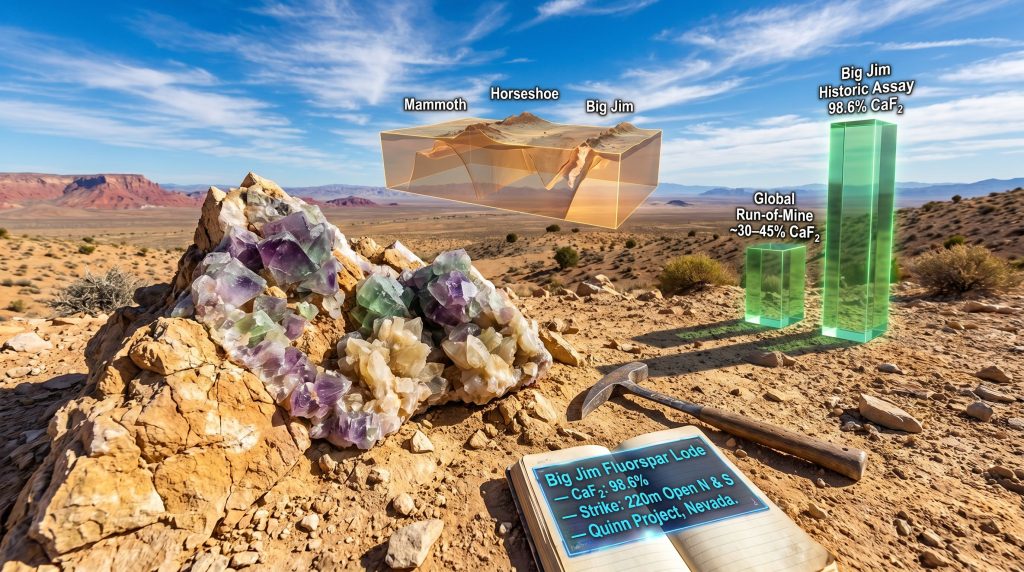
| Big Jim | Breccia-hosted high-grade lode | 220m strike, open N & S | Rediscovered May 2026 |
The spatial clustering of three distinct mineralisation styles within a single project boundary is geologically significant. It suggests that the Quinn area experienced multiple phases of fluorine-rich hydrothermal fluid activity, or that a single large hydrothermal system expressed itself differently depending on local structural and lithological controls. Either interpretation supports a district-scale resource potential interpretation rather than a series of isolated occurrences.
Big Jim sits approximately 1 kilometre NNE of the Horseshoe deposit, a proximity that allows future drilling programmes to efficiently test both systems and potentially identify inter-system connections at depth.
Decoding the Big Jim Fluorspar Lode: Geology, Grade, and Open-Ended Potential
What Makes a Breccia-Hosted Lode Different
Big Jim is characterised as a breccia-hosted fluorspar lode, a mineralisation style in which limestone host rock has been fractured and the resulting void space infilled by massive fluorspar precipitated from hydrothermal fluids. This is geologically distinct from disseminated or replacement-style mineralisation because the fluorspar occurs in a near-monomineralic state rather than mixed with silicate or carbonate gangue minerals.
The practical implication of this style is significant for processing economics. Massive fluorspar mineralisation typically requires less intensive beneficiation than disseminated deposits because the ore is already concentrated. Where a conventional disseminated fluorspar deposit might carry 30–45% CaF₂ at run-of-mine grades and require extensive flotation circuits to reach acid-grade specification, a massive lode system like Big Jim potentially arrives at the processing plant much closer to product specification.
The Grade Profile: Historical Assays and Current Field Estimates
The geological case for Big Jim rests substantially on a documented grade profile that has remained remarkably consistent across nearly eight decades. A 1947 report by Goulet and Jones, referenced in USGS documentation, recorded three assay samples from the Big Jim workings:
| Sample | Recorded CaF₂ Grade | Context |
|---|---|---|
| Sample 1 | 94.6% | 1947 Goulet & Jones report |
| Sample 2 | 96.0% | 1947 Goulet & Jones report |
| Sample 3 | 98.6% | 1947 Goulet & Jones report |
| Lode width | ~2 metres (6 feet) | 1947 measurement |
| Visual surface estimates | 85–95% | 2026 field reconnaissance |
Two of the three historical assay samples breach the 97% CaF₂ acid-grade threshold, while the third at 94.6% sits just below it. The 2026 visual estimates of 85–95% at surface are consistent with the lower end of the historical range, which is not unexpected given that surface-exposed material typically experiences some weathering dilution compared to fresher subsurface samples.
The persistence of this grade profile across nearly eight decades of dormancy suggests the mineralisation is structurally robust and has not been significantly degraded by surface processes. When laboratory assay results from ALS Global in Reno, Nevada are returned, they will provide the first modern analytical confirmation of whether this grade consistency holds under rigorous testing. Mining.com.au's coverage of the discovery highlights that Big Jim represents the highest-grade fluorspar target identified at Quinn to date.
Strike Length and the Open-Ended Geometry
The confirmed 220-metre strike length at Big Jim represents the extent of surface expression mapped during field reconnaissance, but crucially, the system remains open to both the north and south. In exploration terminology, an open-ended system is one where mineralisation has not been closed off by barren rock at the limits of mapping, meaning the true extent remains unknown.
For investors assessing the scale potential of Big Jim, this open geometry is the most important variable. If the lode continues at comparable grades for a further 100 to 200 metres in either direction, the volume of high-grade fluorspar material increases substantially, which directly affects resource estimation outcomes once drilling commences.
The Rediscovery Methodology: Geological Detective Work as a Value Creation Tool
From Archive to Outcrop
The process by which Big Jim was relocated in May 2026 illustrates a cost-effective exploration methodology that is gaining recognition in mature mining jurisdictions with rich historical documentation. Rather than relying solely on geophysical surveys or systematic field traverses, the Quinn team used a structured archive-driven approach:
- Archive review: USGS geological survey reports and the 1947 Goulet and Jones document were identified and cross-referenced to extract descriptions of Big Jim's location, geology, and character
- Search area delineation: Geological interpretation of historic descriptions, combined with modern topographic mapping, defined a probability corridor within which the lode was expected to surface
- Field verification: Targeted ground reconnaissance within the delineated corridor confirmed surface expression of massive fluorspar and identified a historic tunnel consistent with documented workings
- Sample collection: Rock samples were collected and dispatched to ALS Global in Reno, Nevada for independent assay verification
The original workings were established in 1934 by Frank and Joe "Big Jim" Perkins, the brothers whose nickname gave the lode its name. Operations proceeded intermittently through the 1940s before cessation, almost certainly driven by depressed commodity markets and wartime logistics constraints rather than depletion of the resource. This distinction matters: a deposit abandoned for economic rather than geological reasons retains its resource potential intact.
The use of historical geological archives as a primary exploration tool is particularly powerful in US mining districts where pre-war workings were often meticulously documented by USGS geologists and state surveys, creating a detailed record base that modern explorers can interrogate at low cost.
OD6 Metals' managing director Brett Hazelden noted that careful geological detective work and historic descriptions dating back to the 1940s enabled the Nevada team to narrow the search area for the OD6 Metals Big Jim fluorspar lode, and that the discovery now presents a third extensive fluorspar system alongside Horseshoe and Mammoth on the Quinn Project to target for drill-out.
The Processing Pathway: From Ore to Acid-Grade Product
Metallurgical Testwork Currently Underway
With field reconnaissance complete and samples dispatched, OD6's operational focus has shifted to understanding the processing characteristics of Big Jim material. However, the processing challenges associated with achieving consistent acid-grade specification remain an important consideration for any fluorspar development pathway. A multi-stage metallurgical testwork programme is currently underway covering:
- Optical sorting trials: Exploiting the visual and spectral contrast between massive fluorspar and host rock to achieve pre-concentration without grinding
- Crushing and grinding characterisation: Establishing the work index of the ore to model energy requirements and liberation particle sizes
- Flotation circuit testing: The conventional processing route for fluorspar, using reagents that selectively float CaF₂ away from gangue minerals
The sequence matters strategically. Optical sorting, if effective, can dramatically reduce the mass of material requiring downstream processing, lowering both capital and operating costs. For a massive lode system where fluorspar is visually distinct from the host limestone, optical sorting has a higher probability of success than for disseminated deposit styles.
The Acquisition Structure: Option Agreement Risk Management
OD6 secured an exclusive option agreement over the Quinn Fluorspar Project in early March 2026. This structure provides the company with a staged pathway to full ownership while limiting upfront capital exposure during the validation phase. Rather than acquiring the full project before understanding its dimensions, the option approach allows exploration results to inform the acquisition decision. The broader fluorite project strategy context demonstrates how other ASX-listed companies are approaching similar staged acquisition frameworks for high-grade fluorite assets. This is a risk management tool of genuine value at the early stage of a multi-system district.
The next major ASX story will hit our subscribers first
How Big Jim Benchmarks Against Global Fluorspar
Grade in Context
The global fluorspar industry operates across a wide grade spectrum. Understanding where Big Jim sits within that spectrum illuminates the quality of what OD6 has identified.
| Reference Point | CaF₂ Grade | Significance |
|---|---|---|
| Big Jim historical assays | 94.6–98.6% | Near or above acid-grade threshold |
| Big Jim visual estimates (2026) | 85–95% | Surface expression, pre-assay |
| Acid-grade commercial threshold | ≥97% | Minimum for HF acid production |
| Metallurgical-grade threshold | ≥60% | Minimum for steel/aluminium flux |
| Global run-of-mine average | ~30–45% | Typical mined ore grade |
The gap between Big Jim's reported grades and global run-of-mine averages is substantial. Where conventional fluorspar operations must process large volumes of low-grade ore through multiple beneficiation stages to reach acid-grade specification, Big Jim's massive lode character means that a proportion of material may require only minimal processing. Next Investors' analysis of the rediscovery similarly highlights the capital efficiency implications of this grade advantage. This translates directly into capital efficiency and operating cost advantages that cannot be replicated at lower-grade operations regardless of processing technology.
The Demand Convergence: Why 2025–2030 Creates an Unusual Window
Multiple Demand Drivers Arriving Simultaneously
The fluorspar demand outlook is unusual in that multiple independent demand drivers are accelerating concurrently, rather than cycling through the commodity's traditional steel-market-dominated demand base. Each driver below represents a structural rather than cyclical demand increment:
- Battery manufacturing scale-up: LiPF₆ electrolyte demand scales directly with lithium-ion cell production capacity, which continues to expand globally for both electric vehicles and grid storage
- Advanced semiconductor capacity: Leading-edge chip fabrication requires fluorine chemistry at volumes that scale with capital expenditure cycles currently underway at major foundries in the US, Japan, and Europe
- Nuclear energy renaissance: Interest in small modular reactors (SMRs) and conventional nuclear capacity additions in multiple countries increases demand for UF₆ conversion, a fluorspar-intensive step in the uranium fuel cycle
- Defence and aerospace fluoropolymers: Applications with national security sensitivity and no viable substitutes create inelastic demand profiles that price movements do not suppress
Against this demand backdrop, the US sits in a uniquely exposed position. With zero domestic commercial production and import dependence concentrated among sources that carry varying levels of geopolitical risk, the strategic case for developing domestic high-grade fluorspar resources is not merely commercially attractive; it addresses a documented national supply chain vulnerability.
Key Takeaways: Assessing the Strategic Weight of the OD6 Metals Big Jim Fluorspar Lode Discovery
The OD6 Metals Big Jim fluorspar lode rediscovery is best understood not as a single exploration event but as the third piece of a district-scale geological puzzle that is becoming progressively clearer. Several factors combine to give this discovery unusual strategic weight:
- Big Jim adds a third distinct high-grade fluorspar system to the Quinn Project, supporting a district-scale interpretation rather than an isolated occurrence narrative
- Historical assays reaching 98.6% CaF₂ and a confirmed 220-metre strike length that remains open in both directions provide a grade and scale foundation that justifies prioritised drill targeting
- The massive lode mineralisation style creates a potential processing simplicity advantage compared to disseminated operations, which could translate into meaningfully lower beneficiation costs
- The 100% US import dependency on fluorspar creates a structural demand premium for domestic high-grade sources that extends beyond conventional commodity pricing frameworks
- Pending ALS Global assay results and ongoing metallurgical testwork represent the immediate technical catalysts that will define Big Jim's transition from discovery to resource definition
- The option agreement structure provides OD6 with a capital-efficient pathway to validate the asset before committing to full acquisition, which is appropriate risk management at this stage
This article is intended for informational purposes only and does not constitute financial or investment advice. Readers should conduct their own due diligence and consult a licensed financial adviser before making investment decisions. Visual grade estimates referenced herein are preliminary in nature and subject to change upon receipt of formal laboratory assay results. Historical assay data has not been independently verified by the author.
Want to Be First When the Next Major Mineral Discovery Hits the ASX?
Discovery Alert's proprietary Discovery IQ model delivers real-time alerts on significant ASX mineral discoveries — including critical minerals like fluorspar — instantly converting complex geological data into actionable investment insights for both traders and long-term investors. Explore historic discoveries and their market returns, then start your 14-day free trial at Discovery Alert to position yourself ahead of the broader market.