May 11, 2026
The Case for Tungsten Is Structural, Not Speculative
When a single country controls more than four-fifths of the global supply of any industrial metal, the rest of the world pays attention. Tungsten sits precisely in that position. China's grip on global tungsten production has long been acknowledged in commodities circles, but what has changed in recent years is the urgency with which Western governments and industries are responding to that concentration. Prices for tungsten have climbed to record highs as of 2025 and 2026, driven not by short-term speculation but by a compounding set of structural forces: geopolitical realignment, accelerating industrial demand, and the near-absence of credible non-Chinese supply pipelines.
Understanding this backdrop is essential before evaluating any individual project claiming exposure to the metal. Not all tungsten opportunities are created equal. What separates a genuinely compelling exploration target from a market-driven narrative is the presence of high-grade mineralisation, near-term drilling catalysts, infrastructure proximity, and a jurisdiction that offers genuine regulatory stability. These are the criteria against which the Larvotto tungsten opportunities at Curry's Block prospect deserve to be assessed.
When big ASX news breaks, our subscribers know first
Why Tungsten's Supply Problem Is Unlike Any Other Critical Mineral
Tungsten does not behave like most industrial metals in the supply chain context. It is not merely concentrated in one region; it is structurally dependent on a single dominant producer. China accounts for more than 80% of global tungsten output, a level of supply concentration that has no direct parallel among major industrial metals used in defence, manufacturing, and advanced electronics.
This is not a recent development. China's tungsten dominance has been entrenched for decades, but the geopolitical environment of 2025 and 2026 has changed the consequences of that dependence dramatically. Western governments, including Australia, have formally classified tungsten as a critical mineral, recognising that uninterrupted access to the metal is essential to defence manufacturing, semiconductor tooling, high-temperature industrial processes, and the production of armour-penetrating munitions. Tungsten's strategic importance to these sectors cannot be overstated.
What Makes Tungsten Irreplaceable in Industrial Applications?
Tungsten possesses a unique combination of physical properties that make substitution practically impossible in many applications:
- It holds the highest melting point of any pure metal at approximately 3,422 degrees Celsius
- Its density is comparable to gold, making it ideal for radiation shielding and ballistic applications
- Tungsten carbide, formed by combining tungsten with carbon, is one of the hardest materials known and dominates the cutting tool industry
- In electronics, tungsten is used in semiconductor metallisation layers where its thermal stability under high current conditions is unmatched
The combination of irreplaceability and supply concentration is precisely what drives the current pricing environment. Record tungsten prices in 2025 and 2026 are not anomalies; they reflect a market that has structurally underinvested in non-Chinese supply for years.
"The absence of credible alternative tungsten supply from politically stable jurisdictions is not a short-term gap. It represents a decade-long underinvestment in exploration and development outside China that cannot be reversed quickly."
The Hillgrove Project: A Polymetallic Platform in New South Wales
Against this supply backdrop, Larvotto Resources (ASX: LRV) holds a 100%-owned position in the Hillgrove Antimony-Gold Project, located in New South Wales, Australia. The project has historically been characterised as an antimony-gold opportunity, and that development pathway is actively underway: PYBAR Mining Services commenced underground development at Hillgrove in December 2025, marking a significant operational milestone.
However, Hillgrove is not a mono-commodity story. The geological system that hosts the antimony and gold mineralisation also carries tungsten, and Larvotto has identified a discrete exploration target within the broader tenement that may represent one of the most compelling near-infrastructure tungsten opportunities in Australia. Furthermore, the antimony shortage risks that currently affect global supply chains only add to the strategic appeal of the broader Hillgrove system.
Curry's Block: Geography, Geology, and Strategic Positioning
The Curry's Block prospect sits approximately 4.5 kilometres north of the Hillgrove processing plant. This proximity is more than a logistical convenience. In exploration economics, the distance between a mineralised zone and existing processing infrastructure is a critical variable that directly affects capital intensity and development timelines. Most greenfield tungsten projects globally require the construction of entirely new processing facilities, a capital requirement that can be prohibitive at the early exploration stage.
Curry's Block bypasses this challenge entirely. If drilling confirms the mineralisation system at the scale and grade suggested by historical data, the infrastructure pathway to processing already exists.
Geologically, Curry's Block has been characterised through in-depth analysis of historical drilling data as a coherent gold-tungsten-antimony system. Key attributes of the system include:
- Confirmed strike length of more than 1 kilometre
- Mineralisation depth extending beyond 140 metres, remaining open at depth and along strike
- Polymetallic character with gold, tungsten, and antimony co-occurring within the same structural system
- Geological coherence across multiple historical drill holes, supporting the interpretation of a continuous and repeatable mineralised body
The polymetallic nature of the system is particularly significant from an economics standpoint. Gold and antimony in defence applications revenue streams effectively subsidise tungsten development economics. Projects where multiple commodities contribute to the revenue profile are better positioned to sustain operations through commodity price cycles than single-metal projects.
Decoding the Historical Drill Results at Curry's Block
The exploration case for Curry's Block rests substantially on historical drilling conducted by Red River Resources between 2019 and 2021. A comprehensive reanalysis of that data has now been completed, and the intercepts it reveals are material to understanding the scale of the potential resource.
Key Drill Intercepts: What the Numbers Communicate
| Drill Hole | Intercept Width | Gold Equivalent Grade | Depth From Surface | Best Sub-Intercept |
|---|---|---|---|---|
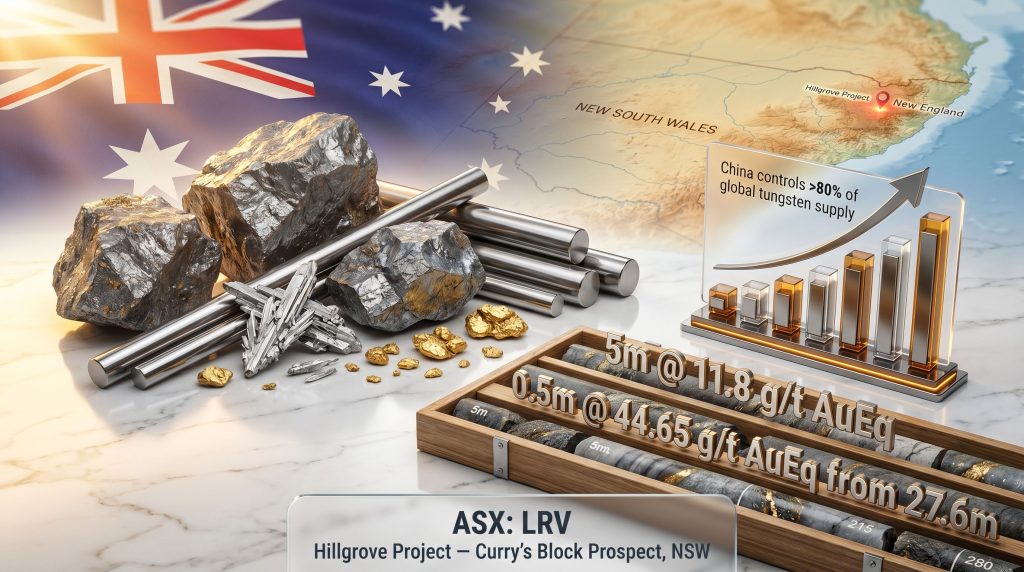
| CUY009 | 5m | 11.8 g/t AuEq | 144m | 2.9m @ 19.5 g/t AuEq from 144m |
| CUY007 | 5m | 5.7 g/t AuEq | 27m | 0.5m @ 44.65 g/t AuEq from 27.6m |
The gold equivalent metric used here is an industry-standard method for communicating the combined value of multiple commodities within a single drill intercept. In this case, the AuEq calculation incorporates gold, tungsten, and antimony grades, converted to a gold-price equivalent to enable direct comparison with the broader gold exploration sector.
A sub-intercept of 0.5 metres at 44.65 g/t AuEq from 27.6 metres depth in drill hole CUY007 is a striking result by any measure. To contextualise this figure, grades above 30 g/t gold equivalent are typically classified as ultra-high-grade in the context of underground gold mining, where 5 to 8 g/t is commonly cited as the economic threshold for narrow-vein systems. The shallow depth of this intercept at 27 metres further elevates its significance, as shallower mineralisation generally implies lower development costs.
The deeper intercept in CUY009, returning 11.8 g/t AuEq from 144 metres, demonstrates that the high-grade signature of the system is not confined to the near-surface. Mineralisation maintaining grades above 10 g/t AuEq at 144 metres depth suggests the system has genuine vertical persistence, a critical factor in resource definition. For further context on interpreting drill results of this nature, understanding the methodology behind AuEq calculations is essential.
Why the Exploration Gap Is an Opportunity, Not a Warning Sign
It is worth addressing the fact that the historical drilling underpinning these intercepts was completed by Red River Resources between 2019 and 2021, and that only limited modern follow-up has occurred since. In exploration investment, an absence of recent activity on a high-grade target can raise legitimate questions. However, the context here is instructive.
The gap between Red River Resources' work and Larvotto's current program reflects a common pattern in junior mining: changes in corporate ownership, commodity price cycles, and shifting strategic priorities can leave genuinely valuable exploration targets dormant for extended periods. The fact that Curry's Block was never subjected to modern, systematic follow-up drilling means the system's extent remains substantially unquantified.
What exists is a strong geological framework from historical data pointing toward a coherent, high-grade system, with the most material exploration upside still ahead.
"When a high-grade drill result sits untested for years, it is often not because the geology failed but because the corporate circumstances changed. The underlying geology at Curry's Block has not changed."
Diamond Drilling: The Next Catalyst for Curry's Block
Larvotto has confirmed that regulatory approvals for diamond drilling at Curry's Block have been secured. Diamond drilling is the industry's preferred methodology for high-grade polymetallic systems for several reasons that are worth explaining for investors less familiar with the technical distinction.
Why Diamond Drilling Matters for This Type of System
Diamond drilling, as distinct from reverse circulation (RC) drilling, recovers solid core samples that can be logged, photographed, and subjected to detailed mineralogical and structural analysis. For a gold-tungsten-antimony system where the precise nature of the mineralisation, its structural controls, and its metallurgical characteristics all need to be understood, drill core is an invaluable dataset.
Diamond drilling at Curry's Block will serve several critical functions:
- Testing the down-dip and along-strike extensions of mineralisation identified in historical holes
- Providing core samples for metallurgical testwork to confirm tungsten recovery rates through the Hillgrove processing circuit
- Establishing precise structural orientations of mineralised veins to guide future resource definition drilling
- Generating data sufficient to underpin a JORC 2012-compliant mineral resource estimate
The forthcoming drilling program will represent the first modern, systematic exploration campaign at Curry's Block. From an investor perspective, this creates a clear near-term catalyst: drilling results that either confirm or expand on the historical high-grade intercepts will drive material re-rating of this exploration target. In addition, definitive feasibility studies conducted at a later stage will rely heavily on the quality of data generated during this initial diamond drilling phase.
Benchmarking Curry's Block Against the Tungsten Exploration Landscape
To properly assess the Larvotto tungsten opportunities at Curry's Block prospect, it is useful to benchmark the target against the broader global tungsten exploration environment.
| Project Attribute | Curry's Block | Typical Early-Stage Tungsten Project |
|---|---|---|
| Strike Length | More than 1km confirmed | Often less than 500m at equivalent stage |
| Depth of Mineralisation | More than 140m, open at depth | Frequently shallow and untested |
| Co-commodities | Gold and antimony | Typically mono-metallic tungsten |
| Processing Infrastructure | 4.5km to existing plant | Greenfield construction typically required |
| Drilling Status | Diamond drilling approved | Pre-drilling in many comparable cases |
| Jurisdiction | New South Wales, Australia | Often higher-risk jurisdictions |
The combination of factors at Curry's Block is unusual. Polymetallic tungsten systems in Tier-1 jurisdictions with existing processing infrastructure and confirmed high-grade intercepts represent a genuinely rare subset of the global exploration pipeline. Most tungsten projects currently under development globally are mono-metallic, face significant infrastructure requirements, or are located in jurisdictions that carry political and regulatory risks that Western industrial buyers actively seek to avoid.
The next major ASX story will hit our subscribers first
Risk Factors and Exploration Uncertainties Investors Should Understand
A balanced assessment of Curry's Block requires clear acknowledgement of the exploration-stage risk profile. Several material uncertainties apply to any project at this development stage.
What the Data Does Not Yet Confirm
- Historical intercepts, however compelling, are not equivalent to a JORC 2012-compliant mineral resource estimate. Until a resource is formally defined, grade and tonnage remain subject to exploration risk
- The system is described as open at depth and along strike, which is framed positively as exploration upside; however, it also means the full extent of mineralisation remains unquantified
- Metallurgical testwork to confirm tungsten recoveries through the Hillgrove processing circuit has not yet been publicly reported for Curry's Block
- Grade variability is an inherent characteristic of polymetallic vein systems; high-grade sub-intercepts do not guarantee uniform grades across the full mineralised body
Geological Risks Specific to Gold-Tungsten-Antimony Systems
Polymetallic systems involving tungsten typically precipitate tungsten as scheelite (calcium tungstate) within skarn or vein environments. The structural controls on these systems can be complex, with grade distribution influenced by fault geometries, host rock competency contrasts, and hydrothermal fluid pathways. Diamond drill core will be essential for mapping these controls and assessing the predictability of grade distribution across the system.
As noted in recent coverage from Australian Mining, Curry's Block has meaningfully lifted the tungsten outlook at Hillgrove, further reinforcing the strategic importance of the upcoming drilling program.
This article contains references to forward-looking exploration targets and historical drill results. Past exploration results are not a guarantee of future resource definition or economic viability. Investors should consider their own financial circumstances and seek professional advice before making investment decisions.
Curry's Block at a Glance: Key Project Metrics
| Metric | Detail |
|---|---|
| Project | Curry's Block Prospect, Hillgrove Project |
| Location | New South Wales, Australia |
| Ownership | 100%, Larvotto Resources (ASX: LRV) |
| Mineralisation System | Gold-Tungsten-Antimony (polymetallic) |
| Strike Length | More than 1km confirmed |
| Depth | More than 140m, open at depth and along strike |
| Distance to Processing Plant | Approximately 4.5km |
| Best Historical Intercept | 0.5m at 44.65 g/t AuEq from 27.6m (CUY007) |
| Previous Exploration | Red River Resources, 2019 to 2021 |
| Next Phase | Diamond drilling, approvals secured |
| Tungsten Market Context | China controls more than 80% of global supply |
What the Curry's Block Story Tells Us About the Broader Sector
The emergence of Curry's Block as a tungsten exploration priority for Larvotto reflects a wider pattern playing out across the critical minerals sector. When commodity prices reach record levels and supply chains are structurally compromised, the exploration industry's response is not to build new mines overnight. Consequently, it is to systematically revaluate legacy tenements, dormant drill targets, and historical datasets that were previously deprioritised when those metals commanded lower prices.
Curry's Block is a textbook example of this dynamic. The geology has been in place for millions of years. The historical drilling was completed five years ago. What changed is the market context that makes the work that follows materially more valuable.
For investors tracking the critical minerals space, the combination of factors present at Curry's Block — namely a confirmed high-grade polymetallic system, near-infrastructure positioning in a Tier-1 jurisdiction, and an approved modern drilling program — represents the intersection of geological merit and market timing that creates genuine exploration optionality. The Sydney Morning Herald has also reported on how Larvotto eyes a tungsten windfall at its NSW gold-antimony mine, underscoring the growing mainstream interest in this development.
This article contains references to forward-looking exploration targets and historical drill results. Past exploration results are not a guarantee of future resource definition or economic viability. Investors should consider their own financial circumstances and seek professional advice before making investment decisions.
Want to Be First When the Next Major Mineral Discovery Hits the ASX?
Discovery Alert's proprietary Discovery IQ model delivers real-time alerts on significant ASX mineral discoveries — including critical minerals like tungsten — instantly transforming complex exploration data into actionable investment insights for both short-term traders and long-term investors. Explore historic discoveries and the returns they generated, then start your 14-day free trial at Discovery Alert to position yourself ahead of the broader market.