May 10, 2026
The Geology Behind the Grades: Why Pinnacles Changes the WDU Equation
Deep underground mining systems rarely reveal their full extent through a single drill hole. The science of polymetallic mineralisation in ancient sedimentary terranes is one of iterative discovery, where each successive intercept either validates or dismantles the prevailing geological model. When a step-out hole lands within ten metres of its predicted target at nearly 1,800 metres below surface, it signals something important: the model has matured, and the system is larger than previously defined.
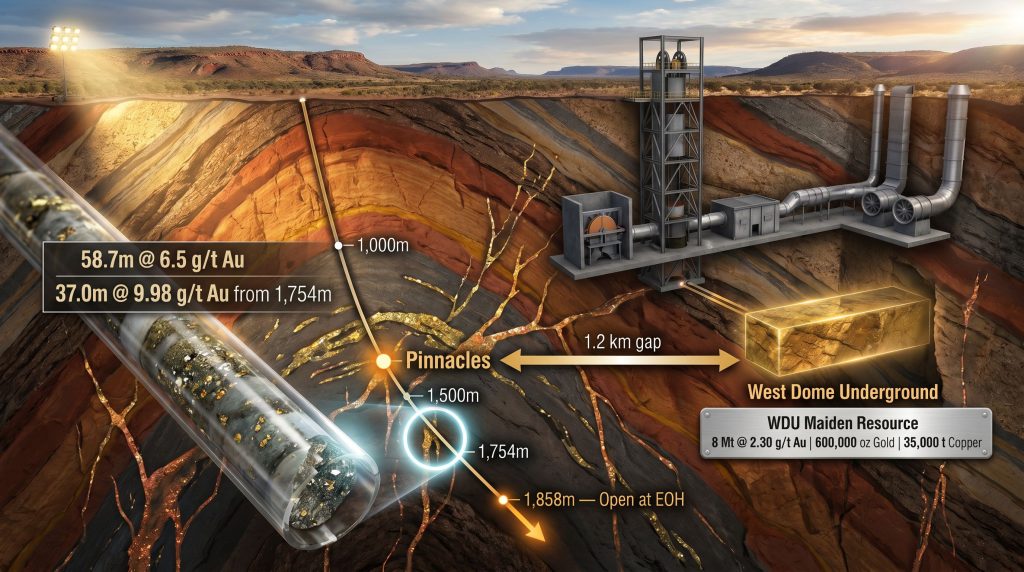
That is precisely the signal delivered by the Greatland Pinnacles gold-copper hit at Telfer, a result that has materially extended the known southern boundary of the West Dome Underground mineralised system in Western Australia's Paterson Province.
When big ASX news breaks, our subscribers know first
Understanding the West Dome Underground: Two Systems, One Architecture
The Telfer operation sits within the Paterson Province, a Proterozoic geological terrane in the remote east Pilbara region of Western Australia. The Province is recognised as one of Australia's most prospective polymetallic corridors, hosting a distinctive style of mineralisation that combines sediment-hosted sulphide replacement with structurally controlled stockwork veining. This dual-system architecture is what defines the West Dome Underground (WDU) deposit and distinguishes it from simpler, single-style ore bodies found elsewhere across the continent.
Two principal mineralised domains govern the WDU's grade distribution and geometry:
-
The Lower Limey Unit (LLU): A sulphide replacement horizon that functions as the primary ore-hosting unit within the system. The LLU carries the bulk of high-grade gold-copper mineralisation and is characterised by the lateral continuity typical of stratiform replacement systems, making it a geometrically predictable drilling target.
-
The Western Stockwork Corridor: A structurally controlled vein network extending deeper into the system. Stockwork corridors form when hydrothermal fluids exploit structural weaknesses in the host rock, producing networks of gold-bearing veins that can extend both vertically and laterally beyond the primary stratiform horizon.
The interplay between these two systems creates a mineralised architecture that extends in multiple directions simultaneously, both along stratigraphy and along structural corridors. This is a fundamental characteristic that investors and geologists should understand: the WDU is not a flat, laterally continuous sheet deposit. It is a three-dimensional system with vertical depth potential driven by stockwork extensions and lateral continuity driven by the LLU replacement horizon.
Geological Context Worth Understanding: In sediment-hosted gold-copper systems like WDU, sulphide replacement horizons typically form where reactive carbonate-rich sediments intersected ancient hydrothermal fluid pathways. These units are geochemically favourable hosts because the chemical contrast between the fluid and the rock drives sulphide precipitation, concentrating gold and copper within predictable stratigraphic intervals. This predictability is what enables geological models to forecast intercept positions at depth with precision.
Breaking Down the Pinnacles Intercept: What the Numbers Actually Mean
The Greatland Pinnacles gold-copper hit at Telfer returned results from hole WRC14503A that warrant careful examination rather than surface-level interpretation. The headline figures are significant, but the internal structure of the intercept carries the most analytical weight. Furthermore, understanding how to interpret drill results is essential before drawing conclusions from any single hole.
| Intercept | From (m) | Width (m) | Gold Grade (g/t) | Copper Grade (%) |
|---|---|---|---|---|
| Main interval | 1,754 | 58.7 | 6.5 | 0.1 |
| High-grade sub-interval (LLU) | 1,754 | 37.0 | 9.98 | 0.14 |
| Deeper stockwork interval | 1,820 | 34.1 | 1.1 | Not reported |
| Total hole depth | — | 1,858 | Open at end of hole | — |
Several aspects of this data structure stand out from a geological and economic perspective:
-
Grade concentration within the LLU: The 37-metre sub-interval at 9.98 g/t Au sits within a broader 58.7-metre interval averaging 6.5 g/t Au. This internal grade distribution confirms that the high-grade core aligns with the LLU horizon, consistent with its role as the primary mineralised unit throughout WDU. The diluting material above and below still averages several grams per tonne, reflecting a mineralised envelope rather than a narrow vein.
-
The stockwork extension below 1,820 metres: A separate 34.1-metre interval at 1.1 g/t Au, encountered beneath the primary LLU zone, is interpreted as the southward continuation of the WDU Western Stockwork Corridor. Stockwork-style mineralisation at this depth and grade is not economically dominant in isolation, but its presence confirms structural continuity of the ore system beyond the LLU horizon, suggesting the overall mineralised system has greater vertical extent than the primary intercept alone implies.
-
End-of-hole mineralisation: The drill hole terminated at 1,858 metres with weakly mineralised material still present. In exploration reporting, an open-at-depth result means the vertical extent of the system has not been defined, only its minimum. This distinction matters for resource modelling. It is also worth noting that the difference between true widths and apparent widths in drill results can significantly affect how these figures are interpreted.
-
Geometric position: Pinnacles sits approximately 1.2 kilometres south of the current WDU resource boundary. This is not a minor step-out. It is a substantial offset that, if confirmed through follow-up drilling, would effectively double the known strike length of WDU-style mineralisation south of the current resource envelope.
Model Validation at Depth: Intersecting target stratigraphy within roughly ten metres of the predicted geological position at approximately 1,750 metres downhole is a meaningful technical achievement. At that depth, small errors in hole deviation, stratigraphic interpretation, or structural modelling compound significantly. Achieving prediction accuracy of this order is a strong indicator that the underlying three-dimensional geological model has moved beyond early-stage conceptual interpretation into a more mature, drill-validated framework.
Contextualising Pinnacles Against the Maiden WDU Resource
To properly evaluate the significance of the Greatland Pinnacles gold-copper hit at Telfer, it must be benchmarked against the foundation resource that preceded it.
West Dome Underground Maiden Mineral Resource (March 2026)
| Metric | Value |
|---|---|
| Total tonnage | 8 million tonnes |
| Gold grade | 2.30 g/t Au |
| Copper grade | 0.44% Cu |
| Contained gold | 600,000 oz |
| Contained copper | 35,000 tonnes |
| Drilling to Dec 2025 | ~19,000 metres |
The maiden resource was established following approximately 19,000 metres of drilling completed through December 2025, after Greatland accelerated its underground drilling programs following its acquisition of the Telfer operation. The progression from exploration target to maiden resource within that timeframe reflects both the geological coherence of the system and the operational intensity of the drilling campaign.
What the grade comparison reveals is particularly instructive. The WDU maiden resource carries an average gold grade of 2.30 g/t Au. The Pinnacles high-grade sub-interval returned 9.98 g/t Au over 37 metres, representing a grade approximately 4.3 times higher than the existing resource average. Even the broader 58.7-metre composite interval at 6.5 g/t Au exceeds the resource average by nearly threefold.
This grade differential does not automatically imply the Pinnacles extension would upgrade the overall resource at equivalent proportions. Resource grade distributions depend on the geometry and continuity of high-grade shoots, and a single drill hole cannot establish whether this result represents a localised high-grade shoot or a spatially consistent enrichment zone. That is precisely what the planned follow-up drilling program is designed to determine.
The Broader Telfer-Havieron Hub
| Asset | Resource Type | Gold | Copper |
|---|---|---|---|
| Telfer (total group) | Mineral Resource | 3.2 Moz | 117 kt |
| West Dome Underground | Mineral Resource | 600,000 oz | 35 kt |
| Group total (all assets) | Combined | ~10.2 Moz | ~387 kt |
WDU currently represents approximately 19% of Telfer's total group gold resource and will grow as a proportional contributor if Pinnacles can be confirmed as a resource extension. The broader group total of approximately 10.2 million ounces of gold across all assets positions the Telfer-Havieron hub as a material multi-asset operation by any global peer comparison standard.
The Infrastructure Calculus: Why Brownfield Discovery Outvalues Greenfield Grade Alone
One of the most underappreciated dimensions of the Greatland Pinnacles gold-copper hit at Telfer is what it represents within an infrastructure context. Junior mining investors frequently focus on grade and intercept width. Experienced mine developers focus equally on the capital cost of converting a discovery into production, and that calculation is fundamentally altered by proximity to existing underground infrastructure.
Telfer's underground infrastructure was originally engineered for the scale of the Main Dome Underground operation. The installed capacity of the underground crusher and hoist system sits at approximately 6 million tonnes per annum (Mtpa). Current throughput through this system runs at approximately 1.2 Mtpa, representing a utilisation rate of roughly 20%.
| Infrastructure Component | Installed Capacity | Current Utilisation | Headroom |
|---|---|---|---|
| Underground crusher and hoist | ~6 Mtpa | ~1.2 Mtpa | ~80% |
| Shaft, pumping and ventilation | Main Dome design scale | Below design throughput | Significant |
| Paste plant | Available | Underutilised | Available |
| Power infrastructure | Full site capacity | Partial utilisation | Available |
Pinnacles sits approximately 1.5 kilometres from this existing crusher and hoist infrastructure. In underground mining terms, lateral development of 1.5 kilometres from an existing shaft is a manageable engineering challenge, particularly when the ventilation, pumping, electrical, and paste infrastructure networks are already in place and operating.
The distinction between brownfield underground extension and greenfield underground development is economically significant:
-
A greenfield underground project at equivalent depth and grade would require shaft sinking or decline development from surface, installation of a new hoisting system, establishment of underground crusher infrastructure, ventilation shaft construction, power supply development, and paste plant construction. Capital costs for projects of this nature can range from hundreds of millions to over a billion dollars depending on depth and throughput design.
-
A brownfield extension leveraging Telfer's existing shaft, crusher, ventilation, power, and paste systems reduces the incremental capital requirement substantially. The primary development cost becomes lateral underground access from existing workings rather than the full suite of surface and shaft infrastructure.
The Brownfield Premium Principle: In underground mining economics, the value of a high-grade discovery is inseparable from its proximity to paid-for infrastructure. A discovery grading 10 g/t Au accessible via existing tunnels can generate superior returns compared with a 15 g/t Au discovery requiring a new shaft and full infrastructure build. The Pinnacles location, 1.5 kilometres from Telfer's crusher and hoist, means incremental development capital is the primary variable, not foundational infrastructure capital.
Drilling Methodology: How Deep Diamond Holes and Wedge Techniques Work
Understanding the technical approach behind the Pinnacles discovery and the planned follow-up program adds important context to evaluating what results will actually confirm or challenge the current geological interpretation.
The Parent Hole: WRC14503A
Diamond core drilling from surface to 1,858 metres is a technically demanding operation. At these depths, maintaining hole trajectory requires careful deviation surveying at regular intervals, with any uncontrolled deviation capable of placing the drill bit hundreds of metres from the intended target by end of hole. The fact that Pinnacles' target stratigraphy was intersected within approximately ten metres of its predicted position confirms the drilling team maintained trajectory control throughout the hole.
Core recovery percentage is a critical but often unreported metric at depth. In massive sulphide zones, competent rock typically returns good core recovery, supporting confident grade interpretation. In structurally complex or fractured zones near stockwork corridors, core recovery can deteriorate, introducing uncertainty into grade calculations. The reported intercepts assume sufficient core recovery to support the stated grades.
How Wedge Holes Test Continuity
The planned follow-up program involves at least three wedge holes from WRC14503A. Wedge hole drilling is a highly efficient method for testing mineralisation continuity from a discovery hole without the cost of drilling entirely new surface holes to the same depth. The process works as follows:
-
A deflection device called a whipstock is cemented into the parent hole at a predetermined depth, typically above the target intersection.
-
A new drill string is advanced from the whipstock at a controlled diverging angle, separating from the parent hole trajectory over a defined wedging distance.
-
Each wedge hole is oriented in a different azimuth or dip direction to test different spatial positions relative to the original intercept.
-
Results from each wedge are compared with the parent hole to establish whether the mineralised horizon maintains grade and width consistency along strike and down dip.
-
The combined dataset is integrated into the three-dimensional geological model to determine whether resource-scale drilling across the 1.2-kilometre gap between Pinnacles and WDU is warranted.
The three planned wedge holes will test mineralisation at 50 to 100 metres along strike and down dip from the discovery intercept. This spacing is designed to establish whether the LLU horizon at Pinnacles has the lateral persistence characteristic of the WDU resource, or whether the high-grade result represents a localised, structurally controlled shoot with limited spatial extent.
The next major ASX story will hit our subscribers first
Systematic Exploration: Pinnacles Within a Broader District Strategy
The Pinnacles discovery does not exist in isolation. It is the southernmost confirmed data point in a systematic exploration effort to define the three-dimensional extent of mineralisation across the West Dome corridor and the broader Telfer district. For additional context on Greatland's Telfer extension plans, the broader strategic ambitions underpinning this drilling campaign are worth reviewing.
Greatland drilled a record 106,766 metres across the Telfer operation in the first half of FY26, including 54,204 metres in the December 2025 quarter alone. This drilling intensity reflects both the financial capacity to sustain aggressive programs, supported by a cash position of A$1.2 billion as of the March 2026 quarter, and the geological conviction that the Telfer district contains substantially more mineralisation than currently defined.
Key exploration threads active across the district include:
-
Thomsons Prospect (14 kilometres northwest of Telfer): Shallow mineralisation confirmed along strike and down dip, with a newly identified high-grade east-west vein set that remains open. Thomsons represents a potentially distinct mineralised system separated spatially from the WDU corridor.
-
Vertical Stockwork Corridor (VSC) and Eastern Stockwork Corridor (ESC): Neither corridor has yet been incorporated into the current resource estimate. Their eventual classification could add further tonnage to the WDU resource envelope.
-
Teague Prospect: Early-stage intercepts including 8 metres at 1.30 g/t Au indicate the presence of mineralisation at this location, though scale and geometry remain to be defined through additional drilling.
The previous best WDU intercept on record was 55.3 metres at 7.4 g/t Au and 0.43% Cu. According to Proactive Investors Australia, the Pinnacles high-grade sub-interval of 37 metres at 9.98 g/t Au now occupies a comparable position in grade terms, while the broader composite of 58.7 metres at 6.5 g/t Au exceeds the previous best in width.
Financial Position and Production Context
The operational and financial environment in which this drilling is occurring matters for evaluating Greatland's capacity to follow through on the exploration program and any future development decision at Pinnacles.
| Financial and Operational Metric | Value |
|---|---|
| Annual gold production guidance (FY26-FY27) | 280,000 to 320,000 oz Au |
| Annual copper production guidance | 7,000 to 11,000 tonnes Cu |
| Cash position (March 2026 quarter) | A$1.2 billion |
| Processing capacity (dual-train mill) | 20 Mtpa |
| Havieron base case throughput | 2.8 Mtpa at 2.74 g/t Au, 0.32% Cu |
The A$1.2 billion cash position provides a material financial buffer to sustain both the Havieron development timeline, with first ore targeted for the second half of 2026 and first gold targeted for the second half of 2027, and an aggressive exploration program across WDU, Pinnacles, and the broader Telfer district simultaneously. Elevated gold prices have amplified operating margins through the period, accelerating cash accumulation relative to earlier planning assumptions.
An important nuance for investors to understand is that Havieron and WDU represent different phases of the capital allocation cycle. Havieron is in active development, moving toward production. WDU is in resource growth mode. Pinnacles, if confirmed through follow-up drilling, would represent a third layer of longer-dated optionality, where resource definition drilling must precede any definitive feasibility study. However, the current financial position gives Greatland flexibility to navigate this sequencing without being forced into premature decisions. Australian Mining has noted that the West Dome corridor continues to demonstrate the kind of structural endurance that justifies sustained capital commitment.
Frequently Asked Questions: Greatland Pinnacles Gold-Copper Hit at Telfer
What is the Pinnacles prospect at Telfer?
Pinnacles is a deep exploration target located approximately 1.2 kilometres south of the current West Dome Underground mineral resource boundary at Greatland's Telfer operation in Western Australia's Paterson Province.
What grades did the Pinnacles drill hole return?
The primary intercept from hole WRC14503A returned 58.7 metres at 6.5 g/t gold and 0.1% copper from 1,754 metres depth, including a high-grade sub-interval of 37 metres at 9.98 g/t gold and 0.14% copper, plus a secondary stockwork interval of 34.1 metres at 1.1 g/t gold from 1,820 metres.
How deep was the Pinnacles drill hole?
The diamond hole was drilled from surface to a total depth of 1,858 metres, with mineralisation present at end of hole.
What is the West Dome Underground maiden mineral resource?
The WDU maiden resource announced in March 2026 comprises 8 million tonnes at 2.30 g/t gold and 0.44% copper, containing approximately 600,000 ounces of gold and 35,000 tonnes of copper.
Why is Pinnacles' location strategically significant?
Pinnacles sits approximately 1.5 kilometres from Telfer's existing underground crusher and hoist infrastructure, which currently operates at roughly 20% of its installed 6 Mtpa capacity. This proximity substantially reduces the potential capital intensity of any future development compared with a standalone greenfield underground project.
What is the follow-up drilling plan?
A minimum of three wedge holes are planned from the existing drill hole to test mineralisation 50 to 100 metres along strike and down dip. Additional surface drilling between Pinnacles and the WDU resource boundary is also under evaluation.
Is the Pinnacles mineralisation open?
Yes. Mineralisation remains open northward toward the WDU resource and southward into entirely untested ground beyond the current drill hole position.
This article is informational only and does not constitute financial advice. Readers should conduct independent research and seek professional advice before making any investment decisions. All financial data and resource estimates referenced are sourced from Greatland Resources' ASX announcements and Proactive Investors Australia reporting dated May 11, 2026.
Want to Track the Next Major ASX Mineral Discovery Before the Market Moves?
Discovery Alert's proprietary Discovery IQ model scans ASX announcements in real time, instantly identifying significant mineral discoveries like the kind of high-grade, infrastructure-proximal hits emerging from Western Australia's Paterson Province — and delivers actionable alerts directly to subscribers. Explore historic discoveries and their remarkable returns to understand what early positioning in major finds can mean, then begin your 14-day free trial at Discovery Alert to ensure you're never behind the market on the next transformative intercept.