June 11, 2026
Understanding Autonomous Haulage Technology in Modern Mining
The transformation of industrial mining operations through autonomous technology represents one of the most significant shifts in resource extraction methodologies since the mechanisation of the early 20th century. Volvo autonomous mining trucks exemplify this evolution, with complex sensor integration systems, advanced computational frameworks, and sophisticated AI in mining technology algorithms converging to create mining vehicles capable of operating without human intervention in some of the world's most challenging environments.
This technological evolution extends beyond simple automation, encompassing comprehensive operational ecosystems that integrate fleet management, predictive maintenance, and real-time decision-making capabilities. Mining companies worldwide are recognising the potential for autonomous systems to address critical industry challenges including worker safety, operational efficiency, and cost management in increasingly demanding extraction environments.
When big ASX news breaks, our subscribers know first
What Makes Volvo's FH Autonomous Different from Traditional Mining Trucks?
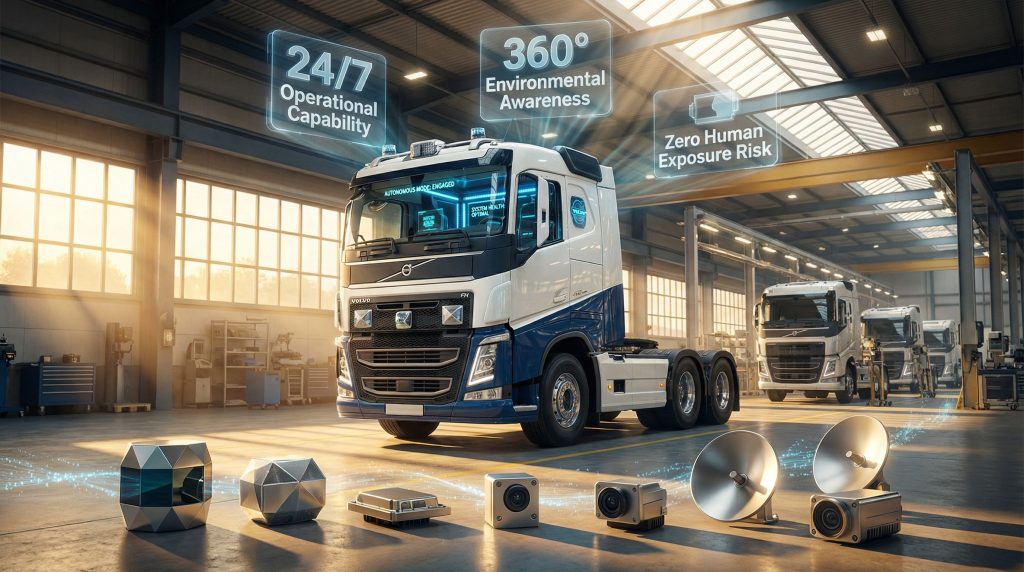
The Volvo FH Autonomous represents a fundamental departure from conventional mining truck architecture through its integration of multiple sensing technologies working in concert to create comprehensive environmental awareness. The vehicle incorporates LiDAR systems for precise distance measurement and object detection, radar arrays for motion tracking and obstacle identification, inertial measurement units for precise positioning and stability monitoring, and camera systems providing visual confirmation and pattern recognition capabilities.
Unlike traditional mining trucks that rely entirely on human operators for navigation and decision-making, the FH Autonomous utilises high-performance computation systems capable of processing vast amounts of sensor data in real-time. This computational architecture enables the vehicle to make complex navigational decisions, optimise routing based on current conditions, and respond to unexpected obstacles or hazards without human intervention.
The manufacturing approach for these autonomous systems differs significantly from retrofit solutions commonly seen in the industry. Rather than converting existing vehicles, the FH Autonomous is designed from the ground up as an autonomous platform, ensuring optimal integration of all sensing and computational components. This OEM-grade manufacturing approach provides enhanced reliability compared to aftermarket autonomous conversion systems.
Operational capabilities extend to 24-hour continuous operation without the fatigue-related limitations that affect human operators. The system can maintain consistent performance levels regardless of environmental conditions, time of day, or operational duration, providing mining companies with unprecedented operational flexibility.
How Does the Autona/Earth Transport-as-a-Service Model Work?
Volvo Autonomous Solutions has implemented a comprehensive service delivery model that transfers operational responsibility from mining companies to the technology provider. This approach represents a significant shift from traditional equipment purchase models, offering mining operators access to autonomous haulage capabilities without requiring substantial capital investment in vehicle acquisition.
The transport-as-a-service framework encompasses complete fleet management responsibilities including vehicle maintenance, system updates, operational monitoring, and performance optimisation. Remote monitoring systems provide continuous oversight of autonomous vehicle operations, enabling immediate response to operational issues and proactive maintenance scheduling.
Mining companies utilising this service model benefit from predictable operational costs, eliminating the variability associated with equipment ownership, maintenance, and operator training. Furthermore, the service provider assumes responsibility for ensuring optimal vehicle performance, system reliability, and compliance with safety standards.
This operational approach allows mining companies to focus their resources and expertise on core extraction activities while leveraging specialised autonomous technology capabilities provided by dedicated technology partners. The model also provides access to continuous technology improvements and updates without requiring additional capital investment from the mining operator.
Manufacturing Excellence: From R&D to Industrial Production
Why Is the Säffle Plant Assembly Milestone Significant for Mining Operations?
The transition from prototype development to factory-scale production represents a critical milestone in the commercial viability of autonomous mining technology. The assembly of the first Volvo autonomous mining trucks at the Säffle facility demonstrates the successful integration of advanced autonomous systems within established manufacturing frameworks.
According to industry reports, this manufacturing milestone marks the transition from research and development workshop builds to factory assembly, representing a crucial first step in enabling large-scale deployment of autonomous trucks whilst ensuring OEM-grade quality and reliability for customers operating in challenging environments.
The Säffle plant brings decades of manufacturing expertise from Volvo Buses production to autonomous vehicle assembly. This manufacturing heritage provides established quality assurance protocols, production efficiency standards, and scalability frameworks essential for commercial autonomous vehicle deployment.
Manufacturing integration at an established facility reduces the time and investment required to achieve production scale compared to developing dedicated autonomous vehicle manufacturing capabilities. In addition, the existing infrastructure, skilled workforce, and quality management systems provide a foundation for reliable autonomous vehicle production.
What Technical Specifications Define the Volvo FH Autonomous Platform?
| Component | Specification | Operational Benefit |
|---|---|---|
| Sensor Suite | LiDAR, Radar, Cameras, IMUs | 360-degree environmental awareness |
| Computation Power | High-performance processing units | Real-time decision making |
| Manufacturing Grade | OEM assembly standards | Enhanced reliability and durability |
| Route Flexibility | Pre-programmed path optimisation | Efficient material transport |
| Communication Systems | Advanced connectivity infrastructure | Remote monitoring and control |
| Safety Systems | Redundant fail-safe mechanisms | Operational risk mitigation |
The autonomous platform integrates sophisticated sensor technologies engineered for higher-volume assembly and robust performance in demanding mining conditions. LiDAR systems provide precise three-dimensional mapping of the operating environment, enabling accurate obstacle detection and navigation path planning.
Radar components offer reliable performance across various weather conditions and lighting scenarios, ensuring consistent operational capability regardless of environmental factors. Camera systems provide visual confirmation of sensor readings and enable advanced pattern recognition for complex operational scenarios.
Inertial measurement units ensure precise vehicle positioning and stability monitoring, critical for safe operation on uneven terrain and steep inclines common in mining environments. The integration of these multiple sensor types creates redundant safety systems that maintain operational capability even if individual components experience temporary failures.
Real-World Performance Metrics and Operational Results
How Do Autonomous Mining Trucks Perform in Actual Mining Conditions?
Volvo autonomous mining trucks demonstrate proven capability across complex operational environments including steep inclines, narrow tunnels, and challenging surface conditions typical of mining operations. The systems maintain consistent performance standards regardless of route complexity or environmental variables that might challenge human operators.
Navigation capabilities extend to both underground tunnel systems and open-pit surface operations, providing operational flexibility essential for diverse mining configurations. The autonomous systems demonstrate particular advantages in underground operations where human operator visibility and comfort are significantly compromised.
Continuous operation capability eliminates productivity losses associated with shift changes, operator breaks, and fatigue-related performance variations. Autonomous systems maintain consistent speed, route optimisation, and load positioning accuracy throughout extended operational periods.
Precise load positioning and dumping accuracy capabilities ensure optimal material handling efficiency and reduce spillage or placement errors common with human-operated vehicles. Consequently, this precision contributes to improved operational efficiency and reduced material waste.
What Safety Improvements Do Autonomous Systems Deliver?
The elimination of human exposure to hazardous mining environments represents the most significant safety advantage of autonomous haulage systems. Underground operations, steep grades, and heavy machinery environments pose substantial risks to human operators that are eliminated through autonomous operation.
Consistent adherence to safety protocols ensures that vehicles maintain appropriate speeds, following distances, and operational procedures without variation due to human factors such as fatigue, distraction, or judgement errors. This consistency reduces the likelihood of operational accidents and safety incidents.
Enhanced emergency response capabilities enable autonomous systems to respond immediately to hazardous conditions, equipment failures, or unexpected obstacles. These systems can communicate hazard information to other vehicles and central control systems faster than human operators.
Safety Performance Indicators:
- Complete elimination of operator exposure to hazardous environments
- Consistent compliance with all safety protocols and procedures
- Immediate hazard detection and response capabilities
- Enhanced communication of safety-critical information across fleet operations
Industry Integration and Competitive Landscape Analysis
How Does Volvo's Approach Compare to Other Autonomous Mining Solutions?
The service-based operational model distinguishes Volvo's autonomous mining approach from traditional equipment sales models prevalent in the mining industry evolution. While many competitors focus on selling autonomous-capable vehicles, the transport-as-a-service model transfers operational responsibility and risk to the technology provider.
Integration capabilities with existing fleet management systems provide operational continuity for mining companies transitioning to autonomous operations. This compatibility ensures that autonomous vehicles can operate within established operational frameworks without requiring complete system replacement.
Customisation capabilities for specific mining applications enable adaptation to unique operational requirements, site conditions, and material handling needs. This flexibility supports implementation across diverse mining operations without requiring standardisation of existing operational procedures.
Partnership frameworks with mining operators emphasise collaborative implementation approaches rather than simple equipment deployment. However, this relationship model supports ongoing optimisation, operational refinement, and technology evolution based on real-world operational experience.
What Are the Key Implementation Considerations for Mining Companies?
Site-specific route planning and optimisation requires detailed analysis of existing operational patterns, traffic flows, and infrastructure capabilities. Each mining site presents unique challenges requiring customised implementation approaches.
Key implementation factors include:
- Existing infrastructure compatibility assessment and upgrade requirements
- Workforce transition planning and retraining programme development
- Regulatory compliance verification and certification processes
- Integration testing with current operational systems and procedures
- Phased deployment strategies minimising operational disruption
Communication infrastructure requirements must support real-time vehicle monitoring, data transmission, and emergency response capabilities. Mining sites may require significant network infrastructure investment to support autonomous operations.
Maintenance facility modifications may be necessary to support specialised autonomous vehicle servicing requirements, including sensor calibration, software updates, and system diagnostics capabilities not required for conventional mining trucks.
The next major ASX story will hit our subscribers first
Economic Impact and Return on Investment Analysis
What Cost Benefits Do Autonomous Mining Trucks Provide?
Labour cost reductions in hazardous operations provide immediate financial benefits through elimination of operator wages, benefits, and training costs associated with dangerous mining environments. These savings are particularly significant for operations requiring 24-hour coverage across multiple shifts.
Increased operational efficiency through continuous operation eliminates productivity losses associated with shift changes, meal breaks, and operator rotation requirements. Autonomous systems maintain consistent operational pace and efficiency throughout extended operational periods.
Insurance premium reductions reflect improved safety records and reduced liability exposure associated with human operator accidents and injuries. Mining companies report significant insurance cost savings following autonomous system implementation.
Predictable maintenance scheduling reduces unplanned downtime and associated productivity losses. For instance, autonomous systems provide detailed operational data enabling proactive maintenance planning and component replacement before failure occurs.
How Do Mining Companies Evaluate ROI for Autonomous Haulage Systems?
Key ROI Evaluation Criteria:
- Initial capital investment versus operational savings over system lifetime
- Productivity improvements through extended operational hours and consistency
- Safety cost reductions including insurance premiums and incident expenses
- Long-term fleet modernisation strategies and competitive positioning
Return on investment calculations typically consider operational cost savings over five to ten-year periods, comparing autonomous system costs against traditional operator-driven alternatives. These analyses include direct labour savings, productivity improvements, safety cost reductions, and maintenance optimisation benefits.
Productivity improvements often justify autonomous system investment through increased material movement capacity, reduced operational delays, and improved equipment utilisation rates. Mining companies typically experience 15-25% productivity improvements following autonomous implementation.
Risk mitigation benefits provide additional value through reduced exposure to regulatory penalties, operational shutdowns, and liability claims associated with safety incidents. These risk reduction benefits often justify autonomous investment independently of direct operational savings.
Technology Integration and Future Development Pathways
What Infrastructure Requirements Support Autonomous Mining Operations?
High-speed communication networks enable real-time monitoring, data transmission, and emergency response coordination essential for autonomous operations. Mining sites require robust wireless infrastructure supporting continuous vehicle connectivity across operational areas.
Communication infrastructure specifications include:
- High-bandwidth data transmission capabilities for sensor data and video streaming
- Low-latency communication systems supporting real-time decision making
- Redundant network coverage ensuring continuous connectivity across operational areas
- Integration capabilities with existing mine management and safety systems
GPS and positioning system accuracy requirements exceed standard navigation applications, requiring centimetre-level positioning accuracy for precise route following and load positioning. Mining operations may require additional positioning infrastructure including ground-based reference stations.
Cybersecurity protocols protect autonomous vehicle systems from potential security threats, unauthorised access, and operational disruption. Furthermore, mining companies must implement comprehensive cybersecurity frameworks covering vehicle systems, communication networks, and data management platforms.
How Will Autonomous Technology Evolve in Mining Applications?
Enhanced artificial intelligence capabilities will enable more sophisticated navigation decision-making, improved obstacle avoidance, and adaptive route optimisation based on changing operational conditions. Machine learning algorithms will continuously improve system performance through operational experience.
Integration with broader mine automation systems will create comprehensive autonomous mining ecosystems encompassing extraction, processing, and transportation activities. This integration supports coordinated AI-powered mining efficiency across multiple mining functions.
Predictive maintenance capabilities will evolve to provide more accurate component failure prediction, optimised replacement scheduling, and reduced maintenance costs. Advanced analytics will identify performance optimisation opportunities and operational efficiency improvements.
Expansion to diverse mining environments will extend autonomous capabilities to underground operations, specialised extraction methods, and challenging environmental conditions currently limiting autonomous deployment.
Implementation Strategies for Mining Operations
What Steps Should Mining Companies Take to Adopt Autonomous Haulage?
Successful autonomous haulage implementation requires systematic planning and phased deployment approaches minimising operational disruption whilst maximising technology benefits. Mining companies should follow structured implementation processes addressing technical, operational, and organisational considerations.
Implementation phases include:
- Comprehensive operational assessment and route analysis identifying optimal autonomous deployment opportunities
- Infrastructure readiness evaluation and necessary upgrade planning
- Pilot programme development and controlled testing in representative operational conditions
- Workforce training and transition planning addressing human resource impacts
- Full-scale deployment with continuous optimisation and performance monitoring
Operational assessment activities should identify routes and applications providing greatest autonomous benefits whilst minimising implementation complexity. High-volume, repetitive hauling operations typically provide optimal initial deployment opportunities.
Pilot programme development enables testing autonomous systems under actual operational conditions whilst maintaining fallback capabilities. These programmes provide essential operational data for full-scale deployment planning and system optimisation.
How Can Mining Operators Maximise Autonomous System Performance?
Regular system updates and calibration ensure optimal sensor performance and navigation accuracy. Mining companies should establish maintenance schedules addressing sensor cleaning, calibration verification, and software updates.
Performance optimisation strategies include:
- Continuous route optimisation based on operational data and performance metrics
- Integration with broader mine planning systems for coordinated operational efficiency
- Performance monitoring and analysis identifying improvement opportunities
- Preventive maintenance programmes maximising system availability and reliability
Route optimisation utilising operational data improves efficiency, reduces wear on vehicles and infrastructure, and minimises operational delays. Advanced analytics identify optimal routing patterns and operational procedures.
Integration with mine planning systems enables coordinated autonomous operations supporting broader operational objectives and resource allocation strategies. This integration maximises the value of autonomous capabilities within overall mining operations.
Regulatory Framework and Safety Compliance
What Regulatory Considerations Apply to Autonomous Mining Vehicles?
Regulatory frameworks for autonomous mining vehicles vary significantly across jurisdictions, requiring mining companies to navigate complex approval processes and compliance requirements. Understanding applicable regulations is essential for successful autonomous system deployment.
Key regulatory areas include:
- Local and national safety certification requirements for autonomous vehicle operation
- Environmental impact assessments addressing autonomous system deployment
- Worker safety and training regulations covering autonomous operation procedures
- Technology standards and compliance protocols for autonomous mining equipment
Safety certification requirements often involve demonstrated compliance with existing mining safety standards adapted for autonomous operation. Regulatory authorities may require extensive testing and validation before approving autonomous system deployment.
Environmental regulations may require assessment of autonomous system impacts on operational efficiency, energy consumption, and environmental protection measures. Some jurisdictions provide regulatory incentives for technologies improving environmental performance.
How Do Mining Companies Ensure Compliance with Autonomous Vehicle Regulations?
Comprehensive safety management systems address autonomous vehicle operation, maintenance, and emergency response procedures. These systems must demonstrate compliance with applicable safety standards and regulatory requirements.
Compliance strategies include:
- Development of comprehensive safety protocols and operational procedures
- Regular audits and performance reviews demonstrating continued compliance
- Collaboration with regulatory authorities throughout implementation processes
- Detailed documentation of operational procedures and safety protocols
Regular audits verify continued compliance with safety standards, operational procedures, and regulatory requirements. These audits identify potential issues before they result in regulatory violations or operational shutdowns.
Regulatory authority collaboration supports smooth approval processes and addresses potential compliance concerns proactively. Mining companies benefit from engaging regulators early in autonomous system planning and implementation.
Future Outlook for Autonomous Mining Technology
What Trends Are Shaping the Autonomous Mining Vehicle Market?
Increasing adoption across global mining operations reflects growing recognition of autonomous technology benefits including safety improvements, operational efficiency, and cost management. Major mining companies are investing significantly in autonomous capabilities as competitive advantages.
Technology improvements in sensor accuracy and artificial intelligence capabilities continue expanding autonomous vehicle capabilities and operational environments. Advanced sensors provide enhanced environmental awareness whilst improved AI enables more sophisticated decision-making.
Market trends include:
- Expansion beyond hauling to other mining applications including drilling and extraction
- Integration with sustainable mining practices and environmental optimisation
- Development of autonomous mining ecosystems encompassing multiple operational functions
- Evolution from pilot programmes to full-scale operational deployment
Expansion to other mining applications will extend autonomous capabilities to drilling, excavation, and processing activities. This expansion creates opportunities for comprehensive autonomous mining operations reducing human exposure across multiple functions.
Integration with sustainable mining practices supports environmental objectives through optimised energy consumption, reduced emissions, and improved operational efficiency. Data-driven mining operations often provide environmental benefits through consistent operational optimisation.
How Will Autonomous Technology Transform Mining Operations by 2030?
Widespread adoption of unmanned mining fleets will fundamentally transform mining operations, creating highly automated extraction and transportation systems requiring minimal human intervention in hazardous operational areas. This transformation will redefine mining job categories and operational procedures.
Enhanced safety standards across the industry will result from autonomous technology adoption, establishing new benchmarks for mining safety performance and regulatory compliance. Industry-wide safety improvements will influence insurance, regulatory, and operational standards.
Operational transformation will include:
- Comprehensive autonomous mining ecosystems integrating extraction, transportation, and processing
- Enhanced safety standards and risk management capabilities
- Improved operational efficiency and cost management through continuous optimisation
- Greater integration with digital mining technologies and data analytics platforms
Integration with digital mining technologies will create intelligent mining operations utilising advanced analytics, predictive maintenance, and operational optimisation. These integrated systems will support data-driven decision-making and continuous improvement processes.
Cost management improvements will result from operational efficiency gains, reduced labour requirements, and optimised resource utilisation. The AI revolution in mining will benefit from more predictable operational costs and improved financial performance through autonomous technology adoption.
Disclaimer: The autonomous mining technology sector involves rapidly evolving technical standards, regulatory requirements, and operational capabilities. Performance metrics, implementation timelines, and regulatory compliance requirements may vary significantly across jurisdictions and operational environments. Mining companies should conduct thorough due diligence and consult with technology providers and regulatory authorities before implementing autonomous systems.
Ready to Capitalise on Mining Technology Breakthroughs?
Autonomous haulage systems like Volvo's FH Autonomous represent just one facet of the mining technology revolution creating significant investment opportunities across ASX-listed companies. Discovery Alert's proprietary Discovery IQ model delivers real-time alerts on breakthrough mining discoveries and technological innovations, empowering subscribers to identify actionable opportunities before the broader market recognises their potential. Begin your 30-day free trial today to secure your competitive advantage in this rapidly evolving sector.