June 11, 2026
How a Single Research Partnership Could Rewrite Australia's Role in the Global Gallium Supply Chain
The global race to secure critical mineral processing capacity rarely begins with a single announcement. It builds slowly, through a series of deliberate technical commitments, institutional partnerships, and research investments that collectively shift a nation's position within the strategic materials hierarchy. For most of the past decade, Australia has occupied an uncomfortably passive role in this race, exporting raw mineral wealth while importing the processed compounds and high-purity metals that power modern technology. The Nimy Curtin University gallium processing partnership, formalised in June 2026, represents a direct challenge to that pattern.
Understanding why this matters requires looking beyond the headline figures and examining the structural gap this initiative is designed to close.
When big ASX news breaks, our subscribers know first
The Invisible Strategic Deficit: Australia's Gallium Processing Gap
Gallium occupies a peculiar position in the periodic table and an even more peculiar position in the global economy. It is not mined in the way that iron ore or lithium is extracted from the earth. Instead, it appears as a trace element within bauxite, the ore from which aluminium is refined, accumulating in the sodium aluminate liquors circulated through the Bayer process at concentrations typically ranging between 50 and 100 parts per million.
Despite processing tens of millions of tonnes of bauxite annually, Australia has historically allowed those liquors to be processed and the gallium value within them to be entirely forfeited. This is not simply a missed commercial opportunity. It is a structural vulnerability in Australia's position within technology supply chains that are now recognised as strategically critical by defence planners, semiconductor manufacturers, and clean energy developers alike.
Gallium critical mineral deposits underpin an extraordinary breadth of modern technology. Gallium nitride (GaN) semiconductors are the enabling technology for high-efficiency power conversion in electric vehicles, data centre power supplies, and 5G base station infrastructure. Gallium arsenide (GaAs) compound semiconductors power the radio frequency electronics in smartphones, satellite communications systems, and airborne radar platforms. Thin-film solar cells incorporating gallium-bearing compounds achieve efficiency levels that silicon alone cannot match. In each of these application areas, there is no commercially viable substitute material currently available at scale.
The Concentration Problem That Western Governments Can No Longer Ignore
What makes gallium's strategic significance acute rather than theoretical is the extreme concentration of its global supply chain. Processing capacity is dominated by a small number of producers whose output reliability has proven inconsistent, and whose export behaviour has at times been subject to geopolitical considerations that create risk for downstream manufacturers in Western-aligned economies. Multiple national governments have classified gallium as a critical mineral precisely because of this combination of indispensability and supply fragility.
The consequences of this concentration have become increasingly visible. Export restrictions affecting gallium availability have triggered significant price volatility for compound semiconductor manufacturers, creating production disruptions that ripple through defence electronics, telecommunications infrastructure, and clean energy supply chains simultaneously. Furthermore, bismuth export controls have demonstrated a similar pattern of supply disruption, highlighting how dependent Western nations remain on a narrow group of foreign processors for strategically critical materials.
For Western nations seeking to maintain technological and military competitiveness, dependence on a narrow group of foreign processors for a material this fundamental represents an untenable strategic position. Australia, despite hosting significant gallium-bearing geology, has until very recently had no domestic pathway to convert that geological endowment into processed, commercially usable gallium. The Nimy Curtin University gallium processing partnership is the most substantive attempt yet to change that.
What the Mons Project Brings to the Table
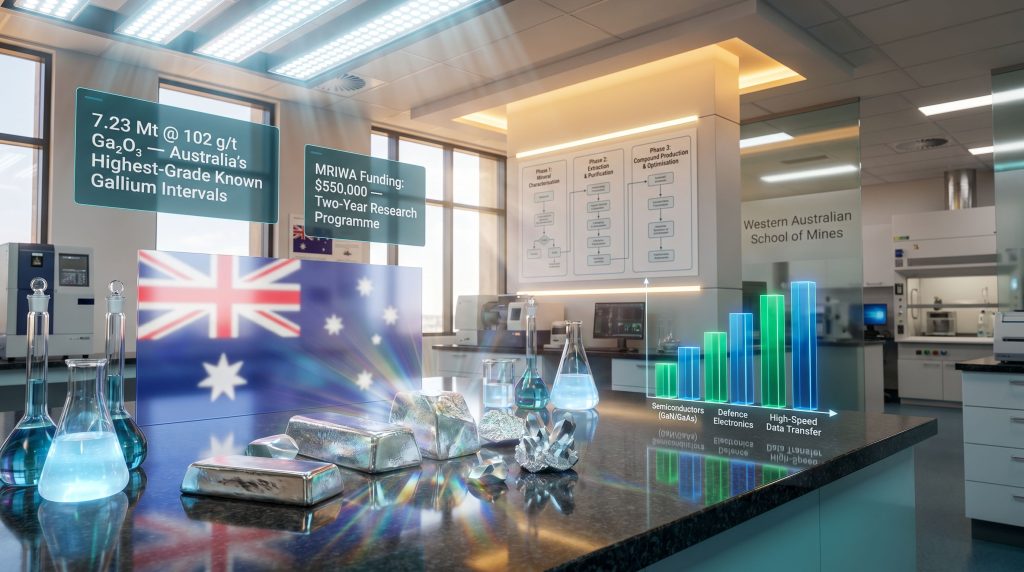
The foundation of this research initiative is the Mons project, located in Western Australia, which ASX-listed Nimy Resources is advancing toward development. The project currently holds an inferred mineral resource of 7.23 million tonnes grading at 102 grams per tonne gallium oxide, a figure that carries particular significance because it represents Australia's highest-grade known gallium intervals.
| Metric | Detail |
|---|---|
| Resource Classification | Inferred |
| Total Resource Tonnage | 7.23 million tonnes |
| Gallium Oxide Grade | 102 g/t |
| Notable Distinction | Australia's highest-grade known gallium intervals |
| Project Location | Western Australia |
Grade is a critical variable in any processing development programme. Higher-grade feed material generally permits more straightforward process design, lower reagent consumption per unit of product, and more robust economics at pilot and commercial scale. The 102 g/t gallium oxide grade at Mons provides a materially stronger platform for process development than would be available from lower-grade resources, because each tonne of ore processed yields more recoverable gallium, reducing the dilution effect that makes processing marginal deposits economically challenging.
The Gap Between Resource and Refinery
Possessing a high-grade resource and possessing the technical capability to commercially process it are entirely different things. This distinction is frequently misunderstood by observers focused primarily on the mining stage of the value chain. The metallurgical complexity of gallium processing is substantially greater than for conventional base metals, requiring specialised hydrometallurgical approaches, ultra-high purity refining techniques, and compound production capabilities that do not exist within Australia's current mining services infrastructure.
Electronic-grade gallium compounds used in semiconductor manufacturing typically require purity levels exceeding 99.9999 percent, a standard that demands multiple sequential refining stages including zone refining, fractional crystallisation, and in some cases vapour-phase purification. The technical knowledge required to design and operate these processes is specialised, held by a small number of researchers and engineers globally, and not readily transferred through conventional mining engineering training.
This is precisely where the partnership between Nimy and Curtin University becomes strategically significant. The research programme is designed to generate the process knowledge that currently does not exist in Australia for gallium ores of this type, creating the technical foundation that any subsequent pilot-scale or commercial operation would require.
The Architecture of the Nimy Curtin University Gallium Processing Partnership
The collaboration is structured around a non-binding Memorandum of Understanding covering gallium research, development, processing, and production. The scope encompasses joint research projects, facility access, and the exchange of academic staff and students working in gallium-related disciplines, creating a knowledge-sharing infrastructure that extends beyond any single funded programme. You can read more about the formal details of this arrangement in Nimy's official MoU announcement.
The research investment underwriting the initial programme is $550,000 committed by the Minerals Research Institute of Western Australia (MRIWA) to support a two-year research programme directed at Curtin University and Nimy Resources jointly. This funding is specifically allocated to investigate novel pathways for concentrating, extracting, and refining gallium ores from the Mons project.
The programme also sits within a broader collaboration ecosystem for Nimy, which includes an existing working relationship with CSIRO focused on gallium extraction and processing optimisation, providing additional technical depth and institutional credibility to the research effort.
Three Phases Toward Pilot-Scale Readiness
The research programme will be led by Dr Jonah Gumatan of the Western Australian School of Mines at Curtin University, structured across three sequential technical phases:
-
Phase 1: Mineral Characterisation and Process Definition – Detailed analysis of ore mineralogy to identify gallium deportment across different mineral phases, establishing the baseline process parameters needed to design downstream extraction systems. This phase determines how gallium is bound within the ore matrix and what liberation and concentration approaches are most appropriate.
-
Phase 2: Extraction and Purification Technologies – Investigation of hydrometallurgical and other innovative extraction routes suited to the specific characteristics of Mons ore, followed by evaluation of purification techniques capable of achieving commercially viable gallium grades. This is the technically most complex phase, requiring iterative experimental work across multiple process configurations.
-
Phase 3: Compound Production and Process Optimisation – Development of gallium compound production pathways and iterative optimisation of the full process flowsheet to support pilot-scale readiness. This phase translates laboratory-scale process knowledge into a technically validated design basis for larger-scale testing.
Metallurgical and processing results from initial sample work at Curtin are anticipated around July 2026, with broader resource development work targeted for later in the year.
The sequential structure of this programme reflects sound metallurgical research methodology. Each phase builds directly on the outputs of the preceding one, ensuring that process design decisions are grounded in characterisation data rather than assumptions, and that purification approaches are tailored to the specific chemical behaviour of gallium in Mons ore rather than generic gallium processing templates.
The Strategic Objectives: Beyond Commercial Development
The stated ambitions behind this partnership extend well beyond the development of a single project. Nimy's managing director, Luke Hampson, has outlined objectives that include establishing Australia's first gallium processing capability, supporting global technology supply chains, reducing dependence on international producers, and positioning Western Australia as a leader in critical minerals innovation. These are national-scale objectives attached to a company-scale research programme, which reflects the genuine scarcity of domestic gallium processing expertise in Australia.
Curtin's commercial executive director, Rohan McDougall, has emphasised that rising gallium demand makes local processing capability essential for supply chain resilience and clean energy transition support. He further noted that establishing sustainable domestic processing will strengthen Australia's sovereign critical minerals position while generating skills and research opportunities for emerging scientists and engineers. Curtin's broader commitment to this area is well demonstrated through their critical minerals research programme, which provides an established institutional foundation for this work.
Defence Alignment and the M2i Global Connection
The strategic context surrounding this partnership is further elevated by Nimy's separate non-binding arrangement with M2i Global, which relates to a US Department of Defense (DoD) gallium procurement effort. This connection is significant for several reasons that go beyond the commercial.
Defence-grade gallium supply chains require materials that meet stringent purity and traceability standards that are materially more demanding than commercial specifications. For Nimy's potential gallium output to qualify for defence procurement pathways, the processing capability being developed through the Curtin programme must demonstrate not only technical viability but also the process control and documentation rigour that defence qualification requires.
The research programme, by establishing documented, reproducible process parameters from first principles, is building exactly the technical credibility that defence-grade supply qualification demands. This creates a strategic alignment between the academic research objectives and the commercial defence market opportunity that is relatively unusual in critical minerals development. The research is not merely de-risking a commercial project. It is building the technical foundation for a supply chain qualification pathway that could connect Australian gallium directly to the most strategically important and highest-value end market available.
Human Capital as Long-Term Strategic Infrastructure
A dimension of this partnership that receives less attention but carries significant long-term importance is the human capital development component. The exchange of researchers, academics, and specialists between Nimy's project operations and Curtin's facilities will gradually build a cohort of Australian metallurgists and process engineers with genuine gallium-specific expertise.
Australia currently has virtually no domestic pool of professionals with hands-on gallium processing experience. This knowledge deficit is not resolved by building processing infrastructure alone. It requires sustained investment in training, research, and institutional knowledge accumulation over time. The Nimy Curtin University gallium processing partnership creates the institutional framework within which that expertise can be systematically developed, with each successive cohort of researchers and graduates adding to a national knowledge base that does not currently exist.
Gallium's Position Within the Energy Transition and Technology Landscape
The demand drivers for gallium span multiple high-growth sectors simultaneously, creating a demand profile that is both structurally robust and highly sensitive to the pace of technological adoption in key industries. In addition, critical minerals and the energy transition more broadly are now firmly embedded within national security frameworks across the Western world, further reinforcing the urgency of establishing domestic processing capability.
| Application Sector | Gallium Dependency | Supply Risk Level |
|---|---|---|
| Semiconductors (GaN/GaAs) | High | Critical |
| LED Lighting | Moderate to High | Elevated |
| Solar Panels (CIGS thin-film) | Moderate | Elevated |
| Defence Electronics | High | Critical |
| High-Speed Data Transfer Infrastructure | High | Critical |
| Electric Vehicle Power Systems | Growing | Moderate to High |
| AI Data Centre Power Conversion | Rapidly Growing | Critical |
The emergence of AI infrastructure as a gallium demand driver is relatively recent but increasingly significant. GaN-based power semiconductors are the preferred technology for the high-efficiency power conversion systems used in hyperscale data centres, where energy consumption at scale makes power conversion efficiency economically critical. As the global AI infrastructure buildout accelerates, demand for GaN power devices, and therefore for the high-purity gallium that underpins them, is growing at rates that were not anticipated in demand forecasts made even three or four years ago.
This adds an urgency to establishing domestic processing capability that purely energy transition-focused analysis might understate. Australia's gallium processing ambitions are not simply aligned with the clean energy transition. They are aligned with the full breadth of the technological transformation underway across defence, communications, computing, and energy infrastructure simultaneously.
The next major ASX story will hit our subscribers first
Translating Resource Endowment Into Processing Sovereignty
The Nimy Curtin University gallium processing partnership reflects a broader policy challenge that Australia has grappled with across multiple critical minerals categories: how to translate a significant resource endowment into a position of genuine processing sovereignty rather than simply raw material export dependency.
The critique that Australia systematically exports raw critical minerals while importing processed compounds at substantially higher per-unit value is well-established and well-documented. However, what is less often articulated is the specific mechanism by which this pattern perpetuates itself. The barrier is rarely capital alone. It is typically the absence of domestic process knowledge, the lack of proven process flowsheets adapted to Australian ore types, and the shortage of engineers with the specific metallurgical expertise required.
These knowledge gaps make processing investment appear higher-risk than equivalent infrastructure commitments in nations with established processing traditions. Consequently, Australia's critical minerals sector has consistently struggled to move beyond extraction into the more lucrative downstream stages of the value chain. University-led research programmes funded through bodies like MRIWA address this barrier at its root.
By generating the process knowledge that de-risks commercial investment decisions, they create the conditions under which private capital can responsibly commit to pilot-scale and commercial-scale processing facilities. The $550,000 MRIWA commitment to the Nimy Curtin programme is, from this perspective, not simply a research grant. It is an investment in the knowledge infrastructure that makes larger downstream investment decisions possible. Furthermore, rare earth elements and strategic supply chains have demonstrated precisely this dynamic, where research investment has enabled countries to move from raw exporters to processed material producers.
This article is intended for informational purposes only and does not constitute financial advice. Statements regarding future research outcomes, commercial development timelines, and market demand projections are forward-looking in nature and subject to material uncertainties. The Mons project resource is classified as inferred, meaning it has been estimated with lower geological confidence than indicated or measured resources. Investors should conduct their own due diligence before making any investment decisions.
Frequently Asked Questions: Nimy, Curtin University, and Australian Gallium Processing
What is the Nimy Curtin University gallium processing partnership?
It is a formally structured research collaboration, underpinned by a non-binding MoU, between ASX-listed Nimy Resources and Curtin University to investigate and develop gallium concentration, extraction, refining, and compound production processes using ore from the Mons project in Western Australia.
How much funding has been committed to the research programme?
The Minerals Research Institute of Western Australia has committed $550,000 to support a two-year research programme led by Curtin University and Nimy Resources jointly.
What are the three phases of the research programme?
The programme progresses through mineral characterisation and process definition, extraction and purification technology development, and compound production with full process optimisation, culminating in a technical foundation for pilot-scale testing.
Why does Australia currently lack gallium processing capability?
Despite hosting gallium-bearing deposits, Australia has historically lacked both the commercial-scale resource base and the processing technology infrastructure to establish viable domestic refining operations. The knowledge barriers specific to gallium metallurgy, including ultra-high purity refining requirements and specialised hydrometallurgical processing, have not previously been systematically addressed within Australian research institutions.
How does this partnership connect to defence supply chains?
Nimy has a separate non-binding arrangement with M2i Global related to a US Department of Defense gallium procurement effort. The processing capability being developed through the Curtin partnership would be essential to meeting the purity and traceability standards required for defence-grade gallium supply qualification.
When are initial research results expected?
Metallurgical and processing results from initial sample analysis at Curtin are expected around July 2026, with broader resource development work anticipated later in the year.
Key Takeaways
-
The Nimy Curtin University gallium processing partnership is the most structurally advanced gallium processing research initiative currently underway in Australia, addressing a knowledge gap that has prevented domestic processing capability from being established.
-
$550,000 in MRIWA funding anchors a two-year, three-phase technical programme designed to produce commercially actionable process knowledge specific to Australian gallium ores.
-
The Mons project's 7.23 million tonne inferred resource at 102 g/t gallium oxide provides a high-grade ore base that strengthens the economic foundation for translational research outcomes.
-
The M2i Global connection to a US Department of Defense procurement effort elevates the strategic stakes of this research programme beyond conventional critical minerals development into sovereign supply chain territory.
-
The programme's outputs will directly inform pilot-scale investment decisions, position Western Australia as a potential global gallium processing hub, and begin building the domestic human capital base that sustained processing sovereignty requires.
-
Gallium demand is now driven by AI infrastructure, defence electronics, electric vehicles, and clean energy simultaneously, creating a demand profile that makes the development of domestic processing capability increasingly time-sensitive.
Want to Know Which ASX Critical Minerals Companies Are Making Significant Discoveries Right Now?
Discovery Alert's proprietary Discovery IQ model scans ASX announcements in real time, instantly identifying high-potential mineral discoveries across gallium, rare earths, and more than 30 other commodities — turning complex data into clear, actionable insights for both traders and long-term investors. Explore why major mineral discoveries have historically delivered extraordinary returns, then begin your 14-day free trial at Discovery Alert to position yourself ahead of the broader market.