
June 23, 2026
Operational Transformation in Mining Automation
Global mining operations are experiencing unprecedented pressure to modernize their material handling systems. Remote locations struggle with workforce availability while commodity markets demand consistent production throughput. This confluence of operational challenges has accelerated the adoption of autonomous haulage systems in mining, fundamentally reshaping how extraction industries approach fleet management and material transport.
The transition from manual to automated haulage represents more than technological advancement. It signals a strategic pivot toward continuous operational capability, addressing the inherent limitations of shift-based labor models that constrain production potential. Mining companies are discovering that automation offers a pathway to operational resilience while maintaining existing infrastructure investments.
When big ASX news breaks, our subscribers know first
Fleet Orchestration: Beyond Individual Vehicle Autonomy
Modern autonomous haulage systems in mining function as integrated fleet orchestration platforms rather than collections of independent vehicles. This systematic approach coordinates multiple trucks through centralised traffic management, real-time load optimisation, and dynamic route adjustment across defined operational zones. Furthermore, these industry evolution trends demonstrate the growing sophistication of mining automation technologies.
The architectural foundation comprises three critical subsystems working in coordination:
Fleet Management Platforms serve as the operational nerve centre, processing real-time data to optimise dispatch decisions and production targets. These systems support both cloud-based and on-premise deployment models, enabling flexible implementation strategies across different mining environments.
Vehicle Autonomy Kits represent the physical transformation of trucks into autonomous units. Available through OEM integration or retrofit installation, these systems utilise vehicle-to-vehicle communication and cellular connectivity to maintain constant coordination with fleet management platforms and other autonomous vehicles.
Manual Equipment Collaboration Systems enable mixed-fleet operations during transition phases. Installed on conventionally operated equipment entering autonomous zones, these systems use vehicle-to-everything communication and object detection technology to coordinate between autonomous and manual operations.
Technical Infrastructure Requirements
The deployment of autonomous haulage systems in mining demands robust communication infrastructure supporting continuous fleet coordination. High-reliability cellular coverage across operational areas, combined with redundant communication systems, ensures mission-critical operations maintain connectivity during adverse conditions.
Road condition management becomes equally critical, as autonomous vehicles require maintained surfaces and clear lane markings for optimal sensor performance. In addition, data-driven operations rely on the precision navigation systems that depend on consistent environmental conditions to maintain positional accuracy within operational tolerances.
Performance Metrics and Economic Analysis
Operational Hour Optimisation
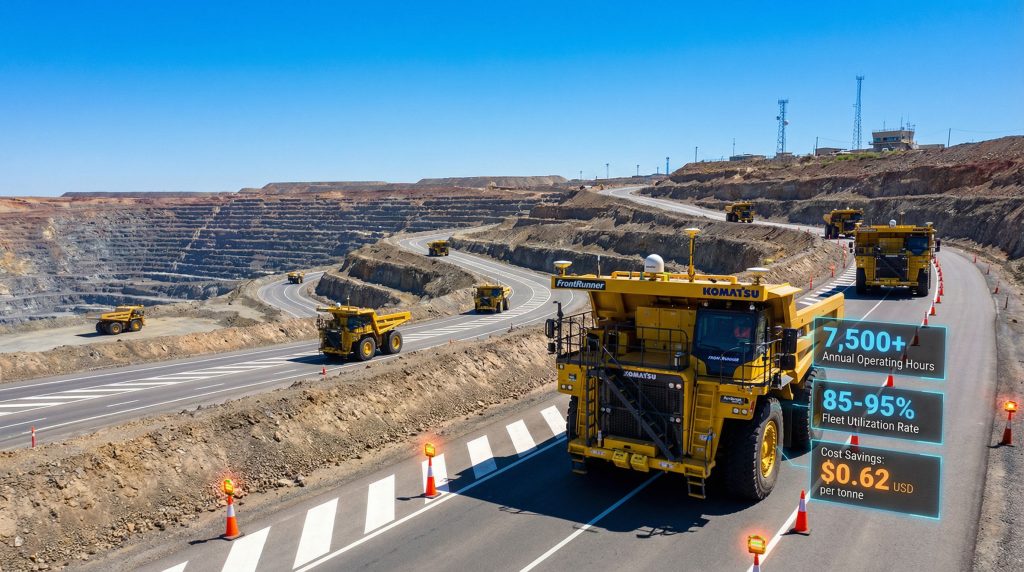
Traditional haulage operations typically achieve 5,000-6,000 annual operating hours through shift-based schedules with inherent downtime for changeovers, breaks, and maintenance windows. Autonomous haulage systems in mining extend this to 7,500+ annual hours through continuous operation capability, representing productivity gains of 25-50%.
Fleet Utilisation Comparison:
| Operational Metric | Manual Operations | Autonomous Systems | Improvement |
|---|---|---|---|
| Annual Operating Hours | 5,000-6,000 | 7,500+ | +25-50% |
| Fleet Utilisation Rate | 65-75% | 85-95% | +20-30% |
| Fuel Efficiency | Baseline | 13% reduction | -13% |
| Maintenance Costs | Baseline | 15-20% reduction | -15-20% |
Cost-Per-Tonne Impact
Leading implementations demonstrate substantial unit cost reductions. Komatsu's autonomous haulage system has documented cost-per-tonne savings of $0.62 USD, scaling to hundreds of millions in cumulative savings across large-scale operations over multi-year deployment periods.
For operations moving 200 million tonnes annually, this translates to $124 million in annual savings. Over a five-year implementation period, cumulative savings reach $620 million, fundamentally altering project economics and return on investment calculations. Moreover, AI in mining automation complements these haulage systems to maximise operational efficiency.
Technology Provider Ecosystem
OEM-Integrated Solutions
Komatsu FrontRunner Architecture leads market deployment with over 3.5 billion tonnes hauled globally. The system integrates GNSS positioning technology with advanced sensor fusion, enabling remote operations centres to manage distributed fleets across multiple mine sites simultaneously.
Caterpillar Command for Hauling emphasises seamless integration with existing equipment infrastructure. The platform's collision avoidance and traffic management systems enable gradual fleet conversion without disrupting ongoing operations.
Third-Party Retrofit Platforms
Retrofit solutions enable miners to modernise existing fleets without vehicle replacement, reducing capital expenditure requirements and accelerating deployment timelines. These platforms offer flexibility for operations with diverse equipment portfolios or budget constraints limiting complete fleet replacement.
The retrofit approach provides particular value during commodity price volatility, allowing operational improvements without major capital commitments while preserving existing asset investments. Consequently, this approach aligns with sustainability transformation initiatives by extending equipment lifecycles.
Implementation Strategies and Deployment Models
Phased Deployment Framework
Pilot Zone Establishment begins with limited-area testing, enabling validation of autonomous haulage systems in mining within controlled environments while maintaining existing operational patterns. This approach minimises risk while generating performance data for expansion decisions.
Operational Zone Expansion follows successful pilot validation, gradually increasing autonomous coverage areas while refining integration protocols with manual equipment and operational procedures.
Full Fleet Integration represents the culmination of phased deployment, achieving complete autonomous operation with sophisticated coordination between autonomous vehicles and remaining manual equipment.
Level 4 Autonomy Standards
Current industry deployments operate at Level 4 automation within Autonomous Operating Zones, achieving full autonomy within defined parameters while maintaining human oversight for complex scenarios or emergency situations.
This autonomy level provides operational benefits without requiring complete elimination of human intervention capabilities, enabling gradual workforce transition and maintaining operational flexibility during unusual circumstances. However, AI-powered efficiency systems continue to enhance these autonomous capabilities.
Safety Performance and Risk Management
Quantified Safety Improvements
Autonomous haulage systems in mining eliminate human exposure to high-risk operational zones while maintaining consistent safety protocols across all fleet operations. Key safety enhancements include:
- Fatigue elimination through removal of human operators from vehicles
- Consistent speed compliance and operational procedure adherence
- Predictable vehicle behaviour enabling advanced collision avoidance
- Real-time monitoring with emergency intervention capabilities
Risk Mitigation Protocols
The transition to autonomous operations requires comprehensive safety case development addressing operational boundaries, emergency response procedures, and data recording requirements. Regulatory compliance frameworks provide structured approaches to risk assessment and mitigation strategy implementation.
The next major ASX story will hit our subscribers first
Regional Market Dynamics
Australia: Global Implementation Leader
Australia leads worldwide deployment of autonomous haulage systems in mining, driven by acute labour shortages in remote locations and supportive regulatory frameworks. Large-scale iron ore and coal operations provide ideal testing environments for fleet-wide autonomous implementation.
The Western Australia Department of Mines, Petroleum and Exploration has established comprehensive guidelines for autonomous system deployment, creating regulatory templates being studied and adapted globally.
North American Adaptation
Canadian and US implementations focus on harsh weather adaptability and integration strategies accommodating existing workforce structures. These markets emphasise gradual transition approaches that address union concerns while achieving operational improvements.
Integration Challenges and Solutions
Infrastructure Dependencies
Network Connectivity Requirements demand high-reliability communication coverage across operational areas. Redundant systems ensure continuous fleet coordination during adverse weather conditions or equipment failures that could disrupt primary communication networks.
Road Maintenance Standards become critical operational factors, as autonomous navigation systems require consistent surface conditions and clear visual markers for optimal performance.
Workforce Transition Management
Successful implementation requires comprehensive change management addressing operator retraining for remote monitoring roles, community impact in mining-dependent regions, and skills development for maintenance and technical support positions.
The transition creates opportunities for workforce advancement into technical monitoring and fleet coordination roles while addressing concerns about employment displacement through systematic retraining programmes.
What Are the Future Technology Integration Opportunities?
Decarbonisation Pathway
Autonomous haulage systems in mining provide foundational infrastructure for transitioning to electric and hydrogen-powered fleet operations. The retrofit approach enables immediate emissions reductions while preparing operational systems for zero-emission vehicle integration.
This dual benefit addresses both operational efficiency goals and environmental sustainability commitments, creating aligned incentives for automation adoption across multiple stakeholder groups. Furthermore, autonomous haulage research indicates significant potential for carbon footprint reduction.
Market Expansion Projections
The technology is expanding beyond traditional large-scale operations to include mid-tier mining operations seeking competitive advantages, underground applications requiring specialised navigation capabilities, and quarry operations with high-volume material movement requirements.
Strategic Implementation Considerations
For Mining Operators
Immediate Assessment Actions:
- Conduct feasibility studies for pilot zone deployment
- Evaluate retrofit options for existing fleet assets
- Develop workforce transition and training programmes
- Assess communication infrastructure requirements
Long-term Strategic Planning:
- Partner with technology providers offering flexible deployment models
- Prioritise solutions enabling gradual fleet conversion
- Invest in network infrastructure supporting automation expansion
- Establish regulatory compliance frameworks
Critical Success Factors
Technical Infrastructure Requirements include robust communication networks with redundancy protocols, integration capabilities with existing operational technology systems, and scalable deployment architecture supporting phased implementation approaches.
Organisational Readiness Elements encompass executive commitment to transformation initiatives, comprehensive change management programmes addressing workforce concerns, and investment in technical skills development for system operation and maintenance.
Regulatory Compliance Strategies involve proactive engagement with regulatory authorities, development of comprehensive safety cases addressing operational protocols, and establishment of clear emergency response and data recording procedures.
The implementation of autonomous haulage systems in mining represents a fundamental shift in operational strategy rather than merely technological adoption. Success requires coordinated attention to technical infrastructure, workforce development, and regulatory compliance while maintaining focus on operational continuity during transition periods.
This analysis is based on publicly available information and should not be considered as investment advice. Mining operations considering autonomous haulage implementation should conduct comprehensive feasibility studies and consult with qualified technical and regulatory specialists.
Ready to Capitalise on Mining Automation Breakthroughs?
Discovery Alert's proprietary Discovery IQ model delivers real-time alerts on significant mining automation and technology discoveries, instantly empowering subscribers to identify actionable opportunities ahead of the broader market. Understand why major mineral discoveries can lead to substantial market returns and begin your 14-day free trial today to position yourself ahead of the market.