
May 23, 2026
The Engineering Logic Behind Autonomous Electric Mining Haulage
The mining industry does not transform in sudden leaps. It shifts through a sequence of compounding pressures: tightening safety mandates, labour market constraints, decarbonisation commitments, and the relentless economics of moving more material at lower cost per tonne. Autonomous haulage technology has been building against each of these pressures simultaneously, yet the sector has lacked a single cohesive model that brings electric drivetrain precision and field-validated autonomy software under one co-developed framework. Understanding why that gap exists, and how the Schaeffler and CiDi mining truck autonomy partnership attempts to close it, requires working through the engineering logic from the ground up.
When big ASX news breaks, our subscribers know first
Two Technology Pillars, One Structural Gap
Most autonomous mining truck solutions on the market today sit in one of two categories: aftermarket autonomy kits retrofitted onto existing diesel platforms, or OEM-integrated systems where the truck manufacturer controls both hardware and software. Neither model is purpose-built for the convergence of electrification and autonomy as co-designed engineering disciplines.
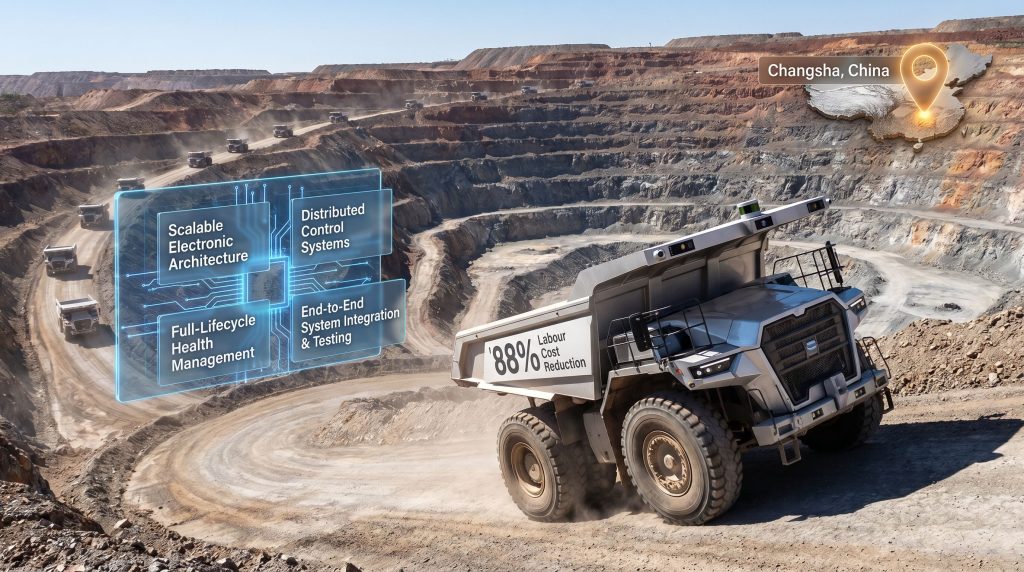
The partnership formalised between German automotive supplier Schaeffler and Chinese autonomous driving firm CiDi on April 29, 2026 targets this gap directly. Under the agreement, both companies are designated as strategic suppliers and preferred customers for one another, creating a bilateral commercial structure that incentivises sustained technical co-development rather than transactional engagement. Both organisations maintain operations in Changsha, China, a city increasingly recognised as a significant centre for intelligent transportation research and autonomous vehicle development in the country.
The division of technical responsibility reflects each company's core competency:
-
Schaeffler contributes electric drive systems, mechatronics hardware, and the systems integration expertise needed to link drivetrain components into a cohesive, controllable platform.
-
CiDi contributes autonomous driving software built specifically for mining haul environments, including mixed-fleet management capabilities and localisation solutions for the GNSS-degraded conditions common in open-pit operations.
What separates this model from aftermarket alternatives is the integration point. When autonomy software is developed alongside the electric drive architecture rather than layered on top of an existing system, the control loops between propulsion, braking, steering, and situational awareness can be tuned as a unified system rather than patched together post-manufacture. Furthermore, mining automation technology continues to evolve rapidly, making co-developed frameworks increasingly important for long-term performance.
The Four Engineering Domains That Define the System
The technical scope of the Schaeffler-CiDi collaboration centres on four interconnected engineering areas, each addressing a different dimension of autonomous electric truck performance.
| Engineering Domain | Technical Objective | Operational Outcome |
|---|---|---|
| Scalable Electronic Architecture | Unified vehicle control framework across truck sizes | Faster OEM integration and platform reuse |
| Distributed Control Systems | Precision and stability across independent subsystems | Safer operation on steep grades and mixed haul roads |
| Full-Lifecycle Health Management | Continuous diagnostics from commissioning to decommission | Reduced unplanned downtime and maintenance costs |
| End-to-End System Integration and Testing | Validation across hardware-software interfaces | Reliability certification for commercial deployment |
Why Distributed Control Architecture Matters at the Pit Face
The distinction between centralised and distributed vehicle control systems is not merely academic in a mining context. A centralised architecture routes all control decisions through a single processing unit. If that unit encounters a fault, the entire vehicle control system is at risk. In a distributed architecture, control functions are divided across independent subsystems, each capable of operating and recovering from faults without cascading failure across the platform.
For a fully loaded rigid haul truck operating on a 30% grade at speeds approaching 45 kilometres per hour, redundancy in control is a safety-critical requirement, not an optional feature. Distributed systems can maintain steering, braking, and traction control functions independently, which is particularly relevant when traversing haul roads shared with manned equipment in mixed-fleet environments.
The GNSS Problem Nobody Talks About Enough
Satellite-based positioning underpins most outdoor autonomous navigation systems, but open-pit mining environments create conditions that systematically degrade GNSS accuracy. The steep walls of a working pit introduce signal multipath, where satellite signals bounce off rock faces before reaching the vehicle's receiver, corrupting positional data. The deeper the pit, the more pronounced this effect becomes.
This is a less-discussed but operationally critical challenge in autonomous mining trucks and haulage systems more broadly. Solutions typically involve sensor fusion approaches that combine GNSS data with inertial measurement units, LiDAR-based localisation, and camera-based landmark recognition to maintain positional accuracy when satellite signals become unreliable. The hardware architecture of the Schaeffler electric drive system must be designed to support the high-frequency data inputs these alternative localisation methods generate, making co-development between hardware and software teams essential rather than optional.
What CiDi's Deployments Actually Demonstrate
Field deployments provide the most credible evidence of where autonomous mining haulage technology genuinely stands. CiDi has two commercially operational deployments that establish concrete performance benchmarks.
Taiwan Cement Jurong Quarry
Operational since November 2022, this deployment involves a fleet of 14 driverless pure electric trucks rated between 60 and 100 tonnes. The operation runs continuously on a 24-hour, seven-day cycle with no onboard operators. Reported performance outcomes include:
-
Labour cost reductions exceeding 88% compared to conventional manned operations
-
Productivity reaching 1.04 times the efficiency of equivalent manned diesel trucks on the same haul routes
-
Sustained commercial operation across multiple years, demonstrating durability beyond pilot conditions
The productivity figure deserves closer examination. At 1.04 times the manned diesel benchmark, the autonomous electric fleet is not dramatically outperforming human operators on a raw throughput basis. The economic transformation comes from the combination of continuous operation — eliminating shift change downtime and fatigue-related productivity losses — and the near-elimination of operator labour costs, which in haulage-intensive mining operations represent one of the largest variable cost components.
Western China Coal Mine
Operational since June 2024, this deployment serves a 16 million-tonne annual coal operation in Western China. The fleet operates without onboard operators across mixed-traffic haul roads, managing speeds up to 45 km/h on grades reaching 30%. The significance of this deployment extends beyond scale.
Managing autonomous trucks alongside manned equipment on shared infrastructure introduces a category of operational complexity that single-vehicle or controlled-environment tests cannot replicate. Real-time awareness of manned vehicle positions, construction zones, and dynamic route changes are core software requirements that only field deployment can stress-test. Consequently, the CiDi 2025 report on mining truck autonomy offers detailed insights into how these challenges have been addressed across deployment cycles.
Collectively, these two deployments indicate that CiDi's autonomy stack has progressed from controlled demonstration into repeatable commercial operation across meaningfully different site conditions, tonnage classes, and haul road environments.
Competitive Positioning in the Autonomous Mining Haulage Market
Understanding where the Schaeffler-CiDi model sits relative to the competitive landscape requires comparing along dimensions that matter operationally rather than simply by brand recognition.
| Capability Dimension | Retrofit Autonomy Providers | OEM-Integrated Systems | Schaeffler-CiDi Model |
|---|---|---|---|
| Hardware Control | Third-party aftermarket | Factory-integrated | Co-developed, vertically aligned |
| Software Depth | General AV stack adapted for mining | Purpose-built for mining | Mining-native, field-validated |
| Electric Drive Integration | Limited or absent | Varies by OEM | Core design principle |
| Scalability Across Truck Classes | Low to medium | Medium | High by design intent |
| Lifecycle Health Management | Limited | Varies | Integrated at architecture level |
| Mixed-Fleet Capability | Limited | Rare | Demonstrated in deployment |
The retrofit market has grown significantly as mine operators sought to extend the working life of existing diesel fleets by adding autonomous capability without full capital replacement. However, retrofit approaches face a structural ceiling: the underlying vehicle architecture was not designed to receive the high-bandwidth sensor data and precision actuation commands that mature autonomy software demands. Integration compromises accumulate, limiting the performance ceiling of what retrofit systems can achieve.
CiDi's 2025 technical reporting indicates the company has also developed modular kit-based retrofitting capability for large rigid and wide-body dump trucks, acknowledging that not all mine operators can justify full fleet replacement. This positions the partnership to serve both greenfield autonomous fleet builds and existing fleet upgrades, expanding the addressable market considerably.
The Economic Case for Autonomous Electric Haulage
Mining companies evaluating autonomous electric truck deployment should assess five distinct cost vectors rather than focusing exclusively on capital acquisition price:
-
Capital acquisition or retrofit cost against fleet replacement cycle timing
-
Energy cost per tonne moved, where pure electric drivetrains eliminate diesel fuel expenditure and regenerative braking on loaded downhill haul segments recovers meaningful energy
-
Maintenance cost per operating hour, where electric drivetrains have substantially fewer moving parts than diesel powertrains and autonomous operation eliminates operator-induced mechanical stress
-
Labour displacement savings, which the Taiwan Cement deployment indicates can exceed 88% of operator-dependent cost structures
-
System downtime cost relative to manned alternatives, where 24/7 unmanned operation eliminates shift-change gaps but introduces dependency on communication infrastructure and remote supervision capability
The interaction between electrification and autonomy is where the most significant economic leverage exists. An electric truck running a human-operated single shift captures fuel savings but leaves the majority of capital investment idle for two-thirds of the day. The same truck operating autonomously across a continuous 24-hour cycle multiplies capital utilisation and compounds the fuel cost advantage across a far greater number of operating hours.
The next major ASX story will hit our subscribers first
Decarbonisation and the Intelligent Fleet Argument
Research published in the Mining IQ Future Fleets Insights 2026 report identifies a critical finding: mining companies must substantially increase their decarbonisation investment if they intend to meet stated CO₂ reduction targets. This finding has direct implications for how autonomous electric haulage should be framed strategically.
Electrification of haulage fleets addresses Scope 1 emissions at the mine site level, replacing diesel combustion with grid or renewable energy sources. In addition, renewable energy in mining is increasingly integrated with fleet electrification strategies to further reduce site-level emissions. However, electrification alone does not resolve the capital justification challenge. The cost per tonne of transitioning to electric haulage must be reduced through operational efficiency gains that make the business case compelling independent of regulatory pressure.
Autonomous operation is the mechanism through which that efficiency gain is achieved. It maximises electric drivetrain utilisation rates, eliminates the productivity losses associated with human shift structures, and enables energy management optimisation that human operators cannot consistently execute across an entire fleet. Lifecycle health management systems also enable accurate energy consumption tracking per tonne moved, providing the granular data that Scope 1 emissions accounting at the mine site level increasingly requires.
The convergence of electric drivetrains and autonomous operation is therefore not simply a technology trend. It is the operational logic through which mining decarbonisation becomes economically viable rather than merely aspirational.
What Mine Operators Must Evaluate Before Committing
The deployment evidence is compelling, but autonomous electric mining truck adoption carries implementation challenges that due diligence must address:
-
Mixed-fleet integration complexity: Autonomous trucks sharing haul roads with legacy manned equipment require sophisticated real-time awareness systems and pre-defined interaction protocols that add integration cost and timeline
-
Charging infrastructure requirements: Pit-floor and remote mine site environments present significant engineering challenges for dense charging network deployment, particularly for large-format electric trucks with high energy demands
-
Communication infrastructure dependency: Real-time fleet management and remote supervision require reliable, low-latency connectivity across the mine site, which in deep open-pit environments can be technically demanding to achieve consistently
-
Workforce transition considerations: Labour displacement at the scale indicated by the deployment data creates workforce transition obligations that vary significantly by jurisdiction and will influence implementation timelines and social licence considerations
-
Regulatory approval pathways: Autonomous mining equipment certification processes differ substantially between jurisdictions, with China's closed-environment testing framework providing an accelerated pathway that may not be directly replicated elsewhere
Frequently Asked Questions: Schaeffler and CiDi Mining Truck Autonomy
What is the Schaeffler and CiDi mining truck autonomy partnership?
The partnership is a strategic supply agreement formalised on April 29, 2026 between Schaeffler, a German automotive and industrial supplier, and CiDi, a Chinese autonomous driving technology company. The agreement combines Schaeffler's electric drive hardware and mechatronics expertise with CiDi's mining-purpose autonomous driving software. Both companies are designated as strategic suppliers and preferred customers for each other and both maintain operations in Changsha, China.
What mining truck types does the combined system target?
The system targets large rigid haul trucks, wide-body dump trucks, and closed-environment logistics vehicles operating in industrial mining settings. CiDi's modular kit capability also supports retrofit deployment on existing fleet assets, reducing the capital threshold for adoption. The broader shift toward electric mining transport is accelerating the relevance of these integrated solutions across multiple fleet categories.
How has the technology performed in real-world conditions?
At the Taiwan Cement Jurong Quarry, operational since November 2022, a 14-truck autonomous electric fleet in the 60 to 100-tonne class achieved labour cost reductions exceeding 88% and sustained productivity at 1.04 times the output of manned diesel equivalents on continuous 24-hour cycles. A Western China coal operation handling 16 million tonnes annually has operated without onboard operators since June 2024, with autonomous trucks managing 30% grades at speeds up to 45 km/h in mixed-fleet conditions.
What distinguishes this model from competing solutions?
The primary differentiation is hardware-software co-development from the architecture level, contrasted with aftermarket autonomy layers added to vehicles designed without autonomous operation as a design parameter. The partnership also addresses electric drive integration as a core principle rather than a secondary consideration.
What are the primary technical challenges for autonomous mining trucks?
GNSS degradation in open-pit environments, mixed OEM fleet integration complexity, haul road communication infrastructure requirements, and charging network design for large-format electric trucks in remote or pit-floor locations represent the most significant technical barriers to broad deployment.
The Strategic Architecture of the Alliance
The mutual strategic supplier and preferred customer designation embedded in the agreement creates a commercial structure with compounding durability. Each organisation's commercial success becomes linked to the technical performance of the other's contribution, which creates aligned incentives for ongoing co-development investment that a simple licensing agreement or component supply contract would not generate.
Near-term priorities for the partnership will likely focus on advancing scalable electronic architecture across multiple truck platform classes, expanding retrofit kit compatibility for existing fleet operators, and building the system integration and testing protocols required for broader market access. The Changsha co-location of both companies compresses development iteration timelines in a way that geographically distributed partnerships cannot easily replicate.
Longer term, the question is whether a co-developed, vertically integrated autonomous electric mining truck platform built on field-validated deployment data can establish itself as a reference architecture that competing approaches must benchmark against. The mining electrification trends shaping the sector suggest the window for establishing that position is narrowing. The deployment evidence from Jurong and Western China, however, suggests the technical foundations to support that ambition are already operational. Readers seeking further detail on the Schaeffler-CiDi cooperation announcement can review the full technical analysis at Mining Magazine.
This article contains forward-looking assessments of technology performance and market positioning based on publicly available deployment data and partnership announcements. Readers should conduct independent due diligence before making any operational or investment decisions based on the information presented.
Want To Identify The Next Major Mineral Discovery Before The Market Catches On?
Discovery Alert's proprietary Discovery IQ model delivers real-time alerts on significant ASX mineral discoveries, instantly transforming complex mineral data into actionable investment insights for both short-term traders and long-term investors. Explore how historic discoveries have generated substantial returns on Discovery Alert's discoveries page, and begin your 14-day free trial today to position yourself ahead of the broader market.