June 27, 2026
The mining sector stands at a technological crossroads where artificial intelligence, robotics, and data analytics converge to redefine operational excellence. This transformation extends far beyond simple automation, representing a fundamental shift toward intelligent mining ecosystems that operate with unprecedented precision and efficiency. The integration of autonomous mining technology now shapes how resources are extracted, processed, and delivered across global supply chains.
Modern mining operations increasingly rely on sophisticated technological frameworks that process millions of data points simultaneously while making real-time operational decisions. Furthermore, mining industry innovation requires comprehensive understanding of both technical capabilities and practical implementation strategies.
Understanding the Fundamentals of Autonomous Mining Systems
Core Technologies Enabling Autonomous Mining Operations
Autonomous mining technology integrates multiple technological layers to create comprehensive operational intelligence. GPS precision mapping forms the foundation of these systems, utilizing Real-Time Kinematic (RTK) GPS technology capable of centimeter-level accuracy through satellite positioning combined with ground-based correction signals.
Artificial intelligence and machine learning algorithms process continuous sensor data streams to optimise routes, predict maintenance requirements, and detect operational anomalies. In addition, AI in mineral exploration analyses geological data patterns while adjusting operational parameters based on real-time conditions and historical performance metrics.
Sensor networks incorporate LiDAR (Light Detection and Ranging), radar, and proximity detection systems that work together for obstacle avoidance and collision prevention. Communication protocols enable seamless data transmission between equipment, control centres, and monitoring systems across mining sites.
According to Melissa Russell, Executive Director of the Society for Mining, Metallurgy and Exploration (SME), modern autonomous systems integrate artificial intelligence capable of analysing millions of data points in seconds, with operators optimising routes in real time while improving safety by removing people from high-risk zones and increasing overall productivity.
Integration with Existing Mining Infrastructure
The transition to autonomous operations requires careful integration with established mining infrastructure. Retrofitting traditional equipment involves installing autonomous control systems, sensor packages, and communication hardware onto existing machinery while maintaining operational continuity.
Communication networks must extend across both surface and underground operations, creating unified command and control capabilities. However, implementation strategies often employ hybrid operational models during transition periods, allowing gradual conversion from manual to autonomous systems while maintaining production targets.
Safety protocols for human-machine interaction zones become critical during implementation phases. Designated areas separate autonomous equipment from manual operations, with clearly defined protocols governing when and how personnel can interact with autonomous systems.
When big ASX news breaks, our subscribers know first
The Technical Architecture Behind Autonomous Mining Equipment
Equipment Categories Leading Autonomous Mining Adoption
The autonomous mining equipment landscape encompasses several key categories that demonstrate varying levels of technological maturity and deployment success:
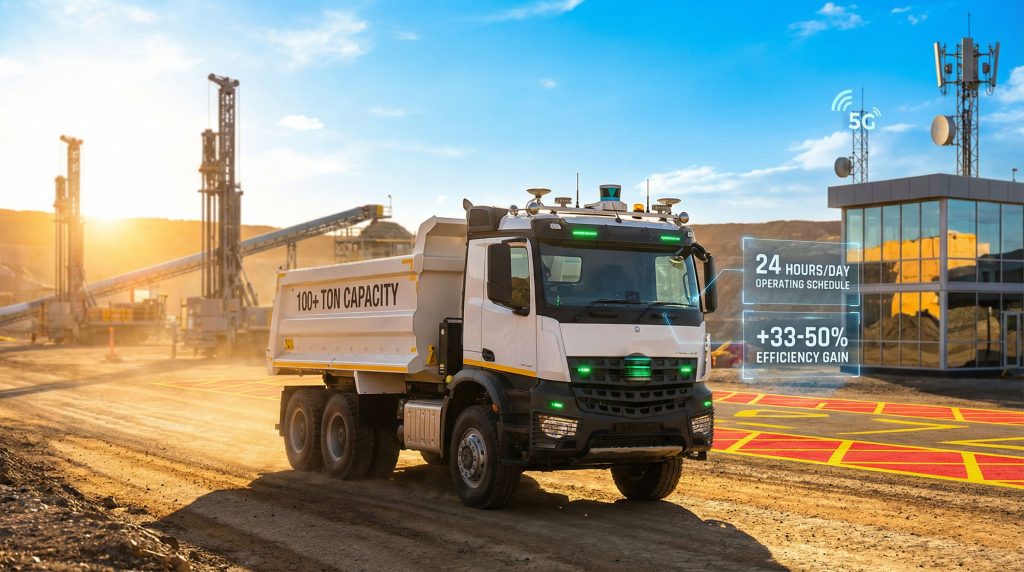
Autonomous Haul Trucks represent the most visible implementation of autonomous mining technology. These large-capacity vehicles transport materials across mining sites using integrated GPS navigation, obstacle detection, and fleet coordination systems. Major manufacturers including Caterpillar, Komatsu, and Volvo produce autonomous haul truck variants designed for mining applications.
Automated Drilling Systems utilise precision positioning and automated drilling protocols to optimise hole placement for blasting operations. For instance, AI in mining drilling integrates geological data with drilling parameters to enhance accuracy while reducing operator exposure to hazardous environments.
Robotic Excavators enable remote-controlled material extraction in challenging or dangerous locations. Advanced hydraulic systems combined with remote operation capabilities allow precise material handling from centralised control rooms.
Smart Conveyor Systems automate material handling and initial processing stages through integrated sensors, variable speed controls, and automated sorting mechanisms. These systems optimise material flow while reducing manual intervention requirements.
Autonomous Dozers handle terrain preparation and site maintenance operations using GPS-guided navigation and automated blade control systems that maintain precise grading specifications.
Russell confirms that large fleets of autonomous haulers, drills, and loaders are already running at scale across major operations, indicating these equipment categories have moved beyond pilot programmes into production deployment.
Safety Systems Protecting Operations and Personnel
Multi-layered safety protocols form the backbone of autonomous mining operations. These systems employ redundant detection mechanisms that continuously monitor equipment status, environmental conditions, and proximity to other vehicles or personnel.
Emergency override capabilities enable immediate human intervention when anomalous conditions are detected. Operators can assume manual control or initiate emergency shutdown procedures from centralised command centres or through on-site emergency stations.
Geofencing technology creates virtual boundaries that restrict autonomous equipment to designated operational areas. These digital perimeters prevent equipment from entering restricted zones or areas where manual operations are occurring.
Continuous diagnostic systems monitor equipment health through sensors that track mechanical performance, hydraulic pressures, engine parameters, and operational efficiency metrics. Predictive maintenance algorithms analyse this data to identify potential equipment failures before they occur.
Russell emphasises that autonomous systems improve safety by removing people from high-risk zones, representing a fundamental shift in autonomous mining technology safety philosophy.
Operational Performance and Productivity Analysis
Productivity Improvements Through Autonomous Systems
Autonomous mining technology enables continuous operations that extend beyond traditional shift limitations. While specific performance metrics vary by operation and equipment type, the theoretical capability for 24-hour operations represents a significant departure from conventional mining schedules.
Route optimisation algorithms continuously analyse traffic patterns, equipment availability, and geological conditions to determine optimal material transport paths. This dynamic routing capability can reduce fuel consumption and equipment wear while improving overall operational efficiency.
Predictive maintenance scheduling minimises unplanned downtime by identifying maintenance requirements before equipment failures occur. Machine learning algorithms analyse historical performance data, current operating conditions, and manufacturer specifications to optimise maintenance intervals.
Load optimisation systems maximise payload efficiency by analysing material density, equipment capacity, and transport route requirements. These systems ensure equipment operates at optimal capacity while maintaining safety margins and equipment longevity.
Russell notes that operators are optimising routes in real time and increasing overall productivity, though specific quantitative improvements vary by operation and implementation approach.
Resource Extraction Optimisation Strategies
Real-time geological data integration enables autonomous systems to adjust extraction strategies based on ore quality assessments and grade distribution patterns. This capability allows operations to maximise valuable material recovery while minimising processing of low-grade materials.
Dynamic scheduling algorithms coordinate equipment deployment based on priority zones, equipment availability, and processing capacity constraints. Moreover, data-driven mining operations optimise resource allocation across multiple extraction areas simultaneously.
Continuous process refinement occurs through machine learning feedback loops that analyse operational outcomes and adjust parameters to improve future performance. This iterative optimisation approach enables gradual but consistent operational improvements.
Quality control systems integrated with extraction equipment can assess material grades during the extraction process, enabling real-time decisions about material routing to processing facilities or waste areas.
Implementation Challenges and Technical Solutions
Infrastructure Requirements Supporting Autonomous Mining
High-bandwidth communication networks form the foundation of autonomous mining operations. These networks must provide reliable data transmission across extensive mining sites, often in remote locations with challenging terrain and environmental conditions.
Centralised control rooms require sophisticated monitoring systems capable of displaying real-time data from multiple equipment sources simultaneously. Operators must be able to assess operational status, identify potential issues, and coordinate responses across entire fleets of autonomous equipment.
GPS base stations provide the positioning accuracy required for autonomous navigation systems. These installations must be strategically located to ensure coverage across all operational areas while maintaining centimetre-level positioning precision.
Data processing infrastructure must handle massive volumes of sensor data, operational telemetry, and analytical processing requirements. Edge computing capabilities enable real-time decision making at mining sites while reducing dependency on external data centres.
Backup power systems ensure continuous autonomous operations during power interruptions. Redundant power supplies protect against operational disruptions that could strand autonomous equipment or compromise safety systems.
Workforce Transformation Strategies
The mining industry faces significant workforce transformation requirements as autonomous mining technology adoption accelerates. Russell describes this shift comprehensively, noting that demand is rising sharply for data analysts, AI specialists, robotics engineers, and technicians skilled in automation and predictive maintenance.
Mining companies now compete beyond traditional natural-resource sectors for talent, directly competing with aerospace, technology, and advanced manufacturing industries for skilled professionals. This competition requires fundamental changes to recruitment strategies and compensation structures.
Attracting the next generation of mining professionals requires showcasing the technological sophistication of modern operations while providing clear career advancement pathways. Traditional mining roles are evolving to require both engineering fundamentals and digital fluency.
Upskilling programmes for existing employees must address the transition from traditional equipment operation to remote control systems, basic robotics maintenance, data interpretation, and emergency response protocols specific to autonomous operations.
Partnership programmes with technical colleges and engineering schools create talent pipelines that align educational curricula with industry requirements for autonomous mining operations.
Economic Impact and Investment Analysis
Financial Benefits Driving Autonomous Mining Adoption
Economic benefits from autonomous mining technology stem from multiple operational improvements that compound to create substantial cost advantages. Extended operational hours through continuous autonomous operation can significantly increase equipment utilisation rates compared to traditional shift-based operations.
Reduced labour costs result from decreased requirements for on-site equipment operators, though this is partially offset by increased demand for technical specialists and remote operators. The net effect varies by operation size, location, and local labour market conditions.
Improved safety performance can reduce insurance premiums and regulatory compliance costs while avoiding operational disruptions associated with safety incidents. Enhanced safety records also support social licence to operate in many jurisdictions.
Fuel consumption optimisation through AI-driven route planning and consistent operational parameters can generate ongoing cost savings throughout equipment lifecycles. Autonomous systems eliminate variability in operator driving patterns that can impact fuel efficiency.
Enhanced operational consistency reduces equipment wear through optimised operational parameters and eliminates human factors that can cause premature equipment degradation.
Russell confirms that autonomous mining systems are increasing overall productivity and notes this as a key driver for adoption, though specific financial returns vary significantly by operational context and implementation approach.
Capital Investment and Operational Savings
Initial capital expenditures for autonomous mining systems include equipment conversion costs, infrastructure development, and system integration requirements. These upfront investments must be evaluated against projected operational savings and productivity improvements.
Infrastructure investments encompass communication networks, control centres, positioning systems, and data processing capabilities required to support autonomous operations. These foundational investments often serve multiple equipment types and operational areas.
Training and workforce development costs represent significant initial expenditures that extend beyond traditional equipment training to include technical skills development, remote operation capabilities, and emergency response protocols.
Ongoing maintenance costs for autonomous systems differ from traditional equipment maintenance due to additional electronic systems, software updates, and specialised technical support requirements.
Return on investment timelines depend on operational scale, equipment utilisation rates, local cost structures, and specific autonomous technology implementations. Each operation must evaluate these factors within their particular operational and financial context.
Global Market Trends and Technology Evolution
Regional Implementation Leadership
Australia leads global autonomous mining implementation, particularly in iron ore operations across the Pilbara region. Major operators including Rio Tinto, BHP, and Fortescue Metals Group have deployed autonomous haul truck fleets in production operations.
North American mining operations focus primarily on copper and gold extraction applications, with autonomous mining technology adoption varying by company size, operational scale, and regulatory environment.
Chinese mining operations pursue large-scale autonomous deployment across coal and mineral extraction sectors, supported by domestic technology development and manufacturing capabilities.
South American mining regions, particularly copper and lithium operations, integrate autonomous systems to address labour shortages in remote locations and enhance operational efficiency.
European mining operations emphasise underground autonomous applications and safety-focused implementations that align with stringent regulatory requirements and environmental standards.
Emerging Technology Enhancements
5G wireless networks enable ultra-low latency communication between autonomous equipment and control centres, supporting real-time remote operation capabilities and enhanced coordination between multiple autonomous vehicles.
Edge computing technology enables real-time decision-making at mining sites without dependency on external data centres. This capability reduces communication latency while enabling autonomous systems to operate effectively in remote locations with limited connectivity.
Digital twin technology creates virtual representations of mining operations that enable scenario testing, operational optimisation, and predictive modelling without disrupting actual operations. Furthermore, 3D geological modelling supports these digital twin applications.
Blockchain systems provide secure, transparent tracking of equipment status, maintenance records, and operational data that supports supply chain transparency and regulatory compliance requirements.
Advanced artificial intelligence algorithms continuously improve predictive maintenance accuracy, operational optimisation, and safety system effectiveness through machine learning applications specific to future mining technologies.
The next major ASX story will hit our subscribers first
Future Outlook and Industry Transformation
Technology Evolution by 2030
Fully integrated mine-to-port autonomous logistics chains will enable seamless material movement from extraction through final delivery without manual intervention. This integration requires coordination between mining operations, transportation systems, and port facilities.
AI-driven geological exploration systems will enhance resource identification and extraction optimisation through advanced data analysis, pattern recognition, and predictive modelling capabilities that exceed human analytical capacity.
Swarm robotics applications for complex underground operations will enable coordinated autonomous equipment deployment in challenging environments where individual autonomous vehicles face operational limitations.
Autonomous processing plants with minimal human oversight will integrate extraction, processing, and quality control systems into unified autonomous operations that optimise material recovery and product quality.
Integration with renewable energy systems will enable autonomous mining operations powered by solar, wind, and battery storage systems that reduce environmental impact while maintaining operational consistency.
Competitive Advantages for Early Adopters
Enhanced operational efficiency attracts investment capital and supports competitive positioning in global commodity markets. Early autonomous adoption creates operational advantages that compound over time through continuous system optimisation.
Improved safety records support regulatory compliance and social licence to operate while reducing operational risks associated with safety incidents and regulatory interventions.
Reduced dependency on skilled labour in remote locations addresses workforce shortage challenges while providing operational flexibility during market volatility or labour disputes.
Greater operational flexibility during market volatility enables rapid response to commodity price changes, demand fluctuations, and operational disruptions without extensive workforce coordination requirements.
Technology leadership positioning supports future mining contract opportunities and partnerships while establishing operational excellence reputation within the industry.
Strategic Implementation Considerations
Reliability and Operational Readiness
Modern autonomous mining systems demonstrate high reliability levels through multiple redundancy layers, continuous monitoring capabilities, and immediate human override options that ensure operational continuity during normal and emergency conditions.
System reliability depends on comprehensive maintenance protocols, regular software updates, and proactive component replacement based on predictive maintenance algorithms that identify potential failures before they impact operations.
Operational redundancy includes backup communication systems, alternative power supplies, and manual override capabilities that enable continued operations during system maintenance or unexpected technical issues.
Implementation Timelines and Requirements
Implementation timelines vary significantly based on site complexity, existing infrastructure, equipment fleet size, and specific autonomous technology selections. Comprehensive planning phases typically precede actual equipment conversion and system deployment.
Site preparation requirements include communication network installation, control centre construction, GPS base station deployment, and integration testing across all autonomous systems before production deployment.
Staff training programmes must be completed before autonomous operations begin, ensuring personnel understand remote operation protocols, emergency procedures, and maintenance requirements for autonomous systems.
Workforce Skills Development
Technical training requirements encompass remote equipment operation, basic robotics maintenance, data interpretation, and emergency response protocols specific to autonomous mining operations.
Career development pathways must align traditional mining experience with technical skills required for autonomous operations, ensuring existing workforce members can transition successfully to new operational models.
Ongoing education requirements include software updates, new equipment training, and continuous improvement in data analysis and system optimisation techniques as autonomous mining technology continues evolving.
Environmental and Operational Conditions
Advanced autonomous systems incorporate weather monitoring capabilities and can adjust operations or implement protective measures during adverse conditions while maintaining equipment protection and operational safety.
Environmental adaptation includes dust protection systems, temperature management for electronic components, and moisture protection that enables reliable operation across diverse mining environments and climate conditions.
Operational flexibility enables autonomous systems to continue functioning during planned maintenance periods through fleet coordination and alternative routing that minimises operational disruptions.
Russell emphasises that the mining industry is entering one of the most consequential inflection points in its history, with autonomous fleets, clean-tech operations, and digitally enabled workforce transformations no longer representing future possibilities but current operational realities that are accelerating across the industry.
Modern autonomous mining technology represents a fundamental transformation in resource extraction operations, combining artificial intelligence, robotics, and data analytics to create intelligent mining ecosystems. Success in implementing these systems requires comprehensive understanding of technical capabilities, infrastructure requirements, workforce transformation needs, and economic implications that extend throughout mining operations and global supply chains.
Ready to Capitalise on the Next Mining Technology Breakthrough?
Discovery Alert's proprietary Discovery IQ model delivers real-time alerts on significant ASX mineral discoveries, instantly empowering subscribers to identify companies pioneering autonomous mining and other cutting-edge technologies ahead of the broader market. Begin your 30-day free trial today and secure your market-leading advantage in the rapidly evolving mining technology sector.