June 16, 2026
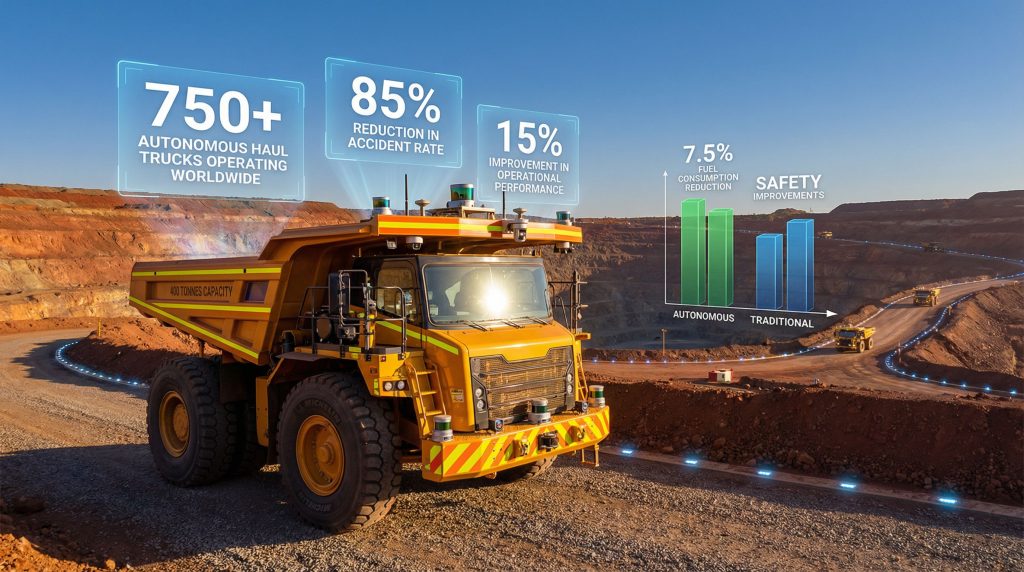
Advanced fleet management systems have revolutionised heavy industrial operations across multiple sectors, with mining emerging as a critical testing ground for next-generation automation technologies. The convergence of artificial intelligence, precision navigation, and real-time data processing has created unprecedented opportunities for operational transformation in resource extraction industries, particularly through the deployment of autonomous mining trucks.
The mining sector's adoption of sophisticated autonomous systems reflects broader trends toward mining industry evolution, safety enhancement, and operational efficiency optimisation. These technological implementations represent more than incremental improvements; they constitute fundamental shifts in how large-scale industrial operations manage risk, allocate human resources, and optimise production workflows.
Core Technologies Driving Mining Automation
Modern autonomous mining trucks integrate multiple advanced technologies to achieve safe, efficient operation in challenging environments. Furthermore, the foundation of these systems relies on precision navigation capabilities that enable vehicles to operate independently whilst maintaining exact positioning accuracy across vast mining sites.
Navigation and Control Systems
• GPS-based positioning with centimetre-level accuracy
• Real-time kinematic positioning for precise movement control
• Advanced sensor arrays for environmental monitoring
• Machine learning algorithms for route optimisation
• Integrated communication networks for fleet coordination
The Caterpillar MineStar Command system exemplifies current technological capabilities, managing mixed fleets where autonomous and traditional vehicles operate simultaneously. Additionally, this platform demonstrates the sophistication required to coordinate complex mining operations whilst maintaining safety protocols and operational efficiency through AI in mining innovation.
Operational Specifications
| Component | Specification | Operational Impact |
|---|---|---|
| Payload Capacity | 320-400 tonnes | High-volume material transport |
| Navigation Precision | Centimetre-level GPS | Accurate route following |
| Fleet Integration | Mixed autonomous/manual | Flexible operational deployment |
| Communication | Real-time data exchange | Coordinated fleet management |
Vale's implementation at their Northern System demonstrates practical deployment of these technologies. Since 2019, their autonomous programme has expanded from initial feasibility testing to operational deployment of 14 autonomous haul trucks, with plans to scale to approximately 90 trucks by 2028.
However, the integration of autonomous systems with existing mining infrastructure requires sophisticated coordination mechanisms. At Vale's Serra Sul facility, autonomous mining trucks operate alongside established truckless conveyor systems, illustrating the complexity of modern mining operations that combine multiple transportation technologies for optimal efficiency.
When big ASX news breaks, our subscribers know first
Safety Enhancement Through Automation
The primary driver for autonomous mining truck adoption centres on substantial safety improvements achieved through human operator removal from hazardous environments. Consequently, mining operations involve inherent risks including equipment failures, environmental hazards, and operational accidents that autonomous systems can significantly mitigate.
Risk Mitigation Strategies
Vale's operational leadership emphasises that autonomous mining trucks eliminate worker exposure to dangerous mining zones whilst creating safer working environments. For instance, the company has documented safety improvements through their multi-year deployment programme, beginning with their 2018 Brucutu mine implementation and expanding through their Northern System operations.
Since 2019, Vale has trained more than 260 professionals in new roles associated with autonomous system operations, demonstrating that safety improvements extend beyond simple risk elimination to comprehensive workforce development. Moreover, this training programme follows international best practices and incorporates global industry developments in autonomous mining technologies, highlighting the importance of boosting haulage safety.
Workforce Transition and Safety Culture
The transition to autonomous operations creates opportunities for worker advancement into technical roles requiring digital system expertise. Rather than simply displacing workers, successful autonomous implementations involve comprehensive retraining programmes that prepare personnel for higher-skilled positions in digitally integrated mining operations.
Carlos Medeiros, Vale's Vice President of Operations, describes autonomous transport technologies as fundamental to strengthening operational excellence culture and preparing teams for increasingly efficient mining challenges. Furthermore, this perspective positions safety improvements within broader organisational development frameworks rather than viewing them as isolated technical benefits.
Environmental Safety Considerations
Autonomous systems provide consistent performance in extreme environmental conditions that may compromise human operator safety. These vehicles operate effectively in temperature ranges and weather conditions that would present significant risks to human operators, ensuring continuous operations whilst maintaining safety standards.
The elimination of driver fatigue as a risk factor represents another critical safety advancement. Consequently, autonomous systems maintain consistent operational parameters throughout extended operating periods, avoiding performance degradation associated with human operator limitations during long shifts or challenging conditions.
Economic Performance and Operational Efficiency
The economic case for autonomous mining trucks rests on documented operational performance improvements and cost reduction mechanisms that justify substantial capital investments. In addition, Vale's operational data demonstrates measurable efficiency gains that support scaled deployment decisions.
Quantified Performance Improvements
Vale's autonomous vehicle operations have achieved up to 15% improvements in operational performance compared to traditional truck operations. Additionally, fuel consumption reductions of up to 7.5% contribute to both cost savings and carbon emission reductions, addressing economic and environmental objectives simultaneously.
These performance metrics derive from results obtained across multiple Vale operations using autonomous vehicles, providing validated baseline data for expansion decisions. Furthermore, the consistency of these improvements across different sites supports confidence in scaling autonomous deployments through data-driven mining operations.
Investment and Expansion Framework
| Timeline | Fleet Size | Investment Phase | Performance Validation |
|---|---|---|---|
| 2018-2019 | Initial deployment | Feasibility testing | Brucutu mine proof of concept |
| 2019-2025 | 14 trucks | Operational validation | Northern System deployment |
| 2025-2028 | 90 trucks | Scaled implementation | Multi-site expansion |
The gradual five-year expansion framework from 14 to 90 autonomous trucks in Vale's Northern System reflects a strategic approach to capital deployment. However, this allows for performance validation before major scaling commitments whilst reducing financial risk and enabling operational learning and system optimisation.
Cost Structure and ROI Considerations
Fuel efficiency improvements of 7.5% per operational cycle translate to significant cost savings across large fleets operating continuously. When combined with operational performance gains of 15%, these efficiency improvements create compelling economic justification for autonomous system adoption.
The integration of autonomous mining trucks with existing fleet infrastructure provides additional economic benefits through mixed fleet optimisation. Rather than requiring complete fleet replacement, autonomous systems can enhance overall fleet performance whilst traditional vehicles remain operational during transition periods.
The economic benefits of autonomous mining trucks extend beyond simple cost reduction to encompass competitive positioning, operational resilience, and long-term sustainability advantages that support mining companies' strategic objectives in increasingly competitive global markets.
Industry Leadership and Deployment Strategies
Vale's position as a leader in autonomous mining truck deployment reflects comprehensive strategic planning that integrates technology adoption with workforce development, operational excellence, and sustainability objectives. Furthermore, their systematic approach provides insights into effective autonomous system implementation across large-scale mining operations.
Vale's Multi-Site Implementation
Vale's autonomous programme began in 2018 at the Brucutu mine in Minas Gerais, establishing initial feasibility and operational baseline data. The programme expanded to the Northern System in Pará in 2019, where deployment focused on the Carajás region's Serra Norte and Serra Sul units.
Currently, Vale operates more than 70 autonomous pieces of equipment across their operations, including not only haul trucks but also autonomous drills and yard machines. This diversified approach demonstrates comprehensive automation strategy rather than limited focus on single equipment types.
Technology Partnership Structure
The collaboration between Vale, Caterpillar, and Sotreq illustrates effective partnership models for autonomous system deployment. Caterpillar provides the MineStar Command technology platform, whilst Sotreq serves as regional deployment partner, and Vale contributes operational expertise and site integration requirements.
Marc Cameron, Senior Vice President at Caterpillar, emphasises the importance of scalable solutions that function across mixed fleets. This approach enables mining companies to implement autonomous systems without requiring complete fleet replacement, reducing capital requirements and operational disruption.
Geographic and Operational Scope
• Brucutu Mine, Minas Gerais: Initial deployment site (2018)
• Northern System, Pará: Primary expansion location (2019-present)
• Serra Norte Units: Autonomous truck integration with existing operations
• Serra Sul Units: Hybrid systems combining autonomous trucks with truckless conveyor networks
The Northern System implementation demonstrates autonomous system integration with diverse transportation technologies. At Serra Sul, autonomous mining trucks coexist with established truckless conveyor systems that use long-distance belt conveyors for ore transport without fuel consumption.
Professional Development Integration
Vale's commitment to workforce development accompanies their autonomous system deployment. More than 260 professionals have received training in new roles created by autonomous operations and digital system interaction. This training follows international best practices and incorporates global industry developments.
The comprehensive approach to workforce transition reflects understanding that successful autonomous implementation requires skilled personnel capable of managing complex digital systems, performing predictive maintenance, and optimising automated operations.
Technology Comparison and System Architecture
Different autonomous mining truck technologies offer varying capabilities and integration approaches, with selection depending on specific operational requirements, existing infrastructure, and scaling objectives. Understanding these differences enables informed technology adoption decisions.
Caterpillar MineStar Command System
The MineStar Command platform represents current industry-leading autonomous haul truck technology, demonstrated through Vale's successful multi-year deployment. This system provides mixed fleet integration capabilities that allow autonomous and traditional vehicles to operate simultaneously within the same mining environment.
System Capabilities and Integration
| Technology Feature | MineStar Command | Operational Benefit |
|---|---|---|
| Mixed Fleet Operation | Full integration | Gradual transition flexibility |
| Payload Capacity | 320-400 tonnes | High-volume material transport |
| Real-time Coordination | Advanced fleet management | Optimised operational efficiency |
| Route Optimisation | AI-powered planning | Fuel efficiency and productivity |
The system's ability to coordinate mixed fleets provides significant advantages during implementation phases, allowing mining companies to introduce autonomous vehicles gradually whilst maintaining operational continuity with existing equipment.
Hybrid Transportation Systems
Vale's Serra Sul implementation demonstrates advanced integration approaches where autonomous mining trucks operate alongside truckless conveyor systems. This hybrid model optimises different transportation technologies for specific operational segments, maximising efficiency whilst minimising fuel consumption.
The truckless system utilises long-distance belt conveyors for ore transport without fuel consumption, whilst autonomous trucks handle segments requiring flexibility and variable routing. This integration illustrates sophisticated operational planning that leverages multiple technologies for optimal performance.
Scalability and Fleet Management
Modern autonomous systems must accommodate varying operational scales, from initial pilot deployments to large-scale fleet operations. Vale's expansion from 14 to 90 autonomous trucks demonstrates scalability requirements and the importance of technology platforms that support growth without fundamental system redesign.
The MineStar Command system's scalable architecture enables fleet expansion whilst maintaining operational coordination and safety protocols. This scalability reduces long-term technology risk and supports strategic planning for autonomous system adoption.
Implementation Challenges and Solutions
Successful autonomous mining truck deployment requires addressing multiple technical, operational, and organisational challenges that can impact implementation timelines, costs, and performance outcomes. Understanding these challenges enables more effective planning and risk management.
Technical Infrastructure Requirements
Autonomous systems require substantial infrastructure investments including communication networks, GPS reference stations, maintenance facilities, and control centres. The five-year gradual expansion timeline in Vale's Northern System reflects the complexity of infrastructure development alongside equipment deployment.
Network connectivity in remote mining locations presents particular challenges, as autonomous systems require reliable, high-bandwidth communication for real-time fleet coordination and safety monitoring. However, mining sites often operate in areas with limited existing telecommunications infrastructure.
Workforce Transition Management
The transition from traditional to autonomous operations involves comprehensive workforce development programmes that address both displaced operators and new technical roles. Vale's training of more than 260 professionals demonstrates the scope of workforce transition requirements.
Successful implementations require retraining programmes that prepare workers for higher-skilled positions in digital system management, predictive maintenance, and autonomous fleet coordination. This approach transforms workforce displacement challenges into advancement opportunities.
Integration with Legacy Systems
Mining operations typically involve substantial existing infrastructure investments that must continue operating during autonomous system implementation. The ability to integrate autonomous vehicles with legacy systems whilst maintaining operational efficiency presents significant technical challenges.
Vale's mixed fleet approach demonstrates effective solutions that allow autonomous and traditional vehicles to coexist during transition periods. This integration flexibility reduces implementation risks and enables gradual technology adoption.
Operational Risk Management
• Equipment failure protocols and backup systems
• Weather and environmental condition adaptability
• Maintenance scheduling and predictive diagnostics
• Emergency response procedures for autonomous vehicles
• Interface management between autonomous and manual operations
These operational considerations require comprehensive planning and testing to ensure reliable performance under diverse operating conditions. The multi-year validation period in Vale's implementation reflects the importance of thorough operational risk assessment and mitigation.
The next major ASX story will hit our subscribers first
Environmental Impact and Sustainability
Autonomous mining trucks contribute to environmental sustainability through multiple mechanisms including fuel efficiency improvements, optimised route planning, and integration with low-emission transportation alternatives. These environmental benefits align with mining sustainability transformation objectives and regulatory requirements.
Carbon Emission Reduction
Vale's autonomous operations have achieved fuel consumption reductions of up to 7.5% compared to traditional truck operations, directly contributing to carbon emission reductions. When scaled across large fleets operating continuously, these efficiency improvements provide substantial environmental benefits.
The integration of autonomous trucks with alternative transportation systems further enhances environmental performance. Vale's Serra Sul facility combines autonomous mining trucks with truckless conveyor systems that eliminate fuel consumption for specific transport segments.
Energy Efficiency Optimisation
Autonomous systems optimise route planning and operational parameters to minimise fuel consumption whilst maintaining productivity targets. Machine learning algorithms continuously improve efficiency by analysing operational data and adjusting performance parameters.
The elimination of inefficient driving patterns associated with human operators contributes to consistent fuel efficiency performance. Autonomous systems maintain optimal speed, acceleration, and route selection to minimise energy consumption throughout operational cycles.
Sustainability Integration
| Environmental Factor | Traditional Operations | Autonomous Operations | Improvement |
|---|---|---|---|
| Fuel Consumption | Standard baseline | 7.5% reduction | Significant |
| Route Optimisation | Variable efficiency | Consistent optimisation | Moderate |
| Operational Consistency | Human-dependent | Algorithm-controlled | Substantial |
Rafael Bittar, Vale's Vice President of Technical Affairs, emphasises that autonomous system integration with artificial intelligence and advanced data analysis modernises mining operations whilst promoting industry transformation aligned with international best practices.
The environmental benefits extend beyond direct fuel savings to encompass broader operational optimisation that reduces waste, improves resource utilisation, and supports sustainable mining practices across multiple operational dimensions.
Future Technology Evolution and Market Projections
The trajectory of autonomous mining truck technology indicates continued advancement in artificial intelligence capabilities, sensor technology, fleet coordination systems, and integration with broader mining digitalisation initiatives. These developments will expand autonomous system capabilities and accelerate adoption across the mining industry.
Technology Advancement Roadmap
Future developments in autonomous mining trucks will focus on enhanced decision-making algorithms that can handle increasingly complex operational scenarios. Machine learning systems will improve through operational experience, enabling more sophisticated responses to unexpected conditions and optimised performance across diverse mining environments.
Sensor technology improvements will enhance obstacle detection, environmental monitoring, and vehicle-to-vehicle communication capabilities. These advances will support more complex autonomous operations and improved safety performance in challenging mining conditions, according to Hitachi Construction Machinery's latest autonomous haulage system developments.
Market Growth and Adoption Patterns
Vale's expansion from 14 to 90 autonomous trucks by 2028 reflects broader industry trends toward scaled autonomous system adoption. As operational benefits become validated through multi-year deployments, mining companies are increasingly committing to substantial autonomous fleet expansions.
The success of mixed fleet integration approaches reduces barriers to autonomous adoption by allowing gradual implementation without complete fleet replacement. This approach enables more mining companies to begin autonomous programmes whilst managing capital requirements and operational risks.
Integration with Mining Digitalisation
Autonomous trucks represent one component of comprehensive mining digitalisation initiatives that integrate multiple automated systems including drilling equipment, processing plants, and logistics coordination. Future developments will enhance coordination between these systems for optimised mining operations.
The integration of autonomous systems with artificial intelligence and advanced data analysis creates opportunities for predictive maintenance, demand-responsive operations, and real-time optimisation across entire mining value chains, as demonstrated by Komatsu's smart mining solutions.
Competitive Landscape Evolution
As autonomous mining truck technology matures, competitive differentiation will focus on system reliability, integration capabilities, and operational support services. Technology providers that offer comprehensive solutions including training, maintenance, and upgrade pathways will gain competitive advantages.
The partnership model demonstrated by Vale, Caterpillar, and Sotreq illustrates effective collaboration approaches that combine technology expertise, operational knowledge, and regional support capabilities for successful autonomous system deployment.
Strategic Implementation Framework
Successful autonomous mining truck implementation requires comprehensive planning that addresses technical requirements, workforce development, financial considerations, and operational integration. The framework developed through Vale's multi-year experience provides insights for effective autonomous system deployment.
Phased Implementation Strategy
Vale's approach demonstrates the effectiveness of gradual expansion from initial feasibility testing through operational validation to scaled deployment. This phased approach allows for performance validation, workforce development, and infrastructure optimisation before major capital commitments.
Implementation Phase Structure
• Phase 1: Initial deployment and feasibility validation (1-2 years)
• Phase 2: Operational optimisation and workforce development (2-3 years)
• Phase 3: Scaled deployment and fleet expansion (3-5 years)
• Phase 4: Full integration and continuous improvement (ongoing)
Each phase requires specific success metrics, risk management protocols, and resource allocation to ensure effective progression toward full autonomous operation. The five-year timeline from Vale's experience reflects realistic expectations for comprehensive autonomous system implementation.
Critical Success Factors
Effective autonomous mining truck implementation requires alignment of multiple organisational capabilities including technical expertise, operational knowledge, workforce development, and change management. Companies must develop these capabilities systematically to support successful autonomous deployments.
Infrastructure development must parallel equipment deployment to ensure reliable autonomous operations. This includes communication networks, maintenance facilities, training centres, and control systems that support scaled autonomous fleet operations.
Risk Management and Performance Monitoring
Comprehensive risk management protocols must address equipment failures, communication disruptions, weather conditions, and interface challenges between autonomous and manual operations. These protocols require regular testing and updating based on operational experience.
Performance monitoring systems must track operational efficiency, safety metrics, environmental impact, and financial performance to validate autonomous system benefits and identify optimisation opportunities. Regular performance review enables continuous improvement and informed expansion decisions.
Successful autonomous mining truck implementation requires systematic planning, comprehensive workforce development, and sustained commitment to technological advancement that positions mining operations for long-term competitive advantage in increasingly automated industry environments.
Disclaimer: The information presented in this article is based on publicly available sources and operational reports as of December 2025. Performance metrics, implementation timelines, and technology specifications may vary across different mining operations and deployment contexts. Investment and implementation decisions should consider site-specific factors, regulatory requirements, and comprehensive feasibility analysis. Future performance projections involve inherent uncertainties and should not be considered guaranteed outcomes.
Want to Capitalise on Mining Technology Innovations?
Discovery Alert's proprietary Discovery IQ model delivers instant notifications when ASX mining companies announce significant technological breakthroughs or operational upgrades that could impact share prices. Stay ahead of the market by identifying companies implementing advanced mining automation and other transformative technologies before these developments create substantial trading opportunities—begin your 30-day free trial today to gain your competitive edge.