June 22, 2026
Understanding Aviation Fuel Specifications and Military Requirements
Modern aviation operations depend on precisely engineered petroleum products designed to meet specific performance standards across diverse operational environments. Military-grade jet fuel represents a specialised category that extends far beyond standard commercial aviation requirements, incorporating advanced additive packages and enhanced safety specifications for extreme operational conditions.
The distinction between civilian and military aviation fuels centres on operational demands rather than fundamental hydrocarbon chemistry. While both categories share similar C9-C16 paraffin and cycloparaffin base structures, military specifications integrate proprietary additive systems calibrated for combat operations, extended storage periods, and multi-platform compatibility across diverse military equipment.
When big ASX news breaks, our subscribers know first
How Do JP-8 and JP-5 Specifications Compare to Commercial Jet A-1?
Chemical Composition and Additive Systems
Military-grade jet fuel maintains hydrocarbon compositions similar to commercial variants but incorporates enhanced additive packages that address operational challenges unique to military operations. These formulations include fuel system icing inhibitors (FSII), corrosion prevention compounds, and antioxidant packages specifically engineered for military equipment tolerances.
JP-8 serves as NATO's primary aviation turbine fuel, meeting MIL-T-83188D specifications while functioning across multiple military platforms including aircraft, ground vehicles, and heating systems. This multi-platform compatibility provides significant logistical advantages through single-fuel operations, reducing supply chain complexity during military deployments.
Flash Point and Safety Performance Standards
The most critical distinction between military-grade jet fuel and commercial aviation fuels lies in safety specifications, particularly flash point temperatures that determine ignition risk during storage and handling operations. Furthermore, recent developments in jet fuel specifications demonstrate the evolving standards that address specific operational environments where enhanced safety margins prove essential.
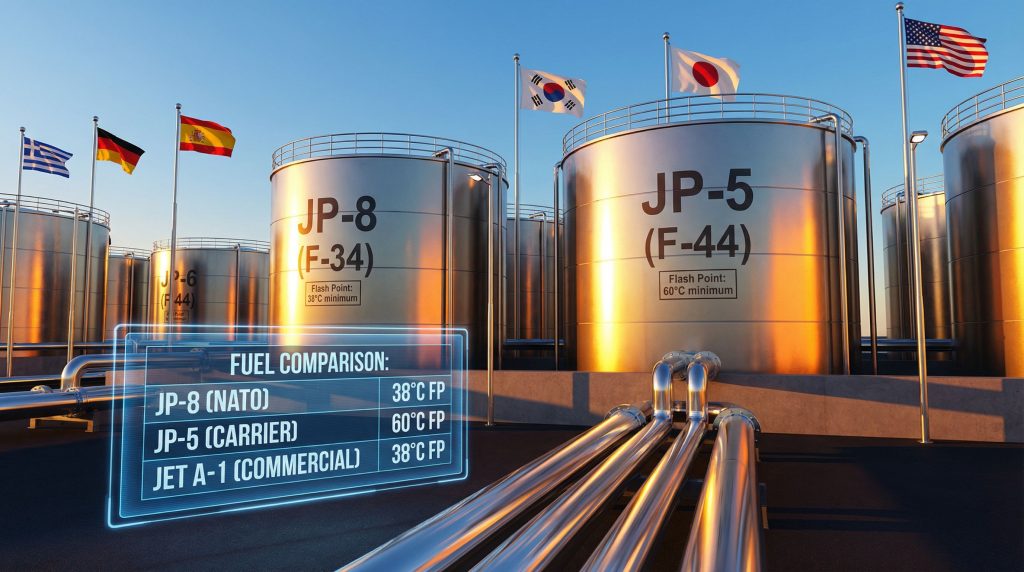
| Fuel Type | Flash Point (°C) | Primary Application | Safety Classification |
|---|---|---|---|
| JP-8 (F-34) | 38°C minimum | NATO standard operations | Ground refueling compatible |
| JP-5 (F-44) | 60°C minimum | Carrier-based operations | Enhanced fire safety |
| Jet A-1 | 38°C minimum | Commercial aviation | Standard safety protocols |
JP-5's elevated flash point of 60°C minimum specifically addresses the hazardous conditions aboard aircraft carriers where fuel vapours in confined spaces present significant fire risks during flight deck operations and refueling procedures. This enhanced safety profile makes JP-5 essential for naval aviation operations where traditional commercial fuel specifications would prove inadequate.
Which Countries Produce and Export Military-Grade Aviation Fuel?
Global Production Capacity Analysis
Military jet fuel production remains concentrated within a limited number of refineries due to security considerations and specialised processing requirements. Global monthly seaborne trade rarely exceeds 100,000 tonnes combined across all military specifications, representing a fraction of commercial jet fuel volumes.
Security protocols deliberately restrict international trade to maintain operational advantages during geopolitical tensions. Industry reports indicate that the majority of military-grade jet fuel production goes directly to the militaries of producing countries, with export activities limited to specific allied relationships.
Strategic Refinery Locations and Export Capabilities
European Production Centres:
- Motor Oil Hellas Corinth (Greece): 180,000 b/d refinery capacity with documented JP-5 exports over the past two years
- Moeve Algeciras (Spain): 244,000 b/d facility producing both JP-5 and JP-8 for export markets
Asian Production Networks:
- GS Caltex (South Korea): Confirmed JP-5 export capabilities with established US military supply contracts
- SK Energy (South Korea): Military fuel production and export activities
- Eneos (Japan): Limited military specification output with verified military fuel contracts
- S-Oil (South Korea): JP-8 exports from Ulsan refinery facility
North American Supply Chain:
Valero Corporation operates as the primary US Gulf Coast supplier, maintaining regular cargo deliveries to Israel approximately every other month between May 2023 and September 2025. The Defense Logistics Agency coordinates US military fuel procurement through DLA Energy based in Virginia.
What Drives Military Jet Fuel Demand During Geopolitical Conflicts?
Operational Requirements During Military Escalation
Geopolitical tensions create immediate demand spikes through multiple operational mechanisms. Increased sortie rates, extended patrol operations, and heightened readiness levels compound fuel consumption requirements significantly beyond peacetime operations.
Recent market developments demonstrate these dynamics in real-time. However, the OPEC production impact on global energy markets creates additional complexity when military conflicts coincide with production adjustments.
Following the February 2026 US-Israeli strikes on Iran and subsequent retaliatory attacks, jet fuel premiums reached extreme levels, with European markets showing premiums exceeding $70 per barrel against crude oil on March 3-4, 2026, representing the highest levels on record.
Industry analysis indicates that intraday swap trading volatility suggested jet fuel premiums exceeding $100 per barrel against crude during peak trading periods, demonstrating how rapidly military conflicts can disrupt aviation fuel markets.
Strategic Chokepoint Disruption
The Strait of Hormuz represents a critical vulnerability in global energy supply chains, with approximately 20 million barrels per day of crude and oil products transiting this waterway in 2025, representing around 25% of global seaborne oil trade.
Recent conflict developments forced tanker traffic to near-standstill conditions, effectively closing this strategic waterway and creating acute supply disruptions. Two major oil product tankers, the Clear Stars and DF Montmartre, abandoned loading operations and departed the region during March 4-5, 2026.
Insurance market dynamics further compound these challenges, with war risk coverage cancellations based on concerns that re-insurers will withdraw coverage at short notice, effectively paralysing shipping operations in affected regions.
How Do Military Fuel Supply Chains Differ from Commercial Markets?
Procurement and Distribution Networks
Military fuel acquisition operates through specialised government agencies rather than open market trading mechanisms. The US Defense Logistics Agency's energy division (DLA Energy) coordinates global military fuel procurement through four distinct programmes:
- Two programmes covering domestic US procurement requirements
- One programme addressing European, Atlantic, and Mediterranean fuel needs
- One programme managing western Pacific operational requirements
This centralised approach contrasts sharply with commercial aviation markets where transparent pricing mechanisms and broad trading networks facilitate price discovery and supply flexibility. In addition, oil price movements in commercial markets create different dynamics compared to military procurement protocols.
Security Considerations and Limited Trading
Unlike commercial jet fuel markets characterised by published pricing assessments and open bidding processes, military-grade jet fuel transactions remain largely confidential due to operational security requirements. This market structure creates pricing opacity and restricts supply flexibility during demand spikes.
The NATO Support and Procurement Agency provides additional infrastructure support through established pipeline networks, including the Central Europe Pipeline System (CEPS) developed in the 1950s to ensure fuel supply to military bases and airports across European operations.
Government-Controlled Procurement Examples:
- GS Caltex maintains direct supply contracts with the US military
- Eneos operates established military fuel contracts
- Israeli procurement entities issue buy tenders directly during conflict escalation periods
What Are the Technical Specifications for Different Military Jet Fuel Grades?
JP-8 Universal Military Fuel Standards
JP-8 functions as NATO's standardised aviation turbine fuel, incorporating enhanced additive packages while maintaining compatibility across multiple military platforms. This universal approach provides significant logistical efficiency through simplified supply chain management.
Key Performance Characteristics:
- Freezing point: Maximum -47°C for cold weather operations
- Boiling range: 175-300°C temperature spectrum
- Hydrocarbon composition: Predominantly C9-C16 paraffins and cycloparaffins
- Additive integration: FSII, corrosion inhibitors, and antioxidant packages
JP-5 Carrier-Based Operations Fuel
JP-5 addresses unique safety requirements for aircraft carrier operations through elevated flash point specifications that reduce fire hazards during deck operations and storage in confined shipboard environments. Comprehensive military jet fuel specifications outline these enhanced safety requirements for naval operations.
The 60°C minimum flash point requirement specifically addresses operational challenges where fuel vapour ignition risks prove particularly dangerous, including refueling operations on aircraft carrier flight decks where space constraints and operational tempo create heightened safety concerns.
The next major ASX story will hit our subscribers first
How Does Military Fuel Production Impact Commercial Aviation Markets?
Refinery Capacity Allocation During Crisis Periods
Increased military fuel production can constrain commercial jet fuel availability when refineries shift production toward military specifications during extended conflicts or large-scale military exercises requiring substantial fuel volumes.
Europe's dependence on Middle East Gulf exports for approximately half of its jet fuel imports means that disruptions in this region affect roughly 15-20% of overall European jet fuel demand. Consequently, WTI/Brent energy trends influence both commercial and military fuel markets during supply disruptions.
Price Transmission Effects and Market Dynamics
Military fuel demand spikes often correlate with broader energy market disruptions, particularly when conflicts affect major oil-producing regions. The International Energy Agency noted that whilst global oil markets maintained significant surplus conditions since early 2025, prolonged supply disruptions could flip markets into deficit conditions.
IEA member countries maintain more than 1.2 billion barrels of public emergency oil stocks, plus an additional 600 million barrels of industry stocks under government obligation, providing potential market stabilisation mechanisms during supply disruptions.
What Role Do Alternative Fuels Play in Military Aviation?
Synthetic Fuel Development Programmes
Military organisations increasingly invest in alternative fuel technologies to reduce dependence on traditional petroleum sources and enhance operational flexibility. Synthetic paraffinic kerosene (SPK) blends can substitute up to 50% of conventional JP-8 under MIL-DTL-83133H specifications.
These synthetic alternatives maintain compatibility with existing fuel systems whilst providing supply chain diversification benefits. Development programmes focus on creating drop-in replacements that require no modifications to aircraft engines or fuel handling equipment.
Biofuel Integration and Sustainability Initiatives
Advanced biofuel programmes target sustainable alternatives that maintain operational capabilities whilst reducing environmental impact. These initiatives align with broader military sustainability goals without compromising mission-critical performance requirements.
Research focuses on feedstock sources that don't compete with food production whilst providing consistent supply availability during various geopolitical scenarios.
Regional Security Implications and Strategic Considerations
Mediterranean Supply Route Vulnerabilities
Greece's Corinth refinery presents logistical advantages for Mediterranean operations, requiring only a few days' sailing time to reach Israeli ports and maintaining historical supply relationships. However, current security assessments indicate these routes fall within range of Iranian missiles and drones.
This geographic vulnerability demonstrates how military fuel supply chains face unique risks compared to commercial aviation logistics, requiring contingency planning for multiple threat scenarios. Moreover, the US drilling decline affects domestic production capacity, adding complexity to strategic fuel planning.
Emergency Procurement Protocols
During crisis periods, military organisations activate accelerated procurement procedures that can override standard competitive bidding requirements. Recent examples include Israeli procurement entities issuing buy tenders immediately prior to conflict escalation, demonstrating rapid response capabilities.
These emergency protocols operate outside normal market mechanisms, providing supply security but potentially creating additional price pressure on available supplies.
Market Psychology and Investment Considerations
Supply Chain Risk Assessment
Investors evaluating aviation fuel markets must consider the interconnected nature of military and commercial supply chains. Military demand spikes during geopolitical tensions can rapidly constrain commercial aviation fuel availability, creating cascading effects across broader transportation sectors.
Risk Factors Include:
- Refinery capacity allocation shifts during military procurement increases
- Insurance market disruptions affecting shipping operations
- Strategic chokepoint vulnerabilities in key supply routes
- Emergency stockpile activation policies
Price Volatility Mechanisms
Military fuel procurement operates on different timescales compared to commercial markets, creating unique volatility patterns. Government agencies may accept premium pricing during crisis periods that exceed normal commercial market tolerance levels.
Understanding these dynamics requires analysis of geopolitical risk factors alongside traditional supply-demand fundamentals in petroleum markets. Furthermore, global oil market influence shapes both military and commercial fuel pricing structures.
Frequently Asked Questions About Military-Grade Jet Fuel
Can Commercial Aircraft Use Military Jet Fuel?
Whilst chemical similarities exist between military and commercial aviation fuels, regulatory restrictions and cost considerations typically prevent cross-utilisation. Military-grade jet fuel often exceeds commercial specifications but may not meet specific airline certification requirements or economic thresholds.
How Long Can Military Jet Fuel Be Stored?
Military fuel storage capabilities extend significantly beyond commercial requirements due to enhanced additive packages that prevent degradation. Proper storage conditions can maintain fuel quality for extended periods, supporting strategic reserve requirements and operational flexibility.
What Happens During Military Fuel Shortages?
Fuel shortages trigger emergency procurement protocols, alternative supply source activation, and potential operational restrictions. Military logistics prioritise mission-critical operations whilst seeking additional supply arrangements through allied nations or emergency contract mechanisms.
Emergency procedures may include:
- Activation of strategic reserve stockpiles
- Accelerated procurement contract negotiations
- Alternative supply route development
- Inter-allied fuel sharing agreements
Disclaimer: This analysis incorporates publicly available information and industry reports. Military fuel specifications and procurement details may involve classified information not reflected in this assessment. Price forecasts and market analysis represent current conditions subject to rapid change during geopolitical developments. Readers should consult additional sources for investment decisions and operational planning.
Looking to Navigate Energy Market Volatility and Military Fuel Dynamics?
Discovery Alert's proprietary Discovery IQ model delivers real-time alerts on significant ASX mineral discoveries, including energy sector developments that could impact global fuel supply chains and military procurement patterns. Stay ahead of market-moving announcements and position yourself to capitalise on opportunities emerging from geopolitical tensions and energy infrastructure developments through your 14-day free trial today.