
July 15, 2026
Understanding Market Disruptions Through Aviation Fuel Volatility
Aviation fuel markets serve as critical indicators of broader energy system vulnerabilities, particularly when geopolitical events cascade through interconnected supply chains. The current jet fuel price surge demonstrates how aviation sector's reliance on specific refined products creates unique exposure patterns that differ fundamentally from crude oil dependencies, generating asymmetric impacts across regional markets and operational frameworks.
The complexity of jet fuel pricing extends beyond simple crude oil correlations. Unlike gasoline or heating oil, aviation fuel requires precise specifications that limit substitution possibilities, creating structural rigidities that amplify supply disruptions. Furthermore, oil price movements indicate that when traditional supply routes face interruption, these technical constraints prevent rapid market adjustment, leading to price volatility patterns that can persist for extended periods.
Current Supply Chain Architecture
Global jet fuel production concentrates in specific geographic regions due to refinery configurations optimised for middle distillate yields. The Persian Gulf region processes approximately 2.8 million barrels per day of jet fuel, representing roughly 34% of global aviation fuel trade. This concentration creates systematic vulnerability when shipping routes face disruption.
Regional supply dependencies have evolved over decades of trade optimisation:
- European markets: 30% import dependency on Gulf suppliers
- Asian markets: 45% reliance on regional refining capacity
- North American markets: 85% domestic production coverage
- African markets: 60% import dependency on European suppliers
The technical specifications for aviation fuel (Jet A-1 standard) require sulphur content below 3,000 ppm, freezing point tolerance to -47°C, and thermal stability at 260°C. These requirements limit alternative sourcing options when primary suppliers face operational constraints.
When big ASX news breaks, our subscribers know first
How Pricing Mechanisms Reflect Market Stress
Aviation fuel pricing operates through complex crack spread relationships that traditionally maintain stable differentials with other refined products. The jet-diesel spread historically fluctuates within a -$5 to +$2 per barrel range under normal market conditions, reflecting seasonal demand patterns and refinery optimisation cycles.
Current market dislocations have shattered these traditional relationships. The European jet-diesel spread has surged to an unprecedented +$48 per barrel, while Asian markets experienced temporary spikes to $79 per barrel before stabilising around $40 per barrel. These extreme differentials indicate structural supply shortages rather than temporary demand fluctuations.
Regional Price Transmission Analysis
Table: Jet Fuel Crack Spread Comparison (March 2026)
| Market Region | Normal Range ($/bbl) | Current Level ($/bbl) | Peak Reached ($/bbl) |
|---|---|---|---|
| Northwest Europe | $15-25 | $65-68 | $78 |
| Singapore | $12-22 | $40 | $79 |
| US Gulf Coast | $10-20 | $35 | $52 |
| Rotterdam | $16-26 | $70 | $82 |
The persistence of elevated spreads in European markets compared to Asian recovery patterns suggests fundamental supply chain disruptions rather than temporary financial speculation. Additionally, comprehensive oil price crash analysis reveals that European refineries cannot easily substitute alternative feedstocks or modify production schedules to compensate for lost imports.
Financial Market Responses
Aviation fuel futures markets have experienced unprecedented volatility, with 60-day implied volatility reaching 85% compared to historical averages of 25-30%. This volatility reflects uncertainty about supply restoration timelines and alternative sourcing capabilities.
Current market conditions demonstrate how refined product dependencies create amplified vulnerability compared to crude oil supply disruptions, where strategic reserves and alternative sourcing provide more flexibility for market stabilisation.
Operational Impacts Across Aviation Sectors
Different aviation market segments exhibit varying exposure levels to fuel cost volatility based on operational characteristics, route structures, and hedging capabilities. Understanding these differences reveals the asymmetric impacts of supply chain disruptions across the industry.
Carrier Vulnerability Assessment
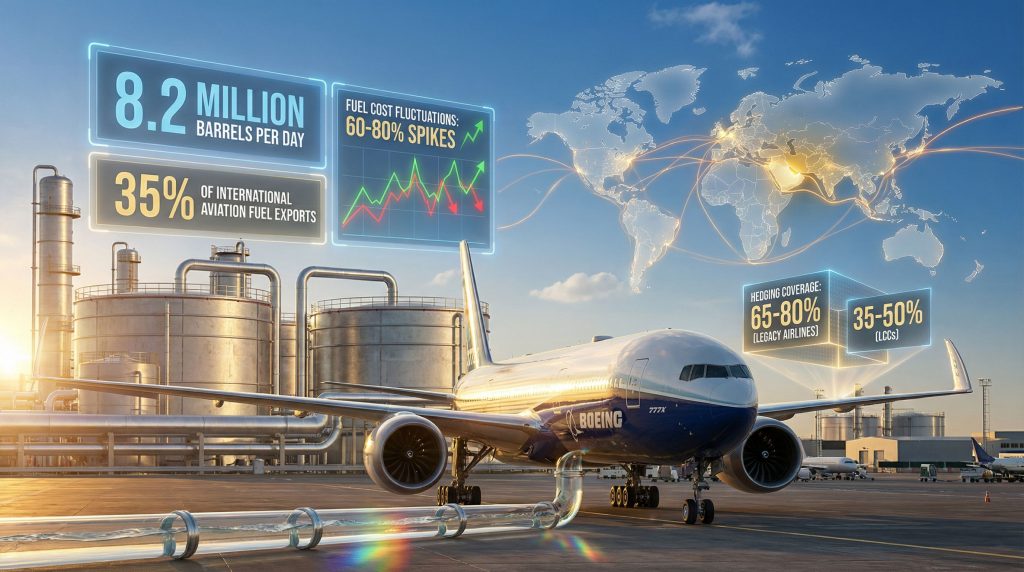
Low-cost carriers face the highest exposure due to limited hedging programmes and thin operating margins. These operators typically hedge only 35-50% of fuel exposure over 6-12 month periods, leaving substantial exposure to spot market volatility.
Legacy full-service carriers maintain more comprehensive risk management programmes, with 65-80% hedging coverage extending 12-18 months forward. However, these programmes assume gradual price movements rather than the 60-80% spot market spikes currently observed.
Regional airlines operate with minimal hedging infrastructure, typically covering only 20-35% of fuel costs over 3-6 month periods. This limited protection creates severe financial stress when fuel costs spike rapidly.
Charter operators face critical vulnerability with 10-25% hedging coverage and 1-3 month time horizons, making them most susceptible to immediate supply disruptions and price volatility.
Operational Adjustment Strategies
Airlines are implementing multi-layered responses to manage unprecedented fuel costs. Consequently, US oil production decline has forced carriers to implement immediate capacity adjustments:
Immediate capacity adjustments (0-3 months):
- Route frequency reductions: 8-15% on long-haul services
- Aircraft utilisation optimisation: 5-12% efficiency improvements
- Load factor targeting: Minimum 85% versus historical 80%
- Fleet parking: 3-7% of total capacity temporarily grounded
Medium-term adaptations (3-12 months):
- Route network restructuring around fuel availability
- Fleet mix optimisation toward fuel-efficient aircraft
- Dynamic pricing incorporating real-time fuel costs
- Ancillary revenue acceleration to offset base fare impacts
Alternative Supply Source Evaluation
When primary supply routes face disruption, aviation fuel markets must rapidly reconfigure around alternative sources. This process involves complex logistics considerations, quality specifications, and economic trade-offs that limit substitution flexibility.
Regional Production Capacity Analysis
Chinese refineries maintain 2.1 million barrels per day jet fuel production capacity, but prioritise domestic aviation demand and regional export commitments. Transportation costs to European markets have doubled to $8-9 per barrel due to freight rate increases and extended shipping distances.
South Korean facilities produce 850,000 barrels per day of aviation fuel, primarily serving Japanese, Australian, and Philippines markets. These established trade relationships limit available export volumes for European buyers, while premium pricing in regional markets reduces incentives for long-distance sales.
Indian production reaches 1.3 million barrels per day, but much of this capacity processes Russian crude feedstocks. EU restrictions on Russian-origin products complicate large-scale import possibilities, even when commercial terms might be attractive.
US production capacity totals 2.45 million barrels per day across Gulf Coast and West Coast facilities, but domestic aviation demand and North American supply commitments limit export availability. Transportation costs to Europe range from $6-9 per barrel, making US supply commercially challenging compared to traditional Gulf sources.
Quality Specification Challenges
Alternative suppliers face technical barriers beyond transportation economics. Aviation fuel specifications vary by region, with European standards requiring specific additive packages and performance characteristics. Alternative suppliers may need additional processing or blending operations, adding 5-8% to final delivered costs.
The Dangote Refinery in Nigeria represents one emerging alternative source, having exported occasional jet fuel cargoes to Spain, France, and the UK. However, volumes averaged only 70,000 barrels per day in 2025, insufficient to replace Gulf supply shortfalls.
Consumer Price Transmission Mechanisms
The relationship between jet fuel costs and airline ticket prices follows complex transmission patterns influenced by competitive dynamics, demand elasticity, and regulatory frameworks. Airlines employ sophisticated revenue management systems that adjust pricing based on multiple variables beyond fuel costs.
Fare Impact Modeling
Industry analysis indicates that every $10 increase in jet fuel per barrel typically translates to 2-4% fare increases on short-haul routes and 4-7% increases on long-haul routes. However, current market conditions exceed historical precedents, creating uncertainty about traditional price transmission relationships.
Route-Specific Impact Analysis:
| Route Category | Fuel % of Cost | Price Transmission | Demand Response |
|---|---|---|---|
| Domestic Short-haul | 22-28% | 8-12% fare increase | Moderate reduction |
| International Medium-haul | 28-35% | 12-18% fare increase | Significant impact |
| Transcontinental Long-haul | 35-42% | 18-25% fare increase | Substantial contraction |
| Cargo Operations | 30-38% | Surcharge mechanism | Limited alternatives |
According to recent reports on flight prices being impacted by Middle East war, major carriers are implementing substantial fare adjustments to offset rising fuel costs.
Revenue Management Evolution
Airlines are transitioning from traditional yield management to fuel-adjusted revenue optimisation, incorporating real-time fuel cost projections into pricing algorithms. This evolution represents a fundamental shift in how carriers balance revenue optimisation with operational cost management.
Ancillary revenue acceleration provides airlines with mechanisms to offset fuel costs without directly raising base fares:
- Fuel surcharges: $25-150 per segment depending on route length
- Premium seat upselling: 15-20% increase in conversion rates
- Baggage fee optimisation: 10-15% average increases across carriers
- Onboard service monetisation: New revenue streams from previously complimentary services
Policy Framework Responses to Energy Security Concerns
Governments are recognising aviation fuel security as critical infrastructure, leading to policy interventions that extend beyond traditional energy reserve mechanisms. These responses reflect understanding that aviation connectivity underpins economic activity and national security interests.
Strategic Reserve Development
European Union considerations include mandatory 90-day aviation fuel reserves similar to crude oil requirements. Initial proposals suggest member states would maintain reserves proportional to annual consumption, potentially totalling 15-20 million barrels across the bloc.
United States evaluation of Strategic Petroleum Reserve jet fuel allocation would dedicate 50-75 million barrels specifically for aviation emergency supply. Current SPR facilities require infrastructure modifications to accommodate refined product storage and distribution.
Asian cooperation frameworks involve regional agreements for emergency fuel sharing among major aviation hubs. Singapore, Hong Kong, Tokyo, and Seoul are exploring coordinated reserve mechanisms totalling 8-12 million barrels of emergency jet fuel capacity.
Sustainable Aviation Fuel Acceleration
Government initiatives are fast-tracking alternative fuel development with unprecedented financial incentives:
- Production subsidies: $0.50-2.00 per gallon for sustainable aviation fuel manufacturing
- Blending mandates: 2-5% SAF requirements by 2027 across major markets
- Research funding: $2.8 billion globally allocated for advanced biofuel development
- Infrastructure investment: Airport fuel system upgrades to accommodate alternative fuels
These programmes represent acceleration of timelines that previously targeted 2030-2035 implementation periods, now compressed to 2026-2028 deployment schedules due to supply security concerns.
The next major ASX story will hit our subscribers first
Market Recovery Scenario Analysis
Recovery from current market dislocations depends on multiple variables requiring scenario-based planning frameworks. Different resolution pathways create distinct implications for investment strategies, operational planning, and policy responses. Furthermore, analysis of the rally in oil prices suggests potential stabilisation pathways.
Three-Pathway Framework
Scenario 1: Rapid Geopolitical Resolution (3-6 months)
- Supply route restoration through diplomatic intervention
- Fuel prices decline to $110-130 per barrel range
- Airline capacity returns to 95% of pre-crisis levels
- Traditional supply chain relationships resume with minimal structural change
Scenario 2: Extended Supply Disruption (6-18 months)
- Intermittent shipping route availability with ongoing uncertainty
- Alternative supply chain development and maturation
- Fuel prices stabilise at $140-160 per barrel elevated baseline
- Permanent shifts in regional supply dependencies and logistics networks
Scenario 3: Prolonged Market Restructuring (18+ months)
- Fundamental realignment of global aviation fuel trade patterns
- Accelerated sustainable aviation fuel adoption driven by supply security
- Industry consolidation pressures from sustained high operating costs
- Consumer behaviour permanently altered toward reduced aviation demand
Investment Framework Implications
Each scenario creates different risk-return profiles across aviation value chain investments. Rapid resolution scenarios favour airline equity positions and traditional energy infrastructure investments, while extended disruption scenarios benefit alternative fuel technology and regional refining capacity investments.
Prolonged restructuring scenarios create opportunities in sustainable aviation fuel production, aviation efficiency technology, and alternative transportation infrastructure that substitutes for aviation services.
Risk Management Considerations for Stakeholders
Current market conditions expose fundamental limitations in traditional aviation industry risk management frameworks. Understanding these limitations guides strategic planning for airlines, investors, and policymakers navigating unprecedented volatility.
Hedging Strategy Evolution
Traditional airline hedging programmes assume gradual price movements and liquid derivative markets. Current conditions exceed these assumptions, creating basis risk where hedged positions provide incomplete protection against extreme price movements.
Next-generation hedging approaches incorporate:
- Collar strategies with wider price ranges reflecting increased volatility
- Supply security hedging beyond pure price protection
- Regional supply diversification as operational hedge against geographic concentration
- Alternative fuel investments as long-term price hedge through vertical integration
Market Psychology Factors
Aviation fuel markets exhibit behavioural finance characteristics during crisis periods. Contango market structures with front-month premiums reflect immediate supply concerns, while backwardation patterns indicate expectations of eventual supply restoration.
Investor sentiment indicators include:
- Implied volatility spreads between aviation fuel and crude oil derivatives
- Airline equity correlation patterns with energy sector performance
- Credit default swap movements for aviation industry debt
- Alternative transportation equity performance relative to airline indices
Technical Market Structure Analysis
Aviation fuel markets operate with distinct characteristics that differentiate them from crude oil and other refined products. Understanding these technical factors explains why supply disruptions create amplified and persistent price impacts. Additionally, trade war oil impact analysis reveals how geopolitical tensions amplify these structural vulnerabilities.
Storage Infrastructure Limitations
Global aviation fuel storage capacity totals approximately 85 million barrels, significantly lower than gasoline (180 million barrels) or diesel (220 million barrels) storage systems. This limited buffering capacity means supply disruptions immediately impact available inventory.
Regional storage distribution:
- Europe: 18 million barrels (21% of global capacity)
- Asia-Pacific: 28 million barrels (33% of global capacity)
- North America: 25 million barrels (29% of global capacity)
- Middle East: 8 million barrels (9% of global capacity)
- Other regions: 6 million barrels (8% of global capacity)
Transportation Infrastructure Constraints
Aviation fuel transportation requires specialised infrastructure distinct from crude oil or other refined products. Product tankers configured for jet fuel typically range from 30,000 to 50,000 deadweight tons, smaller than crude carriers but requiring specific handling systems for aviation fuel specifications.
Pipeline networks for aviation fuel remain limited compared to crude oil infrastructure. Most airports rely on truck or rail delivery for final distribution, creating bottlenecks when regional supply patterns shift dramatically.
Economic Multiplier Effects
The current jet fuel price surge creates cascading economic impacts extending beyond airline operations into tourism, freight, business travel, and regional economic development patterns.
Tourism Industry Impacts
European tourism destinations face dual pressures from higher transportation costs and reduced visitor volumes. Mediterranean markets historically dependent on budget airline connectivity experience disproportionate impacts when low-cost carriers reduce capacity.
Long-haul leisure travel shows highest price elasticity, with 25-35% demand reduction typical when transportation costs increase 20-30%. Business travel demonstrates lower elasticity but still contracts 10-15% under similar price pressures.
Freight and Logistics Implications
Air cargo operations benefit from more flexible pricing mechanisms compared to passenger services, allowing fuel cost pass-through via surcharges. However, modal substitution toward ocean freight increases transit times and requires supply chain reconfiguration.
Express delivery services face margin compression when fuel costs spike rapidly, potentially leading to service level adjustments or pricing restructuring for time-sensitive shipments. Recent analysis from Reuters on airline fuel costs demonstrates the widespread impact across the aviation ecosystem.
Future Market Structure Considerations
Current market stress may accelerate structural changes in aviation fuel supply chains that extend beyond immediate crisis resolution. Understanding these potential shifts guides long-term strategic planning across industry stakeholders.
Supply Chain Diversification Trends
Regional self-sufficiency initiatives gain political support as governments recognise aviation fuel security as national infrastructure priority. This trend may reverse decades of supply chain optimisation based purely on economic efficiency.
Alternative fuel commercialisation accelerates as conventional supply vulnerabilities become apparent. Sustainable aviation fuel production could reach 5-8% of global jet fuel consumption by 2028, compared to current levels below 1%.
Technology Innovation Drivers
Fuel efficiency technology receives increased investment as airlines seek operational hedges against price volatility. Next-generation aircraft engines and aerodynamic improvements provide long-term cost mitigation independent of fuel source diversification.
Digital optimisation systems for fuel purchasing, routing, and inventory management become competitive necessities rather than optional efficiency improvements.
The aviation fuel market disruptions of 2026 represent more than temporary price volatility. They expose fundamental vulnerabilities in globalised supply chains optimised for efficiency rather than resilience. Consequently, the industry's response to these challenges will likely reshape aviation fuel markets for decades, with implications extending far beyond current crisis resolution timelines.
Ready to Capitalise on Energy Market Disruptions?
Discovery Alert's proprietary Discovery IQ model instantly identifies ASX companies positioned to benefit from commodity price volatility, including energy sector opportunities arising from supply chain disruptions. With aviation fuel prices surging and energy markets experiencing unprecedented volatility, Discovery Alert's discoveries page showcases how major mineral discoveries can generate substantial returns during periods of market uncertainty. Begin your 14-day free trial today to access real-time alerts on actionable investment opportunities across over 30 commodities.