July 15, 2026
The Governance Logic Behind Saudi Arabia's 2026 Sustainability Review
Most national sustainability reports function as backward-looking compliance documents, cataloguing what has already been achieved and presenting progress in the most favourable light possible. Saudi Arabia's 2026 Voluntary National Review takes a measurably different approach. Rather than functioning as a ceremonial submission to the United Nations High-Level Political Forum, the Saudi Arabia Voluntary National Review Vision 2030 sustainability report operates as a forward-looking strategic instrument, one that explicitly identifies structural vulnerabilities, sets post-2030 priorities, and ties environmental governance directly to the Kingdom's economic diversification agenda.
Understanding why this matters requires stepping back from the document itself and examining the broader architecture of the UN Voluntary National Review process, along with how Saudi Arabia has evolved its engagement with that process across three separate submissions.
When big ASX news breaks, our subscribers know first
What the Voluntary National Review Process Actually Does
The VNR mechanism, established under the 2030 Agenda for Sustainable Development, is a voluntary self-reporting tool through which UN member states assess their progress against the 17 Sustainable Development Goals. Crucially, the process is non-binding. There are no penalties for underperformance and no external audit function. What the VNR does provide, however, is a structured governance discipline that forces national governments to measure, document, and publicly justify their development trajectories against a globally recognised framework.
For resource-rich nations historically dependent on commodity revenues, this discipline carries particular strategic weight. The VNR process creates an institutional accountability loop that, over successive submissions, builds a traceable record of policy commitments and measurable outcomes.
Saudi Arabia has now completed three VNR submissions, in 2018, 2023, and 2026, with a fourth planned for 2030 to mark the formal conclusion of the Vision 2030 program. Each report has reflected an increasingly sophisticated integration between domestic policy architecture and global SDG alignment.
Comparing the three submissions reveals a clear directional shift:
| VNR Year | Primary Focus | Economic Context | Key Sustainability Milestone |
|---|---|---|---|
| 2018 | Vision 2030 launch alignment, foundational SDG mapping | Early diversification phase | Initial Saudi Green Initiative framework commitments |
| 2023 | Mid-term progress review, institutional capacity building | Post-pandemic recovery, FDI acceleration | Expanded renewable energy targets |
| 2026 | Final-phase acceleration, regional equity, environmental industries | Economy exceeds $1 trillion GDP threshold | National Sustainability Strategy launched (2024) |
| 2030 (planned) | Comprehensive Vision 2030 outcome assessment | Full diversification maturity | Net-zero pathway confirmation |
The 2026 submission is notable not simply for its content, but for the economic context surrounding it. Saudi Arabia's economy has crossed the one trillion dollar threshold, non-oil activity growth is outpacing oil sector contribution as a share of GDP expansion, and the Kingdom's cities and natural environments are being reshaped through investments in green infrastructure, public transport, and conservation. These are structural milestones, not aspirational projections.
Vision 2030's Three-Pillar Framework and the Sustainability Thread Running Through It
Vision 2030 is frequently discussed in terms of its headline economic targets, but its internal architecture is more sophisticated than many external commentators recognise. The program is organised around three interlocking pillars, each carrying distinct sustainability dimensions that are embedded rather than appended.
| Vision 2030 Pillar | Sustainability Dimension | Key Policy Mechanism |
|---|---|---|
| Vibrant Society | Social well-being, quality of life, environmental access | Nature reserves, green public spaces, conservation programs |
| Thriving Economy | Non-oil GDP growth, sustainable FDI, industrial competitiveness | Economic diversification programs, mining sector reform |
| Ambitious Nation | Institutional governance, global partnerships, SDG alignment | VNR process, National Sustainability Strategy (2024), international climate commitments |
What this structure reveals is that sustainability in the Saudi context is not a standalone policy vertical but a cross-cutting governance instrument. Environmental commitments are not siloed within a ministry of environment. They flow through economic planning, industrial policy, investment screening, and regional development frameworks simultaneously.
This integration distinguishes Vision 2030's approach from earlier Gulf development models, which tended to treat environmental policy as peripheral to core economic planning. Furthermore, the Saudi licensing reforms driving industrial expansion are being shaped by this same integrative philosophy, ensuring that new sectors grow within a sustainability-aligned governance structure.
Four Strategic Priorities Defining the Post-2030 Agenda
The 2026 Voluntary National Review identifies four explicit priorities that will shape Saudi Arabia's development trajectory through 2030 and into the following decade:
-
Sustaining non-oil GDP growth as the structural spine of the economy, reducing vulnerability to hydrocarbon price cycles.
-
Attracting sustainable foreign direct investment, with an emphasis not merely on capital volume but on the quality and sustainability profile of incoming investment.
-
Reducing regional economic disparities across the Kingdom, broadening growth beyond primary economic centres.
-
Embedding environmental governance across the industrial and mining sectors to enable responsible expansion.
The explicit identification of regional GDP disparity reduction as a formal post-2030 priority represents a meaningful evolution in Vision 2030's ambition. Many resource-rich economies have achieved impressive headline GDP growth while leaving peripheral regions economically marginalised. Saudi Arabia's acknowledgment of this structural challenge signals that the next phase of development will require geographically broader solutions, not simply sector-level diversification.
The fourth priority, concerning environmental governance in industry and mining, is particularly significant from an investor perspective. Mining has been positioned as a future pillar of Saudi Arabia's export economy, with the Kingdom estimated to hold untapped mineral reserves valued at approximately $1.3 trillion, encompassing phosphate, gold, copper, zinc, and rare earth elements. However, expanding the sector at meaningful scale requires both stronger environmental governance frameworks and a regulatory environment capable of sustaining investor confidence over the long project development cycles characteristic of large-scale mining operations. The issuance of Saudi exploration licences forms a critical part of this regulatory architecture.
The Saudi Green Initiative: Targets, Mechanisms, and Scale
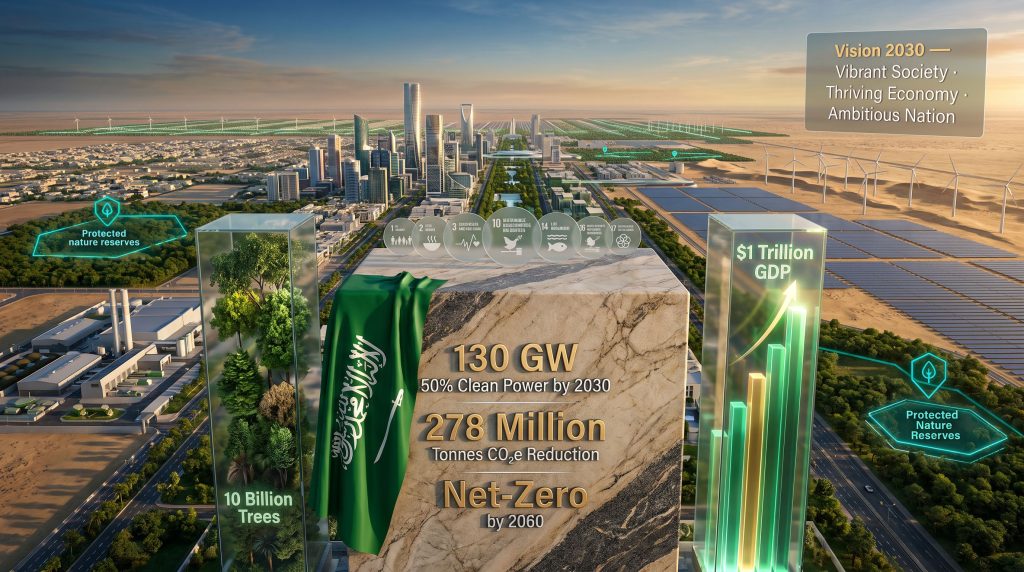
The environmental transformation underway in Saudi Arabia is quantified in the 2026 VNR through a set of targets that, taken together, represent one of the most ambitious national environmental programs in the Middle East.
| Initiative Area | Target | Timeline |
|---|---|---|
| Carbon emissions reduction | 278 million tonnes CO₂ equivalent annually | By 2030 |
| Tree planting program | 10 billion trees | By 2030 |
| Land and marine protection | 30% of total area | By 2030 |
| Renewable energy capacity | 130 GW installed | By 2030 |
| Renewable share of power mix | 50% from clean sources | By 2030 |
| Net-zero emissions | Full carbon neutrality | By 2060 |
The 278 million tonne annual emissions reduction target is the headline figure, but the mechanisms through which it will be achieved are equally instructive. The Saudi Green Initiative operates through what the Kingdom describes as a Circular Carbon Economy framework, organising interventions around four principles: reduce, reuse, recycle, and remove. This framework deliberately accommodates carbon capture and storage alongside renewables deployment, reflecting the reality that a major hydrocarbon producer cannot achieve its emissions targets through renewable energy transition alone.
The 10 billion trees commitment spans both domestic planting within Saudi Arabia and regional contributions through the Middle East Green Initiative, a complementary program targeting ecosystem restoration across the broader region. Domestically, the afforestation effort operates within an arid climate that presents significant horticultural and hydrological challenges, making the selection of native and drought-resistant species central to program viability.
The 130 GW renewable energy target by 2030 represents a fundamental restructuring of the Kingdom's power generation mix. Saudi Arabia's current installed renewable capacity is a fraction of this figure, meaning the pathway to 2030 requires an acceleration in project development, grid infrastructure investment, and financing that is unprecedented in the region's energy history. Indeed, renewable energy in mining is also emerging as a key lever for reducing the sector's carbon footprint as the Kingdom's industrial base expands.
Waste Management as an Economic Opportunity, Not Just an Environmental Obligation
One of the less-discussed dimensions of Saudi Arabia's sustainability agenda is its approach to waste management, which the 2026 VNR frames explicitly as an economic development opportunity rather than merely an environmental compliance requirement.
What Is Saudi Arabia's Waste Management Target Under Vision 2030?
Saudi Arabia's Riyadh waste management initiative aims to divert 94% of waste away from landfills while processing more than 1.3 million tonnes of biodegradable material through composting, positioning environmental industries as a new pillar of the Kingdom's non-oil economy.
This framing matters strategically. By categorising waste management infrastructure as part of the environmental industries growth sector, the VNR effectively creates an investment rationale for private capital deployment in:
- Clean energy generation from waste streams
- Advanced recycling and materials recovery facilities
- Environmental monitoring and compliance technology
- Carbon management and offset verification services
- Water efficiency and wastewater treatment infrastructure
The scale of urbanisation across Saudi Arabia, combined with growing household consumption as living standards rise, means that waste volumes are expanding alongside the economy. The gap between current waste management infrastructure and the 94% diversion target represents a substantial investment opportunity across multiple technology and service categories.
The next major ASX story will hit our subscribers first
Nature Conservation and the Institutional Architecture Protecting Biodiversity
Saudi Arabia currently maintains eight Royal Nature Reserves, which collectively cover 14.9% of the Kingdom's total land area. This protected area network encompasses dramatically varied ecosystems, from the coral-rich Red Sea coastline to the volcanic landscapes of the Harrat Khaybar and the diverse habitats of the Asir highlands.
The recent recording of nine rare migratory bird species for the first time within the King Abdulaziz Royal Reserve illustrates that active conservation management is producing measurable biodiversity outcomes, not simply establishing protected zones on paper.
Within the VNR framework, biodiversity protection serves a dual function. It contributes directly to the Kingdom's land and marine protection target of 30% coverage by 2030, and it provides the ecological baseline data needed to demonstrate SDG progress in areas relating to life on land and below water. The connection between conservation policy and the Kingdom's international climate commitments is also increasingly direct, as intact ecosystems contribute to natural carbon sequestration capacity.
The 140-Entity Stakeholder Architecture Behind the VNR
One of the methodologically distinctive features of Saudi Arabia's 2026 VNR is the breadth of its consultation process. The review engaged more than 140 separate entities spanning government ministries, private sector organisations, academic institutions, and civil society bodies.
The process followed a structured sequence:
- Multi-stakeholder consultation across more than 140 entities representing government, private sector, academia, and civil society.
- Data collection and SDG progress mapping against national indicators aligned with Vision 2030 program targets.
- Ministerial review and cross-departmental alignment with economic diversification objectives.
- Formal submission to the UN High-Level Political Forum.
- Public release and integration of findings into subsequent national planning cycles.
This participatory model serves an important governance function beyond procedural compliance. By embedding private sector and civil society voices in the review process, the VNR creates accountability mechanisms that extend beyond government self-assessment, even if those mechanisms remain advisory rather than binding.
The National Sustainability Strategy, launched in 2024, provides the institutional coordination framework within which these diverse stakeholder inputs are organised and prioritised. Its existence marks a structural maturation of Saudi Arabia's approach to sustainability governance, moving from program-by-program management toward a unified strategic architecture.
What the 2026 VNR Signals for Foreign Investors and Private Capital
For international investors assessing Saudi Arabia's market, the 2026 Voluntary National Review carries several implications that extend beyond the environmental metrics themselves.
The report's explicit framing of sustainable FDI attraction as a national priority alongside non-oil GDP growth signals a qualitative shift in how the Kingdom is approaching foreign investment. The emphasis is no longer simply on capital volume. Sustainability criteria are being applied to the composition and sectoral direction of incoming investment, which has material implications for how international capital allocators structure their Saudi market strategies.
Three investment themes emerge clearly from the VNR's strategic priorities:
-
Environmental industry development: Clean energy, recycling, carbon management, and water efficiency are all identified as growth sectors expected to generate investment, employment, and industrial competitiveness. Companies operating across these verticals are positioned within a policy environment that treats their growth as strategically aligned with national objectives.
-
Mining sector expansion with governance requirements: The mining sector's positioning as a future export pillar creates long-term demand for capital, technology, and expertise, but the VNR is explicit that expansion requires stronger environmental governance and greater investor confidence. The mining decarbonisation benefits being recognised globally are consequently becoming central to how Saudi Arabia frames its own sector development strategy.
-
Green infrastructure: Investments in public transport, conservation infrastructure, urban greening, and renewable energy generation are all identified as areas where private capital deployment aligns with Vision 2030's final-phase objectives. In addition, the broader surge in critical minerals demand driven by the global energy transition reinforces the strategic logic of Saudi Arabia's mineral sector ambitions.
Frequently Asked Questions: Saudi Arabia Voluntary National Review and Vision 2030 Sustainability
What Is Saudi Arabia's Voluntary National Review?
The Voluntary National Review is a self-assessment report submitted by UN member states to the High-Level Political Forum, measuring national progress against the Sustainable Development Goals. Saudi Arabia submitted its third VNR in 2026, with a fourth planned for 2030.
How Does Vision 2030 Align With the United Nations Sustainable Development Goals?
Vision 2030 is structured around three pillars covering societal, economic, and institutional dimensions of development. Each pillar maps to multiple SDGs, and the VNR process is the primary mechanism through which Saudi Arabia formally tracks and reports this alignment.
What Is Saudi Arabia's Net-Zero Emissions Target?
Saudi Arabia has committed to achieving net-zero carbon emissions by 2060, with an interim target of reducing CO₂ equivalent emissions by 278 million tonnes annually by 2030 through the Saudi Green Initiative.
How Many VNRs Has Saudi Arabia Submitted?
Saudi Arabia submitted its first VNR in 2018, its second in 2023, and its third in 2026. A fourth submission is planned for 2030 to provide a comprehensive assessment of Vision 2030's full implementation outcomes.
What Is the Saudi Green Initiative?
The Saudi Green Initiative is the Kingdom's primary environmental program, encompassing emissions reduction commitments, a 10 billion tree planting target, land and marine protection covering 30% of the Kingdom's territory, and a 130 GW renewable energy capacity target, all by 2030. For further context on how such programs interact with global frameworks, the United Nations SDG knowledge platform provides detailed VNR documentation from member states worldwide.
The Unfinished Agenda: Where the 2026 VNR Leaves the Most Important Questions Open
The 2026 Saudi Arabia Voluntary National Review Vision 2030 sustainability alignment is most usefully understood not as a progress report on what has been achieved, but as a diagnostic of what remains structurally incomplete as the program enters its final phase.
Three areas carry the most unresolved complexity:
-
Regional economic equity remains the most analytically demanding challenge. Reducing GDP disparities across a geographically vast and physically diverse nation requires targeted infrastructure investment, localised industrial development, and labour mobility policies that operate over decade-long timeframes. The acknowledgment of this priority in the 2026 VNR is significant, but the mechanisms for achieving it remain less developed than the environmental targets.
-
Mining governance sits at the intersection of economic ambition and environmental accountability. The sector's growth potential is substantial given the Kingdom's estimated mineral endowment, but attracting the quality of long-term institutional capital required for large-scale mining development depends on regulatory predictability and credible environmental standards, both of which are still maturing. Consequently, how Saudi Arabia manages this balance will likely influence how other resource-rich nations approach their own mineral sector governance reforms.
-
Renewable energy acceleration from current installed capacity to 130 GW by 2030 represents an engineering, financing, and grid management challenge of the first order. The timeline is ambitious relative to the starting position, and whether it can be achieved within the Vision 2030 window or will require recalibration into a post-2030 framework is a question the 2026 VNR leaves appropriately open.
| Metric | Figure |
|---|---|
| Annual emissions reduction target | 278 million tonnes CO₂e by 2030 |
| Renewable energy capacity target | 130 GW by 2030 |
| Waste diversion target (Riyadh) | 94% from landfills |
| Biodegradable waste composting | 1.3 million tonnes |
| Protected land and sea coverage | 14.9% of Kingdom's total area |
| VNR stakeholder entities involved | 140+ organisations |
| Saudi economy GDP threshold crossed | $1 trillion |
| Net-zero emissions commitment | 2060 |
| Total VNRs planned by 2030 | 4 submissions |
This article is intended for informational purposes only and does not constitute investment advice. Forecasts, targets, and projections referenced are drawn from official government documents and publicly available sources. Readers should conduct independent due diligence before making any investment decisions.
Want to Track the ASX Mineral Discoveries Shaping the Energy Transition?
As Saudi Arabia accelerates its mining sector expansion and global demand for critical minerals intensifies, Discovery Alert's proprietary Discovery IQ model delivers real-time alerts on significant ASX mineral discoveries — instantly translating complex geological data into actionable investment insights for both short-term traders and long-term investors. Explore historic examples of major discovery returns and begin your 14-day free trial at Discovery Alert to position yourself ahead of the market.