June 25, 2026
The Geometry of Eurasian Trade: Why Landlocked Economies Are Reshaping Corridor Power
Trade corridors rarely emerge from a single diplomatic event. They develop over decades through the slow accumulation of institutional infrastructure, trust-building agreements, and the gradual reduction of friction at each point along the route. The Caspian Sea region is currently experiencing exactly this kind of structural evolution, and the bilateral relationship between Azerbaijan and Turkmenistan sits at its geographic and economic centre.
Understanding what the Azerbaijan and Turkmenistan trade agreements of June 2026 actually represent requires stepping back from the immediate diplomatic choreography and examining the deeper forces at work: a post-2022 restructuring of Eurasian trade geography, a landlocked nation's calculated emergence from self-imposed economic isolation, and Baku's deliberate construction of a hub-and-spoke corridor architecture that could reshape how goods move between Central Asia and Europe.
When big ASX news breaks, our subscribers know first
Why These Two Caspian Neighbours Are Converging Now, Not Earlier
The timing of this deepening bilateral relationship is not coincidental. Two structural forces have converged to make 2025 and 2026 the most propitious window for Caspian economic integration in a generation.
The first force is the disruption of the Northern Corridor. The overland trade routes transiting Russian territory, which historically carried a substantial share of Central Asian goods bound for European markets, became commercially and reputationally untenable for many shippers following the post-2022 geopolitical realignment. This created urgent demand for alternative routing solutions, and the Trans-Caspian International Transport Route, commonly known as the Middle Corridor, became the primary beneficiary of that demand shift.
The second force is Turkmenistan's own recognition that its economic model carries dangerous concentration risk. The country earns the overwhelming majority of its hard currency from natural gas exports to a single buyer: China. This single-commodity, single-customer dependency leaves Ashgabat acutely vulnerable to price negotiations, demand fluctuations, and the broader leverage that concentrated trade relationships confer on the dominant party.
These two forces have created a rare alignment of incentives. Azerbaijan needs eastern anchor points to extend the Middle Corridor's reach. Turkmenistan needs alternative trade relationships to reduce its China dependency. The result is a partnership built on genuine complementarity rather than diplomatic courtesy.
Understanding Turkmenistan's Unique Position as a Closed Economy Opening Up
Turkmenistan occupies a distinctive position in the global economic landscape that makes its integration into regional trade frameworks both strategically significant and operationally complex. Freedom House's 2025 assessment classified Turkmenistan's political system among the most restrictive in the world, a designation that reflects not merely the absence of political pluralism but the structural consequences for economic governance.
Several characteristics define Turkmenistan's economic architecture in ways that directly affect how bilateral agreements translate into commercial reality:
- Single-commodity export dependency: Natural gas exports to China dominate the country's hard currency earnings, leaving the broader economy exposed to commodity price cycles and bilateral negotiation dynamics.
- Limited banking infrastructure: The financial sector lacks the correspondent banking relationships, currency convertibility mechanisms, and trade finance instruments that sophisticated cross-border commercial transactions require.
- Restricted foreign investment frameworks: State ownership and control over strategic assets has historically constrained the entry of external capital into sectors beyond hydrocarbons.
- Governance opacity: Decision-making remains concentrated within a narrow political elite, with power effectively centralised in the Berdymukhamedov family across successive generations of leadership.
What makes the current moment different is the emergence of what analysts of Central Asian political economy describe as controlled liberalisation — a state-managed, incremental opening that preserves regime authority while selectively expanding economic engagement with external partners. Ashgabat has recently signalled aspirations to develop electricity export capacity as an additional revenue stream, a concrete indicator that the country's leadership recognises the structural limits of gas-only dependency.
What the June 22, 2026 Baku Agreement Package Actually Covers
The agreements exchanged during the June 22, 2026 ceremony in Baku represent the most comprehensive bilateral framework between Azerbaijan and Turkmenistan since their foundational Free Trade Agreement entered into force in 1996. Furthermore, the package spans at least eight distinct policy domains simultaneously, a breadth that signals institutional seriousness rather than symbolic diplomacy.
| Agreement Domain | Scope | Strategic Significance |
|---|---|---|
| Economic and Trade Cooperation | Bilateral trade expansion framework | Formalises post-FTA growth trajectory |
| Customs Modernisation | Information exchange, statistics harmonisation | Reduces friction at Caspian crossing points |
| Transport and Maritime | Trans-Caspian corridor enhancement | Critical for Middle Corridor cargo volumes |
| Energy Cooperation | Joint energy sector engagement | Opens door to Caspian energy transit |
| Industrial Cooperation (2026-2028) | Sector-specific programme | Time-bound deliverables with accountability |
| Agricultural and Food Safety | Bilateral agri-trade facilitation | Diversifies Turkmen export basket |
| Healthcare | Institutional cooperation | People-to-people and soft power dimension |
| Foreign Ministry Framework (2026-2029) | Diplomatic coordination programme | Structural diplomatic alignment |
The institutional architecture behind these agreements deserves particular attention. A Bilateral Investment Treaty (BIT), signed in 2018 and entering into force in 2019, established the investor protection mechanisms that now underpin commercial confidence in the sectoral cooperation domains. Investment protection frameworks of this kind typically precede trade expansion by several years, as they reduce the legal and financial risk that private actors must absorb when entering unfamiliar jurisdictions.
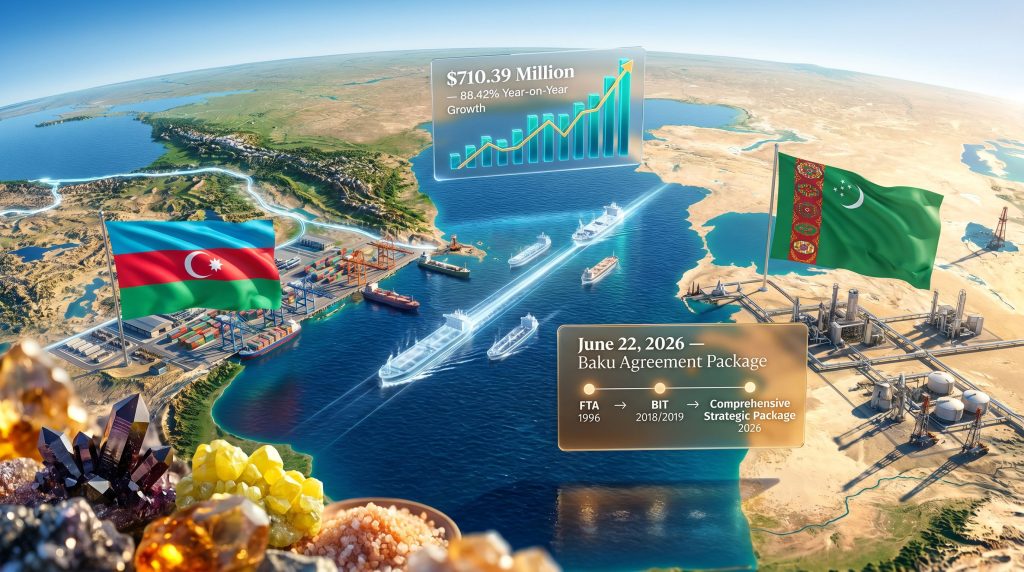
The progression tells a coherent institutional story: Free Trade Agreement in 1996, Bilateral Investment Treaty in 2018-2019, and now a comprehensive strategic package in 2026. Each layer builds on the preceding one. For additional context on these trade agreements, Azerbaijan's broader commercial framework has been increasingly oriented towards multi-partner integration.
Watch Point: The scheduled July 2026 intergovernmental commission meeting in Ashgabat represents the first genuine implementation test of the Baku agreements. Bilateral frameworks of this complexity frequently stall at the commission stage, where bureaucratic inertia and governance opacity can erode the political momentum generated at signing ceremonies. The specificity of the 2026-2028 industrial cooperation programme and the 2026-2029 Foreign Ministry framework, with their defined time horizons and implied accountability mechanisms, may provide stronger implementation incentives than purely aspirational declarations.
How Fast Is Azerbaijan-Turkmenistan Trade Actually Growing?
The headline trade statistics reveal a bilateral relationship that was already accelerating sharply before the June 2026 agreements were signed. Indeed, bilateral trade between Azerbaijan and Turkmenistan had already surpassed significant milestones in preceding years, underscoring the trajectory now being formalised.
Between January and October 2023, bilateral trade turnover reached approximately $710.39 million, representing an 88.42% year-on-year increase compared to the equivalent period in 2022. That kind of growth rate demands careful interpretation, however. A jump of this magnitude can reflect genuine structural trade expansion, or it can be substantially inflated by commodity price movements that temporarily boost the nominal value of hydrocarbon-dominated trade flows.
The composition of trade reveals the asymmetric nature of the current commercial relationship:
| Trade Flow Direction | Primary Commodities | 2022 Value |
|---|---|---|
| Turkmenistan to Azerbaijan | Crude petroleum, petroleum gas | ~$460 million |
| Azerbaijan to Turkmenistan | Raw sugar, insulated wire | ~$25.7 million |
Turkmenistan holds a structural trade surplus of approximately $434 million in the bilateral relationship, driven almost entirely by hydrocarbon exports. Azerbaijan's export basket — dominated by raw sugar and insulated wire — reflects its current limited penetration of Turkmenistan's consumer and industrial markets.
This composition raises a critical strategic question: are the 2026 agreements designed to rebalance the trade structure by developing new export categories, or primarily to scale existing hydrocarbon-dominated flows? The inclusion of an industrial cooperation programme with a defined 2026-2028 timeframe, alongside agricultural and food safety provisions, suggests at minimum an intent to broaden the commercial relationship beyond its current hydrocarbon core.
For perspective, Azerbaijan's exports to Turkmenistan could expand substantially under the new framework if Azerbaijani manufacturers gain improved access to Turkmenistan's consumer goods, construction, and food processing markets — sectors where Ashgabat's import substitution policies have historically constrained external competition.
The Middle Corridor: Architecture, Bottlenecks, and Turkmenistan's Missing Role
The Middle Corridor is the emerging overland and maritime trade artery connecting Central Asian producers to European markets via the Caspian Sea, Azerbaijan, Georgia, and Turkey. Its strategic relevance intensified sharply following the post-2022 routing disruptions that made Russian-transiting alternatives commercially and politically problematic for many shippers.
What the corridor currently lacks is a reliable eastern anchor. Turkmenistan's geography positions it as the natural gateway to the trans-Caspian segment from the east, with the potential to channel not only Turkmen goods but cargo originating from Afghanistan, Iran's northern regions, and deeper Central Asian markets into the corridor network. The shifting geopolitical mining landscape has consequently elevated the strategic importance of every credible alternative routing solution.
Baku's diplomatic strategy toward Ashgabat fits within a broader regional integration agenda that became visible in June 2026 when Azerbaijan simultaneously signed an agreement with Uzbekistan, facilitated through NEQSOL Holding, to develop a comprehensive value chain for Uzbekistan's critical minerals and precious metals sector. This parallel engagement reveals a systematic hub-and-spoke architecture: Azerbaijan is building upstream supply and cargo relationships with Central Asian states while investing in the transit infrastructure that connects them to Western markets.
Key Insight: Azerbaijan is not merely a transit country in this architecture. Baku is positioning itself as the indispensable connector between landlocked Central Asian resource economies and the global markets they need to access, capturing value not from extraction but from facilitation. This is a fundamentally different economic model than the resource nationalism that characterises most of the region's major players.
The next major ASX story will hit our subscribers first
Could Critical Minerals Become the Next Dimension of This Partnership?
One of the most consequential signals to emerge from the June 22 ceremony was the indication that Azerbaijan would support the development of Turkmenistan's mining sector. This requires careful calibration against what is currently known about Turkmenistan's mineral endowment. The accelerating critical minerals demand driven by the global energy transition lends additional urgency to this dimension of the partnership.
According to data published by the United States Geological Survey, Turkmenistan's confirmed mineral production currently encompasses three commercially relevant categories:
- Iodine
- Sulfur
- Potash
These are industrially valuable commodities, but none of them currently qualify as critical minerals under most Western or European Union frameworks, which tend to prioritise lithium, cobalt, rare earth elements, nickel, and manganese — the materials most relevant to energy transition supply chains. Concerns over rare earth supply chains have, however, prompted governments worldwide to look beyond established sources for viable alternatives. Turkmen leadership has expressed interest in commissioning exploratory surveys for critical mineral deposits, acknowledging that the country's subsurface geology remains incompletely characterised.
This geological uncertainty creates a speculative but analytically interesting scenario. The Turan Platform and the Kopet-Dag fold belt, the primary geological structures underlying Turkmenistan, share broad characteristics with adjacent regions of Kazakhstan and Uzbekistan where commercially significant mineral discoveries have been confirmed. If systematic geological surveying identifies viable deposits of energy-transition-relevant minerals, Azerbaijan's pre-established role as mining development partner and trans-Caspian corridor operator would create a structural first-mover advantage in routing those materials toward European processing and manufacturing markets.
This remains a scenario requiring significant confirmation before it carries commercial weight. However, the institutional groundwork being laid now — the mining cooperation signals, the transport agreements, the NEQSOL-style facilitation model already applied through the Uzbekistan minerals initiative — establishes the framework that would be activated if exploration yields material results.
Turkmenistan in Regional Context: How Does Its Opening Compare?
Positioning Turkmenistan's controlled liberalisation against the trajectories of its Central Asian neighbours provides useful analytical perspective on the pace and nature of the current opening.
| Country | Opening Strategy | Key Partner | Primary Mechanism |
|---|---|---|---|
| Uzbekistan | Rapid liberalisation (post-2016) | Multiple | FDI attraction, trade zone development |
| Kazakhstan | Phased integration | Russia, China, EU | EAEU membership plus bilateral FTAs |
| Turkmenistan | Controlled liberalisation | Azerbaijan (emerging) | Bilateral agreements, corridor participation |
| Kyrgyzstan | EAEU-anchored integration | Russia | Customs union membership |
Uzbekistan's post-2016 transformation under President Mirziyoyev offers the most relevant regional precedent. Tashkent moved from a relatively closed, state-controlled economy to an aggressively FDI-oriented liberaliser within a decade, attracting substantial foreign capital across mining, manufacturing, and services. Turkmenistan's current trajectory looks considerably more cautious by comparison, but the institutional sequencing — bilateral agreements before multilateral integration — is a defensible strategy for a government that prioritises regime stability alongside economic diversification.
Structural Risks That Could Constrain Agreement Outcomes
The June 2026 framework carries genuine implementation risks that merit transparent assessment. Several structural barriers could limit the translation of signed agreements into operational commercial activity:
- Banking system underdevelopment: The bilateral banking cooperation agreement addresses a real constraint. Turkmenistan's financial sector lacks the infrastructure for sophisticated cross-border trade finance, including mechanisms for currency conversion, letters of credit, and correspondent banking relationships essential for commercial transactions at scale.
- Currency and payment friction: The absence of a freely convertible Turkmen manat and the limited integration of Turkmenistan's banking system into international payment networks creates practical obstacles for businesses attempting to execute cross-border transactions.
- Political succession risk: With authority concentrated in the Berdymukhamedov family, policy continuity cannot be assumed independent of personal political will. Changes at the apex of the system could affect the implementation environment for commercially oriented reforms.
- Geopolitical counterpressures: Russia maintains a strategic interest in preserving its influence over Central Asian trade routing, and China's leverage over Turkmenistan through gas import contracts gives Beijing a potential instrument to constrain Ashgabat's external diversification if it chooses to use it. Iran represents an alternative Caspian transit option with its own corridor ambitions.
In addition, Europe's critical minerals supply agenda may ultimately apply indirect pressure that accelerates Turkmenistan's opening, as European institutions increasingly seek to engage resource-rich nations across the broader Eurasian landmass.
Forward Scenarios for the Partnership
| Scenario | Conditions Required | Probability Assessment | Strategic Outcome |
|---|---|---|---|
| Full Corridor Integration | Customs harmonisation implemented; Turkmen port capacity expanded | Moderate | Significant cargo volume increase on trans-Caspian route |
| Minerals Cooperation Breakthrough | Critical mineral discoveries confirmed; NEQSOL-style framework applied | Low to moderate | Azerbaijan becomes regional minerals transit hub |
| Stalled Implementation | Governance friction; geopolitical interference | Moderate | Agreements remain aspirational; limited practical impact |
| Accelerated Opening | External pressure from EU funding or Chinese gas price decline catalyses Turkmen liberalisation | Low | Rapid integration into Middle Corridor ecosystem |
The most analytically defensible assessment places the partnership at a genuine inflection point rather than a guaranteed trajectory. The institutional foundations are more robust than at any previous moment in the bilateral relationship, the commercial incentives are structurally coherent, and the June 2026 agreements represent the most detailed and operationally specific framework the two countries have established.
Whether those foundations translate into the consistent policy implementation that commercial actors need to commit capital remains the central open question. What is already clear is that each increment of successful implementation will generate self-reinforcing trade gravity. Additional cargo flows reduce per-unit logistics costs, attract further commercial activity, and progressively raise the economic cost of reversal.
The June 2026 Azerbaijan and Turkmenistan trade agreements may ultimately be remembered less for their immediate commercial impact than for establishing the institutional infrastructure through which a far larger regional trade reorientation becomes possible.
Frequently Asked Questions: Azerbaijan and Turkmenistan Trade Agreements
When did Azerbaijan and Turkmenistan first establish a free trade framework?
The foundational Free Trade Agreement between the two countries entered into force in 1996, establishing the baseline legal architecture for bilateral commerce.
What was the total trade turnover between Azerbaijan and Turkmenistan in 2023?
Between January and October 2023, bilateral trade turnover reached approximately $710.39 million, representing an 88.42% increase over the equivalent period in 2022.
What is the Middle Corridor and why is Turkmenistan's involvement significant?
The Middle Corridor is a trans-Caspian trade route connecting Central Asia to European markets via Azerbaijan, Georgia, and Turkey. Turkmenistan's participation would extend the corridor's eastern reach, potentially channelling goods from deeper Central Asia and neighbouring countries into the network.
What sectors are covered by the June 2026 Azerbaijan-Turkmenistan agreements?
The agreement package spans trade and economic cooperation, customs modernisation, transport and maritime links, energy, industrial programmes running through 2028, agriculture, food safety, healthcare, and a Foreign Ministry coordination framework running through 2029.
Is there a bilateral investment protection framework between the two countries?
A Bilateral Investment Treaty was signed in 2018 and entered into force in 2019, providing legal protections for investors operating across both jurisdictions.
What minerals does Turkmenistan currently produce?
According to US Geological Survey data, Turkmenistan's confirmed mineral production includes iodine, sulfur, and potash. The country has expressed interest in exploring for critical mineral deposits, though commercially significant discoveries have not yet been confirmed.
This article contains forward-looking analysis, scenario projections, and assessments of geopolitical and commercial developments. These represent analytical perspectives based on publicly available information and should not be construed as investment advice. Trade volume forecasts, scenario outcomes, and geological assessments involve inherent uncertainty and are subject to revision as conditions evolve.
Want to Track the Next Major Mineral Discovery Before the Market Does?
The geopolitical reshaping of Eurasian trade corridors and the emerging focus on Turkmenistan's mineral endowment underscore how quickly resource opportunities can materialise in strategically significant regions — Discovery Alert's proprietary Discovery IQ model scans ASX announcements in real time, instantly alerting subscribers to significant mineral discoveries across more than 30 commodities, so they can act before the broader market catches on. Explore historic discoveries and their returns or start your 14-day free trial today to secure a market-leading advantage as new corridors and resource frontiers continue to open.