June 24, 2026
The Architecture of a Compliance Crisis: Understanding the EU Methane Regulation Amendment Debate
Long-term energy supply agreements are built on legal certainty. The ability to commit capital, structure offtake contracts, and price in regulatory risk depends entirely on knowing, with confidence, what the rules are and when they will apply. When that certainty disappears, investment freezes, supply chains contract, and the geopolitical consequences follow quickly. This is precisely the situation now unfolding around the EU methane regulation amendment debate, a dispute that has moved far beyond technical compliance discussions into the territory of energy security and international trade policy.
Understanding what is actually at stake requires examining the regulation's internal mechanics, the structural gaps it contains, and the competing institutional interests now colliding over how to resolve them. Furthermore, the broader geopolitical mining landscape offers useful context for understanding how regulatory uncertainty ripples outward into commodity markets and supply chain decisions.
When big ASX news breaks, our subscribers know first
What the EU Methane Regulation Actually Requires
Regulation (EU) 2024/1787 entered into force on 4 August 2024 and represents the first legally binding EU-wide framework for controlling methane emissions across the energy sector. Its scope is deliberately broad, applying not only to upstream operators within the EU but also to the emissions embedded in imported fossil fuels, covering oil, natural gas, and coal across the full upstream value chain.
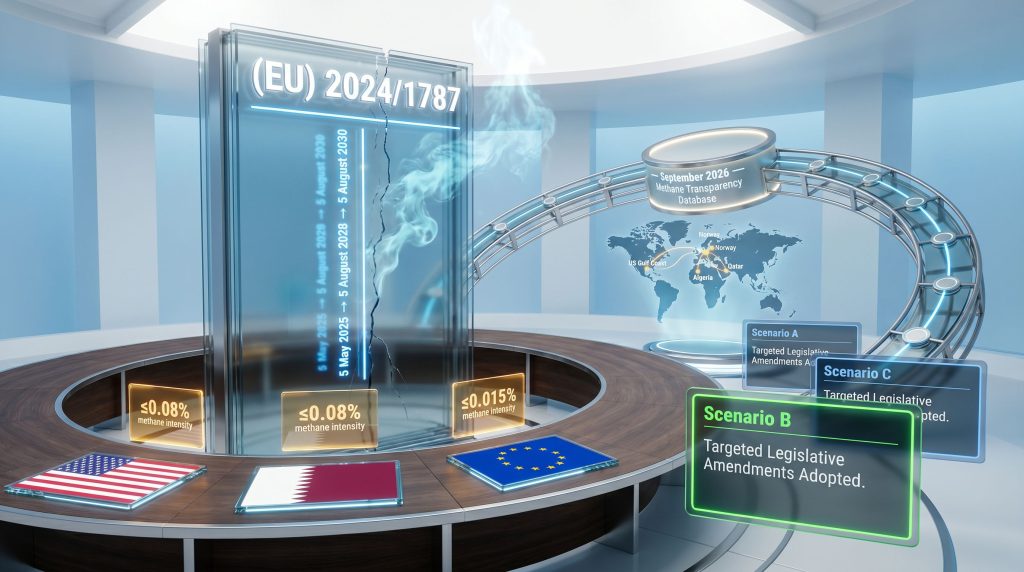
The regulation introduces two categories of binding obligations. The first concerns leak detection and repair (LDAR), with sector-specific methane intensity thresholds set at ≤0.08% for gas and ≤0.015% for oil. The second prohibits routine venting and flaring from EU-operated upstream assets entirely.
What makes this regulation structurally different from previous voluntary frameworks is the enforceability of these obligations. Prior arrangements under the Oil and Gas Methane Partnership (OGMP 2.0) and similar initiatives relied on industry self-reporting and reputational incentives. The EUMR creates financial and contractual consequences, fundamentally changing how energy supply agreements must be structured going forward.
The Phased Compliance Timeline and Where It Breaks Down
The regulation's obligations are staged across several years, with escalating requirements at each milestone:
| Compliance Milestone | Date | Obligation |
|---|---|---|
| Qualitative importer disclosure | 5 May 2025 | Importers submit monitoring and verification information |
| Member State reporting + super-emitter mechanism | 5 February 2026 | EU states publish methane performance profiles |
| Methane Transparency Database launch | September 2026 | Centralised emissions data platform goes live |
| Methane intensity reporting | 5 August 2028 | Importers submit quantitative methane intensity data |
| Maximum methane intensity enforcement | 5 August 2030 | All contracts signed or renewed post-2030 must meet intensity limits |
On paper, this looks like a sensible phased approach. In practice, the architecture contains a critical structural flaw. The European Commission is required to establish delegated acts that define the measurement methodologies and maximum permissible methane intensity thresholds for imports. Without finalised delegated acts, operators face a situation where compliance obligations exist in law, but the specific standards against which conformity will be measured do not yet exist.
This is not a minor administrative gap. It is a foundational problem: exporters and importers are expected to structure legally binding, long-duration supply contracts around compliance standards that have not been defined.
The Methane Transparency Database, scheduled for launch in September 2026, compounds this issue. It will serve as the centralised repository for methane emissions data across energy import supply chains and is a prerequisite for meaningful enforcement of the 2028 intensity reporting obligation. Where upstream operators in third countries lack measurement infrastructure that meets EU verification standards, the database's reliability will be structurally undermined from the outset.
Why Exporting Nations Are Demanding Legislative Change
Gas-exporting nations, including the United States and Qatar, have formally communicated to EU leadership through an open letter addressed to European Commission President Ursula von der Leyen, European Council President Antonio Costa, and EU member state leaders, that the regulation requires targeted legislative amendments before its enforcement milestones apply.
The core argument is not that the regulation's environmental objectives are wrong. It is that the compliance obligations cannot be practically satisfied because the measurement methodologies required for verification have not been finalised. A representative of the US Department of Energy previously stated publicly that the EU methane requirements were operationally impossible to meet under the current timeline, a position that has since escalated to the ministerial level across multiple exporting nations. The US-China trade war impacts offer a useful parallel, demonstrating how geopolitical friction can rapidly reshape long-term energy procurement strategies.
The exporting nations have identified three specific legislative interventions they consider necessary:
-
A stop-the-clock mechanism that formally pauses specific compliance obligations to allow time for methodological development and verification infrastructure to be established. This is legally distinct from informal non-enforcement guidance and requires an actual legislative instrument.
-
Grandfathering provisions for contracts signed during the legislative adjustment period, providing legal protection against retroactive compliance obligations. This is the specific mechanism needed to unfreeze new LNG supply contracting that is currently suppressed by legal uncertainty.
-
Formal penalty suspension during the transition period, enacted through binding EU law rather than advisory communications to member states.
The distinction between formal legislative action and informal guidance is not bureaucratic pedantry. It reflects the practical reality that non-binding recommendations carry no weight in commercial contract disputes or financial institution risk assessments.
Discretionary non-enforcement across 27 separate EU member states introduces jurisdictional inconsistency that creates a commercially untenable environment for structuring long-term LNG and gas supply agreements.
The Commission's Position and Why Industry Considers It Insufficient
The European Commission has consistently maintained that the regulation should be reinforced rather than reopened. EU Climate Commissioner Wopke Hoekstra has affirmed that diplomatic engagement will continue, but within the existing regulatory framework. The Commission's preferred mechanism is non-binding guidance to member states advising against penalty enforcement during the near term.
Industry groups representing LNG supply chains and importing entities have formally rejected this approach as legally inadequate. Their reasoning is straightforward:
- Non-binding recommendations cannot override the text of a regulation that remains enforceable EU law
- Financial institutions structuring LNG offtake agreements require legally certain compliance pathways
- Legal counterparties cannot accept informal administrative discretion as a substitute for statutory compliance certainty
- Energy ministers from exporting nations have explicitly stated that relying on discretionary non-enforcement across all 27 EU member states fails to address the financial and legal risks faced by commercial parties
A coalition of 11 major energy associations has submitted formal proposals requesting 15 discrete amendments to the EUMR through the EU's simplification agenda. These are not proposals to dismantle the regulation but to address specific operational and methodological gaps.
The proposed amendments cluster around four categories:
- Methodological clarity: Establishing finalised, internationally recognised measurement standards before enforcement deadlines apply, with alignment to existing frameworks such as OGMP 2.0 to avoid duplicative reporting obligations
- Third-country implementation feasibility: Creating equivalence pathways for countries with comparable or certified methane monitoring programmes, acknowledging that upstream operators in non-EU jurisdictions are subject to their own national regulatory regimes
- Contractual and commercial protections: Introducing legal certainty provisions for long-term supply contracts currently under negotiation, with clear liability boundaries for EU importers
- Enforcement sequencing: Aligning penalty enforcement timelines with the availability of verified methodologies rather than fixed calendar dates
The Global LNG Trade Implications: Which Regions Face the Most Exposure
The EU is among the world's largest LNG importers, with supply relationships spanning the US Gulf Coast, Qatar, Australia, Norway, and Algeria. The compliance uncertainty created by the EUMR has a direct chilling effect on new long-term LNG contracting, precisely the type of supply security architecture the EU sought to rebuild following the 2022 energy crisis. The current LNG supply outlook highlights how fragile these supply relationships remain in the face of regulatory and geopolitical disruption.
The exposure levels across major exporting regions are notably uneven:
| Exporting Region | Primary Exposure | Compliance Readiness | Key Risk Factor |
|---|---|---|---|
| United States | LNG export contracts | Moderate | Regulatory fragmentation across upstream operators |
| Qatar | Long-term LNG supply agreements | Low-Moderate | Limited third-country equivalence pathway |
| Australia | LNG and pipeline gas | Moderate | Distance from EU regulatory engagement forums |
| Norway | Pipeline gas | High | Proximity to EU regulatory process; existing OGMP alignment |
| Algeria | Pipeline gas | Low-Moderate | Measurement infrastructure gaps |
Norway's relatively higher compliance readiness reflects its existing alignment with OGMP 2.0 frameworks and its geographic and institutional proximity to EU regulatory processes. Algeria and Qatar face more significant challenges, particularly around measurement infrastructure and the absence of a recognised equivalence pathway.
A lesser-known dimension of this problem involves the structural composition of LNG supply chains. Unlike pipeline gas, where a single operator controls the flow from wellhead to delivery point, LNG supply chains typically involve multiple discrete upstream operators, each with different emission profiles, measurement capabilities, and regulatory environments. This fragmentation makes aggregated methane intensity calculations genuinely complex, and the absence of a standardised methodology makes the required calculations literally impossible to perform in a verifiable way.
The next major ASX story will hit our subscribers first
The Energy Security Trade-Off That Cannot Be Ignored
Global gas flaring reached 167 billion cubic metres in 2025, according to World Bank data, up from 157 billion cubic metres in 2024 and the highest level recorded since 2019. The greenhouse gas equivalent of that volume was approximately 429 million tonnes of CO2, with incomplete combustion accounting for a significant portion of unburned methane emissions. These figures underscore the genuine environmental rationale behind the EUMR's ambitions.
The tension this creates is genuine and not easily resolved. The EU faces competing imperatives:
- Its methane reduction commitments under the European Green Deal require enforceable import standards
- Its energy security requirements, sharpened considerably since 2022, demand diversified and reliable long-term supply
- Overly rigid enforcement timelines risk incentivising supply contraction toward European markets
- The contractual uncertainty currently suppressing new LNG agreements could translate directly into higher energy costs and reduced supply resilience across member states
In addition, the challenges facing European raw materials supply illustrate a broader pattern of regulatory ambition colliding with supply chain practicalities, a dynamic that is increasingly central to EU industrial policy.
Three Scenarios for the 2026 to 2030 Policy Window
The period between now and 2030 is structurally decisive. Three distinct regulatory pathways could emerge:
Scenario A: The Commission Holds the Current Framework
Non-binding non-enforcement guidance is issued for 2027 to 2029. Delegated acts are published in late 2026 or early 2027. Enforcement of methane intensity limits proceeds from 2030 for new contracts. The primary risk is that continued legal uncertainty continues to suppress new LNG contracting, and some exporters redirect supply toward markets with simpler compliance environments.
Scenario B: Targeted Legislative Amendments Are Adopted
The EU Parliament and Council agree to a limited package of amendments incorporating stop-the-clock provisions and grandfathering clauses. Methodological development proceeds in parallel with a revised enforcement timeline. This pathway reduces contractual risk, improves exporter engagement, and preserves the long-term methane reduction trajectory.
Scenario C: Broader Regulatory Renegotiation
Sustained diplomatic pressure forces a more comprehensive review of the EUMR. Core methane intensity standards are weakened and the 2030 enforcement milestone delayed significantly. Short-term trade relationship stabilisation comes at the cost of climate policy credibility and the EU's broader regulatory authority.
The most structurally coherent outcome is Scenario B. It preserves the regulation's environmental architecture while resolving the commercially disabling compliance gaps that currently threaten EU energy supply security. The divergence between institutions and exporting nations is over mechanism and timeline, not ultimate destination.
Consequently, the trade war supply chains experience of recent years reinforces that unresolved regulatory disputes have a compounding effect on commercial confidence, making early legislative clarity all the more critical.
Frequently Asked Questions: EU Methane Regulation Amendment
What is the EU Methane Regulation?
Regulation (EU) 2024/1787 is the first EU-wide law requiring mandatory monitoring, reporting, and verification of methane emissions across the energy sector. It covers both domestic EU production and imported fossil fuels and entered into force on 4 August 2024.
When do methane intensity limits apply to imports?
From 5 August 2030, all contracts for imported oil, natural gas, and coal signed or renewed after that date must comply with maximum methane intensity thresholds established by the Commission through delegated acts.
Why are exporting nations calling for an EU methane regulation amendment?
Because the compliance obligations exist in law while the measurement methodologies required for verification remain undefined. Exporting nations argue this makes practical compliance impossible and creates unacceptable legal and financial risk for commercial parties.
What is a stop-the-clock mechanism?
A formal legislative instrument that pauses specific compliance obligations, providing a legally binding deferral period during which methodologies can be developed and verified. It is materially different from informal non-enforcement guidance, which carries no legal weight in commercial disputes.
Has the EU agreed to amend the regulation?
As of mid-2026, the European Commission has not agreed to reopen the regulation. Its stated position is to reinforce the existing framework through diplomatic engagement and non-binding guidance rather than through legislative amendment.
What role does the Methane Transparency Database play?
It will function as the EU's centralised repository for methane emissions data across energy supply chains, scheduled to launch in September 2026. It is a prerequisite for enforcing the 2028 methane intensity reporting obligations and its accuracy depends entirely on the quality of third-country data inputs, which remain unverified.
Disclaimer: This article is intended for informational purposes only and does not constitute financial or investment advice. All timelines, regulatory thresholds, and institutional positions reflect publicly available information as of mid-2026 and are subject to change as the legislative process evolves.
Want to Stay Ahead of the Commodity Market Shifts Driven by Regulatory Disruption?
As regulatory uncertainty reshapes global energy and commodity supply chains, Discovery Alert's proprietary Discovery IQ model delivers real-time alerts on significant ASX mineral discoveries, instantly identifying actionable opportunities before the broader market reacts — explore historic discoveries and their returns to see what early positioning can achieve, and begin your 14-day free trial at Discovery Alert to secure your market-leading edge.