June 24, 2026
The Invisible Chokepoint: Why Mineral Processing Power Is the Real Prize in the New Cold War
The geopolitical contests of previous centuries were fought over trade routes, naval dominance, and fossil fuel reserves. The defining resource competition of the 21st century looks fundamentally different. It is being waged across refinery floors, hydrometallurgical plants, and chemical processing facilities, where raw ore extracted from mines in Africa, South America, and Central Asia is transformed into the high-purity materials that power electric vehicle motors, precision-guided munitions, semiconductor chips, and renewable energy systems.
Understanding this distinction between extraction and processing is essential to grasping why the China BRICS critical minerals dynamic has become one of the most consequential strategic puzzles of the current decade. A nation can possess abundant underground reserves and still remain entirely dependent on a foreign power if it cannot refine what it digs up. Conversely, a country with modest domestic deposits but superior processing infrastructure holds enormous leverage over every economy that feeds it raw material. China occupies precisely this second position, and that asymmetry is now driving the most significant realignment of global supply chains since the post-Cold War era.
When big ASX news breaks, our subscribers know first
Processing Dominance: Understanding the Chokepoint Economy
The term "critical minerals" encompasses a wide range of elements and compounds, but the strategic logic unifying them is consistent: they are inputs with no near-term substitutes for applications that underpin modern economic and military capability. Furthermore, critical minerals demand continues to accelerate as clean energy transitions intensify globally. Rare earth elements, lithium, cobalt, graphite, nickel, and manganese form the core of this category, each serving distinct but equally indispensable roles.
What is less commonly understood is the degree to which China's power over these materials is concentrated not in its mines, but in its refineries and processing plants. The distinction matters enormously from an investor and policy perspective.
"Extraction is a necessary condition for supply chain control. Processing is the sufficient condition. Without refining capacity, upstream diversification achieves very little."
Consider the breakdown across key commodity categories:
| Critical Mineral | China's Production/Processing Share | Strategic Application |
|---|---|---|
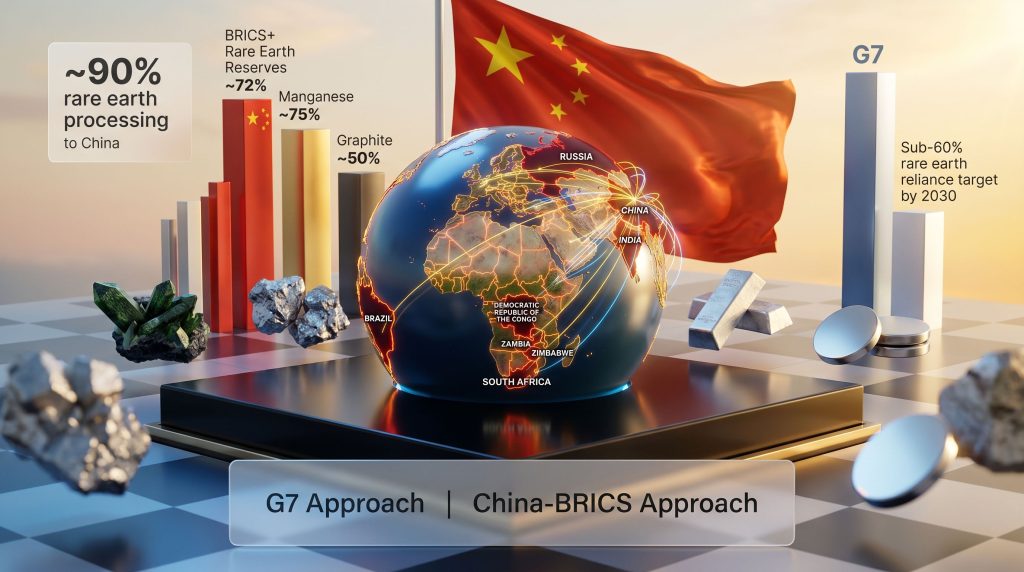
| Rare Earth Elements | ~40% of mining; ~90% of processing | EV motors, defence systems, advanced electronics |
| Cobalt | Dominant in processing | Battery cathodes; DRC supplies ~60% of global exports, nearly all routed through China |
| Lithium | Dominant in processing | EV batteries; ~80% of Chilean lithium exports flow to China |
| Graphite | High concentration in both extraction and refining | Battery anode material for EVs |
| Nickel | Significant processing share | Stainless steel, battery chemistry, defence manufacturing |
Several features of this table deserve attention beyond their headline figures. In cobalt, the Democratic Republic of the Congo produces approximately 60% of global supply, yet the overwhelming majority of that material passes through Chinese processing infrastructure before reaching battery manufacturers in South Korea, Japan, or Europe. This creates a structural dependency that is invisible at the extraction level but decisive at the manufacturing level.
In lithium, a similar pattern holds. Chile and Australia together account for the majority of global lithium mining output, yet an estimated 80% of Chilean lithium exports ultimately flow into Chinese processing facilities. The geographic origin of the ore matters far less than the nationality of the entity that upgrades it into battery-grade lithium carbonate or lithium hydroxide.
China's overall share of global critical mineral production sits at approximately 60% across key commodity categories, but its processing dominance across multiple materials exceeds 85% when measured at the value-added midstream stage. This is the chokepoint that gives Beijing its structural leverage.
China's Vertical Integration Model: Owning the Whole Chain
China's resource strategy is not simply about having large domestic deposits. It is built on a deliberate model of vertical integration that combines overseas asset acquisition with domestic processing capacity. By financing and operating mining assets abroad through state-backed investment vehicles while simultaneously maintaining a near-monopoly on refining infrastructure at home, Beijing has constructed a system in which it controls multiple nodes of the supply chain simultaneously.
In the DRC alone, Chinese firms are estimated to have operational involvement in approximately 80% of the country's critical mineral production assets, according to industry analysis of Chinese investment patterns in the region. These assets feed cobalt and copper concentrates directly into Chinese processing networks, creating a pipeline that is difficult to interrupt without disrupting global manufacturing supply chains.
June 2025 demonstrated how this leverage translates into policy action. China's rare earth export restrictions on rare earth alloy exports served as an important signal to global markets that Beijing is willing to use its processing chokehold as an instrument of trade policy, not merely as a passive commercial advantage. This was not a hypothetical risk scenario; it was a documented demonstration of supply chain weaponisation.
What Is the G7 Actually Doing? Mapping the De-Risking Architecture
G7 leaders have formalised an ambitious coordinated response to China's mineral dominance. The headline commitment targets reducing dependence on Chinese supply for rare earths and permanent magnets to below 60% by 2030, with a longer-term aspiration of reaching 50%. The permanent magnet focus is significant: these components are essential to the electric drivetrains in EVs and to the guidance systems in precision defence platforms, making them among the highest-priority inputs in both civilian and military supply chains.
The operational architecture of the G7 approach rests on three pillars:
- Joint stockpiling mechanisms designed to build strategic reserves that provide buffer time during supply disruptions
- Expanded recycling infrastructure aimed at increasing secondary supply from end-of-life electronics, batteries, and industrial equipment
- An IEA-supported policy monitoring platform that enables real-time supply risk assessment and coordinates crisis response protocols across member economies
Supplementing these mechanisms is the $64 billion critical minerals investment commitment that the G7 has channelled toward emerging market producers, with the explicit goal of building alternative upstream supply relationships. The Minerals Security Partnership (MSP) serves as the institutional vehicle for this friend-shoring effort, coordinating investment flows toward politically aligned producers in Africa, Australia, Latin America, and Greenland.
The US securing preliminary access to Kenya's estimated $62.4 billion rare earth deposit exemplifies this competitive investment dynamic, representing a direct effort to secure upstream supply outside Chinese influence networks.
However, the G7 strategy faces a structural constraint that no amount of investment capital can immediately resolve. Building mining operations typically takes five to ten years from discovery to production. Building refining and processing infrastructure for specialty materials takes additional years and requires deeply specialised technical knowledge. The West's processing capacity gap cannot be filled by policy commitments alone; it requires patient capital, workforce development, and technology transfer at a scale and pace that has not yet materialised.
Is the European Response Sufficient?
In addition to G7-level coordination, the European critical raw materials facility represents a significant institutional effort to address Europe's particular vulnerability. However, the continent's processing gap remains acute, and observers question whether regulatory timelines align with the urgency of the supply challenge.
Why China Is Weaponising BRICS as a Minerals Shield
Beijing's response to G7 de-risking pressure is strategically elegant in its architecture. Rather than attempting to directly block Western diversification efforts, China is building a distributed network of aligned supply relationships through the BRICS framework that insulates its position regardless of how successful Western diversification proves to be.
At the 16th Meeting of BRICS National Security Advisors, China's Foreign Affairs chief Wang Yi articulated Beijing's intent clearly. He called for deepened coordination among BRICS members on strategic minerals and energy security, framing the grouping as a multilateral platform capable of delivering supply chain resilience outside Western institutional frameworks. Wang positioned closer BRICS cooperation as a counterweight to what Beijing characterises as unilateral and protectionist trade measures, situating the minerals question within a broader agenda of global governance reform.
The BRICS+ framework, expanded and formalised in 2024, provides the structural basis for this strategy. The collective resource reserve position of BRICS+ nations is extraordinary:
| Mineral Resource | BRICS+ Share of Global Reserves | Strategic Significance |
|---|---|---|
| Rare Earth Elements | ~72% | Core input for clean energy and defence technology |
| Manganese | ~75% | Battery production, steel manufacturing |
| Graphite | ~50% | Battery anode material for EVs |
"BRICS is not functioning as a mirror-image alternative to Western supply chains. It is operating as a stabilising buffer that reduces China's exposure to G7 diversification pressure while preserving Beijing's dominance over the highest-value processing segment of the global minerals order."
Consequently, the China BRICS critical minerals network is becoming more formally institutionalised with each successive multilateral summit, deepening the strategic challenge for Western policymakers.
The BRICS Minerals Network: Node-by-Node Analysis
Africa: The Extraction Frontier
Africa represents the most critical upstream node within China's BRICS-aligned minerals network. Chinese firms with extensive operational presence across the DRC and Zambia dominate cobalt and copper extraction, while exposure to lithium assets in Zimbabwe and manganese deposits across southern Africa continues to expand rapidly.
What makes Africa particularly strategically complex is the growing trend among African governments toward restricting the export of unprocessed minerals. Multiple countries have introduced or are considering beneficiation requirements that would compel value-added processing to occur domestically before export. Africa's strategic leverage in this competitive dynamic is increasingly recognised by analysts, as the continent seeks to move beyond raw extraction and capture greater value from its resource endowment.
Brazil: The Battery Metal Diversifier
Brazil's geological endowment positions it as a significant diversification node within the BRICS minerals architecture. As the world's dominant producer of niobium and a major holder of rare earth-linked mineral deposits, Brazil provides China with supply relationships that extend well beyond African concentrations. Growing lithium and nickel exploration activity across Brazil's interior is increasingly attracting Chinese state-backed capital, reinforcing the country's role in the battery supply chain.
Russia: Industrial and Defence-Grade Inputs
Russia's contribution to the BRICS minerals network is primarily industrial rather than battery-focused. Its production of nickel, palladium, and specialised industrial minerals serves defence and advanced manufacturing applications. Under conditions of Western sanctions, Russian mineral exports have become more tightly channelled toward Chinese industrial consumers, deepening the bilateral supply relationship within the broader BRICS framework.
India: The Demand Variable and Emerging Refiner
India's role within the BRICS minerals framework is more complex than a simple alignment story. As a rapidly growing consumer of battery materials and a country with explicit ambitions to build domestic refining and battery manufacturing capacity, India represents both an aligned demand node and an independent actor pursuing its own supply diversification strategy. This creates genuine tension within BRICS mineral cooperation, as Indian and Chinese interests in upstream supply relationships are not always congruent.
The next major ASX story will hit our subscribers first
The Overlapping Supply Chain Problem: Why Clean Decoupling Is a Fiction
The most important and least-discussed aspect of the G7 de-risking effort is the degree to which newly constructed Western supply chains remain structurally entangled with BRICS-linked production networks. This is not a transitional problem that will resolve itself over time; it reflects deep capital and operational integration that has accumulated over two decades.
Consider the layered complexity:
- A Western automaker sources lithium from an Australian mine partly capitalised by Chinese investment
- That lithium is refined in a facility with Chinese-licensed processing technology
- The refined material is incorporated into battery cells manufactured in a South Korean plant that sources graphite anode material from China
- The finished battery is installed in a European-assembled vehicle sold into a global market
At what point in this chain has the Western economy successfully de-risked from China? The honest answer is: not fully, at any point. This is what analysts mean when they describe the emerging global mineral order as a system of overlapping supply chains rather than parallel or competing ones.
The midstream processing gap is the most acute constraint. Even where the G7 succeeds in securing upstream mining access through the MSP or bilateral investment treaties, the absence of sufficient Western refining capacity means that ore and concentrate frequently still passes through Chinese processing infrastructure before reaching Western manufacturers. Understanding rare earth supply chains at this level of granularity is increasingly essential for policymakers and investors alike.
Competing Strategic Frameworks: A Comparative Assessment
| Strategic Dimension | G7 Approach | China-BRICS Approach |
|---|---|---|
| Primary objective | Reduce Chinese processing dependency | Reinforce distributed supply network resilience |
| Key mechanism | Friend-shoring, stockpiling, recycling | State-backed investment, BRICS coordination |
| Institutional vehicle | MSP, IEA platform | BRICS National Security framework, policy banks |
| Timeline | Sub-60% rare earth reliance by 2030 | Ongoing; accelerated post-2024 BRICS+ expansion |
| Geographic focus | Greenland, Africa, Australia, Latin America | DRC, Zambia, Zimbabwe, Brazil, Russia |
| Structural vulnerability | Processing infrastructure gap | Dependence on politically complex partner states |
Furthermore, the intersection of critical minerals and energy security is increasingly shaping how both blocs frame their long-term industrial policy, elevating the strategic importance of China BRICS critical minerals competition beyond purely commercial considerations. Analysts at the CSIS have documented how Western economies have repeatedly failed to secure mineral assets ahead of Chinese state-backed competitors, highlighting systemic weaknesses in the Western response architecture.
Frequently Asked Questions: China, BRICS, and Critical Minerals
What percentage of global rare earth processing does China control?
China controls approximately 90% of rare earth processing globally, even though its share of raw extraction is closer to 40%. This processing dominance, not extraction alone, is the core of its strategic leverage over global supply chains.
What is BRICS+ and when was the expanded framework formalised?
The BRICS+ framework was formalised in 2024 and collectively represents approximately 72% of global rare earth reserves, 75% of manganese reserves, and 50% of graphite reserves, positioning it as a structurally significant counterweight to Western-led supply chain diversification efforts.
Why can the G7 not simply build its own critical minerals supply chain?
The primary constraint is midstream processing capacity. Even where Western economies can secure upstream mining access, refining and processing infrastructure for battery-grade and magnet-grade materials takes many years to construct and requires highly specialised technical expertise that is currently concentrated in China.
How are African nations responding to the G7 versus BRICS investment competition?
Many African governments are leveraging the competitive dynamic between Western and Chinese-aligned capital to negotiate better terms on resource development agreements. Growing export restrictions on unprocessed minerals reflect a broader push to capture greater value-added processing within African borders rather than exporting raw ore at low margins.
What did China's June 2025 export restrictions demonstrate?
The restrictions on rare earth alloy exports demonstrated that Beijing is willing to use its processing dominance as an active policy instrument rather than a passive commercial advantage. This China BRICS critical minerals tension signals that supply access cannot be assumed even where long-term contracts exist.
Disclaimer: This article contains forward-looking analysis, market projections, and geopolitical assessments that involve inherent uncertainty. Data on market share figures, reserve estimates, and investment commitments reflect publicly available information and may change as conditions evolve. This content does not constitute financial advice. Investors should conduct independent research before making investment decisions related to any sector, commodity, or geography discussed herein.
Want to Capitalise on the Next Major Critical Minerals Discovery Before the Market Moves?
As the global race for critical minerals processing dominance intensifies, Discovery Alert's proprietary Discovery IQ model scans ASX announcements in real time, instantly notifying subscribers of significant mineral discoveries across rare earths, lithium, cobalt, and beyond — turning complex geological data into clear, actionable investment opportunities. Explore how historic mineral discoveries have generated substantial returns, then begin your 14-day free trial at Discovery Alert to position yourself ahead of the market.