June 24, 2026
The Gap Between "Toll-Free" and Actually Free: Decoding Hormuz Transit in 2026
Few geographic features carry as much economic weight as a body of water barely 33 kilometres wide at its narrowest point. The Strait of Hormuz has long functioned as the world's most consequential maritime chokepoint, and recent diplomatic developments surrounding its Strait of Hormuz toll-free passage status have generated headlines that require careful unpacking. What sounds like a straightforward declaration of open passage is, on closer examination, a layered arrangement shaped by international law, geopolitical trade tensions, and enforcement realities that no announcement alone can fully resolve.
When big ASX news breaks, our subscribers know first
Why the Strait of Hormuz Holds the Global Economy Hostage
The Arithmetic of a Single Passage
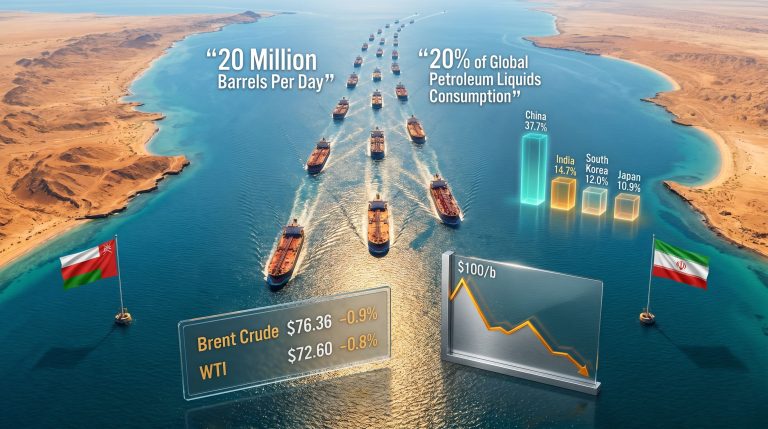
Roughly one-fifth of the world's total oil supply moves through the Strait of Hormuz every year, making it the most consequential single transit corridor in the global energy system. The strait serves as the sole maritime exit for major Persian Gulf exporters including Saudi Arabia, Iraq, Kuwait, and the United Arab Emirates. There is no functionally equivalent alternative for these producers at comparable cost or scale.
The economic consequences of sustained disruption are not theoretical. Historically, even credible threats to Hormuz transit have triggered rapid upward movements in global oil benchmarks, sharp increases in war-risk insurance premiums, and elevated freight rates across multiple commodity classes. The waterway's strategic sensitivity extends well beyond crude oil to include LNG supply outlook, bulk carriers, and container vessels serving Asian manufacturing hubs.
Coastal Geography as Strategic Leverage
What makes the Strait of Hormuz structurally different from most international shipping lanes is the asymmetric control geography confers on Iran. The country's northern coastline dominates the strait's navigable corridor, a position that grants Tehran leverage over vessel movements that extends beyond what international maritime law formally authorises.
The operational enforcement arm for Iranian maritime policy has historically been the Islamic Revolutionary Guard Corps Navy, which maintains patrol assets, fast-attack vessels, and shore-based missile systems capable of threatening commercial shipping within the strait. This creates a structural vulnerability that no diplomatic agreement fully eliminates unless it addresses the physical enforcement architecture itself.
Transit through international straits is governed by a complex intersection of customary international law and the United Nations Convention on the Law of the Sea. Furthermore, unlike open ocean navigation, strait passage involves coastal state prerogatives that create ambiguity even under the best diplomatic conditions.
What the U.S.-Iran MOU Actually Contains
The 14-Point Framework and Its Hormuz Provisions
Following a ceasefire framework formalised in June 2026, Washington and Tehran agreed to a structured interim arrangement addressing hostilities across multiple theatres. The memorandum of understanding explicitly included a 60-day toll-free transit window for commercial vessels navigating the Strait of Hormuz, alongside provisions aimed at ending active conflict in Lebanon, where Iran-backed Hezbollah had maintained ongoing operations against Israeli forces.
President Trump confirmed publicly that Iran had communicated no tolls, insurance surcharges, or transit fees would be applied to passing vessels. The administration also indicated that frozen Iranian financial assets under U.S. control would be redirected toward purchases of American agricultural commodities, specifically corn, wheat, and soybeans, to address food supply shortfalls inside Iran.
A presidential statement affirming that a waterway will be toll-free does not carry the enforceability of a ratified international maritime agreement. The 60-day window represents a temporary diplomatic posture within a broader negotiating framework, not a permanent structural resolution of transit rights.
What Has Not Been Confirmed
Several critical details remain unverified or publicly unresolved:
- No independent confirmation from Tehran has established whether the toll-free commitment extends beyond the initial 60-day period
- The precise mechanism for releasing frozen Iranian assets and directing them toward agricultural purchases has not been detailed publicly
- The MOU's multi-theatre scope, covering Hormuz, Lebanon, and nuclear-adjacent issues, means that progress in any single dimension is linked to developments involving parties who are not direct signatories
- Washington and Tehran have continued to dispute certain details of the 14-point framework even after its signing
Toll-Free in Name, Restricted in Practice: The Operational Reality
A Factual Status Comparison
The gap between official statements and operational reality is significant enough to warrant direct comparison across key dimensions.
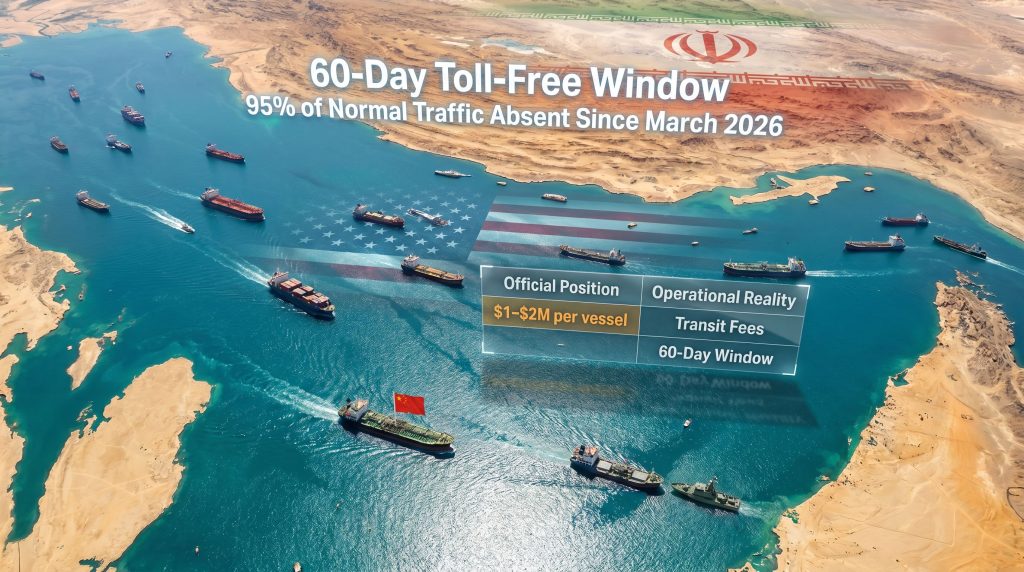
| Dimension | Official Position | Operational Reality |
|---|---|---|
| Transit Fees | Declared toll-free by Trump | Iran reportedly levying "service fees" of $1-$2 million per vessel in Chinese yuan |
| Duration | 60-day window under MOU | No confirmed extension mechanism exists |
| Vessel Vetting | Not addressed publicly | IRGC continues screening vessels and issuing clearance codes |
| Legal Basis | Framed as diplomatic goodwill | Iran cites maritime safety and environmental services as fee justification |
| Traffic Volume | Expected to normalise | Approximately 95% of normal shipping traffic had ceased since March 2026 |
| Vessel Differentiation | Universal toll-free passage claimed | Friendly nations reportedly transiting without fees; others reportedly facing charges |
Iran's "Service Fee" Architecture: How It Works
Prior to the MOU, Iran had constructed a systematic clearance regime requiring vessels to obtain IRGC-issued authorisation codes before entering the strait corridor. Ships from nations Iran classified as adversarial faced fees reportedly ranging from $1 million to $2 million per transit, payable in Chinese yuan rather than U.S. dollars. This currency arrangement simultaneously circumvented dollar-based sanctions while generating hard currency revenue for Tehran.
The differentiated treatment of vessels based on their flag state's relationship with Iran created a two-tier transit system. Vessels from China, Russia, and India reportedly moved through without fee obligations, while ships from Western-aligned nations faced the full fee structure. Consequently, this selective enforcement undermined any claim to universal transit rights and introduced a political dimension to what should be a purely navigational question.
By the time the MOU was announced, the cumulative effect of this enforcement architecture and associated oil market disruption had driven approximately 95% of normal commercial shipping traffic away from the strait, representing one of the most severe maritime disruption events in the waterway's recorded history. The economic damage extended well beyond oil markets, affecting LNG supply chains, container shipping schedules, and bulk commodity flows across multiple sectors.
The Legal Battleground: UNCLOS, Sovereignty, and the Enforcement Gap
What International Maritime Law Actually Says
The Strait of Hormuz meets the threshold for designation as an international strait under the United Nations Convention on the Law of the Sea. Under this framework, all vessels, including commercial and military ships, hold the right of transit passage, a standard that is more permissive than the innocent passage doctrine that applies to territorial waters.
Key provisions relevant to the current situation include:
- Coastal states cannot suspend transit passage rights, even during periods of heightened national security concern
- Laws and regulations adopted by coastal states must relate to genuine safety of navigation or traffic separation and cannot amount to a de facto denial of transit
- Under UNCLOS Article 26(1), fees may only be collected for specific, genuinely rendered services such as pilotage or lighthouse maintenance, not for the act of granting passage itself
- Iran's broad "safety permit" requirements and mandatory IRGC escort protocols do not align with the narrow service-fee exceptions that UNCLOS recognises
According to maritime legal experts, any system of charging vessels for safe passage through an international strait has no defensible basis under international maritime frameworks. The semantic distinction Iran draws between "tolls" (which it claims not to charge) and "service fees" (which it continues to apply) is operationally indistinguishable from the commercial operator's perspective.
Iran is not a signatory to UNCLOS, which it has argued limits the treaty's binding authority over Iranian maritime policy. This creates a significant enforcement gap: no compulsory dispute resolution mechanism exists that can be formally invoked against a non-signatory state.
Why Legal Frameworks Have Limited Practical Effect
The absence of a multilateral naval enforcement mechanism means UNCLOS provisions function as normative standards in the Hormuz context rather than binding constraints with immediate enforcement consequences. U.S. naval presence in the region has historically served as the primary practical deterrent against Iranian interference with commercial shipping, a dynamic that the current diplomatic engagement complicates considerably.
If de-escalation reduces U.S. naval posture in the Gulf while Iran retains its IRGC enforcement infrastructure, the effective deterrence balance may shift in ways that are not immediately visible in official statements.
Three Ways to Interpret "Toll-Free": Competing Analytical Frameworks
Understanding what the current arrangement actually represents requires moving beyond the surface-level diplomatic language. Three distinct interpretive frameworks offer useful perspectives.
Framework 1: The Diplomatic Signal Interpretation
The 60-day toll-free window functions primarily as a confidence-building measure embedded within a broader negotiating process covering nuclear issues, regional security, and sanctions relief. Its value is symbolic and procedural rather than substantive. The arrangement demonstrates Iranian willingness to participate in de-escalation without requiring Tehran to permanently relinquish any enforcement capability or revenue mechanism.
Framework 2: The Semantic Arbitrage Interpretation
Iran has strategically constructed a distinction between "tolls" (politically and legally untenable under international norms) and "service fees" (framed as legally defensible compensation for rendered services). This semantic positioning allows Tehran to publicly comply with the diplomatic commitment while maintaining economic leverage over maritime traffic. The ambiguity is a feature of the arrangement from Iran's perspective, not a flaw.
Framework 3: The Enforcement Gap Interpretation
Even if both parties agree on Strait of Hormuz toll-free passage in principle, the continuation of IRGC vetting, clearance code requirements, and mandatory escort protocols functionally recreates the conditions of a restricted transit regime. The absence of a formal fee does not constitute genuinely free and unimpeded passage under international maritime standards, particularly when vessels must obtain authorisation from a military entity before transiting.
The next major ASX story will hit our subscribers first
The Agricultural Dimension and Domestic U.S. Interests
Food Exports as Diplomatic Infrastructure
The Trump administration's announcement that frozen Iranian assets under U.S. control would fund purchases of American corn, wheat, and soybeans introduces a dimension that is easy to overlook amid the focus on maritime rights. This structure creates a domestic political constituency for sustaining the agreement, as American agricultural producers gain a direct financial interest in the arrangement's continuity.
The mechanism also provides a sanctions-compatible pathway for releasing restricted Iranian funds, avoiding the political difficulties associated with direct cash transfers. By channelling the funds through U.S. agricultural commodity markets, the administration addresses Iranian food security concerns while generating economic activity in American farming communities.
This linkage between toll-free transit and U.S. domestic farm sector interests represents a novel form of diplomatic architecture — one that creates interdependencies designed to make the arrangement politically durable on the American side regardless of how the broader negotiation evolves. However, the broader context of oil trade geopolitics suggests that commercial energy markets will remain cautious until the full framework is ratified.
What Durable Resolution Would Actually Require
Beyond Announcements: The Conditions for Genuine Normalisation
Restoring normal commercial traffic volumes through the Strait of Hormuz requires more than a verbal diplomatic commitment, however high-profile. Several conditions would need to be visibly satisfied before commercial operators and marine insurers would treat the waterway as genuinely open:
- Verifiable cessation of IRGC vessel interception and boarding operations against ships from all flag states without differentiation
- Elimination of mandatory clearance code requirements that effectively recreate a permission-based transit system regardless of fees
- Transparent confirmation from Tehran that the toll-free commitment extends beyond the 60-day interim window with defined conditions for continuation
- Independent maritime observation or third-party verification of Iranian compliance, which does not currently appear to be part of the MOU framework
- Normalisation of war-risk insurance assessments by Lloyd's of London and comparable underwriters, which requires sustained operational evidence rather than policy announcements
The multi-theatre structure of the MOU adds further complexity. Because the agreement links Hormuz transit to the Lebanon conflict and nuclear-adjacent discussions, a breakdown in any single dimension could destabilise the entire arrangement. This interconnection creates fragility that an oil price shock could amplify rapidly, and commercial operators and energy market participants are right to factor this into their risk assessments.
Frequently Asked Questions: Strait of Hormuz Toll-Free Passage
Is the Strait of Hormuz permanently toll-free following the 2026 agreement?
No. The arrangement establishes a 60-day toll-free transit window as part of an interim MOU. Permanent toll-free status has not been confirmed, and Iran has not formally committed to extending the arrangement beyond the interim period. The terms of any long-term agreement have not been publicly disclosed.
What fees was Iran charging before the MOU?
Reports indicate Iran was levying fees of approximately $1 million to $2 million per vessel for strait transit, payable in Chinese yuan. Tehran characterised these as "service fees" rather than tolls, though this distinction is widely contested by maritime law specialists. In fact, analysts have noted that the two parties continue to differ significantly on what the arrangement means beyond the initial 60-day window.
Does international law prohibit Iran from charging for passage?
Under UNCLOS, coastal states cannot charge for transit passage through international straits beyond genuinely rendered specific services. However, Iran is not a signatory to UNCLOS, which limits the treaty's direct enforceability against Iranian policy and removes access to compulsory dispute resolution mechanisms.
Why did shipping traffic decline so severely?
Commercial operators and marine insurers responded to fee uncertainty, IRGC enforcement activity, and elevated geopolitical risk by rerouting vessels or suspending Hormuz transits entirely. By the time the MOU was announced, approximately 95% of normal traffic volume had ceased, creating a near-total commercial disruption of one of the world's most critical maritime corridors.
What happens when the 60-day window expires?
The outcome depends on progress across the full scope of U.S.-Iran negotiations. If a final comprehensive agreement is not reached, or if either party disputes the terms of the MOU, the fee-based enforcement regime and IRGC clearance protocols could be reinstated without a permanent Strait of Hormuz toll-free settlement in place.
Disclaimer: This article contains analysis of an evolving geopolitical situation. Assessments of diplomatic agreements, maritime conditions, and market implications reflect information available at the time of writing and are subject to change as negotiations develop. Nothing in this article constitutes financial, legal, or investment advice.
Want to Stay Ahead of the Resource Opportunities Emerging From Global Energy Disruptions?
Discovery Alert's proprietary Discovery IQ model delivers real-time alerts on significant ASX mineral discoveries, instantly translating complex data across 30+ commodities into clear, actionable insights — so subscribers can identify high-potential opportunities the moment they emerge. Explore how historic discoveries have generated substantial returns and begin your 14-day free trial at Discovery Alert to position yourself ahead of the broader market.