
June 24, 2026
How Commodity Benchmark Timing Shapes Market Confidence in Battery Raw Materials
In the world of commodity price reporting, the gap between when a market is most active and when a benchmark is actually published is rarely discussed openly. Yet that gap carries real consequences. A price assessment anchored to the wrong time zone can systematically miss the peak of market activity, capture stale data, or introduce lag into what should be a real-time signal. For battery raw materials sourced overwhelmingly from China, this problem is not hypothetical. It is structural, and it is now being addressed through the spherical graphite FOB China assessment publication time amendment.
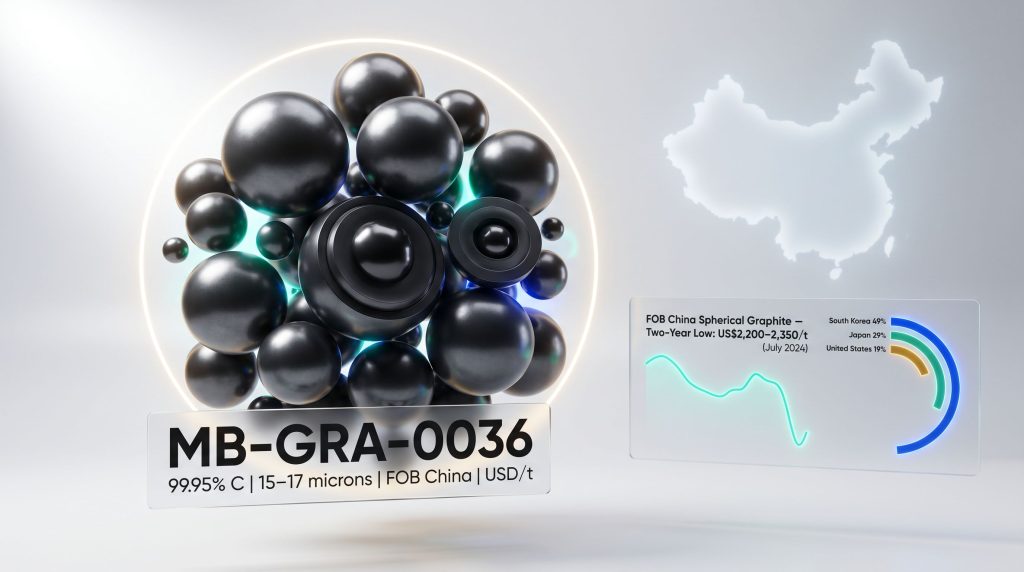
Fastmarkets has proposed a targeted amendment to its spherical graphite FOB China assessment (MB-GRA-0036), shifting the weekly publication time from 4:00 PM London time to 5:00–6:00 PM Shanghai time every Thursday. The proposal also includes realigning the associated holiday schedule with China's domestic pricing calendar. Together, these changes represent a significant methodological refinement that procurement teams, contract managers, and supply chain analysts across the battery industry should take seriously.
When big ASX news breaks, our subscribers know first
Understanding the MB-GRA-0036 Assessment and Its Role in Global Anode Supply Chains
The spherical graphite FOB China assessment published under code MB-GRA-0036 occupies a specific and commercially important position within the battery materials pricing ecosystem. Its full specification is as follows:
| Attribute | Specification Detail |
|---|---|
| Assessment Code | MB-GRA-0036 |
| Material | Graphite, spherical, uncoated |
| Carbon Purity | 99.95% C |
| Particle Size Range | 15–17 microns |
| Trade Term | FOB China |
| Currency/Unit | USD per tonne |
| Minimum Quantity | 20 tonnes |
| Publication Frequency | Weekly, every Thursday |
The 99.95% carbon purity threshold is not arbitrary. Lithium-ion battery cells require anode-grade graphite that meets extremely tight purity standards. At this level, the material is compatible with the electrochemical demands of high-performance cells used in electric vehicles and grid-scale energy storage applications. Impurities beyond trace levels compromise cycle life, capacity, and thermal stability.
The 15–17 micron particle size range is equally deliberate. This specification reflects the range of product actively traded in commercial volumes across China's export port market. An earlier iteration of this assessment was anchored to a strict 15-micron specification, but the expansion to a 15–17 micron range acknowledges that Chinese processors produce and export across this band. The broadened range improves representativeness without sacrificing analytical precision.
Why China's Dominance Makes This Price Signal Globally Consequential
China is not merely a major participant in spherical graphite production — it is the dominant one by a margin that has no parallel in most other battery raw materials. The country controls the overwhelming majority of global spherical graphite processing capacity, and its export pricing directly sets the reference level for procurement teams in South Korea, Japan, the United States, and increasingly Europe. Furthermore, critical minerals demand in these regions continues to accelerate, amplifying the importance of accurate price signals.
The concentration of export destinations further illustrates this dynamic. Based on 2024 trade flow data, South Korea absorbed approximately 49% of China's spherical graphite exports, Japan received around 29%, and the United States accounted for roughly 19%. These three markets alone represent the core of the global lithium-ion battery manufacturing complex, meaning the FOB China price signal is effectively the input benchmark for anode supply chains feeding the world's most advanced battery cell producers.
The accuracy and timeliness of FOB China spherical graphite price assessments carry systemic importance across three of the largest battery-producing nations. A methodology misaligned with Chinese market activity hours introduces systematic distortion into global anode procurement benchmarks.
The Publication Time Amendment: From London Clocks to Shanghai Trading Hours
Why Time Zone Alignment Is a Methodology Issue, Not an Administrative One
The proposed amendment to the spherical graphite FOB China assessment publication time addresses a structural inefficiency that has existed since the assessment was first constructed around Western market operating conventions. Publishing at 4:00 PM London time means the assessment window closes at approximately midnight Shanghai time during standard periods, and earlier during winter when the time difference widens further.
China's spherical graphite spot market at export ports, however, operates during Chinese business hours. By the time a London-based assessment window closes, Chinese traders have already wound down for the day. This creates a scenario where the most price-sensitive trading activity occurs outside the effective data capture window of the assessment — a concern that mirrors the global graphite shortage dynamics already putting pressure on supply chain transparency.
The result is a benchmark that may consistently reflect the prior day's sentiment rather than same-day concluded transactions. For commodity indices that feed into long-term supply agreements or quarterly procurement budgets, even small systematic lags compound meaningfully over time.
The proposed shift to 5:00–6:00 PM Shanghai time resolves this by anchoring the publication window to the close of active Chinese trading hours, capturing final concluded transactions, end-of-day spot indications, and the price compression or expansion that occurs as market participants finalise positions before close.
The Holiday Calendar Realignment and Its Practical Significance
The secondary component of this amendment — aligning the publication holiday schedule with China's domestic pricing calendar rather than Western market conventions — is subtler but equally important. Chinese public holidays, including Golden Week in early October and the Lunar New Year break in January or February, represent periods of dramatically reduced export port activity.
Under the current structure, the assessment may continue publication during periods when Chinese market participants are absent, potentially relying on thin or unrepresentative data. Conversely, the assessment may pause on Western holidays when Chinese markets are fully operational. Correcting this inversion ensures that price continuity and price gaps reflect actual Chinese market conditions rather than calendar conventions designed for a different hemisphere.
Where Spherical Graphite Prices Stand and Why Benchmark Quality Matters Now
Price Compression Has Raised the Stakes for Assessment Accuracy
The graphite market entered a prolonged period of price weakness in 2023 and 2024. FOB China spherical graphite at 99.95% carbon purity and 15 microns reached a two-year low of approximately US$2,200–2,350 per tonne in early July 2024. This compression, driven by Chinese overcapacity and weak downstream demand growth relative to supply expansion, has intensified the commercial sensitivity of individual price assessments.
When prices are elevated and trending upward, even a benchmark with minor methodological imperfections can serve procurement needs adequately. However, when margins are thin and prices are compressed, the difference between a well-calibrated and a poorly timed assessment can materially affect contract settlement values, cost-of-goods modelling, and hedging decisions.
China's spherical graphite producers saw export volumes decline by approximately 28% in the first eight months of 2024 compared to the same period the prior year. In a tightening export environment with falling prices, the reliability of every data point feeding into the weekly assessment becomes more critical. A publication window that consistently misses peak liquidity is less defensible when markets are under stress than when they are liquid and trending.
Comparing Assessment Approaches in the Graphite Pricing Landscape
| Feature | Fastmarkets MB-GRA-0036 (Post-Amendment) | S&P Global (Platts) Equivalent |
|---|---|---|
| Publication Frequency | Weekly | Daily |
| Particle Size Specification | 15–17 microns | 15 microns |
| Publication Time Reference | Shanghai time (5–6 PM) | Not specified |
| Holiday Calendar | Chinese pricing calendar | Not specified |
| Carbon Purity | 99.95% C | 99.95% C |
| Trade Term | FOB China | FOB China |
The divergence in particle size specification between Fastmarkets and S&P Global reflects two different methodological philosophies. A strict 15-micron specification prioritises precision and comparability to a single grade standard, whereas the 15–17 micron range prioritises market representativeness. Users employing multiple benchmark sources for cross-validation should account for this specification difference when reconciling price signals. For broader context, the latest battery raw materials update provides further insight into how these methodological differences affect procurement strategy.
The Consultation Process: How the Amendment Moves Toward Implementation
Step-by-Step Timeline for the MB-GRA-0036 Amendment
-
Proposal Published on Thursday, June 25, 2026, with the full rationale and specification changes outlined in a formal pricing notice.
-
Consultation Period Opens on the same date, inviting feedback from market participants, data submitters, procurement professionals, and industry stakeholders.
-
Consultation Period Closes on Friday, August 7, 2026, after which all submissions are reviewed by Fastmarkets' pricing team.
-
Amendment Implementation is scheduled for Thursday, August 13, 2026, subject to the outcome of market feedback.
-
Holiday Schedule Update takes effect simultaneously, realigning publication dates with China's domestic pricing calendar going forward.
| Milestone | Date |
|---|---|
| Proposal Published | Thursday, June 25, 2026 |
| Consultation Period Opens | Thursday, June 25, 2026 |
| Consultation Period Closes | Friday, August 7, 2026 |
| Amendment Effective Date | Thursday, August 13, 2026 (subject to feedback) |
How Market Participants Can Engage
Fastmarkets actively encourages participation from anyone with commercial exposure to or market knowledge of spherical graphite trading. This includes:
- Battery cell manufacturers and anode material processors who use the assessment as a contract reference
- Procurement and supply chain teams at electric vehicle manufacturers with anode cost exposure
- Trading companies and logistics providers active in China's graphite export market
- Financial institutions using the assessment for structured products or risk management purposes
- Mining companies and downstream processors seeking to influence how export price benchmarks are constructed
Feedback submissions should reference Re: Graphite spherical fob China price in the subject line and can be directed to Fastmarkets' pricing team. Confidentiality requests are accommodated, and non-confidential submissions are made available to the broader market upon request, maintaining the transparency that gives price reporting agency methodologies their institutional credibility.
The next major ASX story will hit our subscribers first
The Broader Maturation of Graphite as a Benchmark Commodity
From Industrial Mineral to Critical Material: What This Amendment Reflects
Spherical graphite has undergone a quiet transformation in how it is perceived and traded by the global commodity market. A decade ago, it was largely treated as a niche industrial mineral with limited price reporting infrastructure. Today, it sits at the intersection of electric vehicle production, grid-scale battery deployment, and critical mineral supply chain security.
This maturation is visible in the increasing rigour applied to how price benchmarks are structured, governed, and refined. The amendment to MB-GRA-0036 is not a response to a crisis but a proactive calibration of methodology to market reality. It reflects growing recognition that the quality of a price benchmark must evolve alongside the markets it serves.
For procurement professionals, this means the data inputs feeding their cost models are becoming progressively more reliable. For contract counterparties, it means settlement references are becoming more defensible. In addition, developments such as the Chinese battery recycling breakthrough and the emergence of a recycled graphite product market are introducing new pricing dynamics that benchmark administrators will need to accommodate over time.
The trajectory of graphite price reporting mirrors the broader evolution of battery raw material markets: from informally priced specialty products toward rigorously benchmarked commodities with transparent, participant-driven methodology governance.
The fact that this amendment is being executed through a formal public consultation rather than a quiet internal revision also carries significance. It reinforces the principle that price reporting agency benchmarks derive their authority from market participant trust, and that trust is maintained through transparency, consultation, and responsiveness to how real markets actually operate. Consequently, the impact of export restrictions from China adds further urgency to ensuring these benchmarks accurately reflect real trading conditions.
Market participants relying on the spherical graphite FOB China assessment publication time amendment for contract indexing or procurement benchmarking should review their internal processes ahead of the August 13 implementation date to ensure settlement and reporting workflows remain aligned with the updated publication window.
This article is informational in nature and does not constitute financial or investment advice. Forward-looking statements, price forecasts, and market projections are subject to change and should not be relied upon as the sole basis for commercial decisions. Readers are encouraged to conduct independent due diligence and consult Fastmarkets' official methodology documentation at fastmarkets.com/methodology for authoritative specification and process details.
Want to Stay Ahead of Major Mineral Discoveries Shaping the Battery Materials Sector?
Discovery Alert's proprietary Discovery IQ model delivers real-time alerts on significant ASX mineral discoveries — including critical battery raw materials — translating complex market data into clear, actionable investment insights for traders and long-term investors alike. Explore how historic mineral discoveries have generated substantial returns by visiting Discovery Alert's dedicated discoveries page, and begin your 14-day free trial today to position yourself ahead of the market.