June 23, 2026
The Engineering Logic Behind Ultra-Deepwater Multi-Block Development
Deepwater oil development is, at its core, an engineering economics problem. The deeper the water, the more sophisticated the infrastructure required, and the more aggressively operators must seek capital efficiency to justify investment at all. In basins like the Lower Congo off the coast of Angola, where geological prospectivity is high but water depths routinely exceed 1,500 metres, the conventional approach of developing each concession block in isolation has increasingly run into a hard economic ceiling. The capital cost of duplicating subsea systems, FPSOs, and export pipelines across adjacent blocks erodes per-barrel economics to a point where otherwise viable reserves sit undeveloped for years.
This tension between geological opportunity and development economics is precisely the context in which the Azule Energy Greater PAJ offshore oil project in Angola becomes significant. It is not merely a large capital commitment. It represents a structural rethink of how deepwater resources are packaged, financed, and developed in one of Africa's most important petroleum provinces.
When big ASX news breaks, our subscribers know first
What Greater PAJ Actually Is and Why the Structure Matters
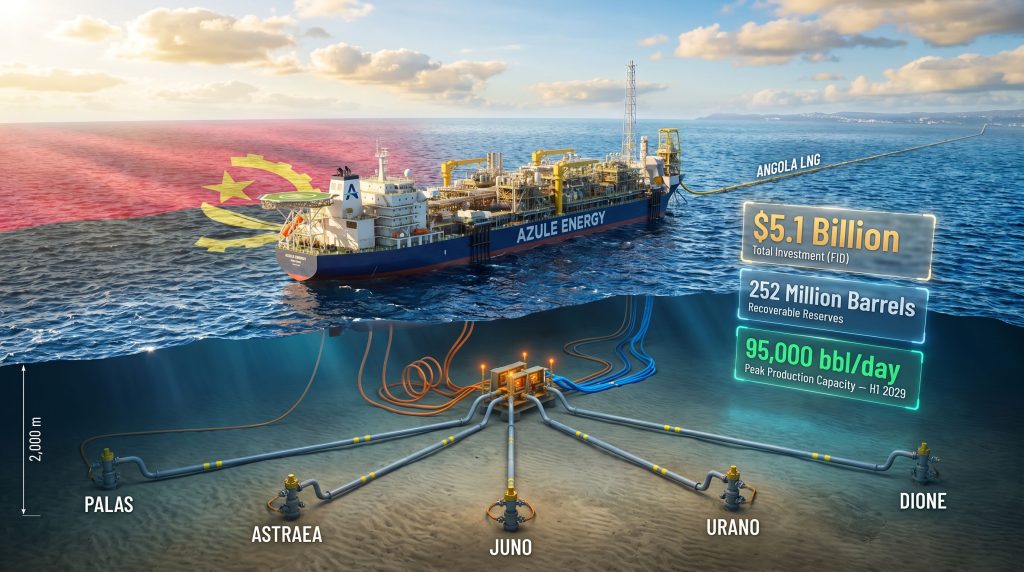
The Greater PAJ project consolidates five discrete deepwater oil fields across two adjacent concession blocks into a single, unified production system. The three fields within Block 31 are Palas, Astraea, and Juno, from which the PAJ acronym is derived. The two additional fields, Urano and Dione, sit within the neighbouring Block 31/21 concession. Rather than treating these as separate developments requiring separate infrastructure, the consortium has designed a shared architecture that serves all five fields simultaneously.
This cross-block integration model is described as Angola's first of its kind, and that distinction matters technically. In conventional offshore licensing structures, concession boundaries are administrative constructs that can create perverse engineering incentives. Two adjacent fields that could efficiently share a single FPSO might instead each require standalone systems if operated under separate block development obligations. Greater PAJ sidesteps this inefficiency by obtaining the regulatory and commercial alignment necessary to build one processing hub for both concessions.
The fields themselves are located in the Lower Congo Basin, approximately 200 kilometres offshore Angola, in water depths reaching up to 2,000 metres. At that depth, the project sits firmly within the ultra-deepwater classification, requiring engineering solutions that are categorically different from shallow or mid-water developments. For broader context on this region, the PAJ Oil and Gas Project profile offers a useful technical overview of the field complex.
Technical Context: Ultra-deepwater operations above 1,500 metres require specialised dynamic positioning systems, high-pressure-rated subsea wellheads, steel catenary risers or flexible pipe systems capable of withstanding extreme hydrostatic loads, and remotely operated vehicle (ROV) intervention for all subsea maintenance tasks. These requirements add substantial cost but are non-negotiable at 2,000-metre depths.
The FPSO Architecture and Why Gas Monetisation Is a Critical Detail
The central processing facility for Greater PAJ will be a newly constructed Floating Production, Storage, and Offloading (FPSO) vessel, supplied by CIMC Raffles. The FPSO will be capable of processing up to 95,000 barrels of oil per day and handling 70 million cubic feet of gas per day.
That gas processing capacity deserves particular attention. In many historical West African deepwater developments, associated gas — the natural gas produced alongside crude oil — was either reinjected into the reservoir or flared. Both outcomes represent economic waste of varying degrees. Greater PAJ takes a different approach: the associated gas will be exported through a dedicated new pipeline directly to the Angola LNG (ALNG) plant, converting what would otherwise be a byproduct into a monetised revenue stream.
This design choice has compounding benefits. It reduces flaring emissions, generates incremental export revenue, and adds long-term utilisation value to the ALNG facility. Furthermore, it reflects a broader maturation in how Angolan offshore projects are now being engineered, with gas treated as an asset class rather than an operational nuisance. The broader LNG market implications of such infrastructure decisions are increasingly relevant across the African continent.
Well Configuration and Reservoir Pressure Management
The full development plan encompasses 17 wells:
- 10 oil production wells connected to the FPSO via subsea flowlines
- 7 water injection wells designed to maintain reservoir pressure throughout the field life
The inclusion of seven water injection wells is a technically sophisticated choice that many non-specialist observers might underestimate. In ultra-deepwater reservoirs, natural pressure depletion can be rapid once production begins. Water injection compensates for this by physically replacing extracted hydrocarbons with injected seawater, sustaining the pressure differential that drives oil toward the wellbore. Without this, production rates at many deepwater fields fall sharply after initial plateau, dramatically reducing the total recoverable resource.
Why This Matters for Reserve Recovery: The ratio of injector wells to producer wells in Greater PAJ is approximately 1:1.4. This is a relatively high injection intensity for a deepwater project and suggests the reservoir engineering team has prioritised long-term recovery factor optimisation over short-term capital minimisation.
Subsea Infrastructure Scope: The Invisible Backbone of the Project
The subsea scope of Greater PAJ is substantial, stretching across a seabed footprint that spans two block concessions at extreme water depth.
| Infrastructure Component | Specification |
|---|---|
| Rigid pipelines | 180 km |
| Flexible flowlines | 38 km |
| Umbilicals | 54 km |
| Production wells | 10 |
| Water injection wells | 7 |
| Maximum water depth | 2,000 metres |
Saipem was awarded the contract covering the engineering, fabrication, transportation, and installation of the rigid pipeline network, flexible flowlines, and umbilicals. The contract is valued at approximately $1 billion and will run for around 40 months. Critically, the fabrication work will be conducted at Saipem's Ambriz yard in Angola, a decision that keeps a significant portion of the construction value within the country's borders and builds industrial capacity at an existing Angolan facility.
Umbilicals, in this context, are composite conduits that bundle together hydraulic control lines, electrical cables, and chemical injection lines within a single armoured sheath. They serve as the communication and control nervous system of the subsea production network, allowing topside operators on the FPSO to manage wellhead chokes, inject hydrate inhibitors, and receive real-time downhole data from wells operating nearly two kilometres below the ocean surface.
Project Consortium and Contract Awards
The consortium structure behind Greater PAJ brings together four distinct stakeholder categories with differing commercial and regulatory interests.
| Partner | Role |
|---|---|
| Azule Energy (BP/Eni 50/50 JV) | Operator and lead developer |
| Equinor | Non-operating equity partner |
| Sonangol E&P | State oil company participant |
| ANPG | National regulatory and concessionary authority |
Six major engineering and procurement contracts were executed simultaneously at the Final Investment Decision (FID) ceremony held in Luanda in June 2026, covering the full spectrum of offshore construction requirements.
| Contract Package | Awarded To |
|---|---|
| FPSO vessel provision | CIMC Raffles |
| Subsea production systems | OneSubsea |
| Risers | Vallourec |
| Flexible flowlines | TechnipFMC |
| Rigid pipeline installation | Saipem |
| Subsea control and instrumentation | Baker Hughes |
The simultaneous awarding of six major contracts at a single ceremony is itself a logistical signal. It indicates that the consortium completed front-end engineering and design (FEED) work to a sufficient level of maturity that contractors could price fixed or target-cost scopes with confidence. This level of pre-FID engineering rigour reduces the risk of cost overruns during execution, a persistent challenge in large offshore developments globally.
Angola's Production Trajectory and Why This Investment Is Strategically Timed
Angola's crude production history provides essential context for understanding why the Greater PAJ FID carries the weight it does. Output peaked at above 1.8 million barrels per day more than a decade ago, driven by the ramp-up of major ultra-deepwater fields that were sanctioned and developed through the 2000s. Since that peak, natural reservoir decline from maturing fields has progressively eroded volumes. The country's current production ambition has been reset to approximately 1 million barrels per day, a target that requires new field developments to offset decline at legacy assets.
Angola formally exited OPEC in late 2023, a decision that removed quota constraints and gave the government greater flexibility to pursue volume growth without cartel coordination obligations. Indeed, the shifting OPEC oil market influence across Africa has had meaningful consequences for how individual nations structure their upstream investment strategies. In the years preceding and following that exit, Angola undertook meaningful revisions to its upstream fiscal and licensing framework, adjusting terms to improve competitiveness for deepwater investment relative to other frontier basins competing for the same international capital.
Important Note for Readers: The fiscal reforms referenced here represent Angola's own policy evolution and domestic regulatory changes. They are not an indication of external government backing, funding, or designated project support for Greater PAJ specifically.
At $5.1 billion, Greater PAJ is one of the single largest upstream investment commitments in Angola since the OPEC departure. When combined with Azule Energy's previously stated intention to invest approximately $5 billion in Angola's oil and gas sector over coming years, the Greater PAJ FID effectively represents the primary vehicle for that capital commitment.
The next major ASX story will hit our subscribers first
Reserve Economics and What 252 Million Barrels Means in Context
The project's estimated recoverable reserve base of 252 million barrels positions it among the more consequential deepwater sanctionings in sub-Saharan Africa during the 2020s. To contextualise that figure, a development of this scale requires sustained production over many years to fully recover the resource base, which is precisely why the FPSO has been designed with long operational life in mind.
At plateau capacity of 95,000 barrels per day, and assuming a typical deepwater production profile that includes a ramp-up phase, a sustained plateau period, and a gradual decline tail, recovering the full 252 million barrel resource would take well over a decade of production. This is consistent with the long-cycle nature of ultra-deepwater investments, where operators typically model 20 to 25 year project lifespans to justify the upfront capital.
| Metric | Value |
|---|---|
| Total project investment | $5.1 billion |
| Recoverable reserves | 252 million barrels |
| Peak FPSO processing capacity | 95,000 barrels of oil per day |
| Gas processing capacity | 70 million cubic feet per day |
| First oil target | First half of 2029 |
| Total wells | 17 (10 producers, 7 injectors) |
| Water depth | Up to 2,000 metres |
| Distance from shore | ~200 km |
| Local content man-hours | ~1.8 million |
| Saipem contract value | ~$1 billion |
| Rigid pipeline scope | 180 km |
| Flexible flowline scope | 38 km |
| Umbilical scope | 54 km |
Local Content and the Ambriz Yard: Economic Value Beyond the Wellhead
Azule Energy has projected that the Greater PAJ development will generate approximately 1.8 million man-hours of local content work across the full development phase. The categories of work include:
- Fabrication and steel manufacturing at the Ambriz yard
- Engineering and technical design services
- Offshore installation operations and vessel logistics
- Training programmes and workforce skills development
- Port services, catering, and procurement logistics
The use of the Ambriz fabrication facility for Saipem's rigid pipeline scope is a particularly meaningful element of this commitment. Fabrication yards represent the most capital-intensive and skill-intensive component of local content in offshore projects. By anchoring that work at an existing Angolan facility rather than fabricating offshore in a third country and shipping components to site, the project keeps construction-phase value inside Angola's industrial ecosystem.
Azule Energy's Angola Portfolio in Context
Formed in 2022 through the consolidation of BP Angola and Eni Angola into a single joint venture entity, Azule Energy has rapidly established itself as Angola's largest independent producer. The company currently produces approximately 220,000 barrels of oil equivalent per day across 18 licensed blocks and accounts for roughly 20% of Angola's total national oil output. The Azule Energy company presentation provides further detail on the full scope of the company's Angolan portfolio.
Greater PAJ sits within a broader portfolio of major project commitments:
| Project | Type | Status |
|---|---|---|
| Agogo Integrated West Hub | Deepwater oil development | Advanced development/producing |
| New Gas Consortium | Non-associated gas (first in Angola) | Development phase |
| Greater PAJ | Cross-block ultra-deepwater oil | FID approved, first oil H1 2029 |
The New Gas Consortium project holds particular strategic relevance because it marked Angola's first development of non-associated natural gas at commercial scale. Angola has historically been an oil-dominated producer, with gas either reinjected or flared rather than developed as a standalone commodity. The evolution toward gas monetisation, reflected both in that project and in Greater PAJ's pipeline connection to the ALNG facility, signals a broader diversification of Angola's hydrocarbon export strategy.
The Energy Transition Tension: Long-Cycle Investment in a Changing World
The sanctioning of a multi-billion dollar, multi-decade deepwater oil project in 2026 invites an obvious question: how do major international operators justify long-cycle hydrocarbon investments against a backdrop of accelerating energy transition pressures and increasing investor scrutiny on emissions?
The pragmatic answer lies in demand forecasting. Multiple credible energy modelling organisations, including the International Energy Agency and OPEC's own research division, continue to project meaningful global oil demand through the 2030s and into the 2040s under most scenarios, with demand concentration shifting progressively toward developing economies in Asia and Africa. For operators with large existing positions in prolific deepwater basins, the calculus of sanctioning a project like Greater PAJ — which has a breakeven economics profile improved by shared infrastructure — continues to make commercial sense within those demand frameworks.
For Angola specifically, the calculus is even clearer. Oil revenue underpins government fiscal capacity, public investment, and social expenditure. Sustaining production is not simply a commercial decision for Azule Energy and its partners. It is a sovereign economic priority for the Angolan state, which participates directly in the project through Sonangol E&P and exercises concessionary oversight through the ANPG.
Disclaimer: Forward-looking statements regarding production timelines, reserve recovery, project economics, and demand forecasts involve inherent uncertainties and should not be interpreted as guaranteed outcomes. Actual results may differ materially from current projections due to technical, operational, regulatory, and market factors.
The Cross-Block Model as a Template for Angola's Future
Perhaps the most underappreciated dimension of the Azule Energy Greater PAJ offshore oil project in Angola is its potential as a replicable development paradigm. Angola's offshore acreage contains numerous instances of adjacent blocks held by overlapping ownership groups where stranded resources sit below the standalone development threshold but could become commercially viable under a shared infrastructure model.
If Greater PAJ executes successfully through construction and into plateau production, it creates a documented proof of concept that Angola's regulatory framework can accommodate cross-block development integration. That precedent could unlock incremental recoverable resources across the country's offshore portfolio that would otherwise remain undeveloped. Furthermore, the broader geopolitical landscape for African energy producers continues to shape how international capital is deployed across competing frontier basins.
Between now and first oil in the first half of 2029, the project will progress through FPSO construction and commissioning, subsea fabrication at the Ambriz yard, offshore installation campaigns covering 272 kilometres of combined pipeline and flowline scope, and a 17-well drilling programme at water depths that place it among the most technically demanding operational environments in African offshore history.
Each of those phases represents a distinct capital deployment milestone, a procurement and logistics challenge, and a continued signal to international energy markets that Angola's deepwater sector remains commercially open, technically capable, and strategically committed to long-term production growth. The evolving crude oil price trends will, however, remain a key variable in how the project's economics are ultimately assessed over its multi-decade production life.
Want to Capitalise on the Next Major Resource Discovery Before the Broader Market?
Discovery Alert's proprietary Discovery IQ model delivers real-time alerts on significant ASX mineral discoveries, transforming complex resource data into actionable investment insights for both short-term traders and long-term investors — explore historic discoveries and their returns to understand the potential, then begin your 14-day free trial at Discovery Alert to position yourself ahead of the market.