August 9, 2026
Why Mali's Evolving Mining Codes Are Reshaping the Economics of West Africa's Largest Gold Producers
The relationship between sovereign resource ownership and foreign mining capital has always been fragile in West Africa. Over decades, the pendulum has swung between open-door investment frameworks designed to attract exploration spending and more assertive legislative regimes that reclaim a greater share of mineral wealth for the state. Mali sits at the centre of this tension, and the regulatory architecture governing how gold is extracted from its soil is now fundamentally different from what it was a decade ago. Understanding this backdrop is essential to grasping the full significance of the B2Gold Fekola Regional exploitation permit in Mali, a development that carries implications far beyond a single project approval.
When big ASX news breaks, our subscribers know first
The Menankoto Exploitation Permit: Scope and Legal Foundation
On August 7, 2026, the State of Mali formally granted the Menankoto exploitation permit to B2Gold's Malian subsidiary, converting the Fekola Regional project from an exploration-stage asset into a legally authorised production zone. This distinction matters enormously in mining law: an exploitation permit grants the holder the legal right to extract ore commercially, whereas an exploration permit only authorises investigation and sampling. Crossing this threshold is therefore a prerequisite for any revenue-generating activity.
The Fekola Regional area comprises two permit components operating in tandem:
- The Menankoto exploitation permit, now formally granted, which covers the core production zone
- The Dandoko exploration permit, which represents the broader regional land package and future growth optionality
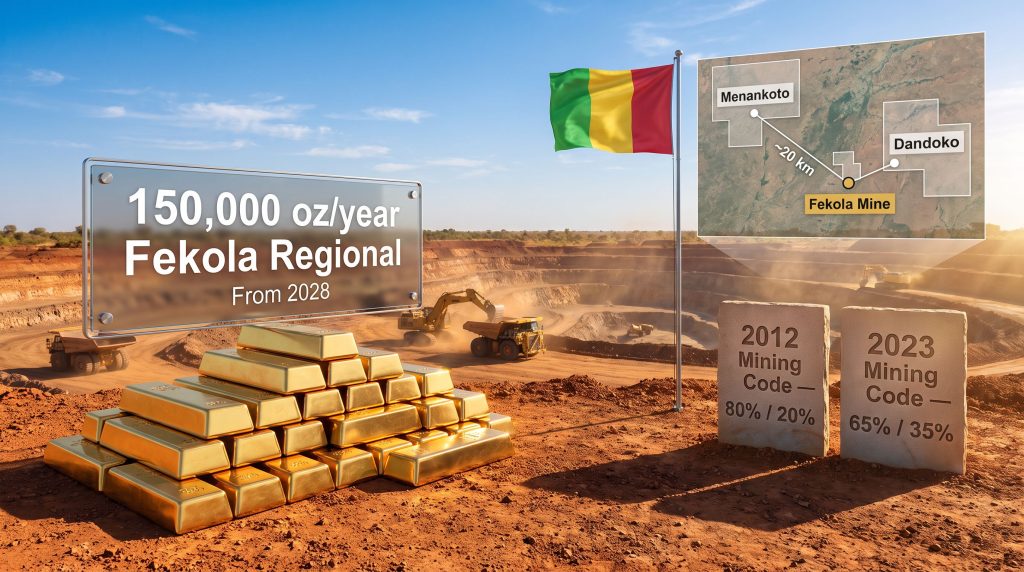
Together, these permits form a contiguous geological corridor situated roughly 20 kilometres southwest of the existing Fekola Mine, within the same highly prospective southern Mali greenstone belt. The geographic proximity to established infrastructure is not incidental; it is central to the economic logic underpinning the entire project.
How Mali's 2023 Mining Code Changes the Ownership Equation
One of the most consequential but least-discussed dimensions of the Menankoto permit is the regulatory framework under which it operates. Unlike the Fekola Mine itself, which is governed by Mali's 2012 Mining Code, Fekola Regional falls entirely under the 2023 Mining Code, a revised legislative framework that carries materially different ownership and fiscal provisions.
The table below illustrates the structural contrast between the two operating environments within the same mine complex:
| Asset | B2Gold Equity | State of Mali Equity | Applicable Mining Code |
|---|---|---|---|
| Fekola Mine (Medinandi Permit) | 80% | 20% | 2012 Mining Code |
| Fekola Regional (Menankoto + Dandoko) | 65% | 35% | 2023 Mining Code |
The shift from a 20% to a 35% state participation level is the most visible expression of Mali's updated resource nationalism posture. Under the 2023 code, the government secures a larger direct equity stake in new mining ventures without necessarily contributing proportional upfront capital, a structure sometimes described in the industry as a carried interest provision. This arrangement has direct consequences for dividend distributions, reinvestment decisions, and the long-run internal rate of return that B2Gold shareholders can expect from Fekola Regional relative to the legacy Fekola Mine.
Furthermore, the current gold market outlook adds another layer of complexity to how investors should interpret these ownership structures, particularly given the elevated price environment that makes even higher-royalty jurisdictions commercially viable.
What makes this situation analytically unusual is that B2Gold now operates under two different fiscal regimes within a single integrated mining complex, a dual-code environment that introduces compliance complexity but also demonstrates a pragmatic approach to navigating evolving sovereign requirements.
Resource Nationalism in the Sahel: The Broader West African Context
Mali's legislative trajectory is not occurring in isolation. Across the Sahel and broader West Africa, governments have moved to reassert control over mineral assets in response to long-standing critiques that earlier investment frameworks transferred too much value to foreign operators. Burkina Faso, Guinea, and Senegal have each undertaken significant revisions to their mining codes or ownership structures since 2021, reflecting a generational shift in how African governments perceive the terms of resource extraction.
Mali's military-led transitional administration, which has governed the country since 2021, has been particularly active in pursuing this agenda. The 2023 Mining Code is one expression of this orientation, alongside broader diplomatic realignments that have reduced Western political influence in the country. For mining companies, this creates a genuinely complex operating environment where technical and geological merit must be weighed against sovereign risk premiums that have expanded considerably over the 2022 to 2026 period.
The geopolitical mining risks present across the Sahel region are increasingly shaping how institutional investors price African gold assets, and Mali's trajectory is a leading indicator of this broader trend.
It is worth noting, however, that resource nationalism in its contemporary West African form is not simply ideological. It reflects a rational fiscal calculation: governments that depend on mining royalties and equity dividends for budget revenue have strong incentives to keep existing operations productive, even as they negotiate harder terms for new projects. This dynamic creates a floor beneath the most extreme sovereign risk scenarios, particularly for operators running high-volume, high-revenue assets like the Fekola Complex.
A Regulatory Timeline: From Negotiation to Permit Issuance
The Menankoto exploitation permit did not emerge from a single transaction. It was the product of a structured, phased engagement between B2Gold and Malian authorities spanning nearly two years. Understanding this sequence reveals important information about how the company has managed its governmental relationships.
Key milestones in the regulatory process include:
- September 2024: B2Gold and the State of Mali reaffirm their commitment to the overarching Fekola Complex governance agreement, establishing a political foundation for subsequent negotiations
- July 2025: Formal discussions commence between B2Gold and Malian authorities regarding the Fekola Regional exploitation permit framework
- July 2025 (concurrent): Malian authorities approve underground mining operations at the existing Fekola Mine, signalling a broader constructive bilateral relationship
- August 7, 2026: The Menankoto exploitation permit is formally issued, unlocking commercial mining activity at Fekola Regional
The sequential approval of underground mining at Fekola Mine, followed by the B2Gold Fekola Regional exploitation permit in Mali, reflects a deliberate pattern of graduated regulatory milestones rather than a single high-stakes approval event. This phased approach may have reduced negotiating risk by allowing both parties to build confidence incrementally before committing to the larger Fekola Regional framework.
What the Permit Actually Unlocks: Operational and Capital Implications
The practical consequences of the Menankoto permit are immediate and material. Two operational priorities follow directly from the approval:
- Pre-stripping commencement: B2Gold is authorised to begin overburden removal at Fekola Regional, the earthworks phase that precedes ore exposure and is typically the most capital-intensive part of early-stage open-pit mine development
- Tolling agreement finalisation: Rather than constructing a standalone processing plant at Fekola Regional, B2Gold is working to complete a tolling arrangement that routes ore from the regional project through the existing Fekola Mine processing facility
The tolling model deserves particular attention because it represents a capital efficiency strategy that is not always well understood outside the industry. In a tolling arrangement, ore from one mining area is transported to a third-party or affiliated processing facility, with the processor charging a fee per tonne treated. For Fekola Regional, this approach allows B2Gold to access production revenue without the multi-hundred-million-dollar capital expenditure typically associated with greenfield processing plant construction. It also accelerates the timeline to first production by removing the bottleneck of permitting and building new infrastructure.
The projected production trajectory for Fekola Regional, based on company disclosures, is outlined below:
| Phase | Approximate Timeframe | Primary Activity |
|---|---|---|
| Pre-stripping and tolling setup | 2026 (immediate) | Earthworks commencement and tolling agreement execution |
| Progressive ramp-up | 2026 to 2027 | Expansion of mining operations and ore feed volumes |
| Full production threshold | From 2028 onward | Annual output exceeding 150,000 oz per year |
| Sustained production window | 2028 through mid-2030s | Consistent high-volume gold production |
The next major ASX story will hit our subscribers first
The Hub-and-Spoke Model: Fekola Complex as an Integrated Production System
The Fekola Complex, encompassing both the Fekola Mine and the newly permitted Fekola Regional area, represents a textbook example of what the industry terms a hub-and-spoke production model. In this configuration, a central processing facility, the hub, serves multiple satellite ore sources within a defined geographic radius, the spokes. The economic rationale is compelling: fixed processing costs are spread across a larger ore volume, extending the productive life of high-cost infrastructure and improving overall unit economics.
For context, the Fekola Mine already operates as a multi-source system, drawing ore from both the Fekola and Cardinal open pits in addition to underground workings beneath the Medinandi permit. Adding Fekola Regional as a tolled ore source simply extends this logic by approximately 20 kilometres to the southwest, well within the practical haulage distance for satellite ore supply in West African open-pit operations.
B2Gold has described the Fekola Complex as currently the largest producing gold mine in Mali, a status that underscores the strategic importance of maintaining and extending its productive capacity. With annual production from Fekola Regional forecast to exceed 150,000 ounces from 2028 through the mid-2030s, the Menankoto permit materially extends the complex's mine life and revenue generation well beyond what the Fekola Mine alone could sustain.
The Fekola Complex governance agreement, reaffirmed in September 2024, established the political and commercial architecture that made this permit possible. Without that foundational agreement, the regulatory milestones that followed would have been considerably harder to achieve.
Sovereign Risk Management: Lessons for the Gold Mining Sector
B2Gold's navigation of Mali's regulatory environment over the 2024 to 2026 period offers a practical case study in pragmatic sovereign risk management for resource companies operating in frontier jurisdictions. Several principles emerge from this experience that have broader industry relevance.
Consequently, the patterns observed here resonate with wider trends in gold M&A activity across global markets, where sovereign risk assessments are increasingly central to deal structuring and asset valuation. The key principles include:
- Incremental engagement outperforms transactional negotiation: The sequential approval structure suggests that building regulatory trust through smaller milestones reduces the risk of a single high-stakes approval failing
- Equity participation is increasingly non-negotiable: The shift from 20% to 35% state equity across the two mining codes signals that operators entering new West African projects should price higher government ownership as a baseline assumption
- Operational continuity is a negotiating asset: Governments that depend on an operation's tax and royalty revenues have strong incentives to approve expansions that sustain production; B2Gold's position as Mali's largest gold producer likely strengthened its negotiating posture
- Dual-code environments require sophisticated compliance infrastructure: Managing two different regulatory frameworks within a single operational complex is not trivial and represents a genuine organisational capability that not all operators can replicate
In addition, the lessons drawn here align closely with what mining feasibility studies increasingly emphasise regarding sovereign risk contingencies as a core component of project economics, not a footnote.
FAQ: B2Gold Fekola Regional Exploitation Permit in Mali
What is the Fekola Regional exploitation permit?
The Fekola Regional exploitation permit refers to the Menankoto exploitation permit, formally granted by the State of Mali on August 7, 2026. Combined with the Dandoko exploration permit, it constitutes the Fekola Regional project area, a southwest extension of B2Gold's Fekola Complex located approximately 20 kilometres from the main Fekola Mine.
Who owns Fekola Regional and under what terms?
Fekola Regional is structured as a 65% B2Gold and 35% State of Mali partnership, governed under Mali's 2023 Mining Code. This contrasts with the Fekola Mine itself, which is held 80% by B2Gold and 20% by Mali under the older 2012 code.
When is Fekola Regional expected to reach full production?
Pre-stripping operations are planned to begin immediately following the permit grant, with activity ramping through 2027. Annual production is projected to surpass 150,000 ounces from 2028, sustained through the mid-2030s.
What is a tolling agreement and why does it matter here?
A tolling arrangement allows ore extracted at Fekola Regional to be processed at the existing Fekola Mine plant rather than at a new standalone facility. This significantly reduces upfront capital requirements and compresses the timeline to first production by leveraging infrastructure that is already built, permitted, and operational.
How does the 2023 Mining Code differ from the 2012 version?
The 2023 code increases mandatory state equity participation in new mining projects, with Fekola Regional reflecting a 35% government stake compared to the 20% applicable under the 2012 code. The newer framework also carries updated provisions covering environmental obligations, local content, and broader fiscal terms.
Furthermore, the broader implications of these code changes extend well beyond a single project, and mining joint ventures across the region are increasingly being structured to accommodate similar state participation requirements as a baseline expectation.
Key Takeaways for Investors and Industry Observers
The Menankoto exploitation permit is best understood not as a discrete approval event but as the culmination of a carefully managed, multi-year regulatory engagement strategy. Several dimensions deserve particular attention:
- The dual-code structure of the Fekola Complex creates a uniquely complex operational and fiscal environment that requires ongoing management attention
- The 150,000-plus ounce annual production target from 2028 positions Fekola Regional as a material contributor to B2Gold's group output, not a peripheral asset
- The tolling model is a capital-efficient pathway to production that avoids the multi-year delays and costs associated with standalone processing plant development
- West African resource nationalism is a structural feature of the investment landscape, not a temporary policy phase, and operators that price this reality into their project economics from the outset will be better positioned than those who do not
Disclaimer: This article is intended for informational purposes only and does not constitute financial advice. Production forecasts and timelines referenced are based on company disclosures and are subject to material risks including regulatory changes, operational delays, commodity price movements, and sovereign risk factors. Investors should conduct their own due diligence before making any investment decisions.
Want to Identify the Next Major ASX Mineral Discovery Before the Market Moves?
Discovery Alert's proprietary Discovery IQ model scans ASX announcements in real time, delivering actionable insights across more than 30 commodities — including gold — so investors can act on significant discoveries the moment they are announced. Explore how historic discoveries have generated substantial returns on Discovery Alert's dedicated discoveries page, and begin a 14-day free trial to position ahead of the market.