July 22, 2026
The Dual Chokepoint Trap: How Two Narrow Straits Now Hold Global Energy Markets Hostage
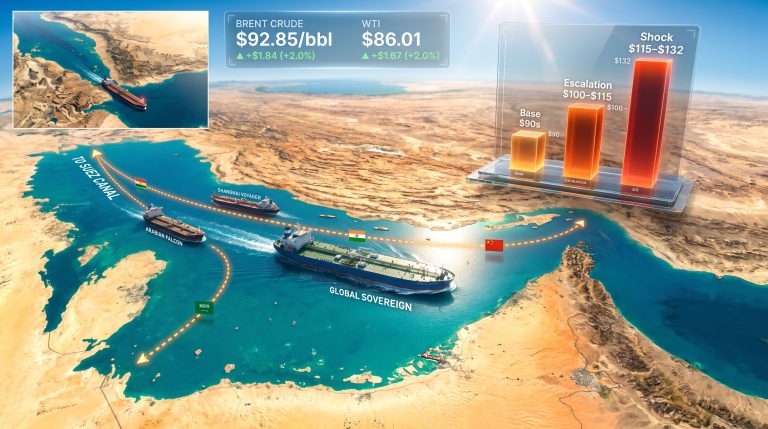
Few vulnerabilities in global trade are as structurally exposed as the world's maritime chokepoints. These narrow corridors, often no wider than a major river at their tightest points, carry a disproportionate share of the world's energy and commerce. When geopolitical conflict intersects with geography at these pinch points, the consequences ripple across supply chains, energy markets, and consumer prices worldwide. That structural reality is now playing out in real time across the Middle East, where Houthi attacks on ships in the southern Red Sea have escalated into one of the most consequential maritime disruptions of the modern era.
When big ASX news breaks, our subscribers know first
Why the Bab al-Mandab Strait Is Unlike Any Other Waterway
The Geography of Vulnerability
The world has roughly five maritime chokepoints that global trade simply cannot function without. The Bab al-Mandab Strait ranks among them, sitting at the southern end of the Red Sea where it meets the Gulf of Aden before opening into the Arabian Sea. At its narrowest point, the strait measures approximately 30 kilometres across, a dimension that sounds generous until you consider the volume of traffic it must accommodate.
Between 10% and 15% of all global seaborne trade transits this corridor annually. That includes crude oil, liquefied natural gas, refined petroleum products, and containerised cargo bound for European and Asian markets via the Suez Canal. Vessels that cannot use this route face the only realistic alternative: sailing around the southern tip of Africa via the Cape of Good Hope, adding roughly 10 to 14 days to each voyage along with substantially higher fuel and operational costs.
What makes the strait uniquely dangerous in the current environment is not just its geography but its proximity to Yemen, where Houthi forces have spent years building an asymmetric maritime warfare capability that has proven far more sophisticated than most analysts anticipated before November 2023.
The Southern Red Sea as a Strategic Intersection
The Bab al-Mandab does not exist in isolation. It sits at the convergence of two separate but interconnected maritime threat environments. At its northern end, the Red Sea connects to the Suez Canal and Mediterranean trade lanes. At its southern end, the Gulf of Aden opens toward the Indian Ocean. Meanwhile, approximately 1,800 kilometres to the northeast, the Strait of Hormuz serves as the primary exit point for Persian Gulf oil producers.
These two straits, Bab al-Mandab and Hormuz, now represent what analysts describe as a dual chokepoint problem: simultaneous pressure at both ends of the Arabian Peninsula's maritime export infrastructure, with no viable workaround at the volumes global energy markets require. Furthermore, the oil market disruption triggered by this dual threat has drawn comparisons to some of the most severe supply crises in recent decades.
How the Houthi Maritime Campaign Evolved From Harassment to Embargo
Origins and Early Escalation
The Houthi campaign targeting commercial vessels began in November 2023, initially framed as retaliation tied to the conflict in Gaza. In its earliest phase, the group targeted vessels with stated or perceived connections to Israel, deploying warning shots and drone harassment as its primary tools.
What followed was a rapid and documented escalation in both capability and targeting criteria. Reporting confirmed that vessels with no verifiable connection to Israel were struck, indicating the campaign had broadened beyond its stated political rationale into a wider interdiction operation against commercial shipping generally. The Red Sea crisis has since become one of the most extensively documented maritime security events of the modern era.
The Weapons Arsenal: More Capable Than Anticipated
The Houthi weapons inventory deployed in this campaign has surprised many defence analysts in its sophistication and variety. The group has demonstrated the ability to conduct multi-vector coordinated attacks combining several distinct systems simultaneously.
| Weapon Type | Operational Role |
|---|---|
| Anti-ship ballistic missiles | Long-range precision strikes on commercial vessels |
| One-way attack drones (UAVs) | Saturation attacks designed to overwhelm ship defences |
| Small boat swarms | Close-range interdiction and boarding attempts |
| Helicopter-assisted operations | High-value vessel seizure and boarding |
This combination of standoff precision weapons and close-range interdiction tools creates a layered threat that is difficult for any single defensive measure to address comprehensively. Consequently, international naval coalitions have struggled to fully suppress the campaign despite sustained presence in the region.
A Campaign in Four Phases
-
Phase 1 (November 2023 to early 2024): Initial strikes on Israel-linked vessels; international naval coalitions form and begin escort and deterrence operations across the corridor.
-
Phase 2 (Mid-2024 to early 2025): Targeting criteria expand significantly; the total documented attack count on commercial vessels surpasses 100 incidents across the southern Red Sea and Gulf of Aden.
-
Phase 3 (July 2025): Attacks resume after a lull, with the vessels Magic Seas and Eternity C reported sunk; seafarer casualties confirmed at 3 to 4 fatalities.
-
Phase 4 (July 2026): Houthis declare a maritime embargo against Saudi Arabia, directly threatening the kingdom's oil export flows through the Red Sea and Bab al-Mandab.
The July 2026 Escalation: Saudi Arabia in the Crosshairs
What the Maritime Embargo Means in Practice
On Monday, July 20, 2026, Houthi forces announced a maritime embargo targeting Saudi Arabia, with stated intent to disrupt the kingdom's oil export flows through the Red Sea and the Bab al-Mandab Strait. The following day, the Joint Maritime Information Center (JMIC), a U.S. Navy-led maritime security body headquartered in Bahrain, issued a formal advisory to commercial mariners confirming that Houthi forces had completed preparations for attack operations, including the positioning of missiles and drone systems near the strait.
The JMIC advisory noted that commercial traffic had continued through the strait for two consecutive days without confirmed attack, and that no changes to established commercial routing patterns had been observed as of the advisory's release on July 21, 2026. The threat classification was assigned as "moderate."
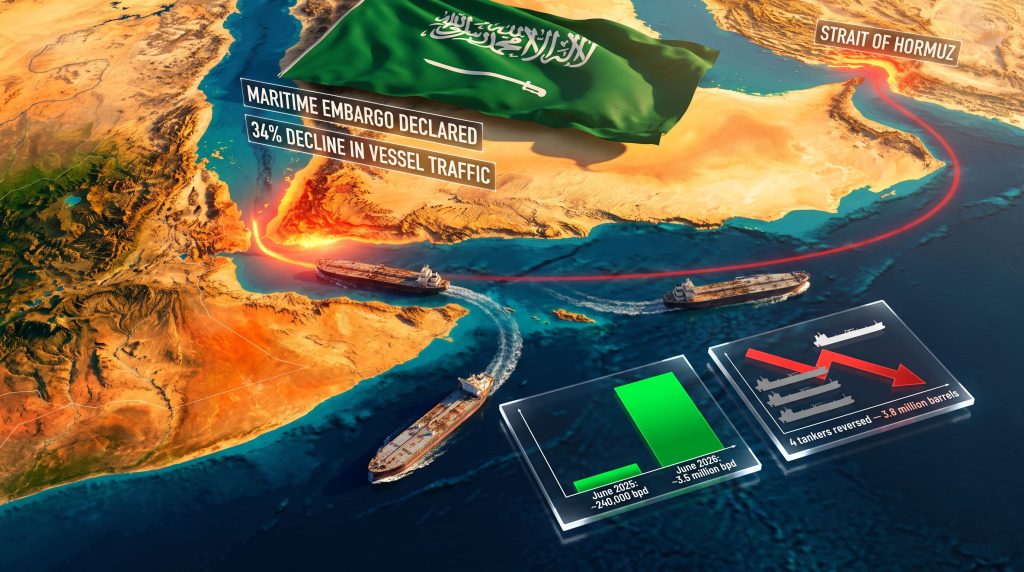
Despite that classification, behavioural data told a different story. Ship tracking firm Kpler recorded a 34% decline in vessel traffic through Bab al-Mandab on Tuesday, July 22, 2026, compared with the volume recorded on the day the embargo was declared. This divergence between the official threat level and observed commercial behaviour highlights a well-documented phenomenon in maritime risk management: threat perception moves faster than threat confirmation.
Shipping operators do not wait for an attack to occur before adjusting course. The declaration of intent, combined with credible evidence of weapons positioning from a group with a documented attack history exceeding 100 incidents, is sufficient to trigger rerouting decisions that can move millions of barrels of cargo off their planned trajectories within 24 to 48 hours.
Saudi Arabia's Exposure: A Vulnerability of Its Own Making
The specific vulnerability facing Saudi Arabia in this escalation is a direct consequence of strategic decisions made to manage a different risk. As Iranian pressure on tankers transiting the Strait of Hormuz intensified through 2025 and into 2026, Saudi Arabia began redirecting crude exports through the East-West Pipeline to the Yanbu terminal on the Red Sea coast, deliberately bypassing Hormuz entirely.
The result has been a dramatic shift in export routing that has concentrated Saudi Arabia's exposure at the precise chokepoint now under Houthi threat. In addition, the role of OPEC market influence in stabilising supply in the face of this disruption has become a central question for energy analysts worldwide.
| Metric | Data Point |
|---|---|
| Saudi exports via Bab al-Mandab (June 2025) | approximately 240,000 bpd |
| Saudi exports via Bab al-Mandab (June 2026) | approximately 3.5 million bpd |
| Year-on-year increase | more than 14-fold |
| Tankers turned back on July 22, 2026 | 4 vessels |
| Cargo volume on diverted tankers | 3.8 million barrels (crude oil, gasoil, naphtha) |
Source: Kpler ship-tracking data and maritime intelligence firm Windward, July 2026
The strategic logic of using the Red Sea route as a Hormuz bypass was sound when evaluated against Iranian interdiction risk alone. However, it created a new single point of failure at Bab al-Mandab that Houthi forces are now explicitly exploiting. Saudi Arabia has, in effect, traded one chokepoint risk for another, and the new exposure is at a location where its adversary has both intent and demonstrated capability to disrupt.
Iran's Parallel Campaign at Hormuz: The Other Half of the Dual Threat
Simultaneous Pressure at Both Ends
While Houthi forces escalated at the southern end of the Red Sea corridor, Iran simultaneously intensified its own campaign against tanker traffic in and around the Strait of Hormuz. Between July 6 and July 22, 2026, a total of 12 ships came under attack in the waters off the coasts of Oman and the United Arab Emirates, encompassing crude oil tankers, product tankers, and chemical tankers.
The International Maritime Organization (IMO), the United Nations maritime agency responsible for tracking such incidents, confirmed that these attacks resulted in the deaths of two seafarers and injuries to more than a dozen others. Iran's stated objective in this campaign has been to force vessels transiting Hormuz to navigate through Iranian territorial waters, a tactic that gives Tehran both physical leverage and a legal pretext for interdiction.
The Scenario Nobody Has a Workable Answer For
The most consequential risk scenario emerging from the current environment is one that neither naval coalitions nor Saudi Arabia's pipeline strategy can fully address: simultaneous effective closure of both Bab al-Mandab and the Strait of Hormuz. The broader context of trade and geopolitics in the region makes this scenario increasingly difficult to dismiss as a remote possibility.
If both chokepoints were rendered impassable at the same time:
- Saudi Arabia's East-West Pipeline diversion strategy would be neutralised, with no viable alternative export route at the volumes required by global energy markets.
- Persian Gulf producers collectively exporting through Hormuz would face the same barrier, compounding the supply shock.
- War risk insurance premiums, already elevated throughout the campaign period, would spike further, potentially making certain voyages commercially unviable regardless of vessel safety considerations.
- Rerouting around the Cape of Good Hope would absorb only a fraction of the diverted volume within any commercially meaningful timeframe, given fleet constraints and voyage duration.
- Global oil prices would face significant upward pressure with knock-on consequences for energy-intensive industries and consumer inflation across importing economies.
This is not a scenario being actively discussed in mainstream financial markets. However, maritime security analysts and commodity trading desks at major energy firms treat it as a tail risk with non-trivial probability given the current trajectory of both campaigns.
The Human and Commercial Toll: Beyond the Headline Numbers
Seafarers: The Invisible Casualties
Maritime conflict generates economic headlines, but its human dimension is often underreported. Since November 2023, the cumulative record of this campaign includes more than 100 documented attacks on commercial vessels, multiple ships sunk including the Magic Seas and Eternity C, and confirmed seafarer fatalities and injuries across multiple incidents tracked by the IMO. A detailed map and list of attacks compiled by Lloyd's List illustrates the geographic concentration of incidents across the corridor.
Seafarers operating in the region face a threat environment that has no parallel in modern commercial maritime history outside of declared wartime operations. War risk clauses in crew contracts, hardship allowances, and crew change complications in high-risk zones have all become operational realities for shipowners routing vessels through or near the corridor.
Supply Chain and Insurance Consequences
The commercial costs of sustained disruption extend well beyond the vessels directly targeted:
- Cape of Good Hope rerouting adds 10 to 14 days per voyage, increasing fuel consumption, crew costs, and charter day counts for every affected vessel.
- War risk insurance premiums for vessels transiting the Red Sea corridor have remained structurally elevated since early 2024, representing a permanent cost increase that is passed through to cargo owners and ultimately to end consumers.
- Containerised goods, energy commodities, and bulk cargo serving European, Asian, and East African markets have all experienced delivery delays that compound over time as fleet availability tightens.
- Spot charter rates for tankers on affected routes have exhibited volatility patterns that make forward planning difficult for energy traders and refiners reliant on consistent delivery schedules.
The next major ASX story will hit our subscribers first
The International Response: Deterrence Without Resolution
What the JMIC Does and Why It Matters
The Joint Maritime Information Center operates as the primary formal communication bridge between naval intelligence assets and commercial shipping operators across the Middle East region. Its advisories, issued to mariners via established maritime communication channels, carry significant weight precisely because they represent consolidated intelligence from multiple naval partners rather than any single nation's assessment.
The JMIC's classification of the current threat level as "moderate" is significant in both directions. It signals active monitoring and credible threat assessment without triggering the formal warnings that would cause large-scale rerouting mandates from major shipping firms. Furthermore, the 34% traffic decline observed by Kpler on July 22, 2026, demonstrates that commercial operators apply their own risk calculus that does not necessarily wait for the JMIC's threat level to escalate.
The Limits of Naval Deterrence
Multiple Western naval coalitions have maintained presence in the Red Sea since early 2024, providing escort functions and deterrence patrols. Despite this sustained commitment, the Houthi campaign has demonstrated a capacity to pause, adapt, and resume operations on timelines driven by geopolitical developments rather than military pressure alone.
The group's resilience reflects both the asymmetric nature of its weapons inventory and the depth of external logistical support that has enabled it to sustain operations across more than two years of active interdiction campaigning. The broader consequences of such sanctions on oil trade in adjacent theatres have further complicated the international community's strategic calculus. The oil price shock reverberating across global energy markets underscores just how structurally exposed the current supply architecture remains to disruption at these critical junctures.
Disclaimer: This article contains forward-looking assessments and scenario analyses based on current reporting and publicly available data. Geopolitical situations can change rapidly, and readers should not treat scenario projections as predictions of specific outcomes. This article does not constitute financial, investment, or legal advice.
Frequently Asked Questions
What is the Bab al-Mandab Strait and why does it matter for global trade?
The Bab al-Mandab Strait is a narrow waterway connecting the southern end of the Red Sea to the Gulf of Aden. It serves as one of the world's most critical maritime chokepoints, through which between 10% and 15% of global seaborne trade must pass annually to reach European and Asian markets via the Suez Canal route.
When did Houthi attacks on ships in the southern Red Sea begin?
The campaign began in November 2023, initially framed as a response to the conflict in Gaza, before expanding in scope across 2024 and into 2026.
How many ships have been attacked since the campaign began?
More than 100 attacks on commercial vessels have been documented across the southern Red Sea and Gulf of Aden since November 2023, with multiple vessels sunk and seafarers killed or injured.
Why are Saudi Arabia's oil exports so exposed right now?
Saudi Arabia increased Red Sea exports from approximately 240,000 bpd in June 2025 to approximately 3.5 million bpd in June 2026 as a strategy to bypass Iranian pressure at Hormuz. That decision has concentrated Saudi export exposure directly at Bab al-Mandab, the chokepoint now under active Houthi embargo declaration.
How are commercial shipping operators responding?
Many operators have rerouted vessels around the Cape of Good Hope, while others continue to transit with elevated war risk insurance. Behavioural data shows that threat perception alone is sufficient to alter routing, as demonstrated by the 34% traffic decline recorded at Bab al-Mandab on July 22, 2026, without any confirmed attack on that day.
Want to Stay Ahead of the Resource Opportunities Emerging From Global Energy Disruptions?
When geopolitical flashpoints reshape commodity markets at speed, Discovery Alert's proprietary Discovery IQ model cuts through the complexity, delivering real-time alerts on significant ASX mineral discoveries so subscribers can identify actionable opportunities before the broader market reacts — explore historic discoveries and their exceptional returns, then begin your 14-day free trial to secure your market-leading edge.