July 22, 2026
The Economics of Processing: Why the Race to Refine Is Reshaping African Mining
For most of the twentieth century, the prevailing logic of African resource extraction was straightforward: dig it up, ship it out. Mineral wealth flowed from the continent in raw, unprocessed form, with the vast majority of value creation happening in refineries, smelters, and manufacturing plants located thousands of kilometres away. The countries sitting atop the ore received royalties and export taxes. The countries processing it captured jobs, industrial capacity, and the far larger share of economic value.
That logic is being systematically dismantled. Nowhere is this shift more visible, or more consequential, than in Zimbabwe, where the Zimbabwe mineral beneficiation policy has moved from aspirational language in policy documents to a framework with enforceable deadlines, export restrictions, and measurable financial outcomes. The first half of 2026 produced the clearest evidence yet that the gamble is generating returns.
When big ASX news breaks, our subscribers know first
What Mineral Beneficiation Actually Means and Why the Distinction Matters
The term beneficiation is often used loosely, but in a mining context it describes a precise progression of value-adding steps applied to raw ore before it leaves a producing country. Those stages move from basic crushing and concentration through to smelting, chemical refining, and ultimately downstream manufacturing.
Each stage in this chain captures a meaningfully larger share of economic value than the one before it. The difference between exporting raw spodumene ore and exporting battery-grade lithium hydroxide is not incremental; it can represent a value differential of five to ten times or more per tonne, depending on prevailing market conditions. Similar premiums apply across Zimbabwe's broader mineral portfolio.
The table below illustrates the core value-addition argument driving Zimbabwe's policy framework:
| Mineral | Raw Export Form | Beneficiated Export Form | Approximate Value Premium |
|---|---|---|---|
| Lithium | Spodumene ore | Lithium sulphate or hydroxide | Substantially higher per tonne |
| Chrome | Raw chromite | Ferrochrome | Approximately 3 to 5 times raw ore value |
| Platinum Group Metals | Run-of-mine concentrate | Refined PGM metal | Significantly higher margin |
| Iron | Iron ore | Steel | Multiple times raw value |
Beyond per-tonne pricing, the economic multiplier effects of domestic processing extend to formal employment creation, skills development, energy and logistics demand, and fiscal revenue from corporate taxes on processing margins that would otherwise be booked offshore. Furthermore, a competitive framework for mineral beneficiation and value addition highlights that capturing these margins domestically is central to sustainable industrialisation across resource-rich African nations.
The Architecture of Zimbabwe's 2026 Beneficiation Framework
Core Policy Instruments
Zimbabwe's beneficiation framework is built on several interlocking regulatory mechanisms, rather than a single policy lever. Understanding how these instruments interact is essential for assessing both the policy's ambitions and its real-world limitations.
The key components of the framework include:
- Export restrictions and commodity-specific bans targeting designated critical minerals, preventing raw ore shipments without demonstrated processing capacity
- Mandatory transition plans requiring mining operators to submit and receive ministerial approval for beneficiation compliance roadmaps before export permits are issued
- Compliance certificates tied to verified processing infrastructure, creating a direct link between operational capability and export authorisation
- State participation mechanisms through Special Purpose Vehicles that give the government equity exposure in strategic mineral projects
- Digital mineral flow tracking systems designed to close the valuation gaps and accountability shortfalls that have historically eroded Zimbabwe's mineral revenue base
How Zimbabwe Classifies Its Mineral Wealth
The 2026 framework draws a clear line between two tiers of mineral management:
Critical Minerals subject to the strictest beneficiation requirements include lithium, platinum group metals, cobalt, nickel, graphite, copper, rare earth elements, and chrome. Strategic Minerals managed under separate oversight arrangements include gold, diamonds, coal, and iron ore.
This classification system matters because it determines which operators face the tightest processing mandates and on what timeline. Lithium and PGMs, given their centrality to clean energy supply chains, sit at the top of the priority hierarchy. In addition, growing critical minerals demand globally has intensified pressure on producing nations to capture more value domestically rather than export raw material.
The Institutional Machinery Behind the Policy
Several institutions share responsibility for implementing Zimbabwe's beneficiation objectives:
- The Minerals Marketing Corporation of Zimbabwe (MMCZ) oversees export marketing, price verification, and mineral valuation for all minerals except gold and silver
- The Fidelity Gold Refinery, operating under the Reserve Bank of Zimbabwe, manages gold and silver exports separately
- The Ministry of Mines and Mining Development retains authority over policy design, licensing, and compliance enforcement
- A proposed network of university-based analytical hubs and technical training nodes, including the Zimbabwe School of Mines, is intended to build domestic metallurgical and chemical engineering capacity over time
Record Revenue: Unpacking Zimbabwe's H1 2026 Export Performance
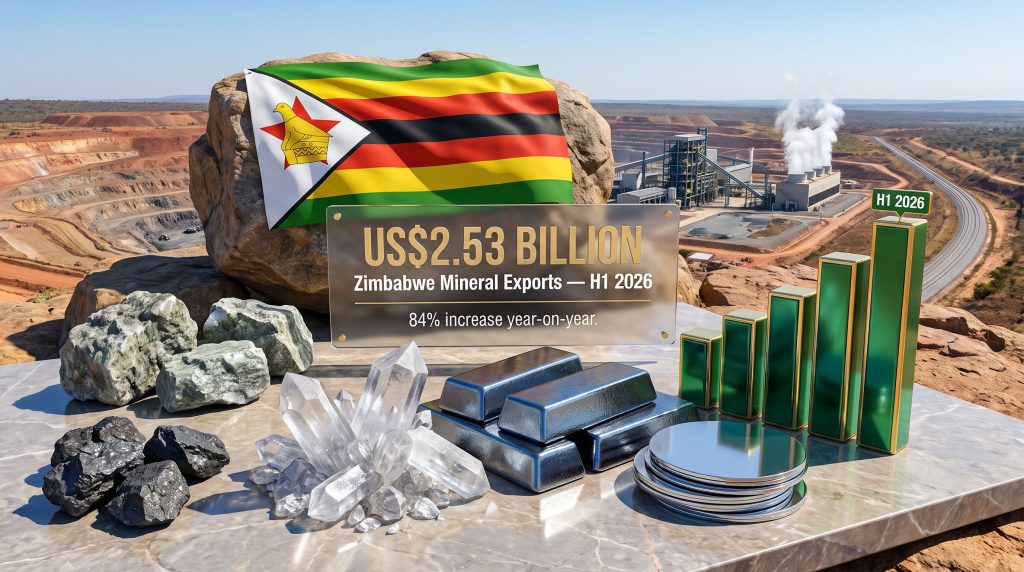
The financial results for the first half of 2026 provide the most compelling empirical argument for Zimbabwe's beneficiation approach. Mineral exports through the MMCZ reached $2.53 billion between January and June 2026, representing an 84% increase over the $1.38 billion recorded in the same period of the prior year. This marks the highest January-to-June export revenue figure the MMCZ has ever recorded.
Dr. Nomsa Moyo, the MMCZ's General Manager, characterised the outcome as direct evidence that the beneficiation framework is functioning as intended. She stated that the results confirm that performance in the mineral sector is no longer measured purely by the volume of material exported, but by the economic value extracted from each tonne. She further noted that Zimbabwe's export mix is increasingly composed of processed products commanding substantially higher market prices, including ferrochrome, steel, polished granite slabs, and lithium sulphate.
Breaking Down the Revenue by Mineral Category
The concentration of Zimbabwe's export earnings across a relatively narrow set of mineral categories reveals both the strength and the structural dependency embedded in the current performance:
| Mineral Category | Share of Total H1 2026 Export Revenue |
|---|---|
| Platinum Group Metals (PGMs) | Approximately 34% |
| Spodumene concentrates (lithium-bearing) | Approximately 26.6% |
| PGM concentrates | Approximately 13.7% |
| Combined top three | More than 74% |
| All other minerals | Less than 26% |
PGMs remain Zimbabwe's dominant export earner, underpinned by the country's position as a significant Southern African platinum producer within the Great Dyke geological formation. The rapid ascent of spodumene concentrates to a 26.6% share signals how quickly lithium has become a structural pillar of Zimbabwe's mineral economy.
What Else Is Driving the Surge
While beneficiation policy deserves credit for improving the value composition of exports, several additional factors have contributed to the revenue surge:
- Elevated global commodity prices for platinum, lithium, and chrome during 2025 and into 2026
- Rising international demand for clean energy minerals, particularly battery-grade lithium and PGMs used in electric vehicles and hydrogen fuel cells
- The commissioning of a new rail corridor connecting Zimbabwe's lithium mining regions to Mozambique's Port of Maputo, which has materially reduced logistics costs and improved export competitiveness relative to other landlocked mineral producers
- Upgraded mineral testing protocols that are reducing the underpricing problem, which has historically allowed mineral value to leak out of Zimbabwe's formal revenue accounting
Zimbabwe's Lithium Sector: The Central Battleground for Beneficiation
The Geological Foundation
Zimbabwe's lithium endowment is dominated by hard-rock spodumene pegmatite deposits, concentrated primarily in the Bikita and Kamativi regions. Hard-rock lithium differs from the brine-hosted lithium deposits found in South America's Lithium Triangle in one critical commercial respect: spodumene requires thermal processing, known as calcination, followed by acid leaching to produce lithium sulphate or lithium hydroxide suitable for battery manufacturing. This processing requirement is both a challenge and an opportunity for Zimbabwe's beneficiation agenda.
The processing intensity of spodumene conversion means the value gap between raw ore and battery-grade output is exceptionally wide, making it one of the most economically compelling cases for domestic beneficiation anywhere in Africa's critical mineral landscape. Innovations such as direct lithium extraction are also beginning to influence how the industry approaches lithium processing efficiency more broadly.
The Accelerated Export Ban and Its Complexities
Zimbabwe moved to halt raw lithium concentrate exports in February 2026, ahead of a formally announced policy timeline that had originally set a January 2027 start date for restrictions on lithium concentrate shipments. The accelerated action followed concerns over accountability and revenue leakage within the lithium export chain.
The speed of implementation exposed a structural tension that will define Zimbabwe's beneficiation challenge for the next several years. By June 2026, lithium mining operators were formally requesting timeline extensions, citing the capital-intensive nature of building processing infrastructure and the practical impossibility of constructing operational refinery capacity within the compressed window created by the accelerated ban.
The central tension in Zimbabwe's lithium beneficiation story is not whether the policy direction is correct, but whether the pace of regulatory implementation can be matched by the pace of industrial investment. Compressing timelines can accelerate compliance pressure, but it can also deter the very capital formation the policy requires.
Zimbabwe's Lithium Output Trajectory Through 2030
According to projections from the Zimbabwe Lithium Association, as cited by The Herald Online, the country's processed lithium output is forecast to grow substantially over the coming years, even as raw material volumes deliberately decline:
| Year | Processed Lithium Output (tonnes) | Spodumene Ore Output (tonnes) | Spodumene Concentrate (tonnes) |
|---|---|---|---|
| 2026 | 130,000 | ~963,049 | ~1,220,000 |
| 2027 | 169,000 | ~467,000 | ~636,000 |
| 2028 | 264,000 | Not specified | Not specified |
| 2029 | 312,000 | Not specified | Not specified |
| 2030 | 344,000 | Not specified | Not specified |
Note: These are forward-looking projections from the Zimbabwe Lithium Association and should not be treated as guaranteed outcomes. Actual production will depend on capital investment, energy availability, processing infrastructure build-out, and global market conditions.
The deliberate compression of raw spodumene volumes between 2026 and 2027 reflects the policy-driven substitution of concentrate exports for higher-value chemical output. Processed lithium output is projected to grow by approximately 165% between 2026 and 2030, a trajectory that would fundamentally alter Zimbabwe's position in the global battery materials supply chain. This aligns with the broader battery manufacturing build-out occurring across global markets, which continues to drive demand for battery-grade lithium chemical inputs.
Improving Lithium Valuation Infrastructure
A less-discussed but operationally critical component of Zimbabwe's lithium strategy involves upgrading the technical infrastructure used to assess mineral grade and composition before export. The Ministry of Mines and Mining Development, working alongside the MMCZ, is modernising laboratory facilities capable of analysing lithium ore at the molecular level, determining grade, impurity profiles, and economic value with greater precision.
The initiative begins at the National Metallurgical Laboratory in Harare and is planned to expand to additional regional facilities. This matters because lithium ore grade is not uniform; spodumene deposits vary considerably in lithium oxide content, and without accurate assay infrastructure, minerals can be exported at values well below their true worth. Closing this valuation gap is as important to Zimbabwe's revenue objectives as the processing mandates themselves.
The Structural Barriers That Could Undermine Zimbabwe's Beneficiation Ambitions
Energy: The Constraint That Cannot Be Negotiated Away
Mineral processing is energy-intensive. Ferrochrome smelting, lithium calcination, and PGM refining all require reliable, large-scale electricity supply. Zimbabwe's electricity grid has historically struggled to meet domestic industrial demand, with load-shedding events regularly disrupting operations. This is not merely an inconvenience; for capital-intensive processing facilities with fixed operating cost structures, unreliable power supply directly undermines financial viability and investment returns.
Until Zimbabwe can demonstrate credible, sustained improvements in electricity supply to industrial consumers, this constraint will continue to act as a ceiling on the pace of beneficiation infrastructure investment. The energy transition in mining more broadly is creating both pressure and opportunity for mineral-producing nations to address their energy vulnerabilities as part of sector modernisation.
Capital Timelines and the Junior Operator Problem
Building a lithium chemical conversion plant or a ferrochrome smelter requires substantial upfront capital, long construction timelines, and access to project financing. For the largest operators in Zimbabwe's mining sector, these requirements are challenging but manageable. For mid-tier and junior operators, compliance with beneficiation mandates within compressed policy timelines may be financially impossible without external capital partners or phased implementation frameworks.
The risk of a two-speed implementation, where large operators with established balance sheets achieve compliance while smaller operators seek exemptions or face shutdown, has implications both for sector competitiveness and for the policy's stated goal of broadening Zimbabwe's industrial base.
Governance and Regulatory Coherence
Zimbabwe's beneficiation framework is also navigating an inherited legislative environment that predates the current policy design. Some existing mining legislation contains provisions that create regulatory ambiguity when applied alongside the newer beneficiation requirements. Resolving these overlaps requires coordinated legislative reform across multiple ministries, which adds complexity and timeline risk to the implementation process.
The MMCZ's investment in digitalisation, including contract monitoring, price verification, and mineral traceability systems, directly addresses one governance dimension: the risk of underpricing and illicit outflows. However, technology-driven accountability tools operate only as effectively as the institutional frameworks supporting their enforcement.
The next major ASX story will hit our subscribers first
Zimbabwe in Global Context: Resource Nationalism and the Critical Mineral Race
A Continent-Wide Shift With Varying Outcomes
Zimbabwe's beneficiation push is not an isolated experiment. It is part of a continent-wide and globally observable shift toward sovereign control over critical mineral supply chains. The clean energy transition has elevated lithium, cobalt, nickel, graphite, and PGMs to strategic status, creating both the incentive and the political legitimacy for mineral-producing nations to assert more demanding terms on foreign operators.
Consequently, approaches to mining decarbonisation in Africa are increasingly intersecting with beneficiation ambitions, as nations seek to modernise their sectors whilst simultaneously asserting greater control over downstream value. Comparing Zimbabwe's approach against regional and global peers reveals a spectrum of outcomes:
| Country | Key Mineral | Beneficiation Approach | Observed Outcome |
|---|---|---|---|
| Zimbabwe | Lithium, PGMs, Chrome | Export bans, mandatory processing plans | Record H1 2026 revenues; implementation gaps remain |
| Democratic Republic of Congo | Cobalt, Copper | Processing requirements, state equity | Mixed results; infrastructure constraints persist |
| South Africa | PGMs, Chrome | Beneficiation charter requirements | Partial success; energy constraints a major barrier |
| Indonesia | Nickel | Full ore export ban implemented 2020 | Significant downstream investment attracted |
Indonesia's experience with its nickel ore export ban is the most frequently cited precedent for Zimbabwe's approach. Following the 2020 ban, Indonesia attracted substantial smelter and battery precursor investment from Chinese and Korean manufacturers, capturing downstream value that had previously been processed offshore. However, Indonesia's success was underpinned by lower energy costs, stronger logistics infrastructure, and a more established industrial base than Zimbabwe currently possesses. Export bans as a first step toward African mineral industrialisation remain a contested but increasingly prominent policy instrument across the continent.
Zimbabwe's Competitive Positioning Through 2030
Despite the implementation challenges, Zimbabwe holds several structural advantages that support its long-term positioning in the battery materials supply chain:
- A diversified critical mineral portfolio spanning lithium, PGMs, chrome, nickel, cobalt, and graphite within a single jurisdiction
- Hard-rock lithium deposits with established operational mines and developing processing infrastructure
- The new Mozambique rail corridor, which addresses one of the most persistent cost disadvantages facing landlocked mineral exporters
- A demonstrated policy commitment, backed by measurable early financial results, that provides a degree of credibility to the framework's long-term intent
Three Scenarios for Zimbabwe's Mineral Economy Through 2030
Scenario One: Accelerated Beneficiation
Processing infrastructure investment gains momentum as financial returns from H1 2026 attract additional capital. Lithium chemical output reaches the projected 344,000 tonnes by 2030. Zimbabwe establishes itself as a mid-stream battery materials supplier to Asian and European manufacturers. Annual mineral export revenues potentially move toward the $6 to $8 billion range under sustained commodity demand conditions.
Scenario Two: Constrained Progress
Energy and capital constraints slow processing capacity build-out. Partial compliance with beneficiation mandates becomes the operative reality, with continued reliance on concentrate exports in some mineral categories. Revenue growth continues but below full-potential trajectory. Periodic policy inconsistency creates investor uncertainty, moderating foreign capital inflows.
Scenario Three: Policy Stagnation
Governance challenges, persistent energy shortfalls, and operator resistance weaken enforcement of the Zimbabwe mineral beneficiation policy requirements. Raw mineral exports continue under exemptions or extended transition timelines. Revenue growth plateaus relative to peers. Zimbabwe's position in the battery supply chain remains primarily upstream, capturing only a fraction of the value available to processing-capable jurisdictions.
Disclaimer: The scenarios presented above are analytical frameworks for assessing potential outcomes and do not constitute financial advice or investment recommendations. Forward-looking projections involve inherent uncertainty and are subject to commodity price movements, political developments, and capital market conditions that cannot be reliably forecast.
Key Indicators to Watch
For those tracking Zimbabwe's mineral sector trajectory, the following metrics provide the most meaningful signals of policy progress:
- Annual MMCZ export revenue for H2 2026 and full-year 2026, as the most immediate test of whether H1 performance is sustained
- Lithium sulphate and hydroxide production volumes relative to declining spodumene ore and concentrate output, as a direct measure of the beneficiation transition
- Compliance certificate issuance rates versus the number of operators still operating under transition plans
- Progress at the National Metallurgical Laboratory and the rollout timeline for regional testing hubs
- Foreign direct investment flows into Zimbabwe's mineral processing sector, which will ultimately determine the pace at which processing capacity can be built within policy-mandated timeframes
This article contains forward-looking statements and projections derived from publicly available sources, including the Zimbabwe Lithium Association and the Minerals Marketing Corporation of Zimbabwe. These projections are subject to material uncertainty and should not be relied upon as the basis for investment decisions. Readers should conduct their own due diligence and seek independent financial advice before making any investment.
Want to Stay Ahead of the Next Major Mineral Discovery?
Discovery Alert's proprietary Discovery IQ model delivers real-time alerts the moment significant ASX mineral discoveries are announced, transforming complex commodity data across 30-plus minerals into clear, actionable insights for both traders and long-term investors. Explore historic examples of major mineral discoveries and their market returns, then start your 14-day free trial to ensure you're positioned before the broader market catches on.