June 9, 2026
Why the World's Most Critical Oil Corridor Is Now Flying Without a Safety Net
The global oil trade has always been defined by its vulnerability to geography. Decades of energy policy, pipeline construction, and tanker fleet expansion have done relatively little to change a fundamental truth: the world's crude supply is funnelled through a handful of narrow maritime passages, and the failure of any one of them carries consequences that ripple across every importing economy on the planet. The Bab el-Mandeb oil export disruption has emerged as one of the most pressing yet underappreciated threats in this fragile system.
Most attention in recent months has been fixed on the Strait of Hormuz, and for good reason. The effective closure of that waterway has already removed approximately 13 million barrels per day from accessible global supply, triggering one of the most significant energy shocks since the 1970s. Yet a second chokepoint, one that has quietly absorbed much of the rerouted Saudi export volume, is now drawing equal concern from energy analysts. That chokepoint is Bab el-Mandeb, and the risks building around it may be the most consequential and least-priced variable in global oil markets today.
When big ASX news breaks, our subscribers know first
The Geometry of Energy Vulnerability: How Two Straits Shape Global Oil Flow
To understand why the Bab el-Mandeb oil export disruption represents such an acute systemic risk, it helps to visualise the physical architecture of global crude delivery. The world's three largest trading blocs — Europe, Asia, and North America — import crude from a relatively small number of origin points concentrated in the Arabian Gulf, West Africa, and Russian-adjacent regions. The pathways between those origin points and their destination refineries pass through a series of narrow geographic bottlenecks.
The two most consequential of these are the Strait of Hormuz and Bab el-Mandeb. Furthermore, while Hormuz has historically received the greater share of analytical attention, the current crisis has reshuffled their relative importance. Understanding crude oil price trends in this context requires grasping how both chokepoints interact within the broader supply system.
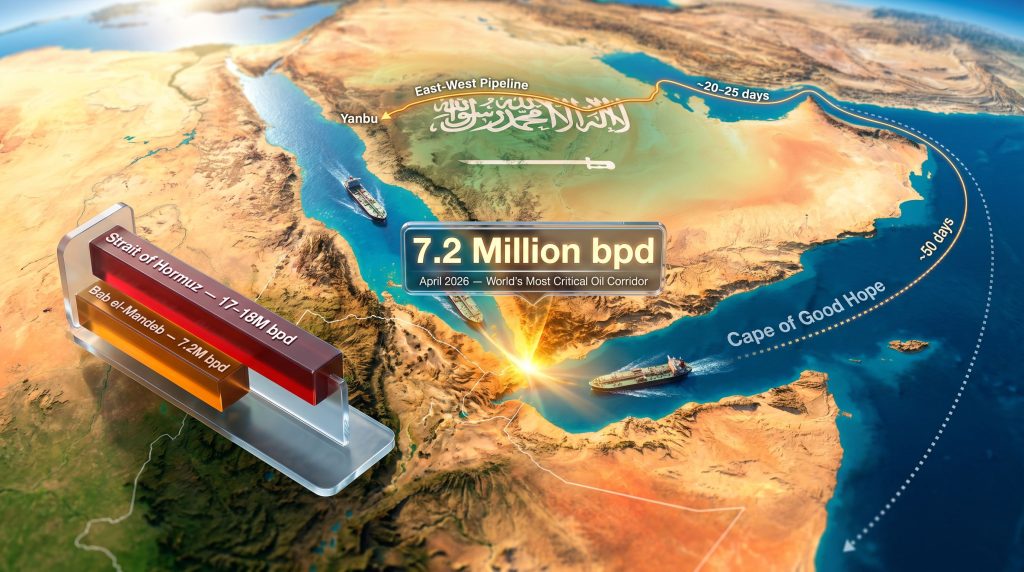
| Chokepoint | Daily Oil Flow (Peak, 2026) | Primary Exporters Exposed | Key Threat Actor | Alternative Route |
|---|---|---|---|---|
| Strait of Hormuz | ~17-18 million bpd | Iran, Iraq, UAE, Kuwait | IRGC / Iran | None viable at scale |
| Bab el-Mandeb | 7.2 million bpd (April 2026) | Saudi Arabia (Red Sea route) | Houthi forces | Cape of Good Hope |
What makes the current situation particularly volatile is that these two chokepoints are not independent risk factors — they are operationally linked. The effective closure of Hormuz forced Saudi Arabia to pivot its entire export operation through its Red Sea corridor, which terminates at the southern end of the Red Sea at Bab el-Mandeb. Consequently, closing Hormuz did not distribute risk; it concentrated it.
What Is Bab el-Mandeb and Why Has It Become So Strategically Exposed?
Bab el-Mandeb, an Arabic phrase broadly translated as the Gate of Tears, is a narrow strait separating Yemen on the Arabian Peninsula from Djibouti on the Horn of Africa. At its narrowest point, the waterway measures roughly 29 kilometres across, making it one of the tightest maritime passages through which large-scale crude shipments must transit. Chokepoint risks such as these have long been identified as potential triggers for significant crude supply tightening.
Under normal operating conditions, the strait carries a mixture of crude oil, refined petroleum products, and liquefied natural gas destined primarily for European and Asian markets. For decades, its volumes were significant but not dominant, typically running between 3.5 and 5 million barrels per day in combined oil and refined product flows. That changed dramatically when the Hormuz closure forced a wholesale restructuring of Saudi export logistics.
The Saudi East-West Pipeline: Infrastructure Under Maximum Stress
Saudi Aramco's East-West Pipeline represents one of the most critical yet least-discussed pieces of energy infrastructure in the world. Running approximately 1,200 kilometres across the Saudi Arabian peninsula, it connects the Kingdom's oil-rich Eastern Province to the Red Sea port of Yanbu, providing an export pathway that bypasses the Strait of Hormuz entirely.
The pipeline's importance in the current crisis cannot be overstated:
- The East-West Pipeline connects Saudi Arabia's eastern oilfields directly to Yanbu on the Red Sea coast
- Aramco confirmed during its first-quarter 2026 earnings that the pipeline had reached its operational ceiling of 7.0 million barrels per day
- Arab Light crude, Saudi Arabia's flagship export grade, has surged from Yanbu as the Kingdom maximised throughput to compensate for Hormuz constraints
- Aramco's president and CEO Amin Nasser confirmed in the Q1 2026 earnings release that the East-West Pipeline had reached its maximum capacity of 7.0 million barrels per day, describing it as a critical supply artery that had helped mitigate the impact of the Hormuz closure on global energy markets (Source: Aramco Q1 2026 earnings release)
The consequence of operating at maximum capacity is that there is zero residual buffer. If Bab el-Mandeb is disrupted, the pipeline cannot be turned up further to compensate. The Kingdom's export capacity would be structurally constrained with no rapid alternative.
How Bab el-Mandeb Oil Flows Reached Record Levels
The transformation of Bab el-Mandeb from a secondary corridor to the world's primary oil export artery has been both rapid and underappreciated by markets. Oil and petroleum product flows through the strait rose from approximately 3.9 million barrels per day in February 2026 to 7.2 million barrels per day by April 2026 — a near-doubling within just two months driven almost entirely by Saudi Arabia's export pivot.
Key Insight: This volume concentration represents a structural vulnerability that did not exist prior to the Hormuz closure. The strait was never designed, nor expected, to carry this level of strategic crude flow, and the threat landscape surrounding it has not diminished proportionally.
A Timeline of Red Sea Disruption: How the Corridor Was Already Weakened
The Bab el-Mandeb risk is not emerging in isolation. Indeed, it is building on top of a shipping corridor that has already experienced sustained disruption over the past several years.
| Period | Event | Traffic Impact |
|---|---|---|
| Late 2023 | Houthi attacks on commercial vessels commence | Widespread voluntary rerouting to Cape of Good Hope begins |
| 2024-2025 | Attack tempo intensifies; global shipping largely avoids Red Sea | Significant reduction in overall transit volumes |
| Early 2025 | Israel-Hamas ceasefire agreed; Houthi operations largely pause | Partial commercial traffic recovery, but well below pre-2022 norms |
| February 2026 | Strait of Hormuz effectively closed by Iranian action | Saudi crude exports pivot sharply to Red Sea and Yanbu |
| April 2026 | Bab el-Mandeb oil flows peak at 7.2 million bpd | Strait becomes the single most critical oil export corridor globally |
A critically underappreciated point in this timeline is that commercial shipping traffic through the Red Sea never fully recovered after the 2023-2024 Houthi campaign, even following the pause in attacks. The psychological damage inflicted on shipping operators and their insurers proved more persistent than the operational pause would suggest. This dynamic is highly relevant to the current risk assessment: a renewed Houthi campaign against energy tankers would not need to be sustained or large-scale to produce a collapse in traffic confidence. The potential ripple effects of such a disruption across global trade are already being closely monitored by analysts and policymakers alike.
Three Disruption Scenarios: Modelling the Range of Outcomes
Scenario 1: Targeted Tanker Attacks and the Confidence Collapse
Scenario Framework: Historical precedent from the 2023-2024 Houthi campaign demonstrates conclusively that a small number of successful vessel strikes can be sufficient to trigger a wholesale collapse in commercial traffic, as insurers withdraw cover and operators voluntarily reroute. A full physical blockade is not required to produce a functional closure of the corridor.
This is actually the most likely disruption pathway and arguably the most insidious, because it operates below the threshold of an overt act of war while achieving many of the same economic outcomes. Two or three successful strikes on crude tankers transiting toward Yanbu would likely be sufficient to trigger insurance market withdrawal, making continued operations economically unviable for most operators.
Scenario 2: Dual-Chokepoint Disruption and the Historic Supply Shock
The scenario that energy security analysts are increasingly focused on involves simultaneous constraint at both Hormuz and Bab el-Mandeb. The arithmetic here is stark:
- Combined accessible supply removed from global markets could exceed 20 million barrels per day
- This would represent the most severe peacetime oil supply shock in recorded history, surpassing even the 1973 Arab oil embargo in absolute volume terms
- Saudi Arabia would lose its primary remaining export pathway, with no equivalent alternative available at comparable scale
- Global strategic petroleum reserves, already under significant drawdown pressure, would face extraordinary depletion demands
- China's strategic stockpile, estimated above 1.2 billion barrels, would provide some buffer but represents a finite and non-replenishable short-term cushion under dual-disruption conditions
Scenario 3: Partial Disruption and the Prolonged Friction Model
Even a partial disruption that forces rerouting without fully closing the strait would carry substantial economic consequences:
- Tankers diverted from Bab el-Mandeb must either transit the Suez Canal or circumnavigate Africa via the Cape of Good Hope
- Transit time to Asian buyers extends from approximately 20-25 days to nearly 50 days, more than doubling voyage duration
- Very Large Crude Carriers (VLCCs), the standard vessel for long-haul crude delivery, cannot transit the Suez Canal due to draft restrictions, forcing operators into smaller, less efficient vessel classes
- Freight rates, fuel consumption costs, and war-risk insurance premiums all escalate materially under extended routing conditions
- The reduction in effective fleet capacity during a rerouting event creates secondary tightening in global tanker availability, amplifying the price transmission effect
Analytical Note: Extended voyage distances do not simply add linear cost. They reduce fleet effective capacity globally, tighten tanker availability during periods of concentrated demand, and can drive freight rates exponentially higher. This secondary price transmission channel is consistently underestimated in headline oil price forecasts and deserves far more weight in market analysis.
Who Bears the Greatest Risk? Mapping Import Vulnerability
Asian Economies: First in Line for Supply Shock
| Economy | Exposure Level | Key Risk Factor |
|---|---|---|
| China | Very High | World's largest crude importer; strategic stockpile provides partial but finite insulation |
| India | Very High | Rapidly growing import dependence; actively diversifying toward Russia, Brazil, and Venezuela |
| Japan and South Korea | High | Near-zero domestic production; heavily reliant on Middle Eastern crude via Red Sea routing |
| Southeast Asia | Moderate-High | Import-dependent with limited strategic reserve infrastructure |
India's response deserves particular attention as a case study in real-time supply diversification under stress. Indian companies have accelerated imports from Russia, Brazil, and Venezuela, with one monthly surge in Venezuelan imports reportedly exceeding 51% as Indian refiners scrambled to secure non-Middle Eastern supply alternatives (Source: OilPrice.com). In addition, Asian energy import pressures have been further compounded by concurrent LNG tariff tensions, adding another layer of complexity to the region's energy security calculus.
European and African Exposure: Often Overlooked in the Analysis
European importers face a more complex exposure profile. Their primary vulnerability through Bab el-Mandeb is not crude oil per se but refined petroleum products and LNG moving northward through the Red Sea corridor. A disruption would lengthen supply chains and elevate costs across the European refining complex at a time when fuel prices are already elevated. Eurozone fuel sales have already declined measurably as the broader Iran conflict has driven energy prices higher.
African and smaller Middle Eastern economies that depend on product imports through the corridor represent a third, frequently overlooked category of exposure. These economies typically hold minimal strategic reserves and have limited alternative sourcing options, making them disproportionately vulnerable to both supply interruption and price escalation.
The next major ASX story will hit our subscribers first
What Do Commodity Flow Analysts Say About the Risk?
Commodity flow intelligence firm Kpler published analysis in March 2026, approximately one month after the Hormuz closure began, assessing the Bab el-Mandeb risk in detail. Senior crude oil analyst Muyu Xu concluded that any Houthi move to disrupt transit through the strait would further restrict Asian buyers' access to Middle Eastern crude supplies that were already significantly constrained by the Hormuz blockade.
Xu specifically noted that rerouting via the Suez Canal and Cape of Good Hope would nearly double voyage duration to approximately 50 days, materially reducing prompt market availability while simultaneously driving up freight and logistics costs (Source: Kpler analysis, March 2026). The key phrase here is prompt availability. Oil market pricing operates on a term structure where near-delivery barrels command a premium or discount to forward barrels depending on supply-demand balance. Extended voyage times do not merely raise costs; they effectively remove barrels from the prompt market, tightening the front of the curve and potentially triggering backwardation that signals genuine physical supply stress.
Are Markets Underpricing the Tail Risk?
Brent crude climbed to approximately $94 per barrel in mid-2026 as Houthi activity targeting vessels linked to Israeli interests escalated in the Red Sea. While this price level reflects genuine concern about Middle Eastern supply, several analysts have argued that markets may be insufficiently accounting for the specific tail risk of a Bab el-Mandeb oil export disruption compounded by the existing Hormuz constraint. Monitoring WTI and Brent futures closely remains essential for understanding how these tail risks are — or are not — being priced into forward curves.
Several factors have collectively suppressed price spikes that might otherwise have been more severe:
- China's strategic crude stockpile, estimated at more than 1.2 billion barrels, has acted as a significant demand-side buffer
- Elevated oil-on-water volumes, with tankers holding crude at sea rather than delivering to storage, have temporarily inflated apparent supply availability
- Saudi Arabia's rapid and successful pivot to the Red Sea route demonstrated logistical flexibility that reassured traders
However, each of these buffers is finite. Strategic stockpiles cannot be replenished if supply routes remain constrained. Oil-on-water volumes will eventually deliver or expire. And the East-West Pipeline is already at maximum capacity.
The critical asymmetry here is that the downside scenario — a dual-chokepoint disruption — is historically unprecedented in scale, while the market appears to be pricing a continuation of the current impaired-but-functional equilibrium. This gap between priced risk and actual tail risk is precisely where energy market dislocations tend to originate.
The Geopolitical Escalation Threshold: When Disruption Becomes an Act of War
Any Houthi move to materially block Bab el-Mandeb would not be simply a logistical problem for Saudi Arabia. It would effectively sever the Kingdom's last significant export corridor, inflicting direct and severe economic damage on Riyadh. The economic consequences would be large enough that they would almost certainly compel a direct Saudi military response rather than a diplomatic one.
The IRGC has repeatedly signalled its awareness of this leverage, issuing threats to close Bab el-Mandeb on multiple occasions, including as recently as the week preceding the mid-June 2026 Iran-Israel escalation. The fact that these threats have not yet been acted upon reflects a complex calculation about escalation thresholds rather than an absence of capability or intent. Furthermore, OPEC's market influence over production decisions adds yet another layer of geopolitical complexity to an already volatile situation.
Understanding this dynamic requires distinguishing between what the Houthis can do and what Iran permits them to do. The operational relationship between Tehran and the Houthi movement means that any serious action against Bab el-Mandeb energy infrastructure would most plausibly occur in the context of a broader Iranian strategic decision to escalate, not as an independent Houthi initiative. The trade war impact on oil markets has similarly demonstrated how geopolitical decisions can rapidly translate into tangible supply and pricing consequences.
Key Takeaways for Energy Market Participants
The current configuration of global oil flows has created a fragility that deserves far more attention than it currently receives in mainstream market analysis:
- Bab el-Mandeb oil flows have nearly doubled since the Hormuz closure, concentrating global supply risk in a single, increasingly exposed corridor
- Saudi Arabia's East-West Pipeline is operating at its maximum capacity of 7.0 million bpd, leaving no residual buffer if Red Sea access is compromised
- A dual-chokepoint disruption scenario could remove more than 20 million barrels per day from accessible global markets, representing an unprecedented peacetime supply shock
- Rerouting via the Cape of Good Hope extends Asian delivery times to approximately 50 days and materially elevates freight, fuel, and insurance costs across the tanker market
- VLCCs, the industry's most efficient long-haul crude carriers, cannot transit the Suez Canal, adding a further layer of logistical friction to any rerouting scenario
- Market pricing at approximately $94 per barrel for Brent may not fully reflect the tail risk of a Bab el-Mandeb oil export disruption layered on top of existing Hormuz constraints
- Importing economies across Asia, Europe, and Africa should be actively reassessing strategic reserve adequacy and supply diversification strategies in light of the structural concentration of risk in this single corridor
Disclaimer: This article is intended for informational and educational purposes only and does not constitute financial or investment advice. All figures, timelines, and scenario projections involve inherent uncertainty and should not be relied upon as forecasts of specific market outcomes. Energy market conditions are subject to rapid change based on geopolitical developments beyond the scope of any analytical framework.
Want to Stay Ahead of the Next Major Commodity Disruption?
When geopolitical shocks reshape global energy markets, the ripple effects reach far beyond oil — significant mineral discoveries on the ASX can represent compelling opportunities for investors positioned ahead of the broader market. Discovery Alert's proprietary Discovery IQ model delivers real-time alerts on significant ASX mineral discoveries, transforming complex data into actionable insights, and its dedicated discoveries page showcases the kind of historic returns that major discoveries have generated. Begin your 14-day free trial today and ensure you never miss a market-moving discovery.