July 7, 2026
Arctic Iron Ore and the Economics of Purity: Why Grade Matters Before Scale
The global steel industry is undergoing one of its most consequential transformations in decades. As European producers face mounting pressure to reduce carbon intensity across their production chains, the quality of iron ore inputs has shifted from a secondary consideration to a central strategic variable. High-grade iron ore, typically defined as material assaying above 65% iron content, reduces the volume of reductants required in steelmaking, directly cutting carbon emissions per tonne of finished steel. This is not a marginal efficiency gain; it is a structural advantage that increasingly determines which ore sources command premium pricing and long-term offtake interest.
Within this context, the Baffinland Mary River mine expansion is emerging as one of the most closely watched iron ore development stories in the Western Hemisphere. The project sits on a deposit that consistently produces ore grading above 65% iron, placing it among the highest-purity natural iron ore sources operating globally. What makes this particularly significant is that most of the world's highest-volume iron ore exporters, concentrated in Western Australia and Brazil, primarily supply lower-grade material that requires beneficiation or blending before use in premium steelmaking applications.
When big ASX news breaks, our subscribers know first
What Makes Mary River Iron Ore Different from Bulk Supply Sources
The Grade Advantage in a Decarbonising Steel Sector
Mary River's ore is a direct-shipping ore (DSO), meaning it requires minimal processing before it can be loaded onto vessels and dispatched to steelmakers. This characteristic alone carries substantial cost and emissions implications. DSO operations avoid the energy-intensive crushing, grinding, and concentration steps required to upgrade lower-grade feedstock to blast furnace specification.
For European steelmakers operating under the EU Emissions Trading System, where carbon costs are a live financial liability rather than a theoretical future constraint, the difference between 62% Fe fines and 66%+ Fe DSO is measurable in euros per tonne of steel produced. Sourcing higher-purity inputs from Mary River can reduce coke consumption rates and improve furnace productivity, delivering both cost and compliance advantages simultaneously. Furthermore, as momentum grows around green iron production, high-purity DSO feedstocks are becoming increasingly central to low-emission steelmaking strategies.
The practical reality of high-grade DSO iron ore is that it functions almost as a direct productivity input rather than simply a raw material, with purity directly influencing carbon intensity, fuel consumption, and ultimately the cost competitiveness of European steel mills.
Geographic Positioning and the Atlantic Supply Chain
One underappreciated dimension of the Mary River project is its geographic orientation. While Australian producers dominate Asian steel markets due to proximity and established logistics, the shipping economics for Atlantic-facing markets favour Canadian Arctic supply. Vessels departing from Baffin Island travel shorter distances to reach ports in Germany, the Netherlands, and the United Kingdom than those originating from Pilbara or the Brazilian interior.
This geographic factor becomes commercially decisive if Baffinland can deliver consistent volumes at sufficient scale. The Baffinland Mary River mine expansion, if fully executed, would position the operation as a 30 million metric tonne per year supplier, making it comparable in output scale to mid-tier Australian producers while serving a market segment those producers are structurally less competitive in. In addition, Australia's iron ore dominance in Asian markets further illustrates why Atlantic-facing supply from Canada carries distinct strategic value for European buyers.
A Decade of Regulatory Navigation: From Rejection to Clearance
Understanding the 2021 Federal Rejection
The federal government's 2021 decision to reject Phase 2 of the Mary River expansion was not primarily driven by opposition to mining in principle. The rejection focused on two specific environmental pressure points: narwhal population disruption in the Milne Inlet shipping corridor and the intersection of proposed infrastructure with caribou hunting grounds relied upon by Pond Inlet Inuit communities.
The original Phase 2 proposal was shipping-volume-led, targeting an increase to 12 million metric tonnes per year through intensified use of Milne Inlet's existing seasonal shipping window. Under this model, vessel traffic was projected to reach approximately 176 ships per year, a figure that federal environmental assessors and Inuit community representatives identified as incompatible with narwhal habitat protection obligations.
| Regulatory Milestone | Year | Outcome |
|---|---|---|
| South Railway to Steensby Inlet approved | 2012 | Initial green light for southern rail corridor |
| Phase 2 expansion proposal submitted | Pre-2021 | Increased shipping to 12 million tonnes sought |
| Federal government rejects Phase 2 | 2021 | Environmental concerns over narwhal and caribou |
| Shipment cap raised to 6 million tonnes/year | ~2022 | Partial approval under Northern Affairs Minister Dan Vandal |
| Baffinland enters creditor protection | 2025 | Financial restructuring; mine operations unaffected |
| Inuit consultation formally concluded | Early 2026 | Federal prerequisite for expansion clearance satisfied |
| Full expansion officially cleared | 2026 | Rail and port construction authorised to proceed |
What Changed Between 2021 and 2026
The reconfigured expansion proposal introduced a fundamentally different infrastructure model. Rather than increasing shipping intensity through a single port, the revised approach distributes throughput across two separate port facilities connected by dedicated railway corridors. This architectural shift was central to satisfying the environmental concerns that had blocked the earlier proposal.
By routing a significant portion of production south via rail to Steensby Inlet, the revised plan reduces the concentration of vessel traffic in Milne Inlet's narwhal corridor. The Inuit consultation process, which concluded in early 2026, represented the final procedural prerequisite before formal expansion clearance could be granted. According to the project's official overview, this dual-port strategy was a cornerstone of the revised development framework from the outset.
Infrastructure Scope: What the Expansion Actually Builds
Two Railway Corridors and a Dual-Port System
The physical scale of the approved Baffinland Mary River mine expansion is substantial by any measure, and extraordinary by Arctic standards. The core infrastructure components include:
- North Railway: A 149-kilometre rail corridor running parallel to the existing tote road, connecting the mine site to the upgraded Milne Inlet port facility
- South Railway: A separate rail line to Steensby Inlet on the southern coast of Baffin Island, operating under the 2012 approval that has remained dormant until now
- Dual Port Upgrades: Expanded capacity at both Milne Inlet and Steensby Inlet to handle Cape-size bulk carriers
- Vessel Class Upgrade: Transition from standard bulk carriers to Cape-size vessels capable of carrying approximately 180,000 deadweight tonnes per voyage
- Extended Shipping Season: Expansion from the current six-month operational window to approximately ten months per year
Production and Operational Comparison
| Metric | Current Operation | Post-Expansion Target |
|---|---|---|
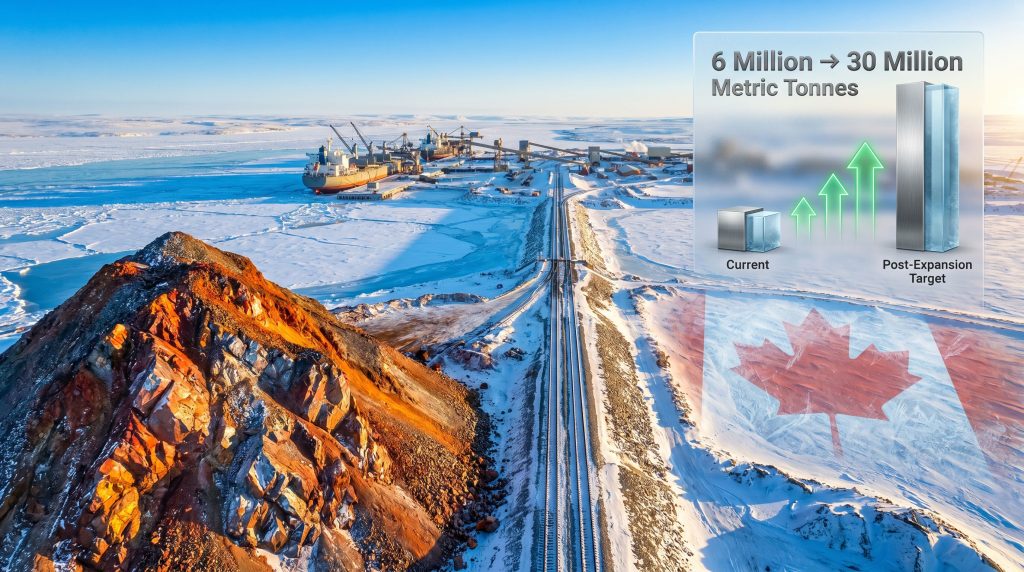
| Annual Iron Ore Output | 6 million metric tonnes | 30 million metric tonnes |
| Shipping Season | ~6 months | ~10 months |
| Primary Transport Mode | Tote road (truck haulage) | Dual rail corridors |
| Active Port Facilities | Milne Inlet only | Milne Inlet + Steensby Inlet |
| Vessel Type | Standard bulk carriers | Cape-size carriers |
The shift to Cape-size vessels is particularly significant from a commercial perspective. Cape-size economics reduce the freight cost per tonne dramatically compared to smaller Panamax or Handymax vessels, consequently improving delivered cost competitiveness for European buyers.
Nunavut's Economic Reality: Iron Ore as a Territorial Lifeline
The Concentration Risk of a Single-Commodity Economy
Iron mining currently represents approximately 25% of all economic activity across Nunavut, a territory with a total population of roughly 40,000 people. This extraordinary degree of economic concentration in a single commodity means that decisions affecting Mary River's output trajectory have territorial-scale consequences, not merely project-level ones.
A fivefold production increase would amplify this contribution across multiple dimensions:
- Direct employment in mining operations and railway maintenance
- Indirect employment in supply chain services, logistics, and community infrastructure
- Expanded Inuit employment opportunities under the terms of the Impact and Benefits Agreement (IBA) with the Qikiqtani Inuit Association (QIA)
- Federal and territorial royalty revenues scaling proportionally with production volume
- Multiplier effects flowing through Iqaluit and regional communities as spending capacity increases
For a jurisdiction with limited industrial diversification and significant infrastructure deficits, the Mary River expansion represents a generational economic inflection point, one whose downstream effects will extend well beyond the mine gate.
Inuit Land Rights and the IBA Framework
The Mary River mine sits on Inuit Owned Lands, a legally distinct land tenure category under Nunavut's land claims framework. This classification means the QIA holds substantive negotiating power over mine development through the IBA mechanism. The IBA is not a static document; it has been augmented over time as operational conditions and community priorities have evolved, with a notable amendment completed in 2018.
Community perspectives on the expansion are not uniform. Workers at Baffinland have previously petitioned the federal government directly to approve expansion, citing the direct link between production volumes and employment stability. However, elders and hunters from Pond Inlet have raised concerns grounded in cultural and ecological knowledge about the intersection of industrial activity with narwhal migration and caribou movement patterns. As Nunatsiaq News has reported, the economic fortunes of Nunavut are deeply intertwined with this mine's trajectory, making these tensions all the more consequential to resolve.
Environmental Risks That Persist Beyond Regulatory Approval
Narwhal Habitat and the Milne Inlet Corridor
Milne Inlet is a seasonally critical habitat zone for narwhal, a species of considerable ecological and cultural significance to Inuit communities. Acoustic disturbance from vessel traffic during narwhal migration periods has been identified as the primary mechanism of impact. The extended ten-month shipping season approved under the new expansion framework increases the duration of this disturbance window relative to current operations, which itself has already prompted monitoring concerns.
Steensby Inlet and Foxe Basin, activated under the South Railway scenario, introduce a second distinct ecological zone requiring impact monitoring. Foxe Basin supports one of the largest polar bear subpopulations in the Canadian Arctic, as well as walrus populations and a range of migratory seabird species. Regulatory approval does not eliminate ongoing compliance obligations in either corridor; environmental monitoring programmes will likely be embedded as licence conditions running for the life of the project.
Caribou and the Spatial Overlap Problem
The 149-kilometre North Railway corridor traverses terrain that overlaps with caribou migration routes used by Pond Inlet hunters. This is not a theoretical concern; the Baffin Island caribou herds are a food security and cultural resource for communities whose connection to the land predates the existence of the Canadian state. Infrastructure crossing migration corridors can fragment movement patterns over time, even when individual crossing events are managed with mitigation measures.
The next major ASX story will hit our subscribers first
Financial Execution Risk: The Creditor Protection Dimension
A Balance Sheet Under Restructuring
Baffinland Iron Mines Corporation entered creditor protection in 2025 carrying approximately $1.1 billion in debt. Mine operations have continued without interruption throughout this process, and production has maintained its approved 6 million tonne annual rate. However, the capital requirements for the approved expansion are categorically different from sustaining capital at current production levels.
Constructing 149 kilometres of Arctic railway, upgrading two port facilities to Cape-size vessel specifications, and extending a shipping season through Arctic ice conditions into winter months are collectively likely to require capital expenditure running into multiple billions of dollars. Securing construction financing whilst operating under creditor protection requires either a resolution of the restructuring proceedings or the entry of a strategic partner capable of anchoring project finance arrangements.
Regulatory clearance and financial close are entirely separate milestones. The gap between achieving one and the other in Arctic mining, under creditor protection, is where execution risk actually lives.
Potential Financing Pathways
Several structural options exist for advancing the expansion despite current financial constraints:
- Restructuring resolution that recapitalises the company under new or existing ownership with clean balance sheet capacity
- Strategic partnership with a major European steelmaker seeking to secure long-term high-grade iron ore supply through an equity or offtake arrangement
- Sovereign or institutional co-investment structures that leverage the strategic significance of Arctic iron ore supply to Atlantic markets
- Project finance secured against long-term contracted offtake volumes, a structure common in large-scale mining developments
Each pathway carries its own timeline and conditionality, and none is without complexity in the context of active creditor proceedings. Furthermore, broader shifts in the steel and iron ore market will inevitably influence the appetite of potential strategic partners and financiers.
How Mary River Compares Within the Canadian and Global Iron Ore Landscape
| Operation | Country | Annual Output (approx.) | Primary Market |
|---|---|---|---|
| Mary River (post-expansion target) | Canada | 30 million tonnes | Europe |
| Labrador Iron Ore (IOC) | Canada | ~20 million tonnes | Global |
| Champion Iron (Bloom Lake) | Canada | ~15 million tonnes | Asia and Europe |
| Major Australian Tier-1 producers | Australia | 200 to 300 million tonnes | Asia |
At 30 million tonnes of high-purity DSO, Mary River would become the largest iron ore operation in Canada by a significant margin and one of the most strategically positioned suppliers to the European market globally. Its competitive position is not built on volume relative to Australian majors, but on grade, purity, and Atlantic logistics economics. Monitoring iron ore price trends will consequently be essential for assessing the commercial viability of the project across its construction timeline.
Key Risks and Catalysts to Monitor
Investors, industry observers, and community stakeholders tracking the Baffinland Mary River mine expansion should watch for the following inflection points:
- Financial restructuring resolution: The timing and structure of Baffinland's emergence from creditor protection will determine the feasibility timeline for construction commencement
- Construction financing close: Capital commitment announcements will signal whether the 2026 construction start timeline is achievable or subject to deferral
- Environmental monitoring outcomes: Early construction-phase data on narwhal and caribou impacts will shape regulatory sentiment and the risk of licence conditions being tightened
- Offtake agreements: Long-term supply contracts with European steelmakers would both validate demand assumptions and provide the revenue certainty needed to anchor project financing
- Arctic construction season realities: The compressed window for effective construction activity in Nunavut means schedule slippage compounds quickly; each lost construction season delays production revenue by at least one full year
In addition, the advancement of hydrogen iron ore reduction technologies across European steel mills will further reinforce demand for the high-purity DSO grades that Mary River is uniquely positioned to supply at Atlantic-competitive freight rates.
This article contains forward-looking statements and assessments based on publicly available information. Mining development timelines, financial outcomes, and regulatory conditions are subject to change. This content does not constitute financial or investment advice. Readers should conduct independent due diligence before making any investment decisions.
Want to Stay Ahead of the Next Major Mineral Discovery on the ASX?
Discovery Alert's proprietary Discovery IQ model scans ASX announcements in real time, instantly identifying significant mineral discoveries and translating complex data into actionable investment insights — explore historic discoveries and their extraordinary returns, then begin your 14-day free trial at Discovery Alert to position yourself ahead of the broader market.