July 7, 2026
The Hidden Architecture of Diamond Pricing Is Cracking
For most of the twentieth century, the global diamond market operated less like a commodity exchange and more like a carefully managed theatre production. Supply was choreographed, prices were curated, and the audience, comprising consumers, jewellers, and traders alike, largely accepted the narrative presented to them. The genius of this system was not geological or technological. It was psychological. Diamonds were scarce because the market was told they were scarce.
That architecture is now under serious structural stress. The De Beers diamond price cuts announced in July 2026 are not simply a commercial adjustment. They represent something far more significant: the formal acknowledgement that the pricing illusion, long maintained through confidential discounted sales running in parallel with artificially elevated official prices, is no longer sustainable.
When big ASX news breaks, our subscribers know first
What the Sightholder System Actually Controls and Why It Matters
To understand why the De Beers diamond price cuts carry such weight, it helps to understand the mechanics of the sightholder system itself. De Beers does not sell rough diamonds through open auctions or commodity exchanges. Instead, it operates through a curated network of pre-approved buyers, known as sightholders, who are invited to purchase parcels of rough stones at ten scheduled sales events per year.
These events are not negotiations. Sightholders are offered a box of diamonds at a stated price, and they can either accept or decline. Historically, declining too often risked exclusion from the programme entirely. This structure gave De Beers extraordinary control over both the volume and the price at which diamonds entered the global cutting and polishing pipeline.
The July 2026 sale marks the first event conducted under a newly restructured sightholder contract, and the buyer list has contracted significantly:
- The sightholder network has been reduced from approximately 70 buyers to between 45 and 50
- This consolidation concentrates purchasing volume among De Beers' most commercially aligned and financially robust customers
- Fewer buyers theoretically reduces the risk of goods being flipped into secondary markets at distressed prices, which had been undermining the official price architecture
However, concentrating buyers also concentrates risk. If even a handful of the remaining sightholders encounter financial difficulty or reduce their purchasing appetite, De Beers has far less buffer. Furthermore, this mining industry consolidation trend mirrors broader patterns seen across resource sectors globally.
The Dual-Pricing Problem That Preceded the Cuts
One of the lesser-known aspects of the current crisis is how De Beers managed the growing gap between its official list prices and secondary market reality over recent years. Rather than formally cutting prices, the company conducted what industry insiders described as confidential or off-market discounted sales running alongside the standard sightholder system.
This approach created a problematic dynamic:
- Official prices signalled confidence and stability to the broader market
- Privately discounted sales acknowledged that the official prices were detached from commercial reality
- Sightholders who were aware of the gap faced a competitive disadvantage against traders accessing goods at secondary market rates
- Buyer trust in the official pricing mechanism eroded over time
The July 2026 cuts represent a formal pivot away from this dual-pricing approach. Official prices are now being brought into closer alignment with actual secondary market levels, where traders, cutters, and polishers transact among themselves. Prior to these cuts, official De Beers prices were running between 5% and 50% above secondary market rates depending on stone category, an extraordinary divergence by any measure.
The introduction of one-line invoicing earlier in 2026, replacing per-box itemised pricing, has added a further layer of opacity. Without per-category price disclosure, precise like-for-like comparisons between old and new pricing become structurally difficult to verify, a transparency issue that industry participants have noted with concern.
Converging Pressures: Why Multiple Forces Hit Simultaneously
The De Beers diamond price cuts did not emerge from a single shock. They reflect the simultaneous convergence of several independent structural forces, each significant on its own, but collectively overwhelming when combined.
The Synthetic Diamond Supply Avalanche
Lab-grown diamond production technology has improved faster than most industry participants anticipated even five years ago. The numbers are stark:
| Category | Price Level |
|---|---|
| Lab-grown wholesale (Indian cutting centres) | As low as ~$50 per carat |
| Lab-grown retail (1 carat, gem quality) | ~$400 to $500 per carat |
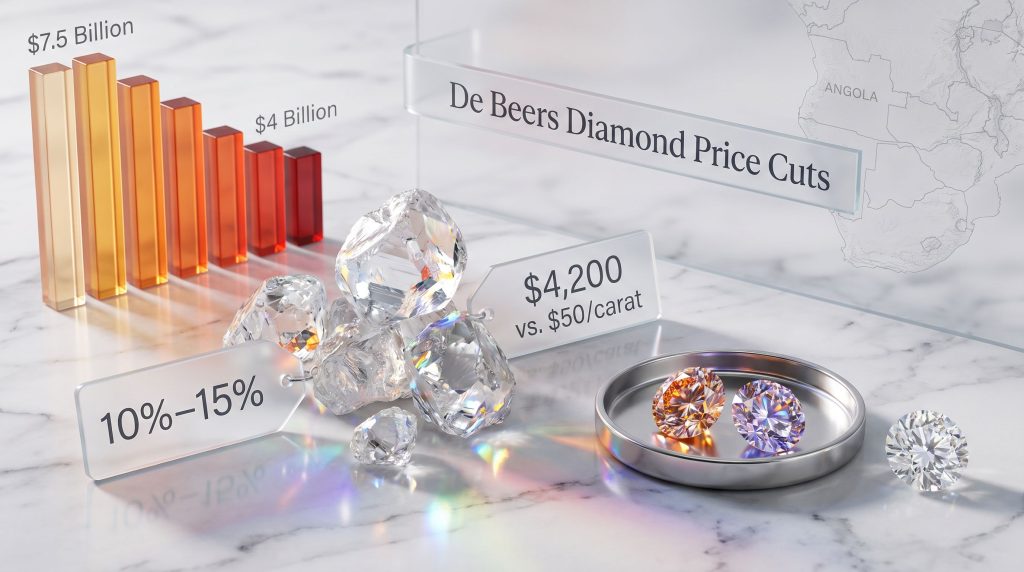
| Natural diamond retail average (1 carat) | ~$4,200 per carat |
The price gap between natural and synthetic stones is not merely large; it is widening on the synthetic side as production scales. Importantly, lab-grown diamonds are not constrained by geology. Unlike natural stones, which require specific mantle conditions, carbon-rich fluid environments, and tectonic uplift mechanisms operating over billions of years, synthetic diamonds can be produced in weeks using chemical vapour deposition or high-pressure high-temperature processes.
This means that synthetic diamond supply has no natural ceiling. As reactor technology improves and production costs compress, wholesale prices will likely continue their descent. The long-term structural implication is that synthetic diamonds will increasingly occupy the value and fashion segments of the market, leaving natural stones to compete primarily on provenance and rarity. In addition, understanding which diamond production countries dominate global supply provides useful context for how this shift is unfolding.
China's Luxury Retreat and Pipeline Gridlock
Chinese consumers represented one of the most important growth pillars for natural diamond demand over the past two decades. The sustained pullback in Chinese luxury spending has not simply reduced transaction volumes at the retail end. It has created a systemic inventory build-up that propagates backwards through the entire supply chain.
When polished diamonds sit unsold in retail showcases, polishers stop buying rough. When polishers stop buying rough, traders accumulate inventory. When traders are overstocked, they sell at discounts in secondary markets, which then undermines official prices. This pipeline gridlock explains why De Beers' confidential discounting strategy eventually became untenable. Consequently, China's cross-border economic activity more broadly has shaped demand corridors for luxury commodities in ways that are only now becoming fully apparent.
Angola's Market-Rate Competition
Angola's emergence as a significant rough diamond producer willing to sell at prevailing market prices, rather than managing supply to defend pricing, effectively set a price ceiling that De Beers could no longer ignore. Angola recorded record rough diamond sales volumes at market rates, providing sightholders and traders with an accessible alternative supply source. When buyers can source comparable goods at secondary market rates from other producers, the premium attached to De Beers official prices becomes commercially indefensible.
Macroeconomic Friction
US tariff announcements across luxury goods categories and ongoing Middle East geopolitical disruption have added demand uncertainty at a time when the market could least absorb additional shocks. Key diamond trading corridors, including those connecting cutting centres in India with retail markets in the United States and Gulf region, have faced logistical and sentiment headwinds. The geopolitical landscape for metals and mining more broadly has similarly created compounding uncertainty across resource markets.
De Beers' Financial Deterioration: Putting the Numbers in Context
The commercial rationale for the De Beers diamond price cuts becomes clearer when viewed against the company's recent financial performance. Furthermore, the scale of value destruction over a short period is striking even by volatile commodity market standards.
| Metric | Data Point |
|---|---|
| H1 2025 Net Loss | $189 million |
| Revenue Decline (H1 2025) | Down 13% year-on-year |
| Rough Diamond Sales Volume Decline | Down 13% |
| De Beers Valuation (2026) | ~$4 billion |
| De Beers Valuation (2024) | ~$7.5 billion |
| Valuation Reduction | Approximately 47% over two years |
The Diamond Standard Index has been in persistent decline since early 2022, suggesting the current market downturn is not a short-term demand correction but a multi-year structural repricing event with compounding drivers.
What makes this cycle distinctly more complex than prior downturns, such as the 2008 to 2009 financial crisis contraction or the 2015 to 2016 oversupply period, is the dual structural nature of the threat. Previous cycles were predominantly cyclical: demand contracted, inventory built up, prices fell, supply reduced, and the market eventually rebalanced. The current environment combines that cyclical dynamic with a permanent structural shift in consumer alternatives. Recovery, if it comes, will likely be slower and less complete than historical cycles suggest. Indeed, commodity prices impacting mining company performance in 2025 reflects a wider pattern of sustained pressure across resource businesses.
The Anglo American Divestiture Dimension
Anglo American's decision to divest De Beers adds a strategic layer to what might otherwise be read as a purely operational pricing decision. A credible, market-aligned price reset serves multiple purposes in the context of a sale process:
- It removes the artificial overhang of inflated official prices that had been eroding buyer trust
- It improves the commercial legibility of the business for prospective acquirers conducting due diligence
- It signals operational transparency at a moment when the business needs to attract serious acquisition interest
Any party acquiring De Beers at approximately $4 billion would be inheriting a business that has already absorbed significant write-downs, a compressed sightholder network, and a market navigating synthetic competition. The price cuts, while painful for near-term revenue, may represent necessary groundwork for a cleaner commercial handover rather than a liability left for a new owner to manage.
The next major ASX story will hit our subscribers first
Natural Diamonds and the Long-Term Rarity Argument
One of the underappreciated aspects of the current pricing reset is its potential long-term effect on natural diamond value positioning. The geological conditions required to produce gem-quality natural diamonds are extraordinarily specific: carbon must be present at depths of approximately 150 to 200 kilometres, under pressures exceeding 45 kilobars and temperatures above 900 degrees Celsius, before being transported to the surface through rare volcanic events known as kimberlite eruptions. This process takes billions of years and cannot be replicated at industrial scale.
This geological scarcity argument remains intact regardless of what happens to synthetic diamond pricing. The challenge for the natural diamond market is translating that geological reality into consumer behaviour at the point of purchase. When a synthetic stone is visually and chemically identical to a natural stone at one-tenth the price, the rarity premium requires active marketing reinforcement to remain commercially meaningful.
Lower rough prices at the De Beers level will gradually transmit through the cutting and polishing pipeline into reduced wholesale and retail costs for natural stones. This may ultimately improve accessibility for consumers without permanently destroying the rarity premium that underpins long-term natural diamond value.
However, De Beers' sales performance following recent price adjustments suggests that official cuts can restore transaction volumes, at least in the short term, even if broader structural questions remain unresolved.
What Industry Participants Should Watch Next
For those tracking the diamond sector, several indicators will determine whether the July 2026 price cuts represent the floor of the current cycle or simply one step in a continuing descent:
- Chinese luxury demand recovery signals: Any sustained uptick in Chinese consumer confidence and high-value goods spending would represent the single most significant positive catalyst for natural diamond prices
- Synthetic diamond adoption rates in engagement ring categories: This segment has historically been the strongest hold-out for natural stone preference; accelerating synthetic penetration here would fundamentally alter demand projections
- De Beers acquisition outcome: The identity and strategy of any acquirer will shape how the sightholder system evolves and whether further structural changes to official pricing architecture are forthcoming
- Angola and other producer pricing behaviour: If competitive producers continue selling at market rates without volume discipline, the ceiling on De Beers' pricing power remains structurally constrained
- Secondary market liquidity: Improving deal flow in trader-to-trader markets following the official price alignment would confirm that the cuts have achieved their intended commercial effect
The De Beers diamond price cuts of July 2026 are best understood not as a concession of defeat, but as a calculated recalibration designed to restore transaction flow, rebuild buyer trust, and position the business for a credible future under new ownership. Whether that recalibration proves sufficient depends on forces that extend well beyond any single pricing decision.
Disclaimer: This article contains references to financial data, market valuations, and forward-looking observations sourced from publicly available reporting. It does not constitute financial or investment advice. Past market performance and valuation trends are not indicative of future outcomes. Readers should conduct independent research before making any investment decisions related to diamond mining or related equities.
Want to Identify the Next Major Mineral Discovery Before the Broader Market?
Discovery Alert's proprietary Discovery IQ model scans ASX announcements in real time, delivering instant alerts on significant mineral discoveries across more than 30 commodities — turning complex data into clear, actionable opportunities for investors at every experience level. Explore how major discoveries have historically generated substantial returns on Discovery Alert's dedicated discoveries page, and begin your 14-day free trial today to position yourself ahead of the market.