
July 7, 2026
The Fiscal Architecture Behind Australia's Critical Minerals Push
Global supply chains for critical minerals are undergoing their most significant structural transformation in decades. The fragility exposed by pandemic-era logistics disruptions, combined with growing geopolitical tension around rare earth and specialty metal supply, has pushed resource-rich nations to compete aggressively for project capital. For Australian states, the challenge is no longer simply attracting exploration activity but converting discovered resources into producing mines within an accelerating international timeline.
The central problem for mid-tier and emerging critical minerals developers is not the availability of ore or even the appetite of international buyers. It is the timing mismatch between capital outflows and revenue generation. This structural financing gap has quietly killed more projects than commodity price cycles ever have. Understanding how fiscal policy can be designed to address this gap, without creating permanent revenue losses for governments, is the key insight behind the NSW critical minerals royalty deferral scheme.
When big ASX news breaks, our subscribers know first
What the NSW Critical Minerals Royalty Deferral Scheme Actually Does
A common misunderstanding in resources sector commentary is treating royalty deferral as equivalent to a royalty waiver. These are fundamentally different instruments with opposite implications for government balance sheets.
A royalty waiver permanently forgoes state revenue. A royalty deferral restructures the timing of an obligation that remains fully enforceable. The NSW model falls firmly in the latter category. All deferred royalty amounts, together with accrued interest, must be repaid in full once the project reaches operational maturity. The state does not surrender a single dollar of revenue entitlement under this scheme.
The scheme operates as an opt-in mechanism within the broader NSW Critical Minerals and High-Tech Metals Strategy 2024-35, a decade-long policy framework designed to position NSW as a globally competitive jurisdiction for critical minerals development. The royalty deferral instrument is specifically engineered to reduce the capital pressure on projects during their most financially vulnerable period — the years immediately following first production when revenue is still ramping while debt servicing and operating costs are already active.
Furthermore, the NSW critical minerals program underpins this broader strategy, reinforcing the state's commitment to attracting and sustaining genuine investment in the sector.
Core Mechanics: How the Deferral Structure Works
The operational parameters of the scheme are precise and worth understanding in detail:
- Royalties can be deferred for a maximum of 5 years from the commencement of production
- Quarterly royalty return lodgements remain mandatory throughout the deferral period, maintaining administrative transparency
- Interest accrues on deferred balances, calculated using the 3-month average yield of 10-year Australian Government bonds as published by the Reserve Bank of Australia
- All deferred principal and accrued interest must be repaid in full upon operational maturity
- Applications are submitted via the SmartyGrants portal
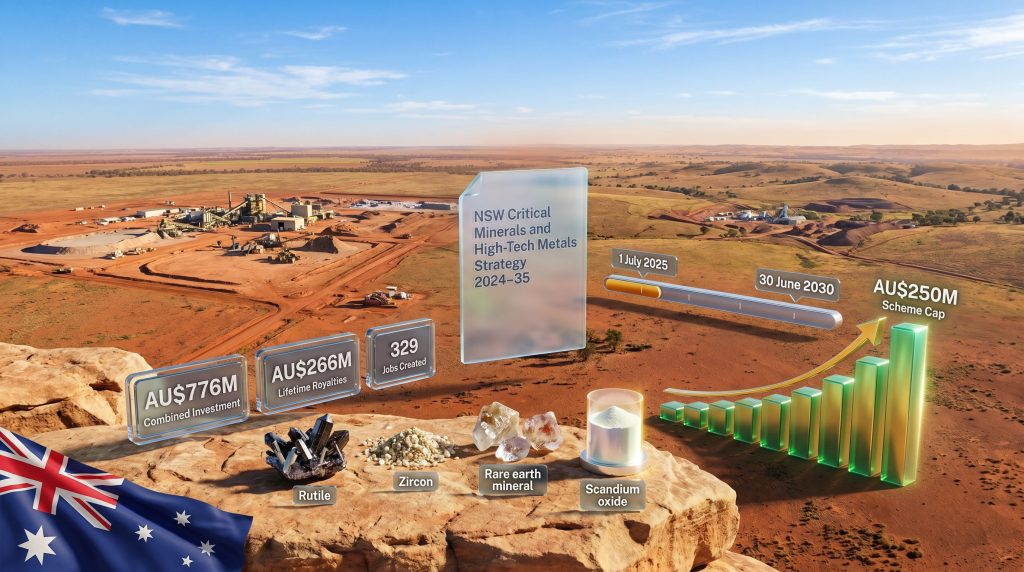
- The scheme window runs from 1 July 2025 to 30 June 2030, and eligible projects must commence production before that closing date
| Parameter | Detail |
|---|---|
| Deferral Period | Up to 5 years from production start |
| Total Scheme Cap | AU$250 million across all approved projects |
| Interest Rate Basis | 3-month average yield, 10-year Australian Government bonds (RBA) |
| Application Window | 1 July 2025 to 30 June 2030 |
| Application Portal | SmartyGrants |
| Eligible Minerals | Commonwealth Critical Minerals List only |
| Market Cap Threshold | Under AU$5 billion (applicant or related body corporate) |
The interest rate linkage to government bond yields is a nuanced design choice. In stable rate environments, this mechanism keeps the cost of deferral low and predictable. However, in a rising rate environment, the compounding cost can erode the cash flow benefit the scheme is intended to deliver. Project financial models must stress-test this variable carefully.
Who Qualifies: Eligibility Criteria Unpacked
Mineral Scope and Commodity Boundaries
Eligibility is tightly scoped to minerals appearing on the Commonwealth Government's Critical Minerals List. This includes lithium, cobalt, rare earth elements, scandium, vanadium, and other materials designated as strategically critical for clean energy and defence supply chains. Copper, gold, and other commercially significant but non-designated commodities are explicitly excluded, regardless of the capital intensity of those projects.
Critically, the scheme requires that recovery of a listed critical mineral be the primary purpose of the mining lease. Projects where a critical mineral is a secondary or by-product stream do not automatically qualify. This boundary is consistent with how critical minerals and energy security policy is framed at the national level, where strategic intent rather than commercial convenience drives classification decisions.
Structural and Tenure Requirements
Beyond commodity eligibility, applicants must satisfy several structural tests:
- The applicant must hold a valid NSW mining lease
- The critical mineral targeted must not have been previously mined on the relevant land parcel, targeting genuinely new development rather than restarts of historical operations
- The applicant or any related body corporate must carry a market capitalisation or valuation below AU$5 billion, concentrating benefits among mid-tier and emerging producers rather than major diversified miners
This market cap threshold is a deliberate policy choice. It reflects the recognition that large-cap operators have access to capital markets and balance sheet flexibility that smaller developers lack. The scheme is calibrated to reduce barriers where those barriers are most likely to prevent a viable project from reaching final investment decision.
The Two Projects Approved in the Inaugural Cohort
In July 2026, the NSW Government confirmed the first beneficiaries of the scheme. Two projects together representing AU$776 million in combined capital investment secured approval, establishing proof of concept for the policy mechanism.
Iluka Resources: Balranald Project, Murray Basin
Iluka's Balranald project is among the more technically distinctive mineral sands operations to enter development in Australia in recent years. Its application of remote underground mining technology to extract mineral sands represents a meaningful operational departure from conventional open-cut and shallow dredging methods that have historically dominated the sector.
The Balranald deposit sits within the Murray Basin, a geological province recognised for its extensive heavy mineral sand resources. The ore suite includes zircon, rutile, ilmenite, and rare earth minerals, with recovered material destined for domestic processing rather than raw export. This onshore value-add component aligns directly with the broader policy objective of building downstream processing capability within Australia.
Key project metrics:
- Projected lifetime royalty contribution to NSW: AU$153 million
- Regional employment: 270 ongoing jobs in rural NSW
- Project status as of mid-2026: commissioning phase underway
Sunrise Energy Metals: Syerston Scandium Project, Central West NSW
The Syerston project occupies a distinctive position in the global scandium supply landscape. Scandium oxide is one of the most thinly supplied critical materials in the world, with primary production historically concentrated in a small number of jurisdictions. Its applications span aerospace aluminium-scandium alloys, which offer significant strength-to-weight performance improvements, and solid oxide fuel cells, where scandium-stabilised zirconia electrolytes enable higher operating efficiency.
Scandium's scarcity in commercial production is not simply a function of geological rarity. It is primarily a consequence of the absence of concentrated scandium deposits that justify dedicated mining. Most global supply historically emerged as a by-product of Ukrainian and Russian titanium and uranium processing operations. Syerston's development as a primary scandium producer would represent a structurally significant shift in supply geography.
Key project metrics:
- Construction commencement: Scheduled for later in 2026
- First production target: Mid-2028
- International financing: Secured a US$67 million debt financing letter of interest from the US Export-Import Bank under the framework of the US-Australia Critical Minerals Partnership
- Projected lifetime royalty contribution: AU$113 million
- Regional employment: 59 ongoing jobs in Central West NSW
| Project | Operator | Commodity | Capital Unlocked | Lifetime Royalties | Jobs |
|---|---|---|---|---|---|
| Balranald | Iluka Resources | Zircon, Rutile, Rare Earths | Part of AU$776M total | AU$153M | 270 |
| Syerston | Sunrise Energy Metals | Scandium Oxide | Part of AU$776M total | AU$113M | 59 |
| Combined | AU$776M | AU$266M | 329 |
Why Early-Stage Cash Flow Is the Critical Constraint
The Pre-Revenue Royalty Problem
Critical minerals projects routinely carry capital intensity figures that dwarf conventional metals mining operations of comparable scale. The combination of specialised processing requirements, remoteness, infrastructure gaps, and the need to meet exacting product specifications for technology-sector offtake agreements pushes upfront capital requirements to levels where marginal changes in early cash flow can determine whether a project crosses the threshold for final investment decision.
When royalty obligations fall due during the pre-revenue or early-revenue phase, they compete directly with:
- Active debt servicing on construction-phase financing
- Drawdowns against project construction contracts
- Working capital requirements as operations ramp toward nameplate capacity
- Cost overrun contingency reserves
The compounding pressure of these competing claims on limited early cash flow has historically pushed viable projects below the economic thresholds that lenders and equity investors require before committing capital. The Association of Mining and Exploration Companies has consistently flagged this structural financing constraint as a primary barrier to greenfield critical minerals development in Australia, with its chief executive noting that improved early-stage cash flow can determine whether a project proceeds or stalls indefinitely at the development stage. Indeed, surging critical minerals demand makes resolving this constraint more urgent than ever.
Comparing Policy Instruments: Deferral vs. Other Incentive Models
The NSW deferral model occupies a specific and deliberate position within the broader landscape of government incentive structures for mining investment:
| Incentive Type | Cash Flow Benefit | State Revenue Impact | Government Risk |
|---|---|---|---|
| Royalty Deferral (NSW Model) | High: delays outflows | Neutral: full repayment required | Low: deferred, not waived |
| Royalty Holiday or Waiver | Very High | Permanent revenue loss | High |
| Grant or Co-investment | Moderate | Direct budget expenditure | Moderate |
| Concessional Debt Facility | Moderate | Indirect | Low to Moderate |
The NSW approach is notable for achieving meaningful cash flow relief while preserving full revenue entitlement for the state. This is a fiscally conservative design that reduces the political risk associated with industry incentives while still providing the timing adjustment that project economics require.
The Syerston Project and the Global Scandium Supply Story
The Syerston project's strategic significance extends well beyond its NSW royalty profile. Scandium's commercial market has historically been constrained not by demand but by supply unpredictability. The material's performance benefits in aluminium alloys are well established in aerospace engineering, with scandium additions of less than 0.3 percent by weight capable of increasing alloy strength by up to 40 percent while improving weldability and corrosion resistance. Yet the absence of reliable, large-scale primary supply has prevented many potential industrial users from incorporating scandium into mainstream product designs.
A dedicated, large-scale scandium producer with stable long-term output would fundamentally change this dynamic. The US Export-Import Bank's engagement with Syerston reflects an active allied-nation interest in establishing non-Chinese supply chains for materials where current geographic concentration creates strategic vulnerability. This aligns with Australia's critical minerals strategy at the federal level, which similarly prioritises supply chain resilience over short-term commercial considerations.
The broader strategic logic here is important for investors to understand: the value of a scandium project is not purely a function of current spot prices. It also reflects the option value of being a primary supplier into a market where supply-induced demand growth has been structurally constrained.
The next major ASX story will hit our subscribers first
Risks and Structural Limitations of the Deferral Model
Scheme Cap Dynamics
The AU$250 million total cap across all approved projects creates a finite pool that will be allocated on a first-come, first-served basis among qualifying applications. With the two inaugural approvals projecting AU$266 million in combined lifetime royalties — which will ultimately flow back to the state at repayment — the scheme's long-term fiscal mechanics are manageable. However, the cap on deferred balances outstanding at any one time means that later applicants face the risk of the pool being exhausted before their project reaches production and qualifies for drawdown.
This creates a structural first-mover advantage for projects that can demonstrate readiness to commence production closest to the scheme's opening date. Operators should review the official royalty deferral scheme guidelines to understand their eligibility and timing position before the window fills.
Interest Rate Risk for Project Operators
The bond-yield-linked interest mechanism introduces a variable cost component that is outside the control of project operators. During periods of elevated interest rates, the accumulated cost of a five-year deferral could become material relative to the cash flow benefit received during the deferral period itself. Sophisticated project financing teams will model multiple interest rate scenarios when assessing whether to opt into the scheme.
Eligibility Design Creates Competitive Asymmetry
The exclusion of copper, gold, and other non-critical commodities from eligibility means that capital-intensive projects in those categories receive no equivalent support, even where their early-stage financing challenges are structurally identical. The AU$5 billion market cap threshold similarly excludes larger operators who may be developing projects with significant regional employment and royalty generation potential.
How the Scheme Positions NSW Within Australia's Broader Critical Minerals Framework
The NSW critical minerals royalty deferral scheme sits within a layered policy environment that includes the National Critical Minerals Framework and bilateral trade and investment arrangements such as the US-Australia Critical Minerals Partnership. NSW is competing not only with other Australian states for project investment but with international jurisdictions that are deploying increasingly aggressive incentive packages to attract critical minerals capital.
The fact that the Syerston project has attracted US Export-Import Bank financing interest alongside NSW state-level royalty deferral demonstrates how complementary policy instruments at different levels of government can stack to improve a project's overall bankability. Neither instrument alone changes the project's fundamental economics. Together, they shift the risk-adjusted return profile sufficiently to support a positive final investment decision. Comparable approaches to critical minerals strategy at the corporate level illustrate how this stacking logic operates in practice.
NSW Minister for Natural Resources Courtney Houssos has framed the scheme as central to the state's long-term economic positioning, emphasising that supporting projects through their highest-cost development phases is how the state builds the regional jobs and supply chain relationships that will matter most in the decades ahead. Detailed analysis of the scheme's design is also available through Allens' breakdown of the NSW royalty deferral framework, which provides useful legal and commercial context for prospective applicants.
Frequently Asked Questions: NSW Critical Minerals Royalty Deferral Scheme
What minerals are eligible under the NSW royalty deferral scheme?
Only minerals listed on the Commonwealth Government's Critical Minerals List qualify. This includes lithium, cobalt, scandium, rare earth elements, and other strategically designated materials. Copper, gold, and other commercially significant but non-listed commodities are excluded.
Does the scheme permanently waive royalty payments?
No. Every dollar of deferred royalties must be repaid in full, plus accrued interest. The scheme restructures the timing of the obligation, not the obligation itself.
How long can royalties be deferred?
Up to 5 years from the commencement of production.
What is the total cap on the scheme?
AU$250 million across all approved applications outstanding at any one time.
How do companies apply?
Through the SmartyGrants portal. The application window runs from 1 July 2025 to 30 June 2030.
Which projects have been approved so far?
As of July 2026, Iluka Resources' Balranald project and Sunrise Energy Metals' Syerston scandium project are the first confirmed beneficiaries, together representing AU$776 million in capital investment and AU$266 million in projected lifetime state royalties.
Key Takeaways for Investors and Industry Observers
Several conclusions emerge from examining the NSW critical minerals royalty deferral scheme in full:
- Fiscal innovation without revenue sacrifice: The deferral model demonstrates that governments can meaningfully improve project economics without permanently forgoing royalty income — a model with strong replicability across other Australian states.
- First-mover advantage is real: The AU$250 million cap creates a finite window. Projects closest to production commencement are best positioned to capture available capacity.
- Scandium supply dynamics are structurally underappreciated: The Syerston project's progression represents a potential inflection point in global scandium availability with implications that extend well beyond NSW.
- Interest rate sensitivity requires active modelling: The bond-yield linkage means the net benefit of deferral is not static. Financial modelling must account for rate scenarios across the full deferral period.
- Stacked incentives amplify bankability: The combination of state royalty deferral and allied-nation debt financing interest illustrates how layered policy support transforms project risk profiles more effectively than any single instrument.
The AU$266 million in projected royalties from just two inaugural approvals makes one point unambiguously clear: deferral is not a revenue concession. It is a timing instrument. And in critical minerals development, timing is often everything.
Want to Track the Next Major Critical Minerals Discovery Before the Broader Market Does?
Discovery Alert's proprietary Discovery IQ model delivers real-time alerts on significant ASX mineral discoveries — including critical minerals like scandium, rare earths, and lithium — instantly converting complex geological announcements into actionable investment insights; explore historic examples of major discovery returns to understand the opportunity, then begin your 14-day free trial at Discovery Alert to position yourself ahead of the market.