July 7, 2026
The Regulatory Tide Turning Against Carbon-Intensive Steel
The global steel industry is entering a period of structural disruption unlike anything seen since the post-war reconstruction era. Not because of demand collapse or raw material scarcity, but because of something more subtle and ultimately more powerful: the gradual but accelerating repricing of carbon. Across European procurement desks, a new calculation is quietly replacing the old one. The question is no longer simply which supplier offers the lowest price per tonne, but which supplier can deliver the lowest embedded carbon per tonne, and at what cost to compliance.
This shift is not theoretical. It is being encoded into trade law, financing frameworks, and long-term industrial contracts in real time. For nickel producers and steel intermediaries with genuinely low carbon footprints, this represents a rare alignment between environmental credentials and commercial advantage. The Canada Nickel RWE partnership for low-carbon steel, formalised through a Memorandum of Understanding in June 2026, is one of the most structurally coherent responses to this shift yet seen in the critical minerals sector.
When big ASX news breaks, our subscribers know first
Why the EU Carbon Border Adjustment Mechanism Changes Everything
CBAM: A Plain-Language Breakdown of the Mechanism
The Carbon Border Adjustment Mechanism, commonly referred to as CBAM, is the European Union's policy instrument designed to prevent carbon leakage — the phenomenon where European industries lose competitiveness to foreign producers operating under weaker environmental regulations. In practice, CBAM requires that importers of specified goods entering the EU purchase certificates that correspond to the carbon emissions embedded in those products.
For steel, one of the five initial sectors covered alongside cement, aluminium, fertilisers, and electricity, this means that every tonne of imported steel carries an implicit carbon cost. The price of CBAM certificates is directly linked to the EU Emissions Trading System (ETS) allowance price, which has traded at elevated levels in recent years and is structurally expected to rise as the EU tightens its emissions cap over time.
The phased implementation timeline is critical for market participants to understand:
- 2023 to 2025: Transitional reporting phase, requiring importers to report embedded carbon data without financial obligations.
- 2026: Full CBAM obligations begin, with importers required to surrender certificates proportional to embedded carbon content.
- 2034: Free allocations for EU domestic producers are fully phased out, completing the level playing field between domestic and imported goods.
The commercial implication is straightforward but profound. A steel producer operating on a coal-intensive grid in Southeast Asia or Eastern Europe faces a materially higher certificate burden than a producer drawing on Ontario's predominantly hydroelectric and nuclear power grid. That difference translates directly into landed cost in European markets.
The Widening Price Gap Between Green and Brown Steel
European industrial buyers are already adjusting their procurement strategies in anticipation of full CBAM implementation. According to analysis from the World Steel Association, the carbon intensity of steel production varies enormously across production routes, from roughly 1.8 to 2.2 tonnes of CO2 per tonne of steel via the traditional blast furnace route to well under 0.5 tonnes via electric arc furnace production powered by renewable electricity.
When EU ETS prices are factored in, this differential creates a cost gap that is not marginal. At ETS prices above €80 per tonne of CO2, the carbon compliance cost disadvantage for high-emission producers runs to tens of euros per tonne of finished steel. At projected ETS prices for the late 2020s, cited by the European Commission as potentially exceeding €100 per tonne, that gap widens further. Furthermore, European steel decarbonisation efforts are accelerating this repricing dynamic across the entire value chain.
The convergence of CBAM enforcement and persistent energy market instability is not merely creating a commercial opportunity. It is structurally rewiring procurement decisions across European heavy industry, pushing buyers toward long-term supply agreements with verified low-carbon producers.
Energy price volatility compounds this dynamic. European steelmakers, already burdened by high electricity and gas costs following years of energy market instability, face a dual squeeze: rising input costs and rising carbon compliance obligations. This creates powerful incentives to secure long-term supply relationships with producers offering both low carbon intensity and price stability. In addition, green steel pricing trends suggest that verified low-carbon products are increasingly commanding a measurable premium in forward contracts.
Understanding the Crawford Nickel Project and Net Zero Metals
The Feedstock Foundation: Ontario's Geological and Energy Advantages
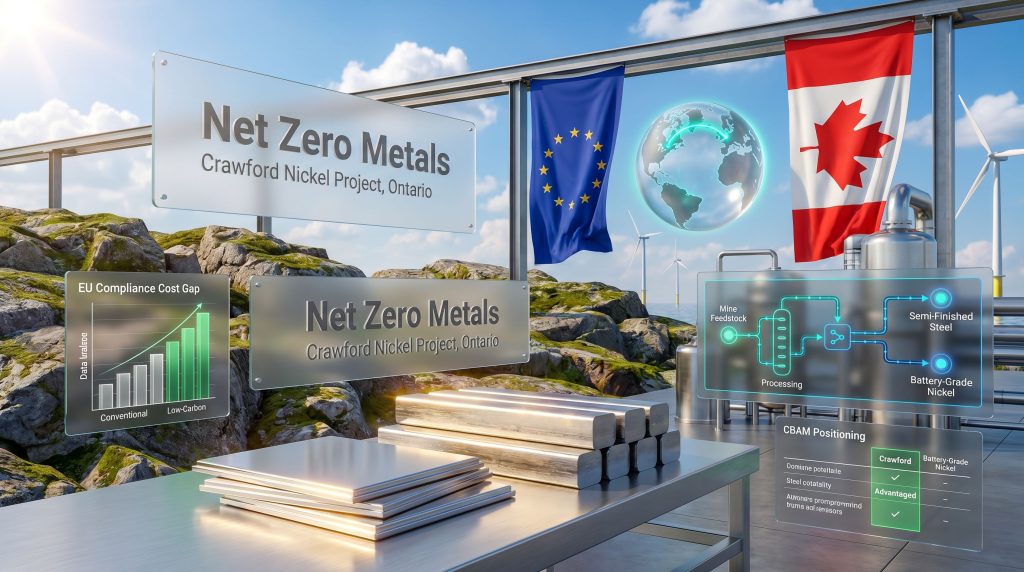
The Crawford Nickel Project, located in the Timmins region of northern Ontario, sits within one of Canada's most historically productive mining belts. The project hosts one of the largest nickel sulphide deposits discovered in recent decades, with a mineral resource base that supports large-scale, long-life production. Critically, the deposit's geological profile supports a relatively straightforward processing pathway compared to laterite nickel deposits, which typically require far more energy-intensive processing via high pressure acid leaching.
Ontario's electricity grid is among the lowest-carbon grids of any major industrial jurisdiction globally, drawing predominantly from nuclear and hydroelectric generation. This means that energy-intensive downstream processing of Crawford nickel carries a substantially lower embedded carbon footprint than equivalent processing in jurisdictions dependent on coal or gas-fired power.
| Attribute | Crawford Nickel Project | Conventional Nickel Supply |
|---|---|---|
| Carbon intensity profile | Low (Ontario clean energy grid) | Variable to high |
| Deposit type | Nickel sulphide | Often laterite (higher processing energy) |
| Downstream processing | Integrated via Net Zero Metals | Typically third-party |
| CBAM positioning | Structurally advantaged | Penalised under full implementation |
| End-market applicability | Steel and battery storage | Primarily one or the other |
Net Zero Metals: Vertical Integration as a Carbon Accountability Tool
Net Zero Metals is a wholly-owned downstream subsidiary of Canada Nickel Company, structured specifically to convert nickel feedstock from Crawford into low-carbon intermediate steel products, including semi-finished steel, stainless products, and alloys. The vertical integration model is significant because it enables end-to-end traceability of the carbon footprint, from ore extraction through to the finished intermediate product delivered to an EU or North American buyer.
This traceability is not a marketing feature. Under CBAM's verification requirements, importers must provide third-party verified embedded carbon data for their products. Producers who cannot demonstrate a clean chain of custody for their carbon accounting face both compliance risk and potential commercial exclusion from the European market. The mine-to-product integration that Net Zero Metals offers addresses this verification requirement at the structural level.
The dual applicability of Crawford-sourced nickel is another dimension of the project's strategic differentiation. High-purity, low-carbon nickel is simultaneously a critical input for stainless steel production and for nickel-based battery chemistries used in energy storage systems. As the EU accelerates both its wind energy buildout and its battery storage deployment, the same product serves two structurally growing demand channels. Consequently, critical minerals demand across both steel and battery sectors is converging on the same verified low-carbon supply sources.
Unpacking the Canada Nickel RWE Partnership Logic
Why a Carbon Trading Firm, Not a Metals Trader?
The selection of RWE Supply and Trading as the commercial partner for Net Zero Metals is one of the more analytically interesting aspects of this arrangement. RWE is not primarily a metals trading house. It is one of Europe's largest energy and carbon market participants, with deep expertise in EU ETS trading, structured offtake development, and the financial mechanisms used by European industrial buyers to manage long-term energy and carbon price risk.
This distinction matters enormously. A conventional metals trader can facilitate transactions but cannot easily translate the carbon attributes of a product into a pricing premium that buyers will pay. RWE can, because it understands both the regulatory mechanics of CBAM and the commercial frameworks — including export credit agency financing — that European industrial buyers use to structure long-term supply agreements. This steel decarbonisation collaboration model, pairing upstream producers with carbon-market specialists, is emerging as a defining feature of the sector's evolution.
The partnership creates a complementary value exchange that neither party could efficiently replicate independently:
- Canada Nickel contributes verifiable low-carbon feedstock, downstream steel processing capability through Net Zero Metals, and a structurally CBAM-advantaged product profile.
- RWE Supply and Trading contributes established EU and US customer relationships, CBAM compliance strategy expertise, access to European export credit agency financing networks, and long-term offtake structuring capability.
How CBAM Compliance Works Step by Step for Steel Exporters
Understanding the operational mechanics of CBAM helps clarify why RWE's expertise is commercially valuable rather than simply reputationally useful.
- Embedded Carbon Calculation: The total carbon emissions embedded in each tonne of exported steel must be calculated across the full production chain, including upstream mining and processing.
- CBAM Certificate Requirement: EU importers must surrender CBAM certificates in proportion to the verified embedded carbon content of their goods.
- EU ETS Price Linkage: Certificate prices track EU ETS allowance prices, introducing ongoing price exposure for importers of carbon-intensive goods.
- Third-Party Verification: Independent verification of embedded carbon data is mandatory, creating both a compliance cost and a potential barrier for producers without robust carbon accounting systems.
- Low-Carbon Advantage Monetisation: Producers with demonstrably lower embedded carbon face proportionally lower certificate obligations, which translates into a real and quantifiable cost advantage at the point of EU import.
RWE's role in navigating steps three through five — particularly in structuring offtake contracts that embed carbon value transparency and accessing export credit financing that recognises low-carbon credentials — is where the partnership generates commercial leverage beyond what a standard distribution agreement would provide.
MOU Structure and the Path to a Definitive Agreement
Under the terms of the June 2026 Memorandum of Understanding, Canada Nickel and RWE Supply and Trading have committed to joint identification and prioritisation of target customers across EU and US markets, development of product positioning and sales strategies covering semi-finished steel, alloys and stainless products, and the structuring of long-term offtake agreements. Both parties have indicated a target timeline for conversion to a definitive commercial agreement later in 2026.
The Broader Market Opportunity: Wind, Battery Storage, and Green Steel Demand
Low-Carbon Steel as Infrastructure for the Energy Transition
The EU's ambitions for offshore and onshore wind capacity expansion are among the most capital-intensive infrastructure programmes in the bloc's history. Wind turbine towers, foundations, and associated structural components are steel-intensive, and as EU decarbonisation policy tightens, the carbon content of that steel increasingly matters to project developers managing lifecycle emissions and ESG reporting obligations.
RWE has itself described low-carbon steel as essential for the planned expansion of European wind capacity, and high-quality, low-carbon nickel as essential for battery storage development in the EU. This assessment reflects the dual demand dynamic that positions Crawford-sourced nickel at an unusual intersection of two major energy transition supply chains simultaneously.
Comparing Commercialisation Models Across the Low-Carbon Steel Landscape
| Commercialisation Model | Carbon Compliance Integration | Market Access Mechanism | Scalability |
|---|---|---|---|
| Canada Nickel / Net Zero Metals with RWE | CBAM-optimised via specialist trading partner | RWE EU and US customer network | Large-scale sulphide deposit base |
| Conventional steel producers with carbon offsets | Reactive, offset-dependent | Traditional distribution | Limited by offset quality |
| Green hydrogen-based DRI steelmakers | Proactive but capital-intensive | Emerging, limited scale | Constrained by hydrogen supply |
Implications for Global Nickel Producers Competing for EU Market Access
The structural advantage that Crawford's Ontario location and sulphide geology confers under CBAM is not lost on competing producers. The Indonesian nickel supply chain, which dominates global nickel volumes through laterite deposits processed via high-energy routes, faces a materially heavier CBAM burden. Australian sulphide producers occupy a more competitive position but lack Ontario's grid carbon advantage.
This creates a scenario where CBAM effectively functions as a geographic and geological sorting mechanism, advantaging producers in low-carbon grid jurisdictions with lower-energy processing routes. For investors assessing nickel assets through a forward-looking lens, the carbon intensity of both the deposit type and the processing jurisdiction is becoming as relevant as the grade and tonnage of the resource itself. However, it is worth noting that Canada Nickel's sustainability approach goes beyond grid advantage alone, incorporating broader environmental commitments across the full project lifecycle.
Disclaimer: This article contains forward-looking assessments regarding regulatory frameworks, commodity markets, and corporate development timelines. These involve inherent uncertainty and should not be construed as financial advice. Readers should conduct their own due diligence before making investment decisions.
The next major ASX story will hit our subscribers first
Frequently Asked Questions
What is the Canada Nickel and RWE Supply and Trading partnership?
Canada Nickel Company and RWE Supply and Trading signed a Memorandum of Understanding in June 2026 to jointly develop commercial pathways for low-carbon semi-finished steel, alloys, and stainless products produced through Canada Nickel's Net Zero Metals subsidiary. The Canada Nickel RWE partnership for low-carbon steel leverages RWE's carbon market expertise and established customer networks to position Net Zero Metals products competitively ahead of escalating EU carbon compliance costs.
What is Net Zero Metals and how does it relate to Crawford?
Net Zero Metals is a wholly-owned subsidiary of Canada Nickel Company, designed to process nickel feedstock from the Crawford Nickel Project in Ontario into low-carbon intermediate steel products for sale into European and North American markets. The vertical integration from mine to semi-finished product enables end-to-end carbon traceability, which is increasingly required by EU importers under CBAM.
How does CBAM specifically affect nickel and steel trade with Europe?
CBAM requires EU importers of steel and other covered goods to purchase certificates proportional to the embedded carbon content of those products, with certificate prices linked to EU ETS allowance prices. Producers drawing on low-carbon energy grids and lower-emission processing routes face smaller certificate obligations, creating a direct landed cost advantage in EU markets relative to higher-emission competitors.
Why is low-carbon nickel valuable for both steel and battery storage?
High-purity, low-carbon nickel serves as a critical input for both stainless steel production and nickel-based battery chemistries used in energy storage systems. As the EU expands renewable energy capacity and battery storage deployment accelerates, both demand channels are growing structurally, providing Crawford-sourced nickel with revenue diversification across two major energy transition supply chains.
When is the definitive agreement between Canada Nickel and RWE expected?
Based on the terms of the June 2026 MOU, both parties have targeted completion of a definitive commercial agreement later in 2026, following completion of joint customer identification, product positioning development, and offtake structure negotiation. The Canada Nickel RWE partnership for low-carbon steel represents one of the most strategically coherent commercial structures to emerge from the current wave of green industrial policy reform.
Want to Track the Next Major Mineral Discovery Before the Broader Market Does?
Discovery Alert's proprietary Discovery IQ model scans ASX announcements in real time, instantly identifying high-potential opportunities across critical minerals — including the nickel and green metals driving the low-carbon industrial transition — and delivers actionable alerts directly to subscribers. Explore historic discoveries and the returns they generated, then begin your 14-day free trial to position yourself ahead of the market.