June 30, 2026
The Technology Gap Holding Back America's Largest Untapped Oil Reserve
Across the global energy landscape, the most consequential production challenges are rarely about finding oil. They are about reaching it. In unconventional tight oil formations, vast hydrocarbon accumulations sit locked within ultra-low permeability rock, accessible in theory but stubbornly resistant to conventional extraction methods. The result is a paradox that defines modern domestic energy strategy: some of the largest known oil accumulations in the United States remain commercially stranded, not because the resource is absent, but because the technology to efficiently recover it has not yet matured to commercial scale.
This is precisely the challenge the Bakken Enhanced Oil Recovery program at the University of North Dakota is designed to solve. On May 8, 2026, the U.S. Department of Energy's Hydrocarbons and Geothermal Energy Office announced a $36 million federal investment in the University of North Dakota's Energy & Environmental Research Center (EERC) to advance commercial deployment of enhanced oil recovery technologies across the Bakken shale formation. The program, formally designated the Bakken Enhanced Oil Recovery – Cracking the Code (Bakken EOR-CC), represents one of the most structurally sophisticated tight oil research programmes ever assembled in the United States.
When big ASX news breaks, our subscribers know first
The 10% Problem: Why Primary Recovery Leaves So Much Behind
The DOE's announcement acknowledges a defining constraint of unconventional oil development: currently, only about 10% of the oil in unconventional shale formations is typically recovered under primary production methods. For a formation as resource-rich as the Bakken, this figure represents an extraordinary gap between what the geology holds and what operators can commercially extract. Understanding crude oil price trends in this context reveals just how much economic value remains locked underground.
To understand why, it helps to contrast tight oil reservoirs with conventional fields:
- Conventional reservoirs possess high permeability, allowing oil to flow freely toward wellbores under natural reservoir pressure with relatively modest engineering intervention.
- Tight shale formations like the Bakken exhibit ultra-low permeability at the nanoDarcy scale, meaning fluids cannot migrate through the rock matrix without hydraulic fracturing to create artificial flow pathways.
- Horizontal drilling and hydraulic fracturing have unlocked primary production in the Bakken, but these techniques alone cannot mobilise the vast majority of oil remaining in the formation after initial pressure depletion.
- Pressure depletion after primary production leaves oil effectively immobile in the matrix, creating what engineers refer to as a recovery efficiency ceiling that primary methods cannot break through.
The implication is significant. The Bakken is not a resource scarcity problem. It is an engineering access problem, and enhanced oil recovery represents the most credible pathway to closing that gap at meaningful commercial scale.
How CO₂ Enhanced Oil Recovery Works in Fractured Horizontal Wells
The Bakken EOR-CC programme centres on carbon dioxide-based enhanced oil recovery, a technique whose mechanics differ substantially from conventional CO₂ flooding in vertical permeable reservoirs. Understanding those differences is essential to appreciating why the programme's integrated research architecture exists.
In conventional CO₂ EOR, the process follows a relatively established playbook: CO₂ is injected into a permeable reservoir, achieves miscibility with the resident crude oil, reduces viscosity, swells the oil volume, and improves flow toward producing wells. Decades of operational history in settings like the Permian Basin have refined this approach into a commercially mature technique.
In the Bakken, however, the process is fundamentally more complex:
- CO₂ must be sourced and compressed before injection. In the Bakken EOR-CC programme, captured CO₂ from North Dakota's coal-fired power plants provides the injection stream, creating an industrial utilisation pathway for what would otherwise be atmospheric emissions.
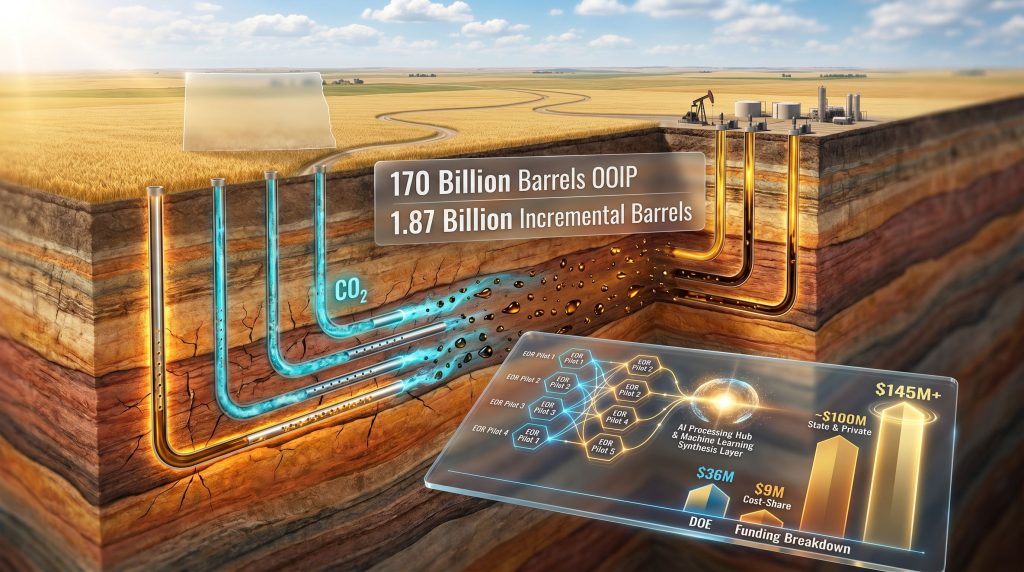
- Injection occurs through hydraulically fractured horizontal wellbores, not vertical pattern floods. The geometry of CO₂ movement through fracture networks differs substantially from matrix-dominated flow in conventional systems, requiring new reservoir modelling frameworks.
- Miscibility conditions must be verified at Bakken-specific pressure and temperature conditions. The threshold at which CO₂ and crude oil mix completely, known as the minimum miscibility pressure (MMP), must be achievable at actual reservoir depth for the technique to deliver optimal recovery uplift.
- A portion of injected CO₂ remains sequestered within the fracture network and matrix, rather than returning to the surface with produced fluids. This creates a measurable carbon storage co-benefit alongside incremental oil production.
- Produced CO₂ can be captured, re-compressed, and recycled back into the injection cycle, improving the long-term economic efficiency of the operation and reducing reliance on new CO₂ supply.
This dual-purpose structure gives CO₂ EOR in the Bakken a value proposition that extends beyond simple recovery enhancement. Each barrel of incremental oil produced carries an associated carbon sequestration credit, fundamentally altering the economics and lifecycle emissions profile of tight oil production.
Programme Architecture: Why Six Pilots Outperform One
The structural logic of the Bakken EOR-CC programme distinguishes it from conventional single-project research initiatives. Rather than concentrating resources on a single field trial, the programme coordinates six simultaneous EOR pilot projects, each testing different injection strategies, reservoir conditions, and operational configurations across the Bakken formation. Furthermore, this multi-pilot approach reflects oil's global importance as a strategic commodity demanding the most rigorous research frameworks.
The funding architecture underlying this structure reflects a deliberate coordination between federal, state, and private capital:
| Funding Source | Contribution | Pilots Covered |
|---|---|---|
| U.S. Department of Energy | $36 million | 1 federally supported pilot |
| EERC & Project Partners (cost-share) | $9 million | 1 federally supported pilot |
| State & Private Sources | ~$100 million | 5 remaining pilots |
| Total Programme Investment | ~$145 million | 6 pilots combined |
Source: U.S. Department of Energy, Hydrocarbons and Geothermal Energy Office, May 8, 2026.
The rationale for this architecture rests on a well-established principle in applied research: single-site experiments generate findings that may reflect local geological anomalies rather than transferable engineering principles. By running six pilots simultaneously across varied reservoir conditions and operational environments, the programme generates a dataset broad enough to distinguish universal success factors from site-specific outcomes.
As the DOE articulated in its announcement, the programme is specifically designed so that individual pilot lessons are translated into actionable strategies for optimising commercial-scale EOR deployment, with the ultimate objective of establishing a comprehensive technical foundation that transcends the scope of any single project. This philosophy mirrors the parallel experimentation approaches used in large-scale industrial R&D programmes where accelerating validated conclusions requires testing multiple variables simultaneously rather than sequentially.
Artificial Intelligence as the Programme's Central Intelligence Layer
Perhaps the most distinctive feature of the Bakken Enhanced Oil Recovery program at the University of North Dakota is its systematic integration of artificial intelligence and machine learning tools across all six pilot projects. The DOE confirmed that these tools will be deployed to identify operational insights, best practices, and critical success factors from the combined multi-pilot dataset.
The role of AI in this context goes beyond simple data processing:
- Pattern recognition across heterogeneous datasets: Each pilot generates unique data streams covering injection rates, pressure responses, fluid compositions, and production curves. AI models can identify correlations and causal relationships across these datasets at a scale and speed that conventional analytical methods cannot match.
- Signal extraction from noisy subsurface data: Shale reservoirs are inherently heterogeneous. Distinguishing genuine reservoir responses from geological noise in monitoring data requires machine learning models specifically trained on the complexity of tight oil subsurface environments.
- Translation of pilot data into commercial deployment protocols: The ultimate output of the AI layer is not academic analysis. It is a set of actionable deployment frameworks that commercial operators can apply when evaluating their own EOR programmes across the broader Bakken play.
- Real-time operational optimisation: AI tools can adjust injection strategies based on evolving reservoir responses, improving efficiency during active pilot operations rather than waiting for post-project analysis.
This approach reflects the broader adoption of digital oilfield methodologies across the industry, where sensor data, reservoir modelling, and machine learning tools are increasingly integrated into operational decision-making.
The Coal-Fired Power Plant Connection: An Unexpected Industrial Symbiosis
One of the less-discussed dimensions of the Bakken EOR-CC programme is its explicit link to North Dakota's coal-fired power generation infrastructure. The DOE announcement confirmed that the programme is designed in part to extend the life of the state's coal-fired power plants by utilising their captured carbon dioxide for EOR operations.
This creates an industrial relationship with implications that extend well beyond oil production metrics:
- Coal-fired power plants facing long-term economic pressure from energy transition dynamics gain a new revenue pathway by converting their CO₂ emissions into a commercially valuable EOR input stream.
- Carbon capture infrastructure becomes economically viable at a lower cost threshold when paired with a paying end-use market, rather than requiring carbon storage economics to stand alone.
- The regional energy economy becomes more integrated, with the viability of one sector partially reinforcing the viability of another in a structure that reduces the total economic disruption associated with decarbonisation pathways.
- Net carbon intensity per barrel produced via CO₂ EOR may compare favourably to conventional primary recovery when lifecycle analysis accounts for permanent CO₂ sequestration within the reservoir.
This regional carbon utilisation loop represents a model with potential relevance to other coal-dependent energy states seeking pathways that balance near-term economic continuity with longer-term carbon management objectives. U.S. oil production decline trends make this kind of industrial symbiosis increasingly important to national energy strategy.
The next major ASX story will hit our subscribers first
North Dakota's Production Ambitions and the EOR Pathway
North Dakota has established ambitious long-term oil production targets, with state energy planners having identified a goal of reaching 2 million barrels per day as a benchmark for the Bakken's full productive contribution to national energy supply. Current production rates fall substantially short of this target, constrained by the same primary recovery limitations that the Bakken EOR-CC programme is designed to address. In addition, U.S. crude oil inventories remain a closely watched indicator of how effectively domestic formations are contributing to overall supply.
DOE Assistant Secretary for the Hydrocarbons and Geothermal Energy Office Kyle Haustveit articulated the strategic significance of this investment: the Bakken formation holds the potential to unlock billions of barrels of oil, representing resources capable of powering energy independence for generations. Haustveit further described the programme as essential to maximising the full potential of the Bakken's hydrocarbon resources, with the integrated pilot projects designed to establish a clear pathway for broad commercial deployment of enhanced energy recovery across the nation.
The connection between successful EOR commercialisation and North Dakota's production ambitions is direct. Without a validated, commercially deployable EOR methodology, the 90%+ of Bakken oil currently stranded underground remains inaccessible regardless of oil price conditions or drilling activity. With it, operators gain a technically credible pathway to substantially higher per-well and per-acre recovery rates.
Comparing Bakken EOR to Global CO₂ Recovery Benchmarks
Understanding where Bakken tight oil CO₂ EOR sits relative to established global practice helps contextualise both the programme's ambition and the technical challenges it must overcome:
| Parameter | Conventional CO₂ EOR | Bakken Tight Oil CO₂ EOR |
|---|---|---|
| Reservoir Permeability | High (millidarcies) | Ultra-low (nanodarcies) |
| Well Configuration | Vertical, pattern floods | Horizontal, hydraulically fractured |
| CO₂ Mobility Protocols | Commercially established | Under active development |
| Commercial Maturity | Fully commercial | Pre-commercial, pilot stage |
| Carbon Sequestration | Moderate | High (fracture network trapping) |
| Technology Transfer | Limited to tight formations | Programme objective |
The Permian Basin represents the world's most mature CO₂ EOR environment, with decades of operational history in conventional carbonate reservoirs providing a commercial template. However, the geological and engineering differences between conventional carbonates and unconventional shale mean that Permian Basin protocols cannot be directly applied to the Bakken without substantial adaptation.
International reference points for geological CO₂ storage, including Norway's Sleipner Field and the Weyburn-Midale project in Canada, provide relevant monitoring and verification frameworks for the carbon storage components of the programme, even though those projects operate in non-shale geological settings. The Bakken EOR-CC programme's emphasis on lifecycle analysis and carbon accounting reflects this growing body of global reference data.
The findings generated by the programme carry potential applicability well beyond North Dakota, extending to other U.S. tight oil plays and to international unconventional formations that face analogous recovery rate constraints. Furthermore, an oil price shock could significantly alter the commercial calculus for operators considering whether to participate in EOR programmes of this scale.
The EERC's Research Foundation: Building on a Decade of Bakken Science
The Bakken Enhanced Oil Recovery program at the University of North Dakota does not begin from a standing start. The EERC has accumulated substantial research infrastructure over more than a decade of Bakken-focused EOR investigation, including prior field laboratory work, state-funded production optimisation programmes, and laboratory-scale core flood experiments establishing the thermodynamic and phase behaviour baseline for Bakken-specific CO₂ injection conditions.
This institutional knowledge base provides the Bakken EOR-CC programme with a significant head start over what a newly established research effort would require. Prior laboratory studies, reservoir characterisation datasets, and field monitoring methodologies developed through earlier programmes all feed directly into the design and interpretation of the current six-pilot initiative.
The EERC's integrated research model, spanning laboratory analysis, computational modelling, and active field operations, is specifically structured to ensure that scientific findings translate into engineering protocols rather than remaining confined to academic literature. This translation function is what distinguishes the Bakken EOR-CC programme from purely academic research initiatives and positions its outputs for direct uptake by commercial operators. The U.S. Energy Secretary's recent visit to the EERC underscored the federal government's commitment to ensuring that commitment extends well beyond financial support.
Frequently Asked Questions About the Bakken EOR-CC Programme
What is the Bakken EOR-CC programme?
The Bakken Enhanced Oil Recovery – Cracking the Code programme is a federally supported research and field demonstration initiative administered by the University of North Dakota's Energy & Environmental Research Center. It coordinates six EOR pilot projects across the Bakken shale formation using CO₂ injection, AI analytics, and integrated reservoir modelling to develop a commercial deployment blueprint for enhanced oil recovery in tight oil formations.
How much total investment has been committed to the programme?
Total programme investment across all six pilots exceeds $145 million, comprising $36 million in DOE federal funding, a $9 million cost-share from the EERC and project partners, and approximately $100 million in state and private funding supporting the five non-federally supported pilots. These figures are sourced directly from the DOE's official May 8, 2026 announcement.
Why is CO₂ specifically used for EOR in the Bakken?
CO₂ can achieve miscibility with Bakken crude oil at reservoir conditions, reducing oil viscosity, swelling oil volume, and improving mobility toward producing wellbores. A portion of the injected CO₂ also remains permanently trapped in the reservoir, providing a carbon sequestration co-benefit alongside incremental oil production.
How does AI contribute to the programme?
AI and machine learning tools are deployed across all six pilot projects to synthesise operational data in real time, identify patterns in injection performance and reservoir response, and translate multi-pilot datasets into best practice frameworks and deployment protocols for commercial-scale EOR programmes across the broader Bakken play.
What role do North Dakota's coal-fired power plants play?
The programme utilises CO₂ captured from North Dakota's coal-fired power generation infrastructure as the injection stream for EOR operations. This creates a regional carbon utilisation loop that provides coal-fired power plants with a new revenue pathway for their captured emissions while reducing the net cost of carbon capture deployment.
This article presents factual reporting based on the U.S. Department of Energy's official announcement dated May 8, 2026. References to production targets, recovery rate estimates, and programme outcomes involving future projections are subject to technical and commercial uncertainty. Readers should not interpret programme descriptions as guarantees of specific production or sequestration outcomes. Independently attributed statistics and technical comparisons are drawn from publicly available industry and government sources.
Want to Stay Ahead of the Next Major Resource Discovery?
Discovery Alert's proprietary Discovery IQ model delivers real-time alerts on significant ASX mineral discoveries, transforming complex geological data into actionable investment insights — explore Discovery Alert's discoveries page to understand how historic finds have generated substantial returns, and begin your 14-day free trial to position yourself ahead of the broader market.