August 24, 2026
The Reserve Allocation Problem Most Central Banks Would Rather Ignore
Reserve management is rarely glamorous work. For most of its history, the discipline has revolved around a quietly accepted hierarchy: U.S. Treasuries first, other sovereign bonds second, and gold somewhere in the background, treated more as a legacy holding than an active strategic tool. That orthodoxy held comfortably for decades, sustained by the assumption that dollar-denominated assets offered both safety and liquidity in sufficient measure to render gold allocation debates academic.
That assumption is now being tested in ways that are visible in the data. Bank of Korea gold buying resumed in August 2026, after a 13-year absence from the market, and this is not simply a single institution adjusting a portfolio. It is a window into a broader reassessment of what reserve diversification actually means in an era of elevated geopolitical friction and dollar-concentration risk.
When big ASX news breaks, our subscribers know first
Why 1.1% Is the Number That Demands Explanation
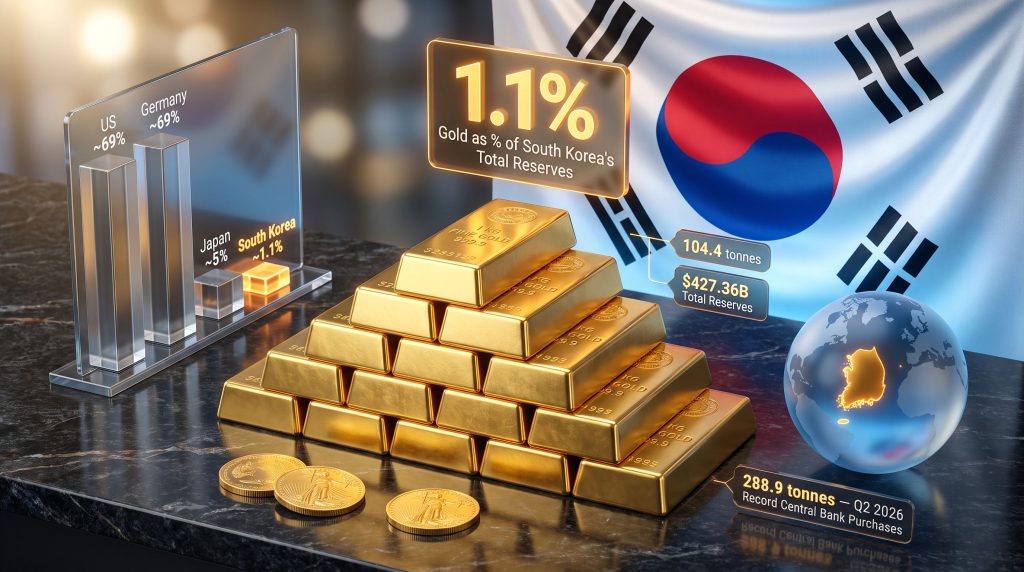
To understand why Bank of Korea gold buying matters analytically, the starting point is the allocation figure itself. As of June 2026, the BOK holds approximately 104.4 tonnes of gold, valued at roughly $4.79 billion. Against total foreign exchange reserves of $427.36 billion, that translates to a gold allocation of just 1.1%.
That figure becomes striking when placed in comparative context:
| Central Bank | Gold Holdings (Approx.) | Gold as % of Total Reserves |
|---|---|---|
| United States | ~8,133 tonnes | ~69% |
| Germany | ~3,352 tonnes | ~69% |
| Japan | ~846 tonnes | ~5% |
| South Korea (BOK) | ~104.4 tonnes | ~1.1% |
| Advanced Economy Average | Varies | ~10-20% |
South Korea is not simply below average. It sits at a level that is structurally anomalous even by the most conservative benchmarks among comparable G20 economies. Japan, which has historically maintained a cautious posture toward gold accumulation, still holds five times as much in proportional terms. The United States and Germany, anchored by decades of Bretton Woods-era accumulation, hold gold at roughly 69% of reserves each.
The BOK's underallocation is not philosophical. It is historical. The bank acquired 40 tonnes in 2011, 30 tonnes in 2012, and 20 tonnes in 2013, then halted entirely when gold prices declined sharply in the years that followed. Domestic political scrutiny over the timing of those purchases created institutional reputational risk, and the response was a full stop on all gold activity for over a decade. The reserve composition problem was not addressed; it was simply left to compound as total foreign exchange reserves grew and the gold share shrank in relative terms.
The Architecture of the BOK's New Acquisition Framework
The resumption of Bank of Korea gold buying is not a single-channel decision. The BOK has constructed a dual-pathway framework designed to build exposure gradually while minimising market impact and managing domestic political optics.
Channel One: Domestic Physical Gold Procurement
The physical acquisition program operates through a purpose-built institutional structure involving several domestic counterparties:
- Gold sourced from domestic producers, specifically targeting refined output from LS MnM and Korea Zinc that would otherwise be directed to export markets
- Transactions executed as negotiated block trades on the Korea Exchange (KRX)
- Settlement and custody handled by the Korea Securities Depository (KSD)
- Estimated annual acquisition volume of approximately 4 to 5 tonnes per year
Channel Two: Overseas Spot Gold ETF Purchases
Simultaneously, the BOK has already begun purchasing overseas-listed spot gold ETFs. This provides immediate market exposure while the domestic physical channel is scaled up over time. Under IMF reserve accounting standards, ETF holdings are classified as securities rather than physical gold, meaning they do not contribute to the bank's physical gold tonnage figure but do provide economic exposure to gold price movements.
Why Are the Settlement and Custody Choices Strategically Significant?
Two structural features of this framework deserve particular attention:
| Feature | Strategic Significance |
|---|---|
| Purchases settled in Korean won (KRW) | No drawdown on foreign exchange reserves required |
| Gold stored domestically in Korea | Reduces reliance on Bank of England custody |
| Block trades via KRX | Minimises local market price disruption |
| Explicitly gradual, long-term mandate | Signals durable structural demand, not tactical positioning |
The won-denominated settlement mechanism is particularly noteworthy. Most gold purchases by central banks are executed in U.S. dollars, which means they effectively draw down existing dollar reserves to acquire a non-dollar asset. The BOK's domestic procurement channel bypasses this entirely, allowing the bank to build gold exposure without reducing its foreign currency holdings.
Furthermore, domestic storage reduces the concentration of BOK gold at the Bank of England, where much of its bullion has historically been held. Both decisions address dollar and Western-custody concentration with a single structural design. Central bank gold reserves across the G20 are increasingly being managed with this kind of dual-risk awareness in mind.
The 13-Year Freeze: Political Risk Management Dressed as Reserve Policy
One of the less commonly examined dimensions of this story is what the 13-year pause actually reveals about central bank behaviour. The BOK's gold purchases in 2011 to 2013 were not strategically flawed in terms of their underlying rationale. Gold reserve diversification makes sense for a country with South Korea's reserve profile regardless of entry timing. The problem was execution timing relative to the gold price cycle.
When gold prices fell after 2013, the BOK faced criticism that it had bought near a market peak. Rather than defending the strategic logic of long-term reserve diversification, the institution's response was to suspend all activity. This represents a pattern familiar to reserve managers: when a policy decision generates political friction, the path of least resistance is inaction, even when inaction itself deepens the underlying structural problem.
The BOK did not change its fundamental view of gold as a reserve asset between 2013 and 2026. What changed was its institutional assessment of the cost of remaining absent from the market relative to the reputational cost of resuming purchases.
The BOK's Reserve Management Group has now explicitly cited escalating geopolitical risks and overconcentration in dollar-denominated assets as the primary motivations for resuming acquisition. This language is meaningful precisely because it frames resumption as a risk management response rather than a market timing decision, providing political cover for a policy shift that was arguably overdue by a decade.
Where Bank of Korea Gold Buying Fits Within the Global Demand Architecture
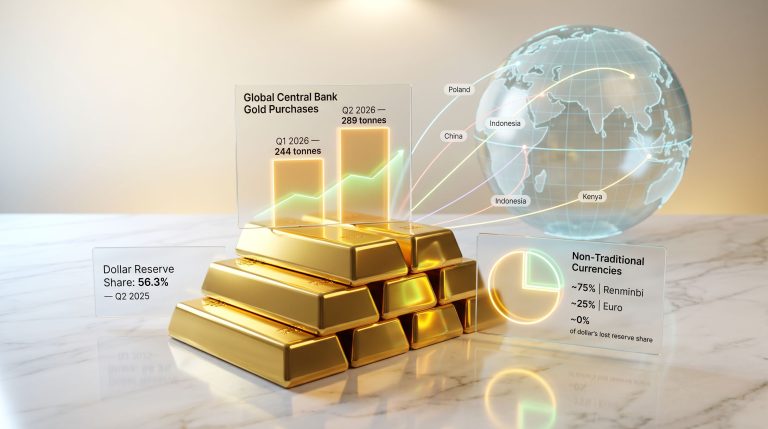
The broader context in which this decision occurs is not incidental. Global central bank gold purchases have averaged approximately 1,000 tonnes per year since 2022, roughly double the pre-2022 historical average. In Q2 2026 alone, central banks collectively acquired 288.9 tonnes, representing a 62% year-over-year increase and the strongest second quarter on record, according to the World Gold Council's Gold Demand Trends Q2 2026 report.
The composition of buyers during this cycle has been heavily weighted toward emerging market central banks executing deliberate de-dollarisation strategies. Understanding where South Korea sits within this taxonomy is analytically important. Central bank buying trends have increasingly reflected a range of motivations, from outright de-dollarisation to more conservative portfolio rebalancing.
| Buyer Profile | Primary Motivation | Geopolitical Posture |
|---|---|---|
| China, Russia | Active de-dollarisation | Adversarial to USD system |
| Turkey, India | Currency hedge, diversification | Broadly neutral |
| Poland | Security-driven accumulation | NATO-aligned |
| South Korea (BOK) | Rational reserve rebalancing | Close U.S. ally |
South Korea's participation introduces a qualitatively different signal into this demand picture. Unlike emerging market purchasers with explicit motivations to reduce dollar dependency, the BOK operates as a close U.S. strategic partner with deep integration into the existing international financial system. Its decision to increase gold allocation is, therefore, not a statement of geopolitical opposition. It is a portfolio management decision made by an institution that has no ideological argument with dollar-denominated assets but has reached the conclusion that its current allocation is structurally insufficient.
This distinction is significant because it expands the universe of plausible future central bank buyers. If the BOK's reasoning is transferable — which it is — then other developed-economy central banks in Southeast Asia and the broader Asia-Pacific region with similarly low gold allocations face analogous structural arguments for rebalancing. Central banks influencing gold prices in this way creates a feedback loop that underpins longer-term price support.
Modelling the Allocation Gap and Its Long-Term Demand Implications
The arithmetic of the BOK's underallocation is instructive. At approximately $4,084 per ounce (the approximate spot price at the time of the August 2026 announcement), the BOK's 104.4 tonnes of gold represents roughly $4.79 billion in value.
Consider what would be required to close the gap to comparable benchmarks:
- To reach Japan's 5% allocation: The BOK would need to acquire approximately 1,960 additional tonnes, nearly 19 times its current holdings
- To reach the 10% lower bound of the advanced economy average: The acquisition requirement rises to approximately 4,100 additional tonnes
- At 4–5 tonnes per year through the domestic channel alone: Reaching Japan's level would take several decades under the current pace
This arithmetic does not suggest the BOK will suddenly accelerate to close the gap rapidly. The bank's own characterisation of its approach as gradual and long-term reflects both the practical limits of domestic supply and the ongoing influence of political risk management in its decision-making.
What it does suggest is that the demand pipeline, once established, is structurally durable. Institutions that have been absent from a market for 13 years and are now re-entering with an explicitly long-term mandate do not typically exit after one or two years. The framework itself, once built, creates institutional momentum.
At 4 to 5 tonnes per year through the domestic channel, annual purchases represent approximately $530 million to $660 million in gold acquisition. Modest in isolation, but when combined with the ETF channel and viewed as the opening of a multi-decade accumulation program by a G20 economy, the structural demand signal is considerably larger than the near-term volume implies. Central bank gold demand of this character tends to support price floors even during periods of retail outflows.
The next major ASX story will hit our subscribers first
The Latecomer Dynamic and Its Implications for Other Underallocated Central Banks
There is a well-documented pattern in reserve market behaviour where institutions that delay entry into a structural trend tend to arrive with more durable mandates than early adopters. Early buyers often face more political resistance and operate with smaller initial allocations. Latecomers, having observed the trend mature, typically arrive with clearer institutional frameworks and longer-horizon commitments.
The BOK's 13-year absence means its rebalancing runway is measured in decades rather than quarters. Several other Asia-Pacific central banks occupy structurally similar positions, with large total reserve bases but gold allocations well below the 5% threshold that even conservative developed-economy peers maintain.
If the BOK's analytical framework — geopolitical risk repricing combined with dollar-concentration concerns — proves persuasive to peer institutions evaluating their own reserve compositions, the incremental annual demand addition to global gold markets could be material. This is particularly relevant against a backdrop where Q2 2026 central bank buying has already reached record levels.
The World Gold Council's Q2 2026 data showed gold ETFs shed 45 tonnes during the same quarter that central banks added 289 tonnes, more than six times as much. That structural divergence — institutional accumulation running counter to retail ETF outflows — characterises the current market in a way that underscores the demand foundation beneath current price levels. Gold in the monetary system has consequently taken on renewed strategic relevance for a growing number of sovereign institutions.
Furthermore, the World Gold Council has reported that South Korea's intention to vault gold domestically marks a notable shift in how advanced-economy central banks are thinking about custody risk alongside allocation risk.
Frequently Asked Questions: Bank of Korea Gold Buying
How much gold does the Bank of Korea currently hold?
As of June 2026, the Bank of Korea holds approximately 104.4 tonnes of gold, valued at roughly $4.79 billion. This represents approximately 1.1% of South Korea's total foreign exchange reserves of $427.36 billion.
Why did the Bank of Korea stop buying gold after 2013?
The BOK accumulated 90 tonnes across 2011 to 2013, then faced domestic political criticism when gold prices declined following those purchases. Rather than defending the long-term strategic rationale for gold diversification, the institution suspended all gold activity for over a decade as a form of reputational risk management.
How does the BOK's new gold buying framework operate?
The BOK has established two simultaneous acquisition channels: a domestic physical procurement program sourcing gold from producers including LS MnM and Korea Zinc via negotiated block trades on the Korea Exchange (targeting approximately 4 to 5 tonnes per year), and a separate program purchasing overseas-listed spot gold ETFs for immediate market exposure.
What makes South Korea's gold buying different from emerging market central bank buying?
South Korea is a close U.S. ally and a G20 advanced economy with no explicit de-dollarisation agenda. Its gold accumulation reflects a portfolio rebalancing decision rather than a geopolitical statement, making the reasoning far more transferable to other developed-economy central banks still sitting on low gold allocations.
What would it take for South Korea to reach a normal gold reserve allocation?
Reaching Japan's relatively conservative 5% gold-to-reserves ratio would require the BOK to acquire approximately 1,960 additional tonnes, nearly 19 times its current holdings. At the current domestic procurement pace of 4 to 5 tonnes per year, closing that gap would take several decades, underscoring the multi-generational nature of the rebalancing timeline.
Key Takeaways
-
The 13-year absence is structurally significant: The BOK is not a new entrant executing a tactical position. It is a major G20 economy recommitting to an asset class it abandoned for political rather than strategic reasons, and that distinction shapes the durability of the demand it represents.
-
The won-denominated settlement mechanism is a model worth watching: By purchasing domestically and settling in Korean won, the BOK simultaneously builds gold exposure and reduces dollar concentration without drawing down existing foreign exchange reserves — a structurally elegant solution other underallocated central banks may study.
-
Volume understates the signal: At 4 to 5 tonnes per year, the direct market impact is modest. The analytical importance lies in what the BOK's return signals about the expanding universe of central banks likely to reassess their reserve compositions.
-
Central bank demand is at record levels: The BOK's entry coincides with Q2 2026 central bank purchasing of 288.9 tonnes, the strongest second quarter on record, adding a new structural buyer to an already supply-constrained demand environment.
-
The rebalancing runway is decades-long: South Korea's allocation gap is so large relative to any advanced-economy benchmark that the acquisition program, regardless of pace, represents durable structural demand rather than a finite adjustment.
This article is for informational and educational purposes only. It does not constitute financial or investment advice. All figures are based on publicly available data as of August 2026. Past market behaviour is not indicative of future results. Readers should consult a qualified financial professional before making investment decisions.
Want to Know When the Next Major Gold Discovery Hits the ASX?
Discovery Alert's proprietary Discovery IQ model scans ASX announcements in real time, instantly identifying significant mineral discoveries — including gold — and delivering actionable alerts before the broader market has time to react. Explore Discovery Alert's dedicated discoveries page to understand how historic ASX discoveries have generated substantial returns, and begin your 14-day free trial today to position yourself ahead of the next major find.