
August 24, 2026
The Hidden Fiscal Time Bomb Sitting Inside America's Gold Vaults
Every half century or so, the global monetary system reaches an inflection point where the rules that once governed money, debt, and sovereign credibility become structurally incompatible with the fiscal realities they were designed to manage. The world is approaching one of those moments now, and the mechanism at the centre of it has nothing to do with interest rate decisions, congressional budgets, or trade policy. It involves a number buried deep inside the United States Treasury's balance sheet: $42.22 per troy ounce.
That is the official statutory price at which the US government currently values its gold reserves, a figure frozen in place since the early post-Bretton Woods transition of the 1970s. It is not a typo, not a rounding convention, and not an administrative oversight. It is the legally established book value of the largest sovereign gold reserve on the planet, and understanding why it has remained untouched for more than five decades is essential to understanding why US gold revaluation has shifted from academic curiosity to serious policy conversation.
When big ASX news breaks, our subscribers know first
America's Balance Sheet Anomaly: What the Numbers Actually Reveal
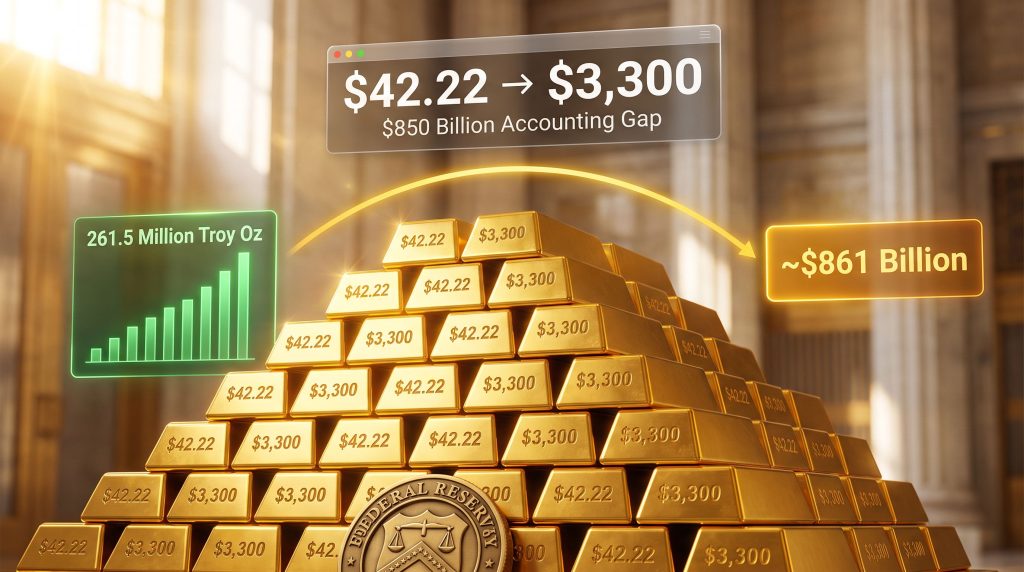
The United States holds approximately 261.5 million troy ounces of gold, the largest official stockpile of any sovereign nation. At the current statutory valuation of $42.22 per ounce, those reserves appear on official ledgers at roughly $11 billion, a figure that generates cognitive dissonance for anyone who checks a live gold price feed.
At market prices near $3,300 per troy ounce, the real-world value of that same reserve approaches $861 billion. The accounting gap between the two figures exceeds $850 billion, representing one of the most extraordinary hidden assets on any government balance sheet in recorded history.
| Valuation Basis | Price Per Ounce | Total Reserve Value |
|---|---|---|
| Statutory (current) | $42.22 | ~$11 billion |
| Market price (approx.) | $3,300 | ~$861 billion |
| Projected (revaluation scenario) | $4,000+ | ~$1.046 trillion+ |
| Long-term scenario (extreme) | $17,000-$20,000 | $4.4T – $5.2T |
Independent analysts place the potential accounting uplift from a revaluation anywhere between $750 billion and over $1 trillion, depending on the gold price used in modelling. At higher projected price levels, the fiscal implications become genuinely transformative.
How US Gold Revaluation Would Actually Work
The mechanics of a potential revaluation are more straightforward than most people realise, and they do not require selling a single gold bar. Furthermore, the US gold revaluation history offers important context for how such a process has been managed in the past.
The Step-by-Step Accounting Process
-
The Treasury holds gold certificates representing its physical reserves, which are deposited with the Federal Reserve as assets on the Fed's balance sheet.
-
A revaluation would update the face value of those certificates from $42.22 per ounce to a figure reflecting current or near-current market pricing.
-
The difference between the old book value and the new value would be credited directly to the Treasury General Account (TGA), the federal government's primary operating account held at the Federal Reserve.
-
This TGA credit creates immediate spending capacity without the issuance of new Treasury debt instruments, bypassing the conventional borrowing mechanism entirely.
-
No gold needs to change hands. No debt ceiling needs to be breached. The operation is, at its core, a balance-sheet reclassification with enormous fiscal consequences.
| Feature | Revaluation Scenario | Traditional Borrowing |
|---|---|---|
| New debt issued? | No | Yes |
| Physical gold sold? | No | N/A |
| Congressional approval needed? | Debated | Yes (debt ceiling) |
| Effect on TGA balance | Immediate increase | Gradual via bond issuance |
| Inflationary risk | Indirect (liquidity expansion) | Moderate |
| Fed balance sheet impact | Yes, complicates runoff | Minimal |
Historical precedent exists for this kind of action. The Roosevelt administration raised the official gold price from $20.67 to $35 per ounce in 1934, generating substantial fiscal capacity during the Depression era. Further adjustments occurred in the early 1970s as the Bretton Woods system unwound. According to official Federal Reserve research, international reserve revaluations follow established precedents that inform how a modern US revaluation might be structured. A modern revaluation would be structurally similar, though vastly larger in nominal scale.
The Fiscal Pressure Making This Conversation Unavoidable
Why America's Debt Arithmetic Has Reached a Breaking Point
The 10-Year US Treasury yield has climbed past 4.7%, a threshold that dramatically increases the servicing cost of the trillions of dollars in outstanding government debt facing near-term refinancing. US tax receipts and GDP growth trajectories are structurally insufficient to absorb that cost without additional monetary intervention of some kind.
The situation is compounded by a historic shift in foreign demand for US Treasuries. Japan, which had been one of the largest foreign holders of US government bonds, has transitioned from a consistent net buyer to a significant net seller. The Federal Reserve has partially absorbed this selling pressure through repurchase agreements, which function in practice as a form of hidden yield curve control, keeping bond prices elevated and yields anchored at the expense of expanding the effective money supply.
Simultaneously, central bank gold demand has accelerated at a pace that exceeds Treasury purchases, a historic inversion that reflects declining institutional confidence in fiat reserve assets. According to data tracked by the World Gold Council, central bank gold buying has remained at elevated levels for multiple consecutive years, with emerging market central banks leading the accumulation trend.
When sovereign institutions with multi-decade investment horizons and the deepest analytical resources available systematically choose gold over government bonds, it represents a macro-level signal that the current reserve asset architecture is under genuine structural stress.
The Fed's Shrinking Toolkit
Conventional rate increases risk producing what economists describe as fiscal dominance, a scenario in which debt servicing costs grow so large relative to government revenues that monetary policy loses its independence. The central bank is effectively forced to accommodate fiscal deficits through money creation regardless of inflation conditions.
The unconventional tools being deployed in the interim, including TGA drawdowns, repo market interventions, and selective non-compliance with Basel III gold impact frameworks to keep major banks liquid, all carry inflationary consequences that fall disproportionately on wage earners rather than asset holders.
The Hamiltonian Dilemma: Manufacturing Revival Meets Monetary Reality
A Policy Framework Designed for a Different America
The Trump administration's stated ambition to rebuild American manufacturing draws deliberate philosophical parallels to Alexander Hamilton's protectionist framework of the 1790s, which used tariffs and trade barriers to develop domestic industrial capacity in an emerging nation. Hamilton's model was effective precisely because it was applied to a country with minimal sovereign debt and a rapidly expanding productive base.
The United States in 2026 carries approximately $36 trillion in public debt. The structural conditions that made Hamiltonian protectionism workable in the eighteenth century are fundamentally absent from the modern fiscal landscape.
The roots of the current manufacturing deficit trace directly to the WTO agreements of 2000 and 2001, which accelerated the offshoring of American industrial production to China. Rather than opening China as a major purchaser of American-made goods, as proponents argued at the time, the arrangement transformed China into the primary manufacturer of goods consumed by Americans, hollowing out the industrial heartland and converting the US economy into a heavily financialised service economy dependent on imports.
The Dollar Debasement Trap
Reversing that structural shift requires a deliberately weaker dollar to make domestic production cost-competitive and to attract the capital investment needed for reshoring. Treasury Secretary Scott Bessent has signalled an intent to pursue exactly this direction, arguing publicly that the US needs to monetise the asset side of its balance sheet rather than continue relying exclusively on debt issuance.
The problem is that dollar debasement without equivalent wage growth erodes purchasing power for ordinary Americans, particularly in energy, food, and housing categories. Official inflation measures have historically understated actual consumer price pressures, meaning the political cost of a weak-dollar strategy tends to arrive before its economic benefits do.
Washington faces an unavoidable trilemma: it cannot simultaneously pursue aggressive dollar weakening, debt-funded reshoring, and price stability. Historical precedent strongly suggests that price stability is the first objective to be abandoned when the other two are pursued in combination.
This is precisely where US gold revaluation enters the policy equation as a potential third path, generating fiscal capacity without formally printing money or issuing additional debt, while providing political cover for the dollar depreciation that the broader reshoring agenda requires.
Gold's Transformation From Monetary Threat to Strategic Asset
A 55-Year Reversal in Official Thinking
Following the US dollar's decoupling from gold in August 1971, a rising gold price was viewed by Washington policymakers as a direct rebuke of dollar credibility. Former Federal Reserve Chair Paul Volcker characterised gold as America's monetary adversary, a perspective that drove the development of institutional mechanisms on the COMEX and related exchanges to manage gold price expectations and protect the dollar's reserve currency status.
The petrodollar arrangement, which anchored global oil trade in US dollars from the early 1970s onward, provided an additional structural pillar supporting dollar demand that partially offset the inflationary pressure created by the decoupling. As that framework faces growing erosion through geopolitical realignment, one of the key pillars sustaining dollar demand is weakening.
Physical gold exchanges in Asia are progressively displacing paper-based pricing mechanisms, reducing the influence of Western futures markets over the global gold benchmark. This shift has practical implications for any future attempt to manage gold prices through derivatives market activity.
What is emerging from senior policy circles in Washington is a fundamental reappraisal. Gold in the monetary system is increasingly being discussed not as a threat to dollar credibility, but as a strategic balance-sheet asset that the US government should allow to appreciate rather than suppress. For a deeper understanding of gold in the monetary system and why this thinking has evolved, the historical context is particularly instructive. The logic is straightforward: a gold reserve marked to a market price of $4,000 per ounce provides meaningfully less fiscal relief than one marked to $17,000 or $20,000 per ounce over the longer term.
The next major ASX story will hit our subscribers first
What Would Revaluation Mean for Key Asset Classes?
Gold Price Implications
A formal US gold revaluation would signal that the federal government views gold as a legitimate and actively managed fiscal asset rather than an inert monetary relic. That paradigm shift would carry profound implications for global gold pricing dynamics:
-
Central banks already accumulating gold would likely interpret a US revaluation as institutional validation of their reserve diversification strategy, potentially accelerating sovereign purchases globally. Analysts tracking central bank gold reserves note that this trend is already well established.
-
A revaluation conducted at a price above current market levels could anchor long-term price expectations well above $4,000 per ounce, with some long-term projections under extreme monetary expansion scenarios extending to $17,000 to $20,000 per ounce or higher.
-
The displacement of paper gold pricing by physical exchange mechanisms in Asia would amplify the price discovery impact, as futures market suppression becomes progressively less effective.
Dollar and Treasury Market Consequences
-
Increased TGA balances from a revaluation could temporarily reduce Treasury's need for new debt issuance, providing short-term relief to bond markets and easing yield pressure.
-
However, the liquidity injection would likely complicate the Federal Reserve's quantitative tightening programme, creating direct tension between fiscal and monetary objectives.
-
Foreign holders of US Treasuries may interpret a revaluation as confirmation of a long-term dollar debasement trajectory, potentially accelerating diversification away from USD-denominated reserves.
-
Markets could read the action as the US crossing a threshold toward balance-sheet monetisation of fiscal deficits, a credibility-sensitive move with uncertain long-term consequences. Analysts at Investing.com have examined whether an official revaluation is genuinely imminent.
The Legal and Political Feasibility Question
Does Congress Need to Approve?
The question of whether a gold revaluation requires Congressional authorisation remains genuinely contested:
-
Proponents of executive authority argue that the Treasury Secretary holds existing statutory power under the Gold Reserve Act framework to revalue gold certificates without new legislation.
-
Constitutional scholars and critics contend that any action creating hundreds of billions in new fiscal capacity, functionally equivalent to off-balance-sheet borrowing, requires Congressional authorisation under established separation of powers principles.
-
Treasury officials have publicly stated that no active revaluation policy is currently being pursued, though the topic has been discussed at senior policy levels according to market commentary.
| Scenario | Likelihood | Key Obstacle |
|---|---|---|
| Executive revaluation via existing authority | Low-Moderate | Fed independence concerns |
| Congressional legislation to revalue | Low | Bipartisan opposition |
| Informal policy signalling without formal revaluation | High | Market credibility risk |
| Revaluation as part of broader monetary reform | Moderate (long-term) | Political consensus required |
Key Risks and Unintended Consequences
Any analysis of US gold revaluation must engage honestly with its downside scenarios:
-
Monetary financing perception: Markets may interpret revaluation as evidence that the US has crossed into direct monetisation of fiscal deficits, a historically credibility-destroying precedent.
-
Liquidity overhang: Injecting hundreds of billions into the TGA without sterilisation mechanisms would complicate the Fed's inflation management mandate and could contribute to broader price pressures.
-
One-time fiscal relief only: The accounting gain is non-recurring. It addresses a cash flow problem temporarily but does nothing to alter the structural deficit dynamics generating the fiscal pressure in the first place.
-
International monetary system disruption: A unilateral US revaluation could trigger competitive responses from other gold-holding nations, destabilising global reserve asset pricing frameworks.
-
Credibility cost: If perceived as a fiscal accounting manoeuvre rather than genuine monetary reform, revaluation could accelerate the very dollar confidence crisis it is intended to defer.
This article contains forward-looking analysis and speculative scenarios. Nothing in this content constitutes financial or investment advice. Readers should conduct independent research and consult qualified financial professionals before making any investment decisions.
Frequently Asked Questions: US Gold Revaluation Explained
What is US gold revaluation in simple terms?
US gold revaluation refers to updating the official book value of America's gold reserves from the current statutory price of $42.22 per troy ounce to a figure reflecting current market pricing. The accounting difference would be credited to the Treasury General Account at the Federal Reserve, creating fiscal capacity without new borrowing.
How much money would a revaluation generate?
At gold prices near $3,300 per ounce, revaluing approximately 261.5 million troy ounces would generate an accounting uplift approaching $850 billion. Independent estimates range from $750 billion to over $1 trillion depending on the gold price used in modelling.
Would gold revaluation cause inflation?
Potentially. The liquidity created by crediting the Treasury General Account could expand effective money supply conditions, complicate the Federal Reserve's balance sheet reduction programme, and contribute to inflationary pressures if deployed into the real economy through fiscal spending.
Has the US ever revalued its gold before?
Yes. The Roosevelt administration raised the official gold price from $20.67 to $35 per ounce in 1934, generating significant fiscal capacity during the Depression era. Further adjustments occurred in the early 1970s as the Bretton Woods system was dismantled.
Is revaluation the same as returning to the gold standard?
No. Revaluation is an accounting and fiscal operation that adjusts the book value of existing reserves. It does not establish a fixed exchange rate between the dollar and gold, nor does it require the government to redeem currency in gold, which are the defining characteristics of a gold standard.
Want to Track the Next Major ASX Gold Discovery in Real Time?
As global monetary dynamics shift and gold's strategic relevance grows, Discovery Alert's proprietary Discovery IQ model scans ASX announcements daily to deliver real-time alerts on significant mineral discoveries — turning complex data across 30+ commodities into clear, actionable insights for investors at every level. Explore how historic discoveries have generated substantial returns and begin your 14-day free trial today to position yourself ahead of the market.